Ready for the real world: Exploring saxophone at Interlochen Arts Academy
Under expert guidance, Interlochen’s saxophone students learn to move fluently between classical and jazz traditions—gaining the versatility, mentorship, and real-world experience needed for today’s ever-evolving musical landscape.
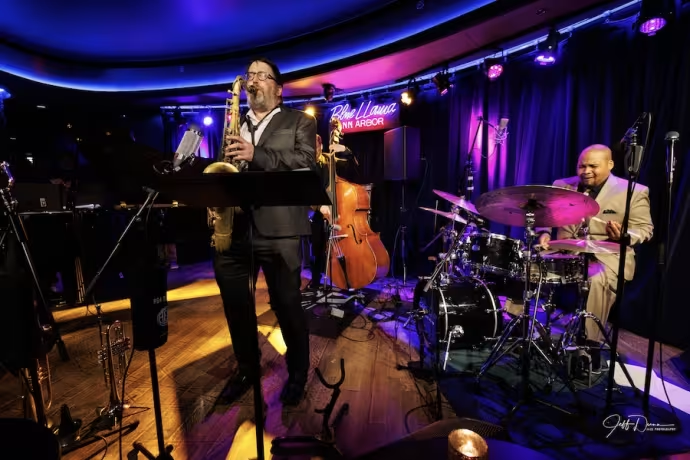
Instructor of Saxophone Andrew Bishop performs at The Blue LLama in Ann Arbor.
In a rehearsal room tucked among the pines of northern Michigan, the sounds of a saxophone quartet rise and fall in conversation—sometimes sharp and bright, sometimes round and warm. A few floors away, another student leans into a solo, confidently improvising over a chord progression. Nearby, others rehearse big band music or work with faculty in private lessons. This is Interlochen Arts Academy, a place where young saxophonists don’t just prepare for auditions, but a life in music.
Interlochen’s saxophone program is led by two of the most respected voices in the field: Andrew Bishop, an accomplished jazz artist, composer, and improviser, and Tim McAllister, a leading figure in the world of classical saxophone performance. Together, they offer students a rare opportunity to explore both musical traditions in depth—and often at the same time.
“With me specializing in jazz and Tim in classical,” Bishop says, “it means that students are able to spend time in band, saxophone quartets, jazz combos, and jazz ensembles. For me, as a professional saxophonist, having had all of those kinds of experiences was truly transformative.”
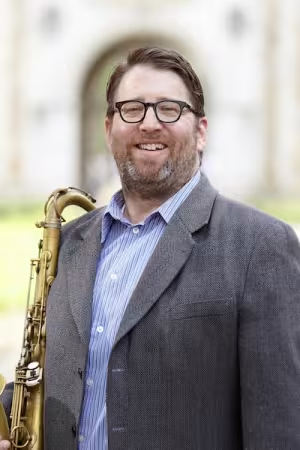
Instructor of Saxophone Andrew Bishop
A program built on versatility
In a world where saxophonists are increasingly expected to do it all, Interlochen’s program reflects the evolving nature of the instrument itself. Classical and jazz no longer exist in separate silos; today’s most successful musicians are those who can cross genres with ease—and bring artistry to each.
“Tim focuses very much on the fundamentals of not only saxophone playing, but also of really just musicianship,” Bishop explains. “I provide the other side of the coin. What happens if you get a gig in a funk band? What happens if you get a gig playing pop music? I help prepare students for that.”
This idea of the “dual-threat” saxophonist is something Bishop has seen grow over the course of his career. While many young musicians arrive at Academy with a leaning toward one genre or the other, they often leave with a far wider range of skills—and a new sense of creative freedom.
“A lot of my career has been built on interpreting composers who fall between the classical and jazz traditions,” he says. “You might be reading really challenging musical textures and rhythms and then possibly improvising in another movement.”
Connecting students to the professional world
Bishop is no stranger to that middle ground. A seasoned performer and composer, he splits his time between Interlochen and the University of Michigan, where he serves as Chair of Jazz and Contemporary Improvisation. His recent projects include performing in Anthony Davis’s The Central Park Five, a powerful new opera that blends classical writing with moments of improvisation.
“It’s a classical piece of music,” Bishop says, “but it requires frequent stylistic changes and even improvisation."
Experiences like this aren’t just relevant—they’re part of what makes Bishop’s teaching resonate with students. His career offers a model of the kind of adaptability young saxophonists will likely need.
“The saxophone is not an orchestral instrument,” he explains. “You don't just finish school and win an orchestral position. You have to be fairly entrepreneurial with it. Both Tim and I have built our careers out of following our passions, but also being entrepreneurs and finding opportunities to play.”
This entrepreneurial mindset is a key part of Bishop’s philosophy as an educator. Beyond the notes and techniques, he wants students to understand what it really means to create a sustainable artistic life.
“I tell my students that the trajectory of my professional career is probably going to look a little different than theirs,” he says, “but there are certain fundamental skill sets that I can help provide them. I can teach them how to hustle and advocate for themselves in the professional world.”
Guidance through the college process
For many students, Interlochen is just one chapter in a long journey. Preparing for college—and for the professional world beyond—is an important part of the Academy experience. With decades of experience teaching at the collegiate level, Bishop and McAllister are uniquely equipped to guide students through that process.
“I really appreciate the kind of attention that goes towards college prep here,” Bishop says. “If you want to study music at the college level, there are so many things you need to put together beyond a normal college application. A real advantage of coming here is that you will have access to a lot of resources to help you pull that together—everything from accompanists to play your repertoire with you to knowledgeable teachers who can coach you through the process.”
In some cases, their personal networks help students find exactly the right fit.
“This year, one of our students is headed to the University of Northern Colorado, which has a really terrific music program,” he says. “Both Tim and I went to school with Andy Dahlke, who's the professor there. Having that kind of network matters. We’re able to say things like, ‘Okay, that’s a great school, but I think you're going to jive even better with this other teacher based on what I know about your learning style.’”
Other recent graduates have gone on to the Manhattan School of Music and the Royal Northern College of Music in Scotland. One was recently admitted to the prestigious Brubeck Institute.
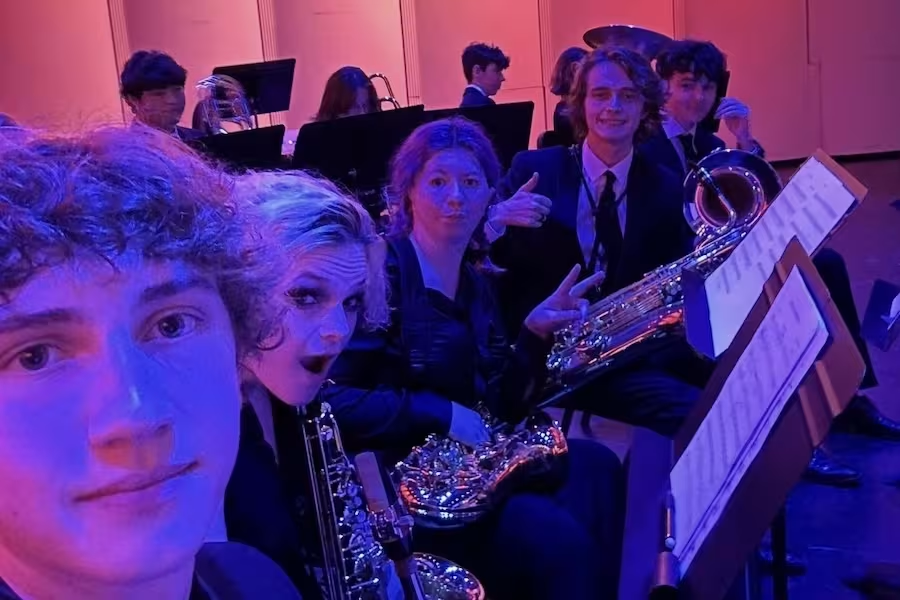
Arts Academy jazz saxophone students gear up for a performance.
A rich calendar of guest artists and performances
Learning at Interlochen isn’t limited to classroom instruction. Students regularly perform on campus and in the nearby community of Traverse City. Some ensembles tour nationally, and recent projects have taken students to New York.
Opportunities to learn from visiting artists are also woven into the program. These guests typically spend several days on campus, offering master classes, private lessons, and performances alongside students.
“Woodwind Day happens toward the end of the winter semester, and we bring in a different guest artist every year,” Bishop says. “Last year we brought in Damani Phillips, who teaches at the University of Iowa. Next year we’re bringing in a top-notch classical player.”
Camille Thurman, an acclaimed jazz saxophonist and vocalist, also spent time on campus recently, sharing both musical insights and career wisdom.
Surrounded by creativity
Part of what makes Interlochen so distinctive is the campus itself—not just its setting among the woods and lakes, but its culture. The Academy is home to artists of all kinds: dancers, actors, visual artists, filmmakers, writers, interdisciplinary artists, and musicians of every style and level.
“I really thrive on being around great artists,” Bishop says, “whether they’re classical pianists or visual artists or involved in theatre. Talking to them about their craft is such an incredible thing to do, and it’s one thing I think is really unique about the program at Interlochen.”
That kind of cross-disciplinary environment helps young musicians think beyond their instrument, connecting their music to broader artistic questions and forms of expression—yet another valuable skill for the professional world.
Looking ahead
The saxophone faculty at Interlochen isn’t shy about setting ambitious goals. In time, Bishop and McAllister want to build a quartet that will compete—and succeed—at the prestigious Fischoff National Chamber Music Competition.
“Tim and I have been doing this at the collegiate level for over 30 years,” Bishop reflects. “But it's amazing how similar and different it is doing it at the high school level. These students rise to the challenge.”
It’s a challenge that students don’t face alone. Whether they’re performing in an off-campus show, preparing excerpts for college auditions, or navigating the complex world of music after graduation, they’re guided by teachers who know the path—and who are ready to walk beside them.
Saxophone students at Interlochen Arts Academy enjoy world-renowned training from gifted professionals alongside college-preparatory academics. Learn more about saxophone at Interlochen Arts Academy.