Meet Katia Waxman: Interlochen’s newest clarinet instructor shares the surprising secret to great musicality
Waxman chats about her current favorite piece and what she’s looking for in prospective students.
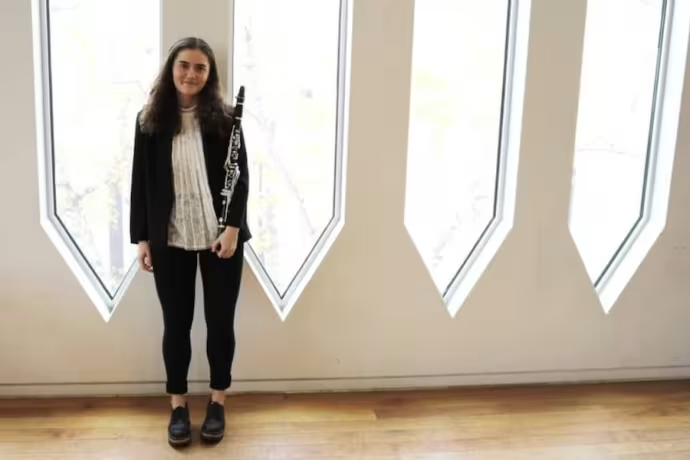
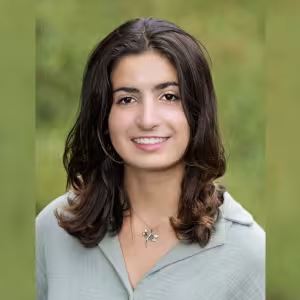
Katia Waxman has performed everywhere from Carnegie Hall in New York to Bela Bartok Hall in Budapest. Active in the festival scene, she’s also a gifted arts educator who loves sharing her passion for clarinet with her students. We sat down with her to chat about her growth as a musician and what she loves about teaching at Arts Academy.
What were some of the most formative aspects of your education as a musician?
I was a dual degree student in my undergraduate education; I earned a degree in economics as well as clarinet. I found that my musicality grew so much when I spent time thinking about other things. Yes, we have to be in the practice room, focusing on our fingers and so on. There are physical elements to the clarinet that require an extraordinary amount of attention, but I'm a big proponent of seeking out greater intellectual stimulation: reading, writing, going to see theatre, dance—these were all hugely informative things for me. Also, coming from a STEM background, I found that solving equations and practicing the repetitive analytical processes of advanced math can actually connect to music in a really meaningful way. I draw upon that background in both my teaching and in my performance to this day.
What is your favorite thing about playing the clarinet?
The clarinet is the chameleon of orchestral instruments. It has a beautiful, ringing, resonant tone. It has classic pieces that have dipped into the popular canon, like “Rhapsody in Blue” or certain jazz standards where the sound of the clarinet is easily recognizable. The clarinet can blend with other instruments and sneak into other sounds in a way that I don't think any other instrument can do. The clarinet can become the flute or an oboe. It's hard to point out, sometimes, because there's so much flexibility to the tone color. It can grab attention and be the solo role, but it's also the ultimate supporting actor. It gives our students a lot of options to pursue professionally.
What is a piece of music that you are really loving to play right now?
I've been spending a lot of time with Joseph Horowitz’s Sonatina over the last couple of months, getting ready to do a performance of that. It's a quirky, jazz-influenced piano and clarinet work from the 1980s. I love to play newer music—the ‘80s was 40+ years ago at this point, but it still feels very fresh and relevant. There are so many borrowed jazz idioms in that piece, and I love to cosplay being an artist from the jazz world. Even though that's not my background, I still get to work in a lot of those sounds and styles through that repertoire.
What are some qualities or skills that you look for in prospective students?
Curiosity is probably number one. Music really is a lifelong pursuit, and you always have to keep asking: “Can I try it this way or that way?” Even if you've been in a pattern with years and years of doing things a certain way, you might realize that you can do better. You need open-mindedness and a willingness to ask questions and reevaluate. I also want to work with students who have discipline. As musicians, we have to work in a really regulated and regimented manner, particularly when we're young, in order to develop techniques that will serve us when we're working professionally. But I also appreciate students who like to have fun and don't take themselves too seriously. I am a pretty open and silly person. I laugh with my students in most of our lessons, and I look for students who share that mentality of being able to be really focused when we’re performing, but also able to have fun.
What do you enjoy most about teaching at Interlochen?
In my first couple of months here, I have really enjoyed watching the community develop in my studio and seeing how my students advocate for and support one another. A lot of my new students have been supporting each other, going to their friends’ performances, sitting in the front row, screaming when they walk out onstage. It comes from a place of genuine friendship. They get so much time together here, not only in my classes, but in their academic classes, over meals, in the dormitories, or going on trips on the weekend. They get to develop these really close relationships where they can really draw on one another and support each other. Being a steward of such a tight-knit community is really special for me.
What is one thing you hope your students just really remember from working with you?
I hope that my students recall and model my openness. I always try to be truthful and transparent with my students. Anytime they ask me a question, I think hard and give them a thoughtful and honest answer. I think that just being your truest self and learning how to communicate that to others in a respectful manner is one of the best things that we can do as people. Modeling that style of communication and hoping that they take that on in their own lives would be the one thing I hope they remember.
Students at Interlochen Arts Academy enjoy world-renowned artistic training from gifted professionals alongside college-preparatory academics. Learn more about Arts Academy.