
Just An Idea
Before blue corduroy and Sound the Call and the land of the stately pines, Joseph Maddy had an idea.
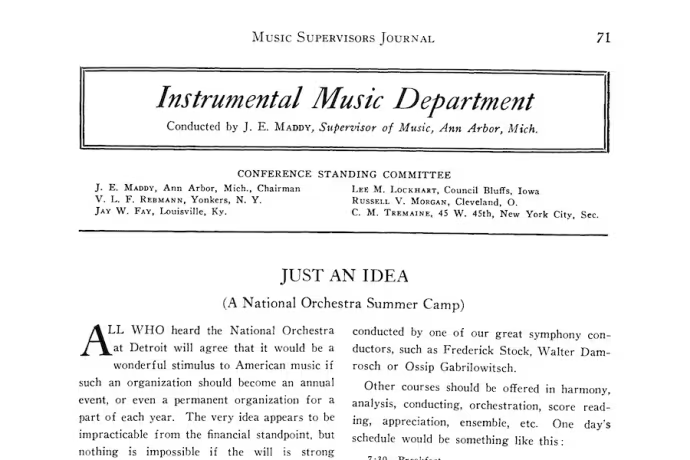
Joseph Maddy's "Just An Idea" article was the blueprint for a dream.
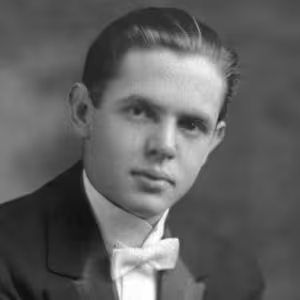
A young Joseph E. Maddy.
In the years leading up to the founding of the National Music Camp, Joseph Maddy was a musician–viola and clarinet–and teacher. At eighteen, he was the youngest member of the Minneapolis Symphony Orchestra. He played vaudeville in Peoria and jazz in Chicago. He taught in Rockwall, Texas, and Rochester, New York.
Maddy met fellow music educator T. P. Giddings at Chautauqua in 1920, and that partnership proved to have a huge influence not only on Maddy’s pedagogical methods but also on the future of Interlochen. Together, they wrote The Universal Teacher, which was published in 1923 and became the standard for teaching orchestra and band instruments to groups.
In 1925, while Maddy was working for both the University of Michigan and Ann Arbor Public Schools, he was asked to organize an ensemble of the nation’s finest high school orchestra musicians to perform at the Music Supervisors National Conference meeting in Detroit the following year. He assembled an orchestra of 230 young musicians from 25 states, and on April 16, 1926, the inaugural National High School Orchestra performed at Detroit’s Orchestra Hall. It was a remarkable success, inspiring conference organizers to approve subsequent performances at the conferences in Dallas in 1927 and Chicago in 1928.
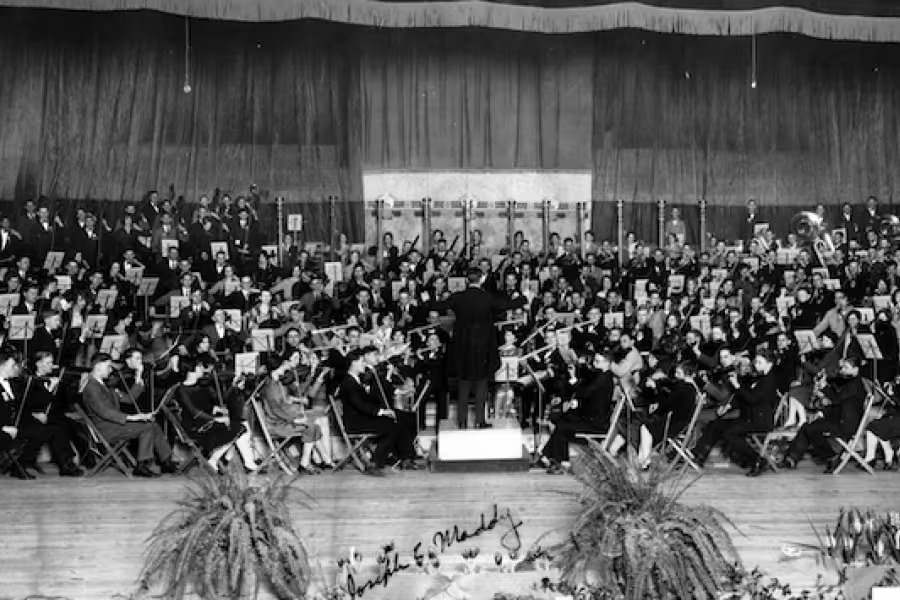
The second National High School Orchestra performs at the 1927 NEA Department of Superintendence conference in Dallas.
Maddy was inspired as well. In March 1927, he published an article entitled “Just an Idea” in the Music Supervisors Journal encouraging his peers to make the National High School Orchestra an annual occurrence–not just for a few days at a conference but for the whole summer. “Why not establish a National Orchestra Summer Camp at some ideal location where swimming, boating, fishing, and other outdoor sports flourish?” Maddy wrote. “The participants should receive this outing, all expenses paid, as a reward for outstanding work in school orchestra or bands with other considerations such as school spirit, citizenship, character, etc.”
At the time of the article, Maddy was offered some property on the coast of Maine for this new venture. But after a visit, Maddy said, “We were eaten by mosquitoes, and our food was carried away by the high tide, and altogether it proved to me that such a location was impossible.”
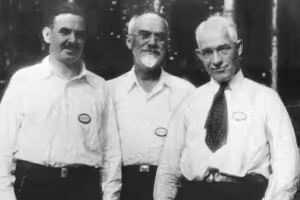
Camp founders Maddy and Giddings stand with Willis Pennington, original owner of the Interlochen property, c. 1929.
Maddy’s idea soon caught the attention of Willis Pennington of Detroit, who owned a large swath of land between two lakes in northern Michigan. Two camps, one for boys and one for girls, were situated on the land, along with a resort hotel built in 1909. Pennington invited Maddy to visit in spring of 1927, and Maddy was so taken with the land that he invited Giddings to join him as soon as possible. They agreed that it was the perfect site for their camp.
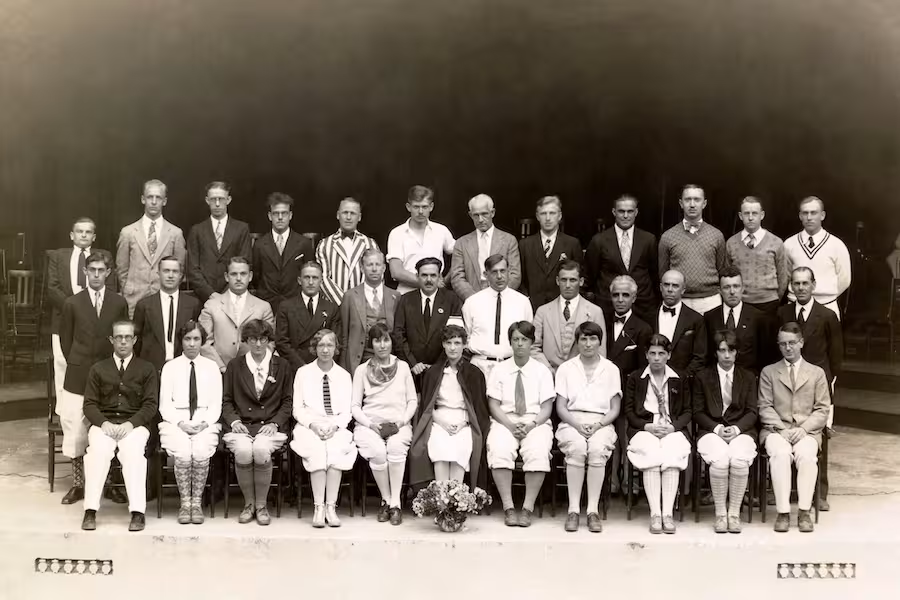
Members of the first faculty and staff gather at Interlochen for the first summer of National High School Orchestra Camp.
On June 24, 1928, the National High School Orchestra Camp opened with 115 students. Now, nearly one hundred years later, Maddy’s vision endures. Encompassing seven artistic disciplines and reaching more than 3000 young artists at Interlochen Arts Camp and 575 students at Interlochen Arts Academy each year, what was once “just an idea” continues to grow.
More Like This



Thursday, July 8, 2027 | 7:30 p.m.
Kresge Auditorium
Jazz at Lincoln Center Orchestra with Wynton Marsalis
Imagined as a deep exchange between some of the world’s leading artists and the students of Interlochen Arts Camp, the Distinguished Artist Series returns in summer 2027 with the Jazz at Lincoln Center Orchestra (JLCO) and trumpeter, composer, and bandleader Wynton Marsalis.
Hailed by many as the “Pied Piper of jazz” and “Doctor of swing,” Wynton Marsalis has rekindled and animated widespread interest in jazz through performances, education, and relentless advocacy. His extensive list of accolades includes the National Medal of the Arts (2005) and a Pulitzer Prize. He has served as the managing and artistic director of Jazz at Lincoln Center since 1987. Established in 1988, the Jazz at Lincoln Center Orchestra is widely regarded as the world’s premier big band.
A component of Interlochen’s centennial celebration, the Shirley Young Distinguished Artist Series brings some of the world’s leading artists to Interlochen Arts Camp to work with students and present public performances. Net proceeds from this performance will be directed into the Shirley Young Distinguished Artist Series Endowment, creating a self-sustaining fund that will enable Interlochen to bring artists of this caliber to our community for generations to come.
Mark your calendar. Tickets will go on sale at a later date.
Friday, July 9, 2027 | 7:30 p.m.
Kresge Auditorium
Jazz at Lincoln Center Orchestra with World Youth Symphony Orchestra
Imagined as a deep exchange between some of the world’s leading artists and the students of Interlochen Arts Camp, the Distinguished Artist Series returns in summer 2027 with the Jazz at Lincoln Center Orchestra (JLCO) performing alongside Interlochen's World Youth Symphony Orchestra (WYSO).
Founded in 1988, the Jazz at Lincoln Center Orchestra with Wynton Marsalis is widely regarded as the world’s premier big band. The orchestra tours the world performing a vast repertoire of music, from historic and rare compositions to commissioned works. The group’s compositions and arrangements include works by Duke Ellington, Count Basie, Fletcher Henderson, Thelonious Monk, Mary Lou Williams, Dizzy Gillespie, Benny Goodman, and Charles Mingus, as well as new music from the group’s unrivaled collection of world-renowned composers and arrangers.
A component of Interlochen’s centennial celebration, the Shirley Young Distinguished Artist Series brings some of the world’s leading artists to Interlochen Arts Camp to work with students and present public performances. Net proceeds from this performance will be directed into the Shirley Young Distinguished Artist Series Endowment, creating a self-sustaining fund that will enable Interlochen to bring artists of this caliber to our community for generations to come.
Mark your calendar. Tickets will go on sale at a later date.
Sunday, July 11, 2027
Kresge Auditorium
Interlochen Centennial "Collage"
Celebrate the 100th season of Interlochen Arts Camp with a “Collage” unlike any other. A special edition of Interlochen Arts Camp’s highly anticipated annual tradition, Centennial “Collage” will bring distinguished alumni back to the Kresge stage to perform alongside current students, creating a vibrant, multigenerational showcase.
From performers on stage to painters in the wings, “Collage” will leave you inspired by the beauty of the arts and the talents of the Interlochen community. Honoring Interlochen’s impact on generations of artists, this high-energy showcase celebrates our storied legacy while envisioning the possibilities of Interlochen’s next hundred years.
Mark your calendar for this special Interlochen centennial event. Tickets will go on sale at a later date.