
Oral History Interview with Susan Snyder Higgins and Carol Koski
Interlochen Affiliation: AS 61
Interview Date: July 10, 2024
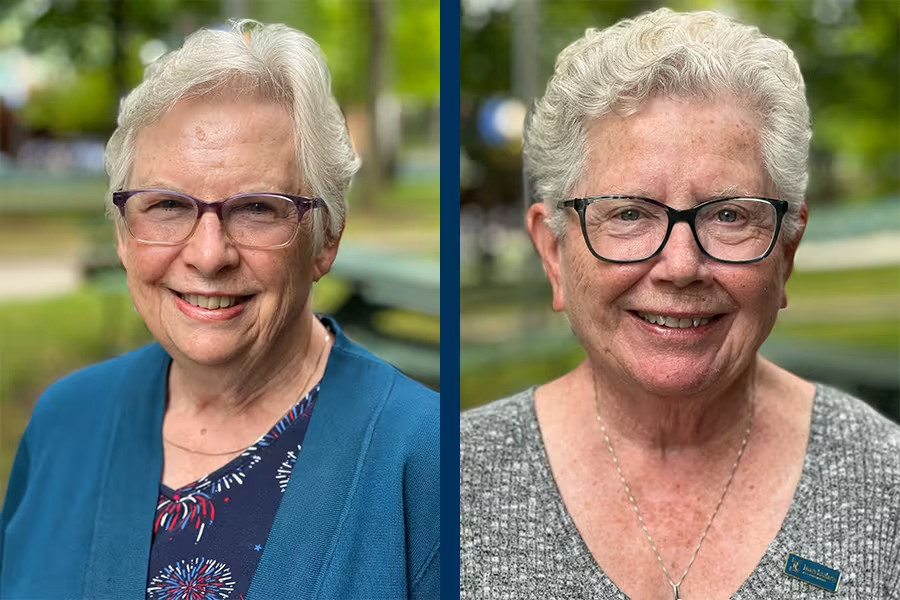
Susan Synder Higgins and Carol Koski were cabin-mates in the National Music Camp All-State division in 1961. Susan studied horn and Carol studied piano. They return to campus each summer to rekindle their lifelong friendship and spend quality time under the stately pines.
This oral history is provided free by the Archives of the Interlochen Center for the Arts (ARTICA). It has been accepted for inclusion in Interlochen’s audio archive by an authorized administrator of Interlochen Center for the Arts. For more information, please contact archives@interlochen.org.
00:00:00 IAN JONES
All right. Today is July 10, 2024 and this is an oral history interview with Carol Koski and Susan Higgins. Susan Snider Higgins, good morning.
00:00:13 SUSAN SNYDER HIGGINS + CAROL KOSKI
Good morning.
00:00:13 IAN JONES
This is being conducted by Ian Jones on the campus of Interlochen Center for the Arts. So you're both here with us today, so maybe, can you tell us just a little bit about each of you, where you were born, what your childhood was like?
00:00:26 CAROL KOSKI
Well, I was born in Marquette, Michigan. That's in the further north that you can get before you get to Canada. I've lived there all my life, except for a brief period when I was in Detroit. Typical family life, one sibling, a sister, we had a great childhood. We could run free and do all kinds of things. And my parents were had the foresight to pursue piano lessons for me. I showed an interest in the piano from a very, very early age, and I can remember my dad just redoing the piano, you know, he sanded it all down and did it, put a new finish on a big old upright. I still have that. I took piano all the way through high school, and then I went to nursing school and was an RN for 40 years.
00:01:12 SUSAN SNYDER HIGGINS
I grew up in a little teeny burg of 300 people called Lakewood Club. It is 18 miles from Muskegon, and I came here in 1962. My oldest brother had been an all-stater a few years before, and I'll never forget coming to the concerts to see him, and that I could see the lake through the in the back of of the of the band, and I knew from watching him the very first time that that I definitely wanted to come here. So I, too, started piano lessons when I was eight. I had the best piano teacher in town, and she was very exacting. She had studied in Europe with some of the big names, and I had to play exactly what was on the page, and so I did learn how to do that. I didn't learn how to play by ear, but I learned that part. And I was also involved in band. That was a family heritage as well, and played French horn. So when I decided to come here for the all state, I definitely wanted piano, and that's how Carol and I got to know each other so well, but I also was in the band, and I could sit first chair at home and be full of myself. And it was a good experience to know that I could thoroughly enjoy band and I didn't have to be first chair.
00:02:35 CAROL KOSKI
And when I was here, like I said, Susie and I were strangers. I didn't know anyone. When my parents dropped me off - it was, Oh, my goodness and I was 15 years old. I loved piano, and I was very good at piano. I knew I was good at it, and in my hometown of Marquette, I was really good at it. I came here and I went, Wow, these people really know how to play piano, and they're passionate, passionate about it. I didn't have that passion, but that's what I learned about me myself when I was here for that period of time.
00:03:06 IAN JONES
So who introduced you both to Interlochen was that a band director? Was that family?
00:03:13 CAROL KOSKI
I had, I won a scholarship. I can't even remember. I had to go to Western Kalamazoo to do this scholarship thing, and I won a paid scholarship here. So that's how I knew it. I can't remember. I think it came from the piano teacher guild in my hometown.
00:03:18 IAN JONES
What about you Susan?
00:03:23 SUSAN SNYDER HIGGINS
And I didn't come on scholarship. My parents were of modest means, but they always made us know for sure that music was a top priority, and so they paid for me to come and it just was an unbelievably positive experience.
00:03:45 CAROL KOSKI
And we were assigned to the same cabin. The only thing we don't agree about is who had the top bunk. I think it was Susie.
00:03:52 SUSAN SNYDER HIGGINS + CAROL KOSKI
[Laughs]
00:03:54 IAN JONES
So you all met that first-
00:03:56 SUSAN SNYDER HIGGINS
The first day.
00:03:57 IAN JONES
- that first day in what's 1961 right?
00:04:00 CAROL KOSKI
We can't agree is it was 61 or 62 but I think 61.
00:04:04 IAN JONES
I think it was 61 that we talked about, but, so you met that first day. And how has this friendship developed over time? You're still you're still friends.
00:04:14 SUSAN SNYDER HIGGINS
Oh, very much so. And we don't live close to each other. We see each other usually once a year. Here. We come for collage. This has become a very treasured experience each year, and my husband makes all the arrangements for us, the reservations and all that. And we've stayed in all of the various places, from camping, to last year, there was a wonderful bonus, we got to stay in the Dow Center that, you know, the premier spot. But it's just such a part of our lives. We got married at about the same time. We, Carol played in our wedding. We came to her wedding. We had our children at about the same time. And even though we don't see each other often, we're extremely close friends because of Interlochen.
00:05:02 CAROL KOSKI
Absolutely. Interlochen was something. I can remember Susie's parents getting in their car and waving to her as as they left. And I think that was, we introduced ourselves, and that was it.
00:05:14 SUSAN SNYDER HIGGINS
That was it. Yeah, that was it.
00:05:16 IAN JONES
And you were bunk mates,
00:05:17 CAROL KOSKI
Bunk mates.
00:05:18 IAN JONES
And continued.
00:05:18 CAROL KOSKI
She was way busier than I was. She was in band, and she never had any free time. She always says I never got to go swimming when I was here. Well, I got to do all those fun things because I was, I was in piano, so um, I even found a boyfriend when I was here, but,
00:05:32 SUSAN SNYDER HIGGINS + CAROL KOSKI
[Laughs]
00:05:35 CAROL KOSKI
but she was very busy, yes, and our friendship has maintained. We, we usually just meet here. Once in a while we would be at your house. You came to our house once or twice, but pretty much, it's Interlochen.
00:05:49 SUSAN SNYDER HIGGINS
Our husbands get along, and neither one of them are musicians,
00:05:54 CAROL KOSKI
not at all,
00:05:54 SUSAN SNYDER HIGGINS
but every year, when we come, we bring the same duet piano music, and we'll go off by ourselves and find a practice room and work up
00:06:05 CAROL KOSKI
Well, three.
00:06:06 SUSAN SNYDER HIGGINS
Yeah. And then we let our husbands know it's time, and they'll sit in the shade outside of the practice room and be a very appreciative audience.
00:06:14 CAROL KOSKI
We've both been married 58 years to the same guys.
00:06:17 IAN JONES
Oh, that's wonderful,
00:06:18 CAROL KOSKI
Amazing isn't it?
00:06:18 IAN JONES
Congratulations.
00:06:19 SUSAN SNYDER HIGGINS
We can hardly believe it ourselves.
00:06:21 IAN JONES
We should all be so lucky.
00:06:22 SUSAN SNYDER HIGGINS
That's right.
00:06:23 IAN JONES
So I understand you had an audience recently, here, you were telling me about.
00:06:27 SUSAN SNYDER HIGGINS
Yes, when we were practicing yesterday afternoon, the students, we had the door open in the practice room because it was hot in there, and students were coming by, and there was a group of four or five of them that stopped. And we waved, and, you know, acknowledged that they were there, and I asked them if they were waiting for that practice room. You know, we didn't want to take up the room for for campers. And they came back. They said, No, they didn't need the practice room. They came back and listened to our story, that we've been coming here for 62 years, and this is where we met, and how important Interlochen has been to our whole lives.
00:06:38 CAROL KOSKI
And that we hoped that their friendships could survive. Yeah. So they all looked at each other and said, We can do that. We can be friends.
00:07:16 SUSAN SNYDER HIGGINS
Yeah, that's right. It was great.
00:07:18 IAN JONES
That's a wonderful story. So thinking back to that, that first summer, that really was the only summer, right?
00:07:24 SUSAN SNYDER HIGGINS + CAROL KOSKI
Yes, yes.
00:07:24 IAN JONES
You both hear one year. Do you have a favorite memory from that time, something that really sticks with you, obviously meeting each other, but?
00:07:32 CAROL KOSKI
Van Cliburn, we heard Van Cliburn that stuck with me my whole life.
00:07:37 SUSAN SNYDER HIGGINS
And we got to go for tea with the Maddy's at their home, and that was just so elegant. I mean, I did not come from elegance. I came from a very, very loving home. But it wasn't elegant, and it was they made us feel comfortable. They made us feel appreciated and valued.
00:07:57 CAROL KOSKI
So important.
00:07:58 SUSAN SNYDER HIGGINS
And it was so important. I think of the performances I was in, my favorite was the piano. I think they even maybe called it a chorale. I think there were eight or 10 pianos in the in the building, two to a piano, and I just loved that. Of I was used to being in band and playing in a group, but to do that with pianos was very unique to me, and I just loved it.
00:07:59 IAN JONES
I think we call those today, kind of the Only at Interlochen Moments, the things that it's like, well, this would only happen here. That's wonderful. So you started to talk a little bit about this. Was there a memorable person? You mentioned Van Cliburn, so you went to an individual, but maybe a person that you encountered at Interlochen who was particularly special to you, and why?
00:08:42 CAROL KOSKI
I had an instructor, a piano instructor, a male. I don't remember his name, an older gentleman. We worked almost exclusively on a Beethoven Pathetique Sonata. And I can remember him with such fun as he he was so knowledgeable, and yet he was so gentle in how he was imparting things. I remember him very much.
00:09:01 SUSAN SNYDER HIGGINS
I can't recall who was the conductor of the band that year, but it it inspired me to play better than I had before with phrasing and things like that, but made me feel very encouraged, very comfortable. If I did make a mistake, I wasn't going to get singled out, and. Yesterday, we watched a rehearsal for a few minutes, and we commented that we heard the director, the conductor, tell students more than once, “Oh, you're right on that.” Instead of, I've worked with many conductors that you know are so full of themselves that they're they’re, think they can only play with the Philharmonic or something, but encouraging young musicians is extremely important, and I was strongly encouraged when I was here.
00:09:48 IAN JONES
That's wonderful to hear. That's obviously what you want for for any student here. So for you after Interlochen, things went different paths. So what were your paths after Interlochen?
00:10:01 CAROL KOSKI
Well, like I said, Interlochen was so important for my path, because I realized then that piano was not going to be my path. I wasn't as passionate about it as I saw other people. And I had a neighbor who was a nurse, and she had a handicapped daughter who was my friend. I became very interested in nursing, and went to St Luke School of Nursing, at the time, it was a three year diploma school. And I spent the next 40 years in bedside nursing and management, nursing and public health. So it, too was a good step for me. Never lost the piano. I always played piano. And the thing I was telling Susie yesterday, the thing I noticed in my medical career was so many physicians and medical people had interest in music as well. Many, many. There's a real correlation there.
00:10:51 SUSAN SNYDER HIGGINS
There is definitely.
00:10:53 IAN JONES
And it stuck with you.
00:10:54 CAROL KOSKI
It stuck with me. Yeah, it has stuck with me. And as a matter of fact, one of my really good friends at home is a piano teacher. And I promised myself, when I retired, that I would go back and take some piano lessons. So I did with Linda, my friend Linda, and we worked up Rachmaninoff concerto, I think it was number two, I can't remember that, but it took us, took me, over a year, to learn that. It was wonderful! We had a big concert in town, and we had a full house, and it was just, just the apex of my piano career. I'll tell you that, yeah, it's good.
00:11:31 SUSAN SNYDER HIGGINS
I had a career in music, but similar to Carol, being here, I realized that I didn't have, I had ability, but I didn't have that drive to devote my life to being a performer. And even at a young age, I had started giving piano lessons, so I knew about what I liked about teaching. But about that same age, my high school band director had been to a music education conference, and he came back and very enthusiastically told us about what was new to him of this career of music therapy. And I said, That's it. That's it. I knew I wanted to help people. I wanted music to be my focus. I just didn't want to have it be only teaching or only performing. So I had a career in music therapy for the first 20 years of my career. Very, very rewarding. I loved it. I used to recruit people to come to our on campus clinic, so I would go give presentations to different nonprofit organizations. And I had this slide show, this was long enough ago, we had slides - that what my one of my favorite pictures was this little girl that was maybe two or three severely handicapped, and she was kind of drooling a little bit, she couldn't control, somebody was holding a triangle for her, and somebody else was holding her hand with the beater. The expression of joy on her face was was every bit as rewarding as I worked with, oh, there was a client that had played violin very, very well in orchestras, but he had some severe psychiatric problems. He would only play composers that were from Scandinavia in some way, and he refused to tune his violin. Now, that was a challenge, but he could get the same kind of joy out of it as this severely handicapped little, tiny girl. And some of my favorite clients that I worked with were adults with psychiatric problems, but also substance abuse issues. And you think about the stereotype of many performing musicians, the pressure of it all, and you know, the rock stars and that, of how much substance abuse there is, but I also found some very talented musicians in in all of that, all of it combined and music therapy was a very rewarding career for me. I got very interested in the fact that back then, insurance companies wouldn't reimburse for music therapy, they would for other therapies. And I got very involved in lobbying for the insurance companies. We got one insurance company was Blue Cross Blue Shield, to try it with one adult disability. Turned out that the insurance executive that was helping me with this, it was his son, but it helped, and we didn't solve the problem, but what I realized was my goals of still trying grandiose trying to make the world a better place, I needed to expand my education, and so I went into public administration. And again, I didn't solve, that was very rewarding, too, but I didn't solve the insurance issues altogether. But just recently, we live in the Grand Rapids area, and the medical mile is just outstanding, and the donors of all of that are so generous. Mostly, they're the Amway family, the people that started Amway, and they announced a major, major contribution, $8 million for not just music therapy, but the creative therapies in the children's unit. And that I related, I did. I wasn't responsible for that, but my little kernel of advocating for Blue Cross Blue Shield helped.
00:15:25 IAN JONES
Yeah, it's interesting that, I'm interested in both of you, you've continued on in fields outside of the arts, but you've remained connected to it. What's your thought on the importance of the arts today?
00:15:37 CAROL KOSKI
Oh my goodness, there's nothing more important. It's the universal language. There's nothing more important. I was working as a nurse, and I, to give back to the community a bit, I would play piano a lot at a lot of the nursing homes, because as I had a couple of friends in there, and it was really good. And I remember one day playing in a memory care unit, and the nurses came up to me and said, "This person hasn't uttered a word since she's been here, and she sang the whole song."
00:16:04 SUSAN SNYDER HIGGINS
I would experience that too.
00:16:06 CAROL KOSKI
Yes, it was amazing to me. It was wonderful. So that was a really rewarding part of my music world. As I went on, even though I wasn't in the music world.
00:16:15 SUSAN SNYDER HIGGINS
At the end of the collage performance last night, the two of us had the same reaction. There's hope for the future. In these political times, it's so easy to get just totally discouraged. No matter what your opinions are, it's just so chaotic.
00:16:31 CAROL KOSKI
And usually that's the first thing to go, isn't it? Oh yeah, the arts are the first thing to go when the school board is trying to budget and all that. It's scary.
00:16:39 SUSAN SNYDER HIGGINS
It's what keeps us sort of civilized.
00:16:42 CAROL KOSKI
Not sort of.
00:16:43 SUSAN SNYDER HIGGINS
It is, yes.
00:16:45 IAN JONES
Well, let me ask you this then, you've been around students the last few days, you saw collage. What advice would you give to current students and future students who attend Interlochen?
00:16:56 SUSAN SNYDER HIGGINS
Well, my experience here of, as Carol described, watching my parents wave goodbye to me, you know, when they dropped me off, try something new. It's okay to be uncomfortable for some time, and at about that same age, well, I think I was born knowing that I wanted to play the harp, and my parents always said, "That's wonderful, and we'll encourage you, but we will never have enough money to buy you a harp, so how do you think you're going to do that?" I said, "I think there'll be an old lady that will want me to have her harp." It actually happened. It's a long story, but it really did happen. And if I hadn't experienced some other experiences too, but to come here was such a positive new experience for me that I had then went through life saying it's okay to try something that makes me uncomfortable, and if it doesn't work out, I can go do something else. But that was one of the most valuable things that I learned here, and it's I encourage my children and my now my grandchildren and many other young people that I'm around to be brave enough to try something new.
00:18:02 CAROL KOSKI
That's good advice. What would I tell students here at Interlochen? Just listen to your heart and do what it tells you to do. Listen to your heart, listen to your gut. It'll tell you.
00:18:12 IAN JONES
That's good advice from both of you. Thank you. So let me ask you, Are there anything else you want to share about your time here, your people you met here. You know, I guess I want to ask, I have conversations with so many people who talk about this place, and they talk about it in all kinds of different frameworks and all kinds of different ways. What is it about this place, this institution, this this community, that's so special?
00:18:40 CAROL KOSKI
I think everyone is so accepted here. We were in the cafeteria this morning, and I didn't hear any English. There were different languages everywhere, and that was so gratifying, just so gratifying. And young people are just starting off, and having the world before them is a wonderful thing. Susie and I come here almost every year. I don't think we've missed a year that we haven't shed tears,
00:19:03 SUSAN SNYDER HIGGINS
Yeah.
00:19:03 CAROL KOSKI
just in the beauty of it.
00:19:05 SUSAN SNYDER HIGGINS
The physical beauty of it, with the grounds, this is the best we've ever seen them. The flowers are great. Every bit of paint, everything is all spruced up beautifully. But the lake and when we first got here, we said we didn't hear any music. We walked around until, of course, we could hear it. Of the just the whole atmosphere and being again, as Carol said, exposed to people from other backgrounds, the commonality is the love of the arts, and that is just unbelievably good. And the striving for excellence is so good, but you don't have to be first chair in order to get everything out of of the experience.
00:19:50 IAN JONES
Okay, so last question for you, then we'll wrap this up. So you've got one word to describe Interlochen to the future. What are you going to say, what's your one word? How do you describe it in one word?
00:20:03 CAROL KOSKI
One word that's hard.
00:20:05 SUSAN SNYDER HIGGINS
I've got my word.
00:20:06 CAROL KOSKI
Go.
00:20:07 SUSAN SNYDER HIGGINS
Okay, peace. What I feel here is peace.
00:20:12 CAROL KOSKI
Peace and love and beauty. If I had one word, beauty, sensual beauty, beauty for your soul and just beauty.
00:20:22 IAN JONES
Thank you. Thank you both for taking the time to be here.
00:20:25 SUSAN SNYDER HIGGINS + CAROL KOSKI
Thank you. Love it. We love it.
00:20:26 IAN JONES
We'll see you again next year.
00:20:27 CAROL KOSKI
Oh, sure.
00:20:28 SUSAN SNYDER HIGGINS
Yep.
00:20:28 IAN JONES
Great.
00:20:28 SUSAN SNYDER HIGGINS
Okay.
00:20:28 IAN JONES
Thank you.
Copyright
Copyright to the audio resource and its transcript is held by the Archives of Interlochen Center for the Arts (ARTICA) and is provided here for educational purposes only. It may not be reproduced or distributed in any other format without written permission