
Oral History Interview with Rusty Edwards
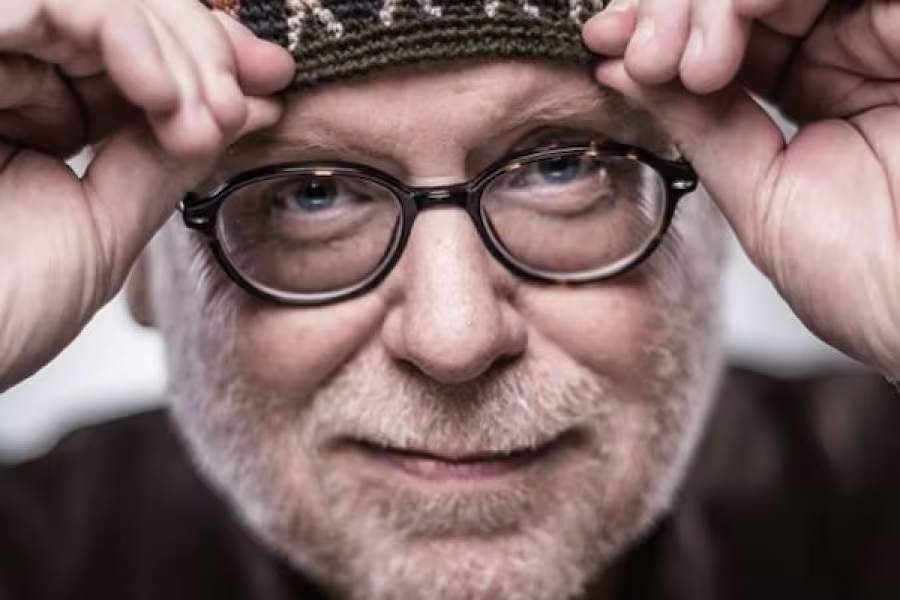
Interlochen Affiliation: IAC/NMC 72 | IAA 72-73 | IAC St 73
Interview Date: July 20, 2025
Rusty Edwards attended National Music Camp and Interlochen Arts Academy, studying percussion and voice. In the summer of 1972, Rusty performed in the first Interlochen summer jazz band. He returned the following summer, after graduation from the Academy, to work at the beloved Melody Freeze.
This oral history is provided free by the Archives of the Interlochen Center for the Arts (ARTICA). It has been accepted for inclusion in Interlochen’s audio archive by an authorized administrator of Interlochen Center for the Arts. For more information, please contact archives@interlochen.org.
ELIZABETH FLOOD 0:00
Today is July 20, 2025 and this is an oral history with Rusty Edwards conducted by Elizabeth Flood on the campus of Interlochen Center for the Arts. Thank you so much for coming in and sharing your story with us today.
RUSTY EDWARDS 0:14
Thank you.
ELIZABETH FLOOD 0:15
So please tell us your name, your connection to Interlochen, and the years that you were here.
RUSTY EDWARDS 0:21
My name is Rusty Edwards, and I now live in Marietta, Georgia, outside of Atlanta. The years I was here were mostly '72 and '73. I started at Camp, and then went to the Academy, and then was on the staff of Melody Freeze.
ELIZABETH FLOOD 0:42
How did you first learn about Interlochen? What brought you here?
RUSTY EDWARDS 0:48
My family was on vacation, and my sister Coggin always wanted to go to Interlochen, so we took a ferry over Lake Michigan and came to Interlochen State Park. And when we got there, it was just pouring down rain. And we had a little camper, and my father was trying to put up the camper, and having no luck, and the guy at the campsite next to us came over and said, "Well, why don't you come over? You guys can get in our tent and stay dry and we'll go back when it stops raining." "Okay." And we went there and make a long story short, we ended up camping with them almost every year for 30 years. It was great. But the first thing I noticed was that this guy had a radio, and instead of playing, you know, whatever news or pop music or whatever he had on Interlochen radio. As the years went by, I noticed that his children knew the music because of listening to the radio all the time. He had it on all day long, you know, unless we were singing at the campfire or something. It was just constantly on, and other people started listening to Interlochen Public Radio along with it, so as you were walking down the path, you can kind of still hear it. So he was very influential in that way. Anyway, my sister ended up joining the staff, and I understand she's been on staff the longest of anyone she's been here, I think, fifty-three years. So that's a long time.
ELIZABETH FLOOD 2:27
Is she your older sister? Or how- where-
RUSTY EDWARDS 2:30
Yes, she's my oldest sister, but she was very influential on me learning about music, and especially classical music and Broadway too. She would put on West Side Story, or she got me an album of Russian composers for Christmas, and I would come home at lunchtime and be the director and play that Russian Easter Overture. And I got to the point where I didn't want to spend so much time, but I still wanted to do it, so I put the speed up to 45 and it sounded really weird, and if anybody else came in they would think I was crazy. But I just wanted to do the whole piece before I went back to school.
ELIZABETH FLOOD 3:08
Do you remember what was on the radio at camping when that man was playing Interlochen Public Radio? Like, what did that sound like?
RUSTY EDWARDS 3:18
Well, it was just nice to hear classical music on the radio. I don't think we had any classical stations in the small town that I lived in, so that was great. And I still listen to it and still support it.
ELIZABETH FLOOD 3:32
Yes! Support public media!
RUSTY EDWARDS 3:33
Yep.
ELIZABETH FLOOD 3:34
So what was your first summer like at Camp?
RUSTY EDWARDS 3:39
It was great. I came here, and it turned out that they were starting a Jazz program, and it was going to be the first summer of Jazz. So not only did I get to be in the first Jazz group, but I also was in a trio that we got to play for the staff which meant we got to stay up late. That was nice. But we had some of the first Jazz concerts here. And then Stan Kenton came to play, and since I was a drummer at the time, I was asked to help with the equipment for Peter Erskine- who had his first concert with Stan Kenton here at Kresge. And that was pretty amazing. And we're still friends. We're still in contact all the time. We've written music together, and I've written a lot of hymns, and I've got a lot of books of hymns out, and he did the photo for my newest book. So that's pretty nice.
ELIZABETH FLOOD 4:36
What was it like to be here at the start of the Jazz department? Was it department? Or-
RUSTY EDWARDS 4:42
I don't think it was a full department. It was nice because they'd never had it before, so it was all new and fresh and. The way they got it through, because they were very skeptical about jazz at the time, you know, how is this going to work? And so Dave Sporny, who was the director, came up with the idea of saying, "Well, we're not really a jazz group. We're a studio orchestra." And they said, "What's that?" And he said, "Well, you know, they always need musicians for shows like The Tonight Show and different TV shows, and those guys have to be able to play anything. And so this is what this orchestra is for." And they said, "That makes sense," and they'd let it happen. And so we got to be in the first jazz group at Interlochen.
ELIZABETH FLOOD 5:32
Wow.
RUSTY EDWARDS 5:34
That was 1972.
ELIZABETH FLOOD 5:37
What were some of the memorable performances or projects or activities that you were either a part of or that you bore witness to in your time at Interlochen?
RUSTY EDWARDS 5:49
I think the biggest one, and Coggin has written about this, they were going to play Grand Canyon Suite, and just as they started the piece you could see clouds coming, like dark, ominous clouds, and, you know, it looked like we were going to get some weather. And there's a section or a movement in that piece that's called rainstorm or something like that. I mean, you could not have planned this. And just as that started on that movement, lightning and thunder, and, you know, you could see everything, because of Kresge, it was open, and it was just an amazing moment. And you could never plan it to have something like that happen. But it did.
ELIZABETH FLOOD 6:36
The magic of the music.
RUSTY EDWARDS 6:37
Yeah.
ELIZABETH FLOOD 6:37
And the place.
RUSTY EDWARDS 6:38
Right. And the other concert that I think stuck out was one of the summers we came up was the summer that the movie 2001 came out. And so at The Bowl they had the orchestra playing, but in the back they had probably a dozen trumpet players, and in the aisles they had, I think, four sets of timpani and so, you know, [singing] Duh Duh Dun Dun Dun Dun! And I was a timpani player, so I just thought that was heaven.
ELIZABETH FLOOD 7:11
That's a real fun one.
RUSTY EDWARDS 7:13
Yeah. But I guess the concerts we did with the studio orchestra also stand out because just being first. And the two other people that were in the trio, one is Alan Gerber, who recently just passed away, and the other one was Michael Hedges. And Michael became a really big- they called it new age music. And he played guitar, and he played things that nobody else can play. He was in the studio orchestra, and also in our trio.
ELIZABETH FLOOD 7:43
What brought you to the Academy? What made you go to the Academy?
RUSTY EDWARDS 7:48
Well, I didn't think I could do it because at the end of summer I was getting into my home school, and I was a senior, so I had some leadership things going on there, and one of the things I had to do was to get a group for a concert. And I thought of Stan Kenton, but I didn't know how to get a hold of him, so I called up Dave Sporny and said, "Can I have the phone number of whoever I call? Their manager, whoever." And he said, "Sure." And he says, "Why don't you come up here and be my singer?" And I said, "Well, we're already started in school. I can't." He says, "Well, we're not started." And two days later, I was in the car coming from Illinois to Michigan, and the rest is history. And I got to sing with the jazz band at the Academy, and we ended up playing at a theater in Detroit and a few other places.
ELIZABETH FLOOD 8:40
What was it like to have been a camper here and then to be a high school student? What was that kind of transition of place like for you?
RUSTY EDWARDS 8:52
I think the number of people made a big difference, because in the summer there's a couple thousand people, whatever number it was at that time. And in the Academy it was maybe three or four hundred at the most. And so there are a lot less people, and so you had a lot of freedom to move around and stuff. The rules were a little bit more relaxed. I totally understand, especially at the time, that you know, they had to kind of account for all the students with that many kids, you know that who knows what could happen and so, and during the year, they kind of eased up on us. So that was really nice. And we were in a dorm room instead of a wooden cabin.
ELIZABETH FLOOD 9:34
What were and are some of your favorite places on campus?
RUSTY EDWARDS 9:37
[Contemplation]
ELIZABETH FLOOD 9:40
When was the last time you were here? Or how often do you come back?
RUSTY EDWARDS 9:45
I used to come back all the time, but in the last few years I haven't been able to do that. It's been a little while. It feels like home. Interlochen is home, and so just to come back and see what's going on. You know, you hear about new buildings being built and new programs and stuff. And I wondered if it would be recognizable, and it really is. I mean, yeah, there are new buildings and stuff. Like Corson Auditorium was just a hole in the ground. They just had the groundbreaking when I was at the Academy, and so that wasn't there. It's not that big of a place, so you can figure out. Kresge is still in the same place, you know, Melody Freeze is still in the same place. So, I was glad that I could still figure out how to get around.
ELIZABETH FLOOD 10:32
Totally. What was it like to work at the Melody Freeze?
RUSTY EDWARDS 10:37
Oh, I loved it. You got to talk to people and sharing the food. People loved it. We had a another staff person named Christy Larimer. And Christy's dad was the operetta guy for middle school- I think the Intermediates. And so she was working at the Melody Freeze that year, and people would ask her to sing. And most of us were like, you know, no, we're serving ice cream. There's a line here. But Christy would go ahead and sing something short, like Amazing Grace or something. And people loved it. They would try to find her window so they could get her to sing.
ELIZABETH FLOOD 11:16
You were talking a little about the buildings. How has campus changed since you were here? I know in many ways, I've been talking to people about what they're noticing when they return to camp, in terms of, is there anything feeling wise, that has changed?
RUSTY EDWARDS 11:32
Right. Well, the accordion building is now the alumni building. That's one, but there's probably two dozen new buildings since I was there. So quite a bit is different, but it's a lot the same. And I guess they have male and female at different places now. Used to be like the boys are over here and the girls are over here. I guess that's different now.
ELIZABETH FLOOD 11:54
Could you talk about some of the memorable people that you encountered at Interlochen?
RUSTY EDWARDS 11:59
Well, as far as the grown ups, John Cage came and wanted to go mushroom hunting. That was, that was his teaching for the for the week, which kind of strange, but people loved it. Of course, Stan Kenton was one, and I got to eat pizza with him the second year at the Cracker Barrel which no longer exists, but they had this cream cheese pizza which was amazing, and I've never seen it anywhere else quite like that. So that's another one. Of course, Peter Erskine has become a lifelong friend. Aaron Copeland came to the Melody Freeze. But then a lot of students have gone on to do big things, like Cheryl Studer is a well known singer, and folks like that.
ELIZABETH FLOOD 12:52
How did your time at Interlochen influence your personal and professional journey? Like, how did your time at Interlochen last with you, or how has it been lasting with you or appeared throughout your life?
RUSTY EDWARDS 13:04
Well, I did end up becoming a Lutheran pastor, but I still started writing hymns, and that's still going on. I was down in Detroit for a Hymn Society thing and sharing my new book, and so I'm still doing it at age 70, and it's all because of Interlochen. Because I was able to take composition here and jazz improvisation and that kind of stuff, and just my love for music. Partially it was hearing it on the public radio at Interlochen State Park, but some of it was just, there's a spirit here that you're surrounded by the arts, and it's not just music. My girlfriend was a dancer. You know, there's all kinds of people that do different kinds of things, artists, and just to be able to mix with folks like that, and folks that kind of get it, if you're talking about a certain composer or just talking about some kind of frustration you have as a musician, they'll understand where somebody else will say, "Why does that bother you?" And the musician will listen to you, or artists, and get it, understand it. And that's very helpful.
ELIZABETH FLOOD 14:18
Very helpful. A sense of community, and also, like an understanding of how one is in the world.
RUSTY EDWARDS 14:24
Right. You were asking about significant people, another person was James Cathcart, Jimmy Cathcart, a graduate of the academy. And he did music all of his life, but he also became the translator and then about ten voices for Pokemon. And he did Meowth, and I don't know a bunch of them, and he started a Facebook page for Interlochen, and it said Interlochen Academy '69 through '72 or so, you know, so anybody can join it. And Jim was very instrumental in keeping people together and getting people together. And he just passed away about two weeks ago, which was very, very sad, but people will remember what he did and so forth.
ELIZABETH FLOOD 15:17
Wow, I didn't know that. What was that group like for you? Had you stayed in touch with some of the people that you were here with, or was this kind of a reuniting moment?
RUSTY EDWARDS 15:32
I'd stayed in touch with some people, but a lot of times if you just have something you want to share, like I did this yesterday or whatever, you might not call up your neighbor growing up. But if you put something on Facebook, I know Facebook's both good and bad, but like just yesterday, I went to the new dance building and it was gorgeous! And I said something about it. And my next door neighbor from home, who came up here had danced at the old building, and so she made a comment about it, and, you know, I wouldn't have thought to call her, but since we have that page that you can still be in touch with folks, which is great.
ELIZABETH FLOOD 16:13
That's really nice.
RUSTY EDWARDS 16:14
Yeah.
ELIZABETH FLOOD 16:15
That's beautiful.
RUSTY EDWARDS 16:17
Thanks.
ELIZABETH FLOOD 16:18
What advice would you give to current and future students of Interlochen?
RUSTY EDWARDS 16:25
The number one thing I would say is to use your time wisely and go to concerts and things that your fellow students are doing, because, first of all, some of those things that they're doing you might not see somewhere else. I wish I had been more supportive of my fellow students and gone to more concerts. I mean, you're young, so you want to have some free time and all that kind of stuff, but I think to make use of what's here because there's really nowhere else like it. I mean, there's other schools and other camps and things, but there's only one Interlochen. Just don't waste the time. Oh, one other teacher I have to mention is Carol Eilber, and her husband was the acting dean at the time. I dated his daughter, but she was interested in filmmaking and started some filmmaking classes, and she was instrumental getting a lot of people involved. In fact, her daughter, Julie, took a short course with her because she was her mother, and she ended up doing a lot of stuff for TV, including, there's a PBS special of Peter, Paul and Mary, and I think she was associate producer for that. And they played that for years and years and years. So you never know what's going to happen.
ELIZABETH FLOOD 17:56
No, not at all.
RUSTY EDWARDS 17:58
Right.
ELIZABETH FLOOD 17:58
This place has many- the threads weave a very intricate tapestry.
RUSTY EDWARDS 18:04
Yeah.
ELIZABETH FLOOD 18:06
Appear and reappear. This is a broad question, but why does art matter in the world today?
RUSTY EDWARDS 18:14
Besides being a universal language, I think it's a way to express your own feelings, and as you hear music or look at art, you can make up your own mind about what it means. I mean nobody really tells you what a painting means. I think in Japan, they talk about a second artist that the person who's looking at it interprets it the way they want to interpret. I think it has that going for it. Music in particular, can be like a marching band, like pumping people up. But the other kind, there's calming music. And for a lot of people, like, if they're in a bad mood or sad about something that music kind of brings them back to where they should be.
ELIZABETH FLOOD 19:06
Most definitely. So this project is part of Interlochen's centennial celebration project, and so I've been asking people what do you hope for Interlochen in the next 100 years? Both what part of the history and traditions would you like to see carried into the future of the next 100 years, and what are some of the things that haven't quite manifested yet that you would like to appear in the next 100years?
RUSTY EDWARDS 19:35
The first thing, and maybe most importantly, is just that it stays open. I've seen a lot of institutions, including my own seminary, that are having to downsize or whatever because of what happened with Covid and just changes in how education is done, and they kind of let their buildings fall apart. And I like the fact that they've taken care of this place, the physical, because you kind of have to have that to make it a welcoming place. And I think they've done an excellent job doing that. You know, who knows what the future is going to be, but I think things like filmmaking and the creative writing are fairly new to Interlochen, but I think that will grow as time goes on. And I just hope they keep encouraging people to make music. Look at me, I mean, I've had songs in 100 different books in 11 countries. I wouldn't have done any of it without Interlochen.
ELIZABETH FLOOD 20:41
My last question was just going to be if you have anything else you wanted to share or say before we close out?
RUSTY EDWARDS 20:49
I want to say thanks to all the students and also all the staff and the faculty. I wish I would be able to thank every faculty person in person, but some of them are gone now, and you can't really do that. It's been nice to be able to talk to Dave Sporny, who was the originator of the Jazz program, and just tell him thank you. To be still in communication that many years later. It's just a joy.
ELIZABETH FLOOD 21:21
Thank you so much for coming down and speaking with me today.
RUSTY EDWARDS 21:24
Well, thank you.
ELIZABETH FLOOD 21:25
It's been a pleasure.
RUSTY EDWARDS 21:26
Oh, thank you. I hope I can get here for the 100th that would be really nice.
ELIZABETH FLOOD 21:32
Yeah, you got to come on back.
RUSTY EDWARDS 21:33
Think I'll write some words for the Interlochen theme.
Copyright
Copyright to the audio resource and its transcript is held by the Archives of Interlochen Center for the Arts (ARTICA) and is provided here for educational purposes only. It may not be reproduced or distributed in any other format without written permission