
Oral History Interview with Peter Sparling
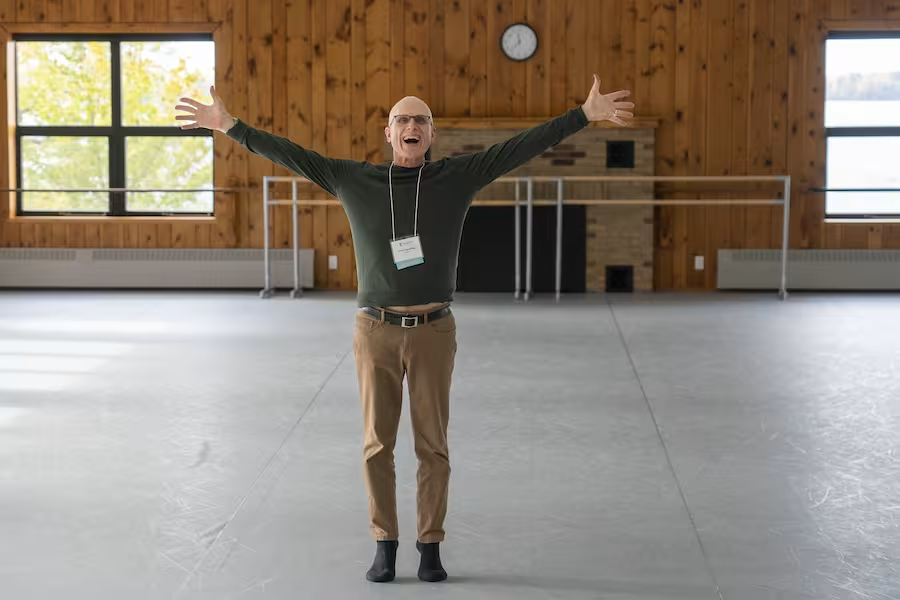
Interlochen Affiliation: AS 64-66 | IAA 66-69 | IAC St 70 | IAC Fac 72
Interview Date: June 21, 2025
Peter Sparling studied violin in the All-State division of National Music Camp before transitioning to studying violin at dance at Interlochen Arts Academy.
This oral history is provided free by the Archives of the Interlochen Center for the Arts (ARTICA). It has been accepted for inclusion in Interlochen’s audio archive by an authorized administrator of Interlochen Center for the Arts. For more information, please contact archives@interlochen.org.
00:00:00 ELIZABETH FLOOD
Today is June 21, 2025 and this is an oral history interview with Peter Sparling, conducted by Elizabeth Flood on the campus of Interlochen Center for the Arts. Thank you so much for taking this time and sharing your story with us, Peter.
00:00:16 PETER SPARLING
It's a pleasure. I'm glad I could be in the area and participate in this significant goal of Interlochen, one hundred years.
00:00:25 ELIZABETH FLOOD
Please tell us your name, your connection to Interlochen, and the years that you attended.
00:00:30 PETER SPARLING
My name is Peter Sparling. I first attended Interlochen as a camper in All-State in 1964, '65-66 as a violinist. I came to the Interlochen Arts Academy in '66 as a violinist, changed my major to dance, graduated in dance with English honors and went to Juilliard, but I returned the summer of '70 to be a High School Boys counselor. I then returned summer '72 to be on the dance faculty of the National Music Camp. And since '73-74 I have often returned as a guest artist, teacher, performer and choreographer.
00:01:15 ELIZABETH FLOOD
Wow. Beautiful, spanning relationship with this place. How did you learn about Interlochen in the first place, what drew you here originally?
00:01:24 PETER SPARLING
I was very fortunate to be a student of Ara Zerounian in Detroit, in the Detroit Public School System. Mr. Z trained a remarkable number of terrific string players, many who came to Interlochen. A large Armenian community in Detroit, the Ani Kavafian, Ida Kavafian, Michael Ouzounian, also Jorja Fleezanis, Kim Kashkashian -- I was one of the few W.A.S.P.s there amidst all this brilliance. And Mr. Z got me a scholarship from the local Kiwanis Club to attend a place called Interlochen. And so I was just coming out of seventh grade. I came up to Interlochen with my footlocker and attended the two week All-State program. Just fell in love with the place. That was how my first exposure to Interlochen happened.
00:02:26 ELIZABETH FLOOD
Who was the most memorable person? Or, I know that's a very pointed question, but who are some of the people that you met along the way in your time here, and who has stuck out with you or carried with you throughout your life?
00:02:24 PETER SPARLING
I'm glad you didn't just, you know, tell me I only had one person to pick from all the people, but -- the first person that comes to mind is Howard Hintze, who was an English teacher at the Academy. He had a profound influence on me in terms of his very careful, measured perspective on literature, on what it can do. I seemed to connect with his sensibilities. I also worked quite a bit with Howard as the editor of the school paper. We then had a paper called The Paper, and we would spend hours editing, collating, putting things together. And I learned so much from him. I was motivated to write, to think about literature, and he helped me hone my skills in writing, which have really been invaluable in my career. Not only as an administrator, but as an artist, choreographer, artistic director, and oftentimes now as an essayist, lecturer and a poet. So Howard Hintze, who was a longtime faculty member, one of the longest tenures, I think, of faculty at the Academy. And he's beloved by many.
00:04:00 ELIZABETH FLOOD
That's so beautiful. Do you remember what you wrote about?
00:04:03 PETER SPARLING
Yes, I do. A few poems here and there, but I remember in particular, it was during the Vietnam War, and I wrote a wish list for Interlochen. And one of the items was that Interlochen divest of any connection with the Dow Chemical Company because of their production of napalm, and how it contradicted the whole essence of what it meant to be an artist and to make art and to be a humanist. Howard, bless his heart, allowed me to go ahead with it. It was published, and very soon afterwards, I was summoned into the Associate Director's office and essentially had my hand slapped. You do not bite the hand that feeds you. I wasn't penalized or punished, but I was just kind of forewarned that this was not a good thing to do, that I had some lessons to learn. And I must say that since then, I've been a rabble rouser. I've always stuck my neck out and kind of learned it here at Interlochen.
00:05:08 ELIZABETH FLOOD
That's beautiful, and that's a beautiful precedent for young artists, I believe.
00:05:13 PETER SPARLING
I hope so. I hope there's still rabble rousing.
00:05:18 ELIZABETH FLOOD
We need that.
00:05:19 PETER SPARLING
Yeah, we do.
00:05:19 ELIZABETH FLOOD
I'm interested in that point in time, and when you switched from violin to dance, and what that was like for you.
00:05:30 PETER SPARLING
That time was so charged for me, with so many people who come to the Academy. You're searching for yourself, you're searching for your place amidst so many talented people, you're trying to figure out whether you can have a career as an artist, whether you really think you can make it. And very open and vulnerable, but at the same time, honing certain skills, a competitive edge, your own confidence. It was one of the first days I arrived for my tenth grade year at the Academy, my first year, I didn't know I was going to start at the Academy. I'd already started my first year at Plymouth High School in Plymouth, Michigan, after having spent my third All-State summer here in the Intermediate orchestra. And my mother got a phone call that Interlochen wanted me to come up to audition because they needed violinists for the Academy here. And so I got home from my first week at Plymouth High, which I hated, and my mother told me of this, and I just jumped. And we packed up the car, we drove up to Interlochen, I auditioned, I was offered a work scholarship, and told that if I wanted to attend, I needed to be back ready to go the following Tuesday. Because we started things on Tuesdays back then Mondays were off. And so, drove back down to Detroit, packed up the footlocker, got on the bus in Ann Arbor, and I remember my mother, with tears rolling down her face, waving goodbye to me as the bus pulls out of the Ann Arbor station to come north. So I arrived and I went to the -- I was going to say costume -- into the Uniform Dispensary. I was so wound up, and it was also the scent of the starch in this little cabin. Before I knew it, I'd fainted. And when I woke up, all these elderly women who worked there in their blue corduroys and blue shirts were peering down at me, "are you okay? Are you okay?" I woke up. So that was kind of my introduction to Interlochen, kind of going into the, down the rabbit hole, into the zone. And then shortly thereafter, I was told I had the option of getting out of Phys. Ed. if I took an Introduction to Dance class. And I said, hell yes, get me out of Gym, anything. And so I enrolled in Dance and was taking kind of elementary ballet, standing at the bar, I was told to kind of turn my toes outwards with my heels together, and then extend one leg out into what we call second position, and then bend my knees. And the teacher gasped and said, "oh my god, you have incredible turnout." And I said, "what's turnout?" And of course, turnout being the gold standard of classical ballet, one thing led to the next. I was a Dance Minor my eleventh grade year, while still being in the orchestra and being very competitive. My first year, I was first chair, second violins, and kept it through all of the challenges. I don't know if you've heard about challenges. The end of my junior year, I was allowed to choreograph a piece for a little workshop showing and I created a dance trio, myself with two other women, and made in my own musical score, taking a portable tape recorder and recording sounds around the campus. And we performed it in the old Dance Building. And it was the first time I had performed in public as a dancer, and it was the last thing in the program. The audience went wild. This bolt of white light went down through my body into the floor, and it was like, bingo. Oh, this is what I'm going to do with the rest of my life. Of course, this is it. And so I went to Admissions -- was it John Dudd? I negotiated with the head of the Dance Program at that time, William Hug, and they were eager for men, for boys, men in dance, because we were such a scarcity, a rarity. And then the big challenge was to tell my parents that I was going to change my major. And my mom always supported whatever I wanted to do, my dad kind of put his head in his hands, and my mother later admitted to me that out in the hall he turned to her and said, "Oh my god, I don't want my son to become a sissy." And my mother turned to him and kind of read him the riot act. And then the Admissions person turned to my father and said, "Well, Peter will get a larger scholarship as a dance major than as a violinist." And that kind of calmed him down, so that that was my entry into the dance world. I did my senior year as a dancer and was put on stage before I really knew what I was doing. Because of my musical experience, in the early stages of developing my body memory, I would just fit everything to musical structures and remember movement that way. And it took me a while to separate myself from that dependence, which is another story about working with Martha Graham. Anyways, back to challenges the dreaded challenges. There was a long standing tradition that was begun by Joe Maddy, I'm sure, of sectionals, so that each ensemble had its sectional rehearsals where the first violins would be alone, the second violins would be alone, et cetera. And weekly, we would be given certain passages of that week's repertoire to rehearse ourselves, such that on Thursdays, we'd come together in sectionals, and we'd have challenges, so that we'd start at the back of the section, and the last person would challenge the next person playing the same passage. Everyone would close their eyes so it would be anonymous, and then there would be a vote as to who played it best, and if the last person was voted better than the person in front of them, they would move up, and then it would just keep going. They'd keep challenging the person. And this created a lot of tension to say the least. I mean, the whole campus reeked of B.O. on Thursdays because people were so nervous. Oh, and then that came the time when Interlochen decided that it was going to abolish challenges because it was inhumane. It was too stress inducing, whatever. It was not good for self health at all. And there was quite a reaction among many alums who said that no, challenges taught them what it meant to be on and to challenge and to protect or hold one's own authority and to create and produce under great stress, which which had happened throughout careers and challenges at Interlochen had prepared them for that. So, of course, there are no more challenges, but back in the day...
00:12:45 ELIZABETH FLOOD
Where did you stand on the divide of...?
00:12:48 PETER SPARLING
Oh I became cutthroat. I mean, there's another question you have about what I've learned at Interlochen, and it was very much a healthy, and perhaps somewhat delusional sense of self confidence, but also this cutting edge competitive force where one could produce the goods on the spot and kind of defend one's turf. I don't mean to make it sound territorial, but the arts are competitive. Extremely. In any profession. So yeah, I learned quite a bit about holding my own and having the confidence to believe that I deserved it.
00:13:36 ELIZABETH FLOOD
That's an important thing to build, especially to then carry on being -- to see yourself being an artist as a lifelong profession, but also a way of being in the world.
00:13:47 PETER SPARLING
Yeah, and another aspect of it is that -- yes, although I kind of perfected a way of using challenges to my benefit, I also had a growing realization that I may have been a very good ensemble player and section leader, but that I would never be a soloist. I didn't have what the more talented kids had. I couldn't translate my soul, my inner heart's yearnings, into the instrument in the same way. Put me out there as a solo player, and I really became a nervous wreck. And I think that also was a lesson that led me towards trying out dance, because when I was dancing, I had none of that. I felt entirely confident, and my body was my instrument. There was nothing between me and the expression.
00:14:45 ELIZABETH FLOOD
And such a beautiful gift to be able to find that.
00:14:48 PETER SPARLING
And I was able to do all of that here, within three years of high school.
00:14:54 ELIZABETH FLOOD
What was the, that exploration like for you? To be exploring the idea, slash the sensation, of using your body as the instrument. What did that study mean for you?
00:15:07 PETER SPARLING
I found it fascinating that as a choreographer -- and I'll say that I had most interest in choreography, not so much as a performer or a dancer. The idea of arranging, moving bodies within a proscenium frame, of creating, as we often say in dance, musical visualizations where you can you can visualize music in terms of its architecture, its counterpoint, its compositional aspects, and embody them in the space with bodies. So not only is the body a moving sculpture in itself, but the way you arrange bodies begins to have its own inner geometry. Well, it can be static because you're dealing with formations, but at the same time, you can really mess with formations and have everything dissolve into this blur, or into some very complex but somehow ordered sequence of transformation. It just fascinated me. To move to music and to make shapes fired off some kind of understanding, deep understanding in me, of what it meant to embody, to enact, to allow the body to sing, both in silence and in correspondence with a musical structure.
00:16:46 ELIZABETH FLOOD
Were there any performances that you saw or were in, or projects that you partook in that stand out in your memory from your time here at Interlochen?
00:16:58 PETER SPARLING
So many. I must say that it was the orchestral repertoire that I participated in my first two years, first under Thor Johnson, a very dynamic conductor, who challenged us in such extraordinary ways. The faith that he had in us to produce, we had a different, an entirely different repertoire every week, which no longer happens. Maybe the World Youth Symphony in the summer does, but not at the Academy. And so it was fierce. We were constantly playing top level orchestral repertoire. And it would then be broadcast and then played on Interlochen radio. So not only would we experience the performance, but then we'd all sit together in one of the lobbies of the student dorms to listen to ourselves afterwards. It was crazy. But so much of that repertoire has stayed with me so that if I hear that music on the radio, or played on a recording, or at a concert, the amount of music that I played myself is just outrageous. And I remember in particular, playing the Mahler Fifth Symphony. I remember Symphony Fantastique, the Berlioz I remember also playing contemporary music. Leslie Bassett, who I later was on the faculty with at University of Michigan School of Music. Dancing, a work by William Hug called "Lines and Designs," two and -- Five Pieces for Clarinet and Piano, Alban Berg. That elevated the act of choreography to contemporary music, such that it really held, it really stuck with me. Gosh. My senior concert, I shared the concert with one of my friends, Paul Epstein, who was a composer, really talented composer. We were so into Merce Cunningham and John Cage, that we had our manifestos that we read on opposite sides of the stage simultaneously. And then I did a piece called "Environments One and Two" to his very kind of out there sound score, and we felt that we were these radicals. You know, we were just really messing with everything. And again, it's what we were allowed to do. We were not only given these -- this extraordinary experience delving deeply into the legacies of dance and music and the arts, but we were allowed to then rebel against those things and kind of show our own stuff.
00:19:51 ELIZABETH FLOOD
I'm a student of John Cage, Merce Cunningham Fluxus performance. So I was also curious earlier when you brought up the tape recording. What are some of those sounds? Were you seeking sounds? Or were you just recording as you came across things? Or do you remember any of it?
00:20:09 PETER SPARLING
A little of both. I remember going into the cafeteria at Stone Student Center and the clatter, the silverware in the voices. I remember water running down along a curb. I remember, oh, and then I would sit down in a practice room and just improvise on the piano these rhythmic sequences, that I could later transpose or translate into movement. One of the pieces I made with that kind of sound score was a solo I made called "Street Song," and it was the solo I took to New York in March of '69 to audition at the Juilliard School. And it got me into Juilliard.
00:20:45 ELIZABETH FLOOD
What were your favorite places around campus. Any places you'd like to return to? Or that you have really fond memories of?
00:20:55 PETER SPARLING
My memories of place, really focus on the walks I took. Particularly in the autumn. It was the woods. It was the lakes. It was the nature part of Interlochen that was entrancing and that supported all of my adolescent longings. You know, this -- the artist, the lone artist, out in nature, very kind of German Romantic, you know. Caspar David Friedrich has had this name, the artist, the painter. Anyways, it was the natural setting of Interlochen. Other places, the Dance Building, the old Dance Building, which fortunately has been preserved as part of the renovation. Had that been knocked down, I never would have returned here. I would have been so angry. But I think there was enough public or alumni feedback when was let out that they were renovating and building a new Dance Building that the people here figured they'd better keep the old.
00:22:03 ELIZABETH FLOOD
What did it mean to you? What does it mean to you to have kept that space?
00:22:08 PETER SPARLING
It was my introduction to the extraordinary phenomenon of a dance studio as a home, as a haven, as a safe place, as a training center, the floors, the sprung floors, the wooden bars that one held on to. The smell of the sweat of bodies. The sensation of the bare feet on the floor, the tradition, for better or for worse, of constantly seeing your body in the mirrors, and of learning how to use the mirrors, not as an obsession, but as a tool to help shape what it is you do. To this day, wherever I go, whenever I travel, if I walk into a large space, it either sings to me as a potential dance studio, or it doesn't. I'm looking at floor, I'm looking at elevation, height of ceiling. I'm looking at the light. And yeah, I'll walk into a space, and I'll -- the first thing I will be, this would make a good studio, or I'd like to film something here.
00:23:18 ELIZABETH FLOOD
And the location of that studio is very divine the current day.
00:23:24 PETER SPARLING
Yeah, I mean, it is situated overlooking the lake. I'm not sure if it's Wabekanetta or Wabekaness. I think it's Wabekanetta, and it had that spaciousness, and also the, kind of the boundary between the interior space of the dance studio and everything that was out there. The boundary was so almost transparent. It was so thin that you could kind of be in both places at once.
00:24:01 ELIZABETH FLOOD
When was the last time that you've been here?
00:24:05 PETER SPARLING
I have been fortunate to have returned many times. I was here last March, '24. I was allowed to use the studio during the Academy break. Joseph Morrissey and Katie Dorn allowed me to use the space to create a new work where I was using two men who live in the area, one man who lives in Manistee and the other man from Petoskey. We came together and made what I feel is a really profound duet called "Love Thy Enemy," about two men patrolling opposite sides of a demilitarized zone who move from being enemies to actually sharing, falling in love and having this intimate experience. It meant so much to me to make this particular piece in the same studio where I began dancing fifty five years earlier. I will be returning this September of ‘25. I've done this before for Joseph and his dancers to set a suite of dances from Martha Graham's Appalachian Spring on the dancers. And that'll happen the second week of September.
00:25:23 ELIZABETH FLOOD
Wow, I would love to see that. I'm just -- I knew of Martha Graham's name, but as a really recent student of dance, in many ways, I've been acquainting myself with some of the archival videos that I can find.
00:25:38 PETER SPARLING
It's a big year in '26 because it's the hundredth anniversary of the forming of her company, and a celebration of her company as the oldest working American dance company. Which brings me to answering perhaps another question, the friends that I made that I still am in contact with and that I interact with. My dear friend, Janet Eilber was a Dance Major in my same class. She was the diva. She was the queen of dance. She could do anything. Everyone would admired her. She was a perfect, a perfect body, a perfect person. And we ended up attending Juilliard together and being paired together, we then joined the Graham Company together in '73 and were again paired together. Because William Hug, here at Interlochen had groomed us in improvisation, Janet and I were prime suspects for Martha Graham to use in new works. She knew that Janet and I could improvise, so she would allow us to kind of suggest or feed her materials when she could no longer move herself. She would give us a theme, an idea, a piece of music, and let us just go, the two of us. And then she would say, "All right, I'm going to leave the studio and try to remember what you just did and put something together." Fifteen, twenty minutes later, we'd see Martha's face peering between the double doors of the studio on East 63rd Street, New York City -- "Are you ready for me?" And she would hobble in and sit down, and then we would perform this duet, you know. And she would say, "All right, now come and sit. Let me talk here. First of all, you two move like eels. You never stop moving. You need to punctuate. You need to give me beginnings and endings." And so she would kind of shape it that way. Then she would say, "Well, you didn't remember the moment Peter, where you were on the floor, and Janet, you arched over him, and there was, you kind of touched hands" and she remembered things of our improvisation that we had not remembered. So those were kind of brought back into the mix, and she would gradually shape it this way. Which for me, was the ultimate experience for what my original intention was to join Martha's Company, which was to be an apprentice to a master. I wanted to know how she shaped movement. Because I wanted to steal from her. Or now that's what Picasso supposedly said about stealing from the best. But I wanted to be an apprentice. I figured that was a good way of learning.
00:28:26 ELIZABETH FLOOD
And I feel like you just touched on a few of the other things you've mentioned thus far. Punctuating, I was relating to the professor who ran the press-
00:28:35 PETER SPARLING
Howard Hintze.
00:28:36 ELIZABETH FLOOD
Howard Hintze, and then I was thinking about you dropped a thread earlier about body memory and how you were learning that in your beginning, learning of dance. So I feel like that was just a lovely new culmination of some of those thoughts from earlier.
00:28:51 PETER SPARLING
Yeah. It definitely weaves all together. Having moved from music to dance with writing as an underpinning, to choreography, to administration, to being a director of a dance company, to become chair of a dance department at a major research university, to then discovering screen dance, or how bodies move on a screen, and how one uses cameras, and particularly how one uses editing to essentially choreograph footage for the screen. And then, leading to about eleven years ago, my becoming obsessed with painting acrylics on every imaginable surface. If I were to have to get up on a soapbox and say, this is what I believe in, it would probably be something about transferable skills. How we have the capacity to transcend or even transgress boundaries or borders or silos. But our culture, and even Interlochen, I must say, back in the day, so encouraged specialization and the deep dive into one discipline. I do believe in the value of that, in that kind of depth. But I also, if I were to recommend anything to today's students, it would be, yes, take the deep dive into the rigors of a discipline, but also keep your interests and your eyes wide open to a much broader universe of creative endeavors and of the imagination. Always continue to see the imagination as this free forming blessing that you have. That as deeply as you go into a single discipline, you must also expand outwards to recontextualize it consistently. To give yourself permission to find as many channels for your creativity and your inner voice as possible. For myself, developing an interdisciplinary practice was a choice, but it was kind of an intuitive drive in me to prove something about transferable skills. How what I sense as a violinist in music fuels my dancing. How my understanding of the human body fuels the pacing and the lyricism of editing together sequences on a film. And how everything gets poured into the brush stroke. How one holds the brush. How one applies painting onto a canvas. How the body moves that brush and relates all its kinesthetic empathy through that brush onto the canvas. I mean, that would be my sermon on the mount, if you will.
00:32:03 ELIZABETH FLOOD
I think you touched a lot of answers in this question, but I still want to ask, what do you hope for Interlochen for the next hundred years? Specifically, what do you hope that the institution and the people who make up the institution carry into the future that's already here? What do you hope is preserved, and what do you hope for there to be that is not here currently?
00:32:26 PETER SPARLING
For the past few years I've helped with the annual campaign, where I will either provide social media or I will leave texts with a list of people or whatever, because I really believe in scholarships. And one thing that really encouraged me and inspired me to continue with this volunteering was when I learned that Interlochen has made a, I don't know if it's a promise, but a proposal, to have all students able to have their financial needs met by the year 2028. And this was after getting feedback from one of the alums that I'd sent a text to asking for funds, who got back to me and said, I won't provide a penny to Interlochen because it's elitist, because only wealthy kids can attend. And it got me thinking, it's like my hope for Interlochen is that it defies that perception of it being an elitist school, and that it somehow figures out a way to be incredibly inclusive in terms of race, gender, sexual orientation, financial, economic status, et cetera, and that it learns to balance its relative isolation in this beautiful space with an engagement, such that its students always are aware of the preciousness of the arts, of what they do, and that they also learn skills and knowledge to better allow them to survive and endure and make a difference. I think it's more important than ever in this political climate, in this cultural climate, when we have so many greedy, opportunistic people vying for power and using such despicable means to do so, I mean, it deflates, it threatens our humanity and it threatens our ability to have empathy and compassion for each other, which I think is what the arts do. I'm not talking about artifice and kitsch and sentimental bullshit. I'm talking about arts. Arts in the broadest sense. One always risks making it too elitist and too narrow, whereas I never saw the arts as that,
00:35:07 ELIZABETH FLOOD
I have like a backwards curiosity of something that you said earlier, but I'm very curious about what brought you back for your two years on staff and faculty here. The first one was in '70 when you were working in camp, and then you're, what it was like to then be teaching dance.
00:35:28 PETER SPARLING
Coming out of the Academy, I don't know if it was the era, '66, was it the fourth, the third or fourth year that the Academy was in existence. The nostalgia, the degree of being homesick for Interlochen was outrageous. So after my first year in New York City, talk about a contrast to the north woods. I mean mind blowing. Not having made any plans for my first year after my first Juilliard summer. And the first thing I did when I flew home to Detroit from New York City that early June was to commandeer the family station wagon and drive up to Interlochen just because I missed it so much. And I was walking down the concourse and someone spotted me who knew me from the Academy, an administrator, and just latched on to me and said, "Peter. We're in desperate need for High School Boys counselors. Would you do it? Can you do it?" And I just, sure, why not? I have no more plans. What can you pay me? You know? And it was like flashback to my first experience at the Academy. Is that I drove back down to Plymouth, packed up my bags and drove back up to Interlochen and started the summer. It was one of the best summers of my life, having a cabin full of high school boys, real some really talented kids. I mean, one of the kids, Michael Kaiser, ended up becoming the executive director, not only at the Kennedy Center, but at the Alvin Ailey company, of the Royal Ballet. I mean, yeah, Michael, I'll never let him forget it. Another thing that happened in my senior year at Interlochen was that William Hug, the head of the Dance Department, put together a quartet of the quote, unquote, top students. This was Janet Eilber, Diana Hart, Angeline Wolf and myself. And we would do lecture demonstrations, he taught us what it meant to do a “lecture dem.” This was something that modern dancers had largely invented. I mean dancers because they found that they had to kind of spread the gospel of modern dance in whatever way they could find to build audiences and to educate people. So you would create a forty five minute program with excerpts from dances, and different dancers would step forward and speak about what the dance meant, where it came from, et cetera, to share with the audience in a kind of a conversational way, and then move back into a little excerpt of a performance. So this format continued, and I ended up doing that very often while at Interlochen, and carrying it forward from there. It was with that same cohort. We all ended up going to Juilliard together. Angie, one year later, and all having wonderful careers. Janet and Diana in the Graham Company, and Angie in with Jennifer Muller and once with Lar Lubovitch. Oh, the list of dance alums who have made it is incredible. I could go on. But back to this summer of '72, we call ourselves "dance mobile." The four of us were hired by Interlochen to be the modern dance faculty at the National Music Camp that summer. And so we already had a built-in repertoire. We had gotten along together, and it was the whole package that they hired. And so, yeah, that's how that worked. We all came from New York to spend the summer at the National Music Camp.
00:38:56 ELIZABETH FLOOD
Was that your first experience teaching?
00:38:59 PETER SPARLING
That was the first experience, and also something I learned as a modern dancer very early on, is that at least back then, it was assumed that we not only were going to perform, but we were going to choreograph, we were going to teach, we were going to advocate, we were going to write about, we are going to fundraise, we are going to administrate, we are going to know how to light, how to costume, how to collaborate with composers, scenic designers, sculptors, scientists, poets, musicians, etc. It was just assumed that if you were a modern dancer, you were eventually going to do it all. And that certainly has been true.
00:39:46 ELIZABETH FLOOD
What of that first summer teaching do you remember or do you reflect on in the many years of teaching that you have done since. Were there ever moments when you thought of things that you did there or experiments that happened during class?
00:40:00 PETER SPARLING
Well it was the first time I had the opportunity to work with large groups, with ensembles. One of the pieces I made must have had at least sixteen dancers to a Michael Colgrass score "As Quiet As." Which had live music conducted by Don (Jaeger) the Oboe Instructor, who was also an excellent conductor. Whose grandson is now a very fine ballet dancer. You might walk into the studio having a whole set of notes and of preconceived movement sequences. But you have to sometimes be willing to throw all that away and create something anew in the moment, in the space with the dancers, you have to allow the spontaneity to enter the process if you're going to want a work that really has life. And that generates its own kind of spirit. And I think it was in the dance studio with those groups that I first kind of dared to free myself from my preconceived notion of what the piece should be and allowed for things to happen in the moment.
00:41:13 ELIZABETH FLOOD
Do you have any other memories of this place? I mean, of your time here, or people here that you'd like to share before we close out?
00:41:23 PETER SPARLING
Well I do realize, having been the class ambassador for our fiftieth alumni reunion a few years ago. For the first time, I became aware that certain of my peers didn't necessarily have the same positive experience that I had. That there were people who had never spoken out, who felt belittled, bullied, inferior. In other words, they weren't caught up in the star-making system of the competitive ethos, if you will. And they didn't necessarily have great experiences. That shocked me, because I maybe naively thought that we all had these super charged, idyllic, very inspirational experiences here, and it makes sense to me, in retrospect. But no, something about the deeply ingrained yearning to return. This eternal return. I always have this pull to get back to Interlochen, to drive north. Usually it is driving north. And to walk onto the campus. It is this kind of awe inspiring opening that happens in my body, in my chest, and I allow myself to be both in the moment of its beauty and also in the past at the same time, very Proustian. And I learn something from it every time I come back. How I've changed, how what I remembered was somewhat delusional and conditional upon where, who I was and where I was at at the time. And yet somehow, after fifty five - sixty years, that yearning for the eternal return never ceases. It never ebbs and never goes away. And that I always get a kick. I always get a thrill to come back.
00:43:29 ELIZABETH FLOOD
Can I ask you a little bit more about what it was like to be the class ambassador for the fiftieth year anniversary? And what that job entailed, slash how big your class was? And what that was like for you?
00:43:42 PETER SPARLING
I think we had about a hundred and fifty in our class of '69. It was during the pandemic. And thus, we had to delay the actual reunion by a year. But we still wanted to celebrate in, that would have been '19, 2019. So what I did was that I sent out the call, and I asked people to send me one minute video clips that answered certain questions. Their favorite moment, their favorite person, their favorite experience, that kind of thing, and who they were and where they were at now. I think I ended up with maybe about seventy five. Fifty to seventy five little video clips, and I made a video which became our reunion yearbook. And I sent out the link to everyone, and it was put out the day of the opening of the, you know, of the alumni reunion, quote, unquote. It was an amazing way to reunite, to reconnect, to use social media, to cast the net. It was a joy. I'm not sure who of us will be around for 2028. That would be our sixtieth reunion. It's always a thrill to actually meet people who are able to return here. Where we're essentially being in the same place that we existed together sixty years ago. That's really extraordinary. So I look forward to that.
00:45:16 ELIZABETH FLOOD
That's really lovely. Thank you so much for your time and your sharing of knowledge and memories. I've really enjoyed speaking with you today.
00:45:23 PETER SPARLING
Thank you. You've witnessed this kind of infinite well of memory that I can get lost in.
00:45:31 ELIZABETH FLOOD
It's a gorgeous gift. You know Pauline Oliveros?
00:45:34 PETER SPARLING
Yes.
00:45:35 ELIZABETH FLOOD
I've been thinking about quantum listening her theory and moments during this conversation.
00:45:41 PETER SPARLING
Yeah. Memory. Spaciousness and all that.
00:45:49 ELIZABETH FLOOD
Time. Thank you!
00:45:51 PETER SPARLING
You're welcome.
Copyright
Copyright to the audio resource and its transcript is held by the Archives of Interlochen Center for the Arts (ARTICA) and is provided here for educational purposes only. It may not be reproduced or distributed in any other format without written permission