
Oral History Interview with Ken Dake Jr.
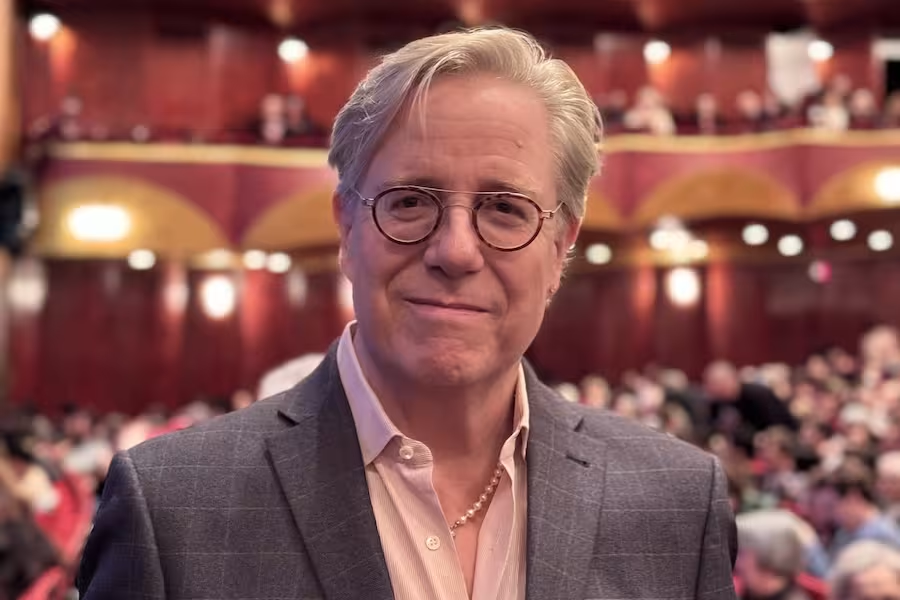
Interlochen Affiliation: IAC/NMC 71-78 | IAA 77-79
Interview Date: July 8, 2024
Ken Dake Jr. attended the National Music Camp for eight summers and Interlochen Arts Academy for two years.
This oral history is provided free by the Archives of the Interlochen Center for the Arts (ARTICA). It has been accepted for inclusion in Interlochen’s audio archive by an authorized administrator of Interlochen Center for the Arts. For more information, please contact archives@interlochen.org.
00:00:00 IAN JONES
Today is July 29th, 2024. This is an oral history interview with Ken Dake Jr, conducted by Ian Jones on the campus of Interlochen Center for the Arts. So, would you just say and spell your name for us?
00:00:13 KEN DAKE JR.
My name is Ken Dake, D a k e.
00:00:17 IAN JONES
Okay, so Ken, would you share kind of where were you born? What was your childhood like growing up?
00:00:22 KEN DAKE JR.
Yeah, I grew up on the outskirts of Chicago, the suburbs, Northwest, and I started piano when I was five. And then I took up the cello, actually, and the trumpet. And so I was always, you know, in band and in orchestra and always running to music lessons. And music was the center of my whole life.
00:00:40 IAN JONES
So can you tell me a little bit more about how you came to music? Were people in your family musical and they introduced you to it? How did you come to music as a form of art?
00:00:49 KEN DAKE JR.
Yeah, my mom was a little bit musical. She was a pretty good amateur pianist, but when I was five years old, they gave me a bright red phonograph player. And so my first record was Peter and the Wolf. So I would play the record in my bedroom, and I would make a mad dash to the piano down the hall and try to play what I had just heard. So that's how they began to figure out they couldn't keep me away from the piano. So that's kind of how it started.
00:01:18 IAN JONES
And how did you get introduced to cello and trumpet?
00:01:21 KEN DAKE JR.
Well, cello. I always loved the timbre of the cello, and I loved the idea of being able to play in an orchestra. And I was too young to start trumpet, so I decided to take up the cello and play in a community orchestra. And then as I when I first came to Interlochen, I was a pianist and cellist.
00:01:41 IAN JONES
It sounds like music has, I mean, for a very long time been a part of your life from a pretty young age. What has that meant to you over the course of your childhood and then into your adulthood?
00:01:52 KEN DAKE JR.
You know, it's the center of my being, really. It's the thing that has brought me the most joy, and I remember playing the cello. My first rehearsal in an orchestra with adults and the repertoire was the Brahms Third Symphony. And I don't think we'd gotten four bars into the piece that I just had tears rolling down my cheeks. And, you know, looking back, I'm sure it was a, you know, God awful community orchestra. But to me, it sounded like the New York Philharmonic, and I was part of it. And that was a paradigm shift in my life.
00:02:25 IAN JONES
And so that was cello. How did you find your way then later to trumpet, presumably. Was that through school or some other mechanism?
00:02:32 KEN DAKE JR.
No. This is a story I love to tell because this is an Interlochen success story. So when I was ten years old, 1971, it was my first summer here, eight weeks. I'd never been alone. I was an only child. I'd never been away from home for a single night in my life. And I came to Interlochen for eight weeks, and I was, I was homesick for about 24 hours. And then after that, I just, you know, what parents? But as part of that first summer, I was junior boys and we had it was called Talent Exploration class. And so for four weeks we tried every single instrument and then we were allowed to choose two. And I chose the harp and the trumpet. Then we studied those two instruments for two weeks, and then we narrowed down to our favorite. And I chose the trumpet. And so that was 1971. And 1977, six years later, I was principal trumpet of World Youth Symphony, and then for two summers. Interlochen discovered I had no idea that I had a talent for the trumpet. That's on Interlochen. They discovered it, they nurtured it. They inspired me. And then six years later, I was principal of World Youth.
00:03:46 IAN JONES
You found success, though, because you obviously invested time in it. You practiced. You wanted to be part of what you did, right? What kind of discipline did you have to make that happen because it wasn't just Interlochen. That was you as well.
00:04:00 KEN DAKE JR.
I mean, I think we were all very driven. I remember when we did fun, athletic, you know, games and stuff like that in junior boys, intermediate boys. I don't know if they still do, but we called it forced fun because what we really wanted to do was practice. And then they made us, you know, do something fun, like go swimming or whatever. But yeah, I mean, I think it was just that goal that, you know, to want to be the best that you can possibly be. Now, the cello, I should say, you know, when I was playing the cello in intermediate division, I was the last chair in the top orchestra, and I always wanted to hold on to being in the top orchestra. I was happy being last chair as long as I was in the top orchestra. But then when I decided to finally kind of give up the cello and move to trumpet, then I was always principal after that. So I think I made the right choice. I was not a good cellist. I loved it, but I didn't have the discipline for the, for the cello.
00:04:59 IAN JONES
Yeah. You found your instrument, it sounds like.
00:05:00 KEN DAKE JR.
I did.
00:05:01 IAN JONES
So let's back up a little bit. So can you tell me, how did you first find out about Interlochen? What drew you here?
00:05:10 KEN DAKE JR.
I mean, I have to say, my parents found out about it, and it must have been through school teachers, I'm guessing, who saw my talent and suggested it. You know, I discovered when I was in first grade, I discovered I had perfect pitch because some violinists came to perform at our school. And my mom asked what they had played, and I said, I don't know, it was something in A minor. And she said, well, how do you know that? I said, well, because it was in A minor, you know, everybody knows that. So I think that was a tip off. You know, there were other things. And so I think they thought about sending me when I was nine, but they waited until I was ten, which was probably the right decision.
00:05:47 IAN JONES
What do you remember about coming here for that first time?
00:05:50 KEN DAKE JR.
Well, I remember it was a lot of fun, too. I mean, it wasn't just, you know, when we were in juniors, we weren't as obsessed with practicing. And we were, you know, we went on canoe trips, which were amazing. We went to Point Betsie, we went to the Sleeping Bear Dunes. We would sleep out and watch shooting stars. You know, we did all of, you know, we did lots of swimming. We did all the stuff that campers do, but we were also discovering music. So it was kind of the best of all worlds.
00:06:20 IAN JONES
Is there something from that time, a specific memory, a project, a performance, an activity that's particularly memorable? That could be any time during your camp experience?
00:06:30 KEN DAKE JR.
Well, yeah, I'm not so sure. I have musical memories from juniors, but certainly, you know, once I got into high school and once I got into World Youth Symphony, there were a couple performances that really stood out for me. I think the biggest success or joy was in the summer of 1977, when Robert Marcellus came to guest conductor, World Youth Symphony, and we played the Mahler First and I was doing the off stage principal trumpet parts and stuff, and I'll just say I nailed it. And I don't say that about very many performances. That was a, that was an exception. But afterwards, Robert Marcellus said, you know, "Is there any chance you would like to come to the Academy?" Because he was the director of the Academy Orchestra at the time, and I had never really thought about going to the Academy. I'd already done two years of high school, had my public high school outside Chicago, and so I said, "Yeah, I would, I would love to come to the Academy." And so I twisted my parents arms and there were a lot of tears, you know, about letting their only son go at the age of 16. But it changed my life. And I'll tell you, I never I'm skipping ahead, but I never, ever, ever would have gotten to New York and Juilliard without going to the Academy.
00:07:43 IAN JONES
We'll talk about that. Talk about that experience. How did you find your way there? How did that time at Interlochen turn into.. This is where I'm headed. This is my path.
00:07:53 KEN DAKE JR.
Yeah, I mean, I was still I was very serious piano and trumpet. So by then I was really a double major. And, you know, one of the great things was that we did all these tours. The pianist would go on tour and, you know, Michael Coonrod was, was on the faculty. I had the pleasure of visiting with him yesterday, and my teacher was Kim Kabala, and we had an amazing piano class and we performed a lot. We went all over Michigan. We performed in Orchestra Hall in Detroit, we performed in Hill Auditorium in Ann Arbor. And so we were doing this, these performances night after night after night. And that's very rare for pianists to get to do that, because that's how you get over the nerves, is to be able to perform night after night after night. And by the end of those tours, we were different pianists and same thing with the trumpet. I was in the brass ensemble and we went on tour. It was in the orchestra, we went on tour, so I don't know when I got any classwork done, but it was a lot of performing and a lot of great music making, and I think that's what prepared me to get to Juilliard. And the other thing I would say is, you know, back in the day, in the summers, we had challenges. And, you know, they were affectionately known as Bloody Friday and immensely stressful, competitive. But part of the reason we practiced so hard was because of those challenges. And maybe some of that tension and competitiveness was not healthy, but it also prepared us for what it was going to be like in the real world. Because when you're up against, you know, 300 pianists at a competition, it's going to be equally stressful, if not more so. So that also really prepared me for what it was going to be like in the real world.
00:09:33 IAN JONES
Put you in familiar territory.
00:09:35 KEN DAKE JR.
Yeah, exactly, exactly.
00:09:37 IAN JONES
So how did the people, the experience, the things here, how did that manifest then in your professional life...beyond school, where you've been, how you've gotten there? Is there anything that from Interlochen that's been a through line?
00:09:54 KEN DAKE JR.
Well, you know, one thing that Interlochen taught me that was not maybe about music necessarily was how to be a leader. And I actually became the president of the All Camp Senate in 1978, and it wasn't a hugely important position in the grand scheme of things, but it was important to me because, you know, people looked up to me and I was very privileged to give the address at a stamp commemoration, the Postmaster General and, you know, I was very honored to highlight the phrase at the back of Kresge, "Dedicated To The Promotion Of World Friendship Through The Universal Language Of The Arts", and to talk about some of the experiences I'd had on that stage, you know, with Howard Hanson, for example. So I just was able to learn what it meant, I think, to be a model for others and to be able to lead. And that really served me well because I ended up in my career becoming a director of music in a church. And so I had a lot of people looking up to me, looking to me for vision, for leadership, For innovative ideas, and I think I learned so many of those skills at Interlochen without knowing I was learning them.
00:11:10 IAN JONES
Any challenges or obstacles in your professional life or in your artistic journey? I'm just interested in what kinds of things you've encountered over the years and maybe how you overcame them.
00:11:21 KEN DAKE JR.
Well, I'll start with the fact that I lost my principal chair, my last three days at Interlochen. That I had to- the therapies helped, though. You know, I laugh about it, and really, it was a great life lesson. You know, it was like, watch your back because you got to always work hard. You can never let up on the gas, you know. But, you know, I ended up, after I had my master's from Juilliard in piano performance, I ended up switching to organ and choral conducting, and I'd always wanted to be a conductor. In fact, when I was here at Interlochen, I would just get my friends together and form ad hoc ensembles and conduct them. And I would go to the library and check out music and we would just say, hey, let's just put this together and, you know, reserve some, some shed and do a little ad hoc performance. So, so I ended up becoming more of a choral conductor and organist. So I think, you know, I never had the fire maybe in my belly to win an international competition in piano. I never had those nerves of steel, but I wanted to be a great musician, and I found a way to do that. So you find your own niche. I wouldn't say it's a setback or a failure. It's just finding the path. And it may not be the path that you originally set out on.
00:12:42 IAN JONES
No, I agree with you 100% on that. All right. So we're here on campus, right? You're spending some time here. Tell me about a favorite spot here on campus. Do you have a favorite? What is it? Why?
00:12:52 KEN DAKE JR.
Well, certainly the main Camp. You know, seeing Kresge, hearing music wafting over the main campus is definitely a favorite spot. The Bowl, you know, as the principal trumpet, I was also the bugler and I had a lot of bugle. I don't know if they still do bugling I'm not sure they do, but I was the kind of camp bugler. So, you know, we would raise the flag every morning in The Bowl and I would play the fanfare for that. And then one of my other duties that did not win me any popularity contests was to play the bugle call when it was time in the evening for the boys to say good night to their dates and go back to the boys camp. And I would start that bugle call and everybody would go, "Aww". So I don't know if, that's not exactly a favorite spot, but certainly, you know, just walking onto the main campus and just hearing, you know, music everywhere you walk. Last night I was walking around Kresge and The Bowl and the beautiful new dance studio on the lake and just music, music, music everywhere. It's like the sound of people becoming.
00:14:05 IAN JONES
That's about place. Let me ask you something about people. So what lasting friendships have you formed at Interlochen? Are you still connected to people from your time here? How they impacted your life?
00:14:17 KEN DAKE JR.
Yeah, well, one of my great friends is one of my classmates, Anli Lin, and she was a piano student of Michael Coonrod, and we've stayed in touch. We're actually visiting campus together. She lives in LA and has had a very successful career, and I built a lot of lasting friendships here. It's hard when you go off and have your own life in another part of the country to keep in touch with all those friends, but they still are very much a part of my, you know, part of my life. For example, I go whenever I go to the Metropolitan Opera I see, as principal percussionist of the Metropolitan Opera, Gregory Zuber. Gregory Zuber and I were in cabins together since we were little kids. And I'm just, I don't know, I love going to The Met and seeing Greg. There's Greg in the pit. You know.
00:15:04 IAN JONES
It's fun to make those connections with people and to see them, you know, doing what they love to do. Could you share a little bit about, in your current work, your creative process? How do you find inspiration? What kind of techniques or routines do you have to continue to do what you do?
00:15:24 KEN DAKE JR.
Yeah, I mean, I've made my career in church music and I have done a lot of choral composition and arranging, and I think at this point, one of my inspirations is trying to find really powerful texts to set to music, to set to choral music. And I'm kind of on an intermission right now. I left my job after 28 years at the same church. I left my job a year ago, so I'm kind of looking for the next calling, and I think it's going to be really centered on writing and publishing a lot more choral music.
00:15:57 IAN JONES
That sounds exciting.
00:15:58 KEN DAKE JR.
Yeah, I'm thinking of wanting to write some things for Interlochen, too.
00:16:03 IAN JONES
Great. That sounds great. Thinking about Interlochen again.. How was your experience at Interlochen kind of shaped your view of arts education? I'm kind of interested in what you think about arts education today, its importance, how it's structured. How does Interlochen shaped your view on the importance of arts education?
00:16:23 KEN DAKE JR.
Well, I think one of the things that can be concerning is that arts education is reserved for a select few. And maybe they are of a certain financial means or a certain background that makes the arts much more accessible. And that, I think, is something that I would hope and that I believe Interlochen can work to rebalance, and make it accessible to more people because I think, you know, it has to do with not just quality of life, but quality of calling, quality of dreaming, of community of expression. You know, I think it's so important. It's not, it's not just about learning an instrument and learning how to master a specific craft. It's really so much more than that. It's learning how to connect with fellow human beings and how to be able to fully express yourself. And I think to unlock that in people, regardless of their means or background, is an amazing thing.
00:17:41 IAN JONES
So with your many years of experience here at Interlochen, still experiencing now, how do you describe Interlochen to someone who knows nothing about it? They've never experienced it.
00:17:52 KEN DAKE JR.
Best place on earth, first of all. Wow, that's it's hard to describe in one sentence, but it's just-
00:17:59 IAN JONES
You're not limited to one sentence.
00:18:01 KEN DAKE JR.
Yeah, I would say it's a place that you can come discover who you are artistically, what you're capable of, who you can become. It's a place where you can just, in a profound way, let music infuse your life experience. And I'm sorry, I'm a musician, so I tend to see things through the lens of music. But when I say that, I mean dance and theater and writing and filmmaking and all the other incredible arts that are going on here at Interlochen, it's a place where you can discover how you connect with other people. You know, I was in the public high school outside Chicago, and it was a tough experience for me. You know, being a talented person was the prescription for getting bullied. I mean, that was just life and coming to Interlochen and realizing that there wasn't something wrong with me because I liked Mahler or Beethoven or, you know, it didn't mean I was flawed because I had a talent that others didn't have. And to, to kind of all of a sudden realize that I could be totally accepted as the talented person I was and not just accepted, but respected. And that connection with other people was, you know, was great. And I think that's such a great gift to give young people. I mean, it just it changed my whole life.
00:20:10 IAN JONES
So what advice would you give to current and future students at Interlochen? Now's your chance to say, "Here's what you should think about."
00:19:24 KEN DAKE JR.
Yeah, I would say, first of all, practice as much as you can now because the older you get, the less time you'll have to practice. That's one thing I definitely learned. But that's the narrow answer. The wider answer is, you know, experience all the arts. And I wish I had done more of this because, you know, when I went to New York, we were so focused on how loud and fast you could play, how much repertoire you could cram into your fingers, into your brain. And, you know, now, if I had to do it over again, I would read more poetry, I would go to more art museums, I would go to more plays. I would I would read more books. I would try to become a fuller artist because that would have made me a better pianist. So I would say it's a both and- I would say, practice your craft, and it's also not just how many hours you practice, but the way you practice, and be diligent about that now, because this is a golden opportunity that you won't have again. But on the other hand, open yourself up to lots of other artistic genres because it's going to make you a better all around artist.
00:20:44 IAN JONES
Let me ask you a little more about that. How do you think those other arts disciplines inform? For instance, your in your case, music. So how do the visual arts and cinematic arts and dance inform the work that you do now?
00:20:59 KEN DAKE JR.
Well, I mean, music is infused with color, infused obviously with dance, and it's infused with storytelling. I mean, when you play a piece of music, you need to be telling a story. It's not enough to just play the notes and even play them well and play them beautifully. There has to be a reason. You know, I used to say to my choir, don't just sing something, say something. And it's the same thing with any instrument. You need to say something through your craft. And in order to do that, I think you're drawing on all the different arts. You know, I think there's direct parallels and direct impact, really, especially with visual arts, because, you know, all musicians should be colorists and storytellers, dancers. You can't play Bach if you don't understand dance. You know, if your Bach doesn't dance, it's dead. Yeah. So it's all connected. It really is.
00:21:54 IAN JONES
So let me ask you this then. Why does art matter in the world today?
00:21:58 KEN DAKE JR.
I think because it is sacred. And I think the most important thing that we all need to remember now is that, you know, this human experience that we're having is sacred. It's short, it's communal, it's something we share, to heal. de Chardin had this saying we're all spiritual beings on a human journey. So, you know, it can reconnects us with the divine. It reconnects us with the spiritual journey that we're on.
00:22:33 IAN JONES
Okay, so let me ask you. No doubt you came in here with other stories. So what's the burning couple of stories that you've got that you, you want to make sure you share?
00:22:44 KEN DAKE JR.
Shared a lot of them.
00:22:46 IAN JONES
It's okay if they're not anymore. I just always like to loop back and say what, you know, is there anything else you'd like to share as a part of what we're doing here today?
00:22:54 KEN DAKE JR.
Well, I'll think of something the minute I walk out, of course.
00:22:57 IAN JONES
We can always do another one.
00:22:59 KEN DAKE JR.
Oh, the time in 1970...'74, 1974 that we played Led Zeppelin's Stairway to Heaven so many times in our cabin that the counselor took the tape away from us. True story.
00:23:28 IAN JONES
Just got sick of it.
00:23:30 KEN DAKE JR.
Yeah. We were we were pretty much obsessed with that song. I remember the time that President Ford came to speak. That was exciting. I remember the night that Nixon resigned. We were all ushered back into Kresge. WYSO had finished the concert, we were headed back to our Camps, And they said, no, no, we're all going back to Kresge. And we were all like, what's going on? What's going on? And then they played over the loudspeaker Nixon's resignation. I remember all of the great artists that visited all the great jazz bands. I heard Duke Ellington, Count Basie, Stan Kenton, Maynard Ferguson. I mean, Bob Hope came, you know, with full band. I mean, one after another. Doc Severinsen. Oh my gosh. He was my idol as a trumpet player, and he came and played with World Youth. I was in heaven. And so that morning we'd been rehearsing all week and Doc was here that morning. I was sick as a dog. I had a temperature, God even knows what it was. And I was just going to muscle through. I wasn't going to tell anybody. So I went into the food line at Stone Student Center, and, I mean, my temperature was through the roof and I passed out. I dumped my whole tray of food on the floor, and I passed out. And then I was in the infirmary and I was like, you know, you are not going to keep me from playing with Doc Severinsen tonight. I was like, no, it's not going to happen. And somehow I convinced them to let me out. And I still got to play with him. That's a vivid memory. Van Cliburn oh, my God, all the times Van Cliburn came, and he was also my idol growing up. And my middle name is Vaughan. So I had this idea when I was a boy that when I became famous, I would be Vaughan Dake, just like Van Cliburn. And so he would come and I, you know, I was playing trumpet and he was playing McDowell Concerto and Grieg and Tchaikovsky and he was so gracious and so amazing. And my parents would drive up from Chicago every two weeks faithfully to come visit me for eight summers. So they made like 40 trips to Interlochen. But one particular weekend, my dad flew up. My mom drove and my dad flew from Chicago, and she came to meet him at the airport. And he gets off the plane, and right next to him is Van Cliburn. And she starts motioning wildly to my father, you know, do you know who that is? Do you know who you've been sitting next to? And he was like, yeah, I got this, you know. And so this is back in the day of physical airline tickets. So my dad had been sitting next to Van Cliburn on the plane, got him to sign the back of his airline ticket to me, and it still framed, sitting above my desk.
00:26:17 IAN JONES
Amazing.
00:26:17 KEN DAKE JR.
Yeah.
00:26:18 IAN JONES
Yes. He's like, yes, I have this under control. I know what I'm doing.
00:26:22 KEN DAKE JR.
On it.
00:26:24 IAN JONES
That's got to be a treasured piece for you.
00:26:27 KEN DAKE JR.
Yeah, yeah. All the great conductors that we had. And of course, I remember very fondly George Wilson, because he, I played many times in World Youth Symphony under him, and he was president at the time of Interlochen and Gustav Meier. I mean, all the great conductors that I got to play under that I'm so grateful for. Howard Hanson, as I mentioned, Frederick Fennell, Clyde Roller. I mean, it was one right after another. And these were just these were icons to me.
00:26:57 IAN JONES
How do you think that influenced your, you know, next steps after Interlochen to have work through so many different conductors, so much different rep over the course of a summer, multiple summers. How did that prepare you? Did that give you a leg up when you were looking at schools after Interlochen?
00:27:18 KEN DAKE JR.
I think it did. I mean, it certainly gave me a leg up on just being a better musician. And, you know, I still, gosh, whenever I hear the Beethoven Eroica Symphony, I think back to when Gustav Meier conducted me in World Youth doing that piece. You know, it just comes roaring back.. Or the Mahler First, or whatever it is. But, you know, we were exposed to such a variety of repertoire and I hadn't been exposed. I mean, these were first introductions to a lot of these pieces. I talked now as if, you know, I knew all of them, but I remember the first rehearsal of the Mahler First, and when it comes time for that first trumpet, da da da da da da da da da da da da. You know, and we were, we were rehearsing in what is now the library. But it was a gymnasium. And that's where we had a lot of our WYSO rehearsals, and it was the first rehearsal of the week. And it came to that and, you know, our trumpet section went da da da da da da da. We didn't know. And the conductor just stopped, Robert Marcellus just stopped and said, "Gentlemen, it's it's twice as fast." But I never heard them all at first, so I just had this incredible introduction to all of these amazing pieces, this wide variety of styles of conducting, styles of music making interpretations. And I think that that just gave me kind of almost a world view of the variety of not only a variety of music, but a variety of musical interpretation.
00:28:46 IAN JONES
Anything else you want to share with us today?
00:28:49 KEN DAKE JR.
You've made the mistake of asking that once, and it opened the floodgates.
00:28:54 IAN JONES
And it was very productive. So I'm asking it again.
00:28:59 KEN DAKE JR.
You know, my hope for Interlochen is that it will continue to be as important to countless other lives as it was to me. That's what I want to say, I want to. It's very important to me now to do whatever I can to make sure that as many other people as possible have the experience I had. But I want to try to do my part to make sure that it's available to, to everyone, no matter of their background.
00:29:36 IAN JONES
Well, thank you, Ken. Thank you for being here. Thank you for sharing this with us today.
00:29:40 KEN DAKE JR.
Thank you. It was a pleasure.
Copyright
Copyright to the audio resource and its transcript is held by the Archives of Interlochen Center for the Arts (ARTICA) and is provided here for educational purposes only. It may not be reproduced or distributed in any other format without written permission.