
Oral History Interview with Ingrid Temple
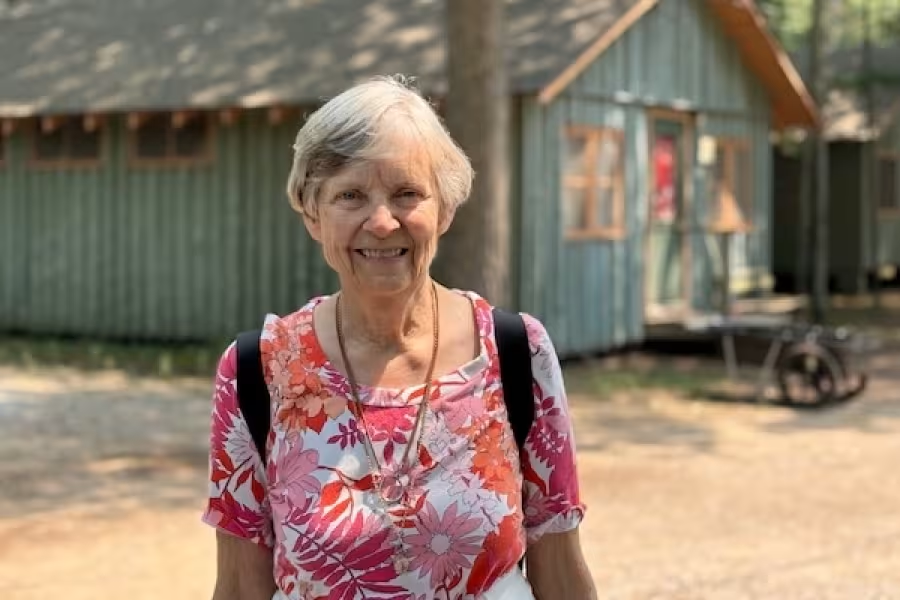
Interlochen Affiliation: IAC/NMC 55
Interview Date: July 19, 2025
Ingrid Temple attended National Music Camp for one summer, studying violin, dance, and singing in the chorus.
This oral history is provided free by the Archives of the Interlochen Center for the Arts (ARTICA). It has been accepted for inclusion in Interlochen’s audio archive by an authorized administrator of Interlochen Center for the Arts. For more information, please contact archives@interlochen.org.
ELIZABETH FLOOD 0:00
Today is July 19, 2025, and this is an oral history interview with Ingrid Temple conducted by Elizabeth Flood on the campus of Interlochen Center for the Arts. Thank you so much for coming in this morning to speak with me.
INGRID MALM TEMPLE 0:13
You're welcome.
ELIZABETH FLOOD 0:14
Please tell us your name, your connection to Interlochen, and the years that you attended.
INGRID MALM TEMPLE 0:20
Okay. My name is Ingrid Malm Temple. I came as Ingrid Malm in 1955 to the High School division. I came from Salt Lake City, Utah.
ELIZABETH FLOOD 0:33
How did you learn about Interlochen?
INGRID MALM TEMPLE 0:35
My uncle and his family lived in Glen Ellyn, Illinois, and they sent their children to Interlochen. And so he told my dad, his brother, who then decided to send my sister and me. She was three years older than I was and came in '52, and then I followed in '55.
ELIZABETH FLOOD 0:56
Wow. Did you hear stories about Interlochen from your sister before coming?
INGRID MALM TEMPLE 1:00
I did, and she was in the Intermediate division. She was the first chair flutist. She was a much better musician than I was, but she had such a good time that I was very eager to come when it was my turn.
ELIZABETH FLOOD 1:16
And you told me a little bit about this yesterday, but how did you get here?
INGRID MALM TEMPLE 1:20
Oh. I lived in Salt Lake City, so my parents took me down to the train depot, and I boarded the California Zephyr and rode through the night into Denver, which I got to in the morning. I got off in the terminal and walked around a little while, and then got back on the train, thank goodness. And then rode to Chicago. My aunt lived in Glen Ellyn. She picked me up. She took me from the track that I got off of in Union Station to the train that was coming to Interlochen with my trunk, which I think must have been loaded by somebody else, and my suitcase. And then I took the train in from Chicago into Interlochen.
ELIZABETH FLOOD 2:04
Wow.
INGRID MALM TEMPLE 2:05
Yeah.
ELIZABETH FLOOD 2:05
It was quite a journey.
INGRID MALM TEMPLE 2:06
It was, and it was my first time on a train. My first time ever being apart from my family. But my older sister had done it. I knew I could do it, and I was eager, very eager, to get to Interlochen. So it was all good.
ELIZABETH FLOOD 2:20
Could you tell me about some of the memorable people that you met while you were here at Interlochen? Who were some of the names?
INGRID MALM TEMPLE 2:28
My cabin mates are the ones that really come forth. My cabin counselor was from Michigan State, as I recall, and we called her Izzy. My best friends were Carol Seelig, who was from Highland Park, Illinois. Judy Ornduff, she was from Terre Haute, Indiana, which, of course, I was from Utah at that point. Bonnie Wilson, who was a dance major from Wisconsin. Her parents owned a restaurant, and she told us it was a state law in Wisconsin to serve cheese every time you served apple pie. I don't know if that's true, but I have never forgotten that Bonnie Wilson told me that at Interlochen. Funny things that you pick up along the way. Those three probably were my best friends. I'll probably think of some others, but those three were my best friends.
ELIZABETH FLOOD 3:21
Do you remember what y'all did together here at Interlochen, or some of the time that you spent together?
INGRID MALM TEMPLE 3:26
Well we were in a cabin with, I think sixteen, there were sixteen of us in the cabin, and we had Reveille that woke us up. It was a senior high trumpeter who would come and stand outside High School girls gate and play Reveille. And then we'd all slowly wake up. We were in bunks, I was on the top bunk I remember. We would get dressed and wander down to the dining hall, which I believe is the same dining hall here now, and eat breakfast. And then I think our first rehearsal was, in my case, High School orchestra, which was at nine or nine-thirty. And we met in The Bowl and practiced for, I think, an hour and a half. And if there was a guest conductor, the local conductor would get us started, and then if the guest was coming that week, he would come and finish up the rehearsal. After that, we'd have a little break, and then the strings would have private rehearsal time to work on those hard parts. It was so over my head. I had not played anything by Lohengrin, which is just total runs up and down the scale high on the violin. It was well beyond my capacity. I learned, if you want to know, I learned to play like the first note of the run because I was just awful playing all those other notes. So I would play the first note and then just run my finger up, but I wouldn't make any sound because I was definitely dragging down the violin section. So it was so far above me, which- There were no auditions to get here. I don't even know. I've always thought maybe they asked for what music I was playing at the time, but I kind of doubt it. I don't know. I think they were excited to have someone from Utah, probably. But anyway, I faked my way through an awful lot of the orchestra part. I was not up to the standards. And then we would have practice time in the practice cabins, which I did not make use of very much, I have to confess. Well, we went to the dining room, yeah, and we would drink Cokes and hang out there, which was all new to me, because my family didn't have Cokes in the fridge and stuff like that. So I gained weight at Interlochen, for sure. But we did have other classes, and of course the dancer was off in another whole world as far as I was concerned, Bonnie from Wisconsin, you know, she was doing her thing, and the band person was having band rehearsals, but we would get together. Do you want me to talk about the lake and the swimming?
ELIZABETH FLOOD 6:05
Oh, yes, please.
INGRID MALM TEMPLE 6:05
So we were all required, I think, in my mind as I remember, we were all required to show that we could swim to an island or to a place out in the middle of the lake. And I hated swimming in the lake. I hated the way it felt on my feet. It seemed as though I had my menstrual period for eight weeks that summer. And they never challenged me, but in my memory, which may not be accurate, but we would have to report to the lake to do these swimming trials to show that we could swim, and I would say I'm having my period. And so they would excuse me. And I did that for eight weeks. So either they just didn't care or it was a different counselor every week, probably. But anyway, I could just go back to the cabin, take my suit off, and go through the rest of the week. I don't think I was ever in the lake. Which I didn't want to be, but, you know, I came from Salt Lake City, where the water was salty in the lake, so I just had a negative feeling toward the lake. I think I got away with that for eight weeks.
ELIZABETH FLOOD 7:11
I was going to ask you about the twenty-minute challenge, which I think was the test that they were doing at that time.
INGRID MALM TEMPLE 7:17
Oh, you had to stay afloat. No, never did it. So it probably wasn't swimming out to something. It was more just being able to dog paddle.
ELIZABETH FLOOD 7:23
Yeah, someone told me yesterday that the reason they did it was you can get anywhere on a boat in twenty minutes in the lake, so if the students could float for twenty minutes, then they would be okay.
INGRID MALM TEMPLE 7:32
Yeah, I got out of that apparently.
ELIZABETH FLOOD 7:35
Were the challenges happening when you were here?
INGRID MALM TEMPLE 7:37
Oh, yes.
ELIZABETH FLOOD 7:38
What was your experience of challenges?
INGRID MALM TEMPLE 7:40
I think we called it bloody- would it have been Monday? Bloody Tuesday? I mean, we knew the music a little bit before the challenges started. They would spot me as being not one of the strongest violins, and so then they would say, "I challenge Ingrid on stand such and such." In my mind that was what happened. And then we would go off somewhere, and that person would play, and I would play, and then the judge would say, "All right, Ingrid, you're down one chair." Usually. I think there were eight stands in the broadcast orchestra and maybe fifteen stands in all, in the first violin section. That one summer, my dad came to visit, was the only time that I actually made the eighth stand, the broadcast orchestra. He didn't realize that that was the one and only time I did it. I probably told him eventually, but anyway, so he was very proud to see me up there for when they broadcast over the radio. I was up there on the eighth stand, which was the only time I must have put forth the effort, you know, to do that. But yeah, so I was near the end of the violin section, and those fast runs that I was telling you about, I would basically play the first note so that I didn't make a mess, and-
ELIZABETH FLOOD 9:01
It's a good strategy.
INGRID MALM TEMPLE 9:02
Well, I'm sure the conductor was happy because, you know, it's funny, even today, when I hear some of the violins going [squeaking sounds] not quite right, I think, oh, some of those should just sit that out. Which is what my gut told me to do.
ELIZABETH FLOOD 9:15
Good advice.
INGRID MALM TEMPLE 9:18
So I'm not the stellar musician person that might be coming to Interlochen, but.
ELIZABETH FLOOD 9:25
You had an ear. You were right.
INGRID MALM TEMPLE 9:26
Oh, I had a very good ear. That's why I was playing violin, yeah, but that was- I didn't work that hard.
ELIZABETH FLOOD 9:33
Where were some of the places that you wanted to come back to on this visit?
INGRID MALM TEMPLE 9:37
Oh, can you girls...
INGRID'S DAUGHTERS 9:38
Rehearsals in The Bowl.
INGRID MALM TEMPLE 9:39
Yeah, I'm enjoying the rehearsals a lot, and I love sitting in The Bowl now. But as far as being a camper, I think I would actually do some of that when I was a camper too. Watch rehearsals of things, watch the play rehearsals. I didn't really have anybody in theatre, but it was fun to watch that. And with Bonnie in the dance, I learned more about dance that summer because my friend Bonnie was doing that. I woke up this morning and I was thinking about this interview, and I thought, really, I have very fond memories of singing in the High School, choir, chorus, whatever we were called. Maynard Klein and Ken Jewell were the directors. One was from University of Michigan and one was from Michigan State, and they were tag teaming. I mean, the both of them were directing this High School choir, and we were good. I mean, you know, the tenors, all, everybody was really good. I was an alto. I was a good alto. I didn't have a solo voice, but we were excellent. And I loved being in that choir, probably the very most of anything. And those two men just made it so much fun. They would kid, they would joke, but boy, did we sound really good. I have a CD that my husband bought me from Interlochen that has the choir singing on it, and I can still sing along with that because that was a huge part for me, much more than the orchestra ever was for me. Smaller ensemble, you know, it was just excellent, and I felt really joyful. I think it was at 11 every day. I loved going, absolutely. And we sang on Sunday for a non-denominational church service. So we did it every Sunday, not just for concerts. And that was fun, too.
INGRID'S DAUGHTERS 11:30
You had funny nicknames for the directors-
INGRID MALM TEMPLE 11:34
Oh, Uncle Ken and Uncle Maynard, yeah. And they were friends, I mean, and they were both from Michigan, different universities, but they were very much friends together too. It was fun, yeah, Uncle Ken and Uncle Maynard. Yeah, they were so much fun.
ELIZABETH FLOOD 11:52
How many people about? Were there a lot of people?
INGRID MALM TEMPLE 11:55
Yes, it was a good size ensemble. We were good. And, of course, there were choral majors, you know, like I majored in the orchestra. There were definitely people who were there for their singing.
ELIZABETH FLOOD 12:09
What made you pick to be in choir? How did you get to choir?
INGRID MALM TEMPLE 12:13
I've always loved singing. My family's pretty musical, and so we've just sung a lot. I mean, I realized last night or this morning when I woke up, that was my happy, happy place at Interlochen.
INGRID'S DAUGHTERS 12:23
Requiem.
INGRID MALM TEMPLE 12:25
Yeah, we sang Mozart's complete Requiem during the course of eight weeks. So probably the eighth week we performed Mozart's Requiem, which I think when I came I wasn't even sure what a requiem was. And I learned Latin. I learned how to pronounce all the words, and I definitely knew what a requiem was. And when I hear anyone performing the Mozart Requiem, in fact, I even have a CD of it, I can sing along. I still love that music. It was so beautiful, and I would not have ever learned to appreciate that if I hadn't had that summer with Uncle Maynard and Uncle Ken, you know, teaching us that. And the ways they explained and explored things was just the best for me. I grew up in Salt Lake City, where the Mormon Tabernacle Choir was a big thing. I don't know if you know about that, but the Mormons came to Salt Lake City. They were pioneers, and they landed there, and they built this tabernacle, and they have a very famous choir that's on television and radio every Sunday, I think. I was not Mormon, but I grew up there, so choir music, I think, was important to me. To my mother's dying day. She listened to the Mormon Tabernacle Choir on Sunday morning. You know, that was just a part of her life even though she was not Mormon.
ELIZABETH FLOOD 13:50
Could you tell me anything about the services, the Sunday services?
INGRID MALM TEMPLE 13:55
Oh yeah. I think they, would they have been in The Bowl?
ELIZABETH FLOOD 13:58
I think people are saying that they were in Kresge.
INGRID MALM TEMPLE 14:01
I don't have a sense of where it was, but it was fairly large. And I think a fair number of campers came to it. For one thing, we were, a lot of us were singing. Probably there was some musical accompaniment, you know, I think the orchestra probably played, the band probably played. So that would pack the audience a little bit. Parents came. It was totally non-denominational, but it was not Catholic, it was Protestant. So I think the Catholics had a mass somewhere or they went off grounds to have their Sunday Mass, but people who were not Catholic could all join together, in fact, I think my Jewish friend, Carol Seelig, came. It was just kind of a Sunday morning thing before lunch. Joe Maddy gave a sermon one time, I mean different people at the Camp spoke to us, and then, of course, the choir sang. And it was church. It was just like the church that I had been attending as a Protestant in Utah. We were here eight weeks, and so eight Sundays this went on, and I just didn't ever want to miss. I was afraid, I didn't want to miss out. FOMO is what they say now, Fear Of Missing Out. I was one of those kids. I came to almost everything that was available because I didn't want to miss out, and I knew when I got home it would be none of that, so.
ELIZABETH FLOOD 15:29
Did you ever meet Joe Maddy?
INGRID MALM TEMPLE 15:30
Yes. I mean, I think I shook his hand. As I say, he was alive and well and mingling, and he gave the welcome. I remember when we all came for that first, we were in The Bowl, and we were all there, and people were on the stage. He spoke to all of us and gave us the whole Interlochen philosophy. I mean, you know, just welcoming us and all. It was very impressive. And I don't know if we even sat as a cabin yet, I was pretty much just me, you know, and then over the time, then our cabin would always sit together and do things together, but I doubt we were at that point right away. But yeah, he made a huge impression. He, of course, spoke at that last one too, and you know about that [laughs]. We all cry, and it's just so emotional because, I mean, the train- I just left, you know, just got on that train and left that night, I think after the Les Preludes production, it was goodbye, and here's your suitcase, and it's pretty, you know, it was done.
ELIZABETH FLOOD 16:35
Did you stay in touch with anyone from Interlochen?
INGRID MALM TEMPLE 16:38
I did for a brief time, Harriet and Carol Seelig mostly. Judy Ornduff a little bit, but we really tapered off. And of course, the boys maybe one time, and then I was, you know, often doing other things. But yeah, I have some letters, but sadly I didn't bring them or keep them.
ELIZABETH FLOOD 16:57
Actually, this is my first summer here. This is my first time at Interlochen.
INGRID MALM TEMPLE 17:00
Oh, you've got a lot to learn.
ELIZABETH FLOOD 17:02
So I've never seen Les Préludes. I've been hearing about. All of my knowledge has been to me-
INGRID MALM TEMPLE 17:09
From us.
ELIZABETH FLOOD 17:10
Yeah, you and from the people I'm speaking to.
INGRID MALM TEMPLE 17:11
Well, I've been telling my kids about it, but it's the culmination of the whole summer, and it's done the same way every last day, and we build up to it through eight weeks of activities and learning and then you're just gone. I mean, it was just, I think the train taking me down to Chicago was- I was just leaving. I'm not sure if it was Sunday afternoon. Is it always on Sunday? I don't know. You don't know either. And you know nobody here to pick me up or anything. I just took the train to Chicago, and then I think my aunt picked me up because- This is interesting. Probably everybody has this story. I could not zip up my skirt that I came in, which had been put away in a suitcase for eight weeks. So I had the skirt unzipped. I kind of tied a jacket around my waist to cover up that open, gaping hole. And so my aunt nicely took me to Marshall Fields and bought me a skirt so that I could ride on the train back to Utah. Few extra pounds in the wrong place. And, you know, fifteen, I was still kind of a developing girl. Amazingly, I had my period every week.
ELIZABETH FLOOD 18:21
A phenomenon.
INGRID MALM TEMPLE 18:21
It was a real phenomenon. I think I should have had blood transfusions or something [laughs]. But anyway, I mean, I was, I hadn't gone through whole puberty yet I don't think so. I think the main difference for me was eating dessert because I don't think we ate dessert at home very much. But no, it was meat and potatoes and cafeteria style. I mean, we would walk through, I believe in the dining room, we certainly weren't served. We would walk through and choose what we were going to eat. And, you know, over the eight weeks time, I kind of figured out I shouldn't be eating all the chocolate in the place. But there was nobody looking over my shoulder about what I ate, you know, no one was saying, "Are you eating enough vegetables?" I mean, it was pretty much free range, as I think. It was our social time during the break in lunch, and then depending on whether we had to be nervous about the concert at night or whether we were just going to a concert. We always went to some kind of concert at night. So dinner could be fun or could be, "Oh, my stomach is churning. I can't really eat." But, you know, the food was not impressive one way or the other, except I do remember eating a lot of pie.
ELIZABETH FLOOD 19:46
How did your time at Interlochen impact the rest of your life?
INGRID MALM TEMPLE 19:52
Oh man, I'm so aware that it did. It showed me many things about myself. That I could go off by myself, take a train for 28 hours, or however long that ride was. It was, you know, overnight and into the next day. I could get on the train on time and get off the train at the right place. Because I was the baby in the family. I was youngest of three girls, so I always had somebody grabbing my hand, and there I was. I wasn't scared. I was excited and happy, and I learned that I could do it. I mean, my parents took us to the symphony when I was maybe seven or eight, we started going to the Utah Symphony, which performed in the Mormon Tabernacle. So we would be up on the balcony, the three of us and my parents would be downstairs looking up at us and glaring if we were giggling or wiggling or something. But, I mean, I grew up with classical music. My parents played it on the radio and all, but coming here, I guess I claimed it, you know. And so to this day, when I'm at a concert- I now live in the Chicago area, and when the Chicago Symphony is playing, I'll think I played that! That was from Interlochen. I remember that! And it does make me love classical music and understand, like even the oratorios, which I hated, oratorios which are singing dramas, you know, in a way, because of being here, I now know what they are all about. Yeah, it's definitely broadened my appreciation of music. My parents kind of knew that. I don't think they ever thought I was going to be Jascha Heifetz or something on the violin, but I think they knew what it would give me as far as appreciation for music, and I think that's what they wanted, and that's what I got. Oh, yeah, and I still sing in a choir. I live in a retirement place now, and the Monarch Singers. I just sing out of pure joy and love. And I still sing alto. I can still do it on pitch. So yeah, it stayed with me long after violin was gone. Yeah, so it's impacted me that way too.
INGRID MALM TEMPLE 19:52
Do you have any advice for students who are coming here for their first time? Either current students or students who come in the future? What advice would you give them as someone who also spent time here?
INGRID MALM TEMPLE 22:12
First, congratulations for coming because it's a big step. And it's not eight weeks anymore, I understand, but still, you're giving up your summer. So good for you for coming. Just do it all if you can. Except the lake, you don't have to do the lake. I love to go to rehearsals, and I always did, you know, go to the rehearsal, see what's going on, try everything, if you're allowed. I mean, I think I had two weeks of dance in those eight weeks. I know! Only time in my life I had dance. I'm pretty sure we all had dance. We all had singing. Don't think I had to take band because I was in orchestra, but yeah, we had to experience. We did art, not drama so much, but I'll bet there's drama now, too. I bet there's a lot of drama. And TV and radio all those things. Do it all.
ELIZABETH FLOOD 23:11
This is a broad question as well, but why does art matter today? Why does art matter in this world?
INGRID MALM TEMPLE 23:19
Well, it's the value, I think. It's the values that we have. The people involved in art are the people who are maintaining our world to be a safe and beautiful place. It's so awful when I hear the news now, and to think that Interlochen is teaching these kids every day to appreciate art and to participate and know art. I mean, that's just a whole dimension that we need very badly in our world.
ELIZABETH FLOOD 23:52
So this whole project is for the centennial anniversary-
INGRID MALM TEMPLE 23:55
Oh, wonderful.
ELIZABETH FLOOD 23:56
So in 2028 it'll be the hundred-year commemoration of Interlochen beginning, and so what do you hope for Interlochen in the next hundred years?
INGRID MALM TEMPLE 24:06
Wow.
ELIZABETH FLOOD 24:07
I'm asking both as what histories and traditions should we carry into the future? And what are, if anything, that you feel that this place needs in the next hundred years?
INGRID MALM TEMPLE 24:19
I'll speak more to the traditions, I think, I mean, it'll be so different. It's already very different from 1955, but just the valuing of the role that art and culture plays in our world. Promoting education along those lines, so that these people who have the potential to be artists, in many ways, clay or dance or whatever is in their hearts, can be fed and nurtured and encouraged, because what a world it would be without any of that. And I just don't even want to think about what the world might be like in that many years. So I think art will keep us on track. Connecting with other countries too. When I was at Interlochen, I don't know that there were foreign students here. There probably were, but they weren't in my cabin, so I didn't ever really get to meet them particularly, but now the cross-global education that kids are offered. That's fabulous, and we need to appreciate people from all walks of life and all cultures, and understand their contributions to the world.
INGRID'S DAUGHTERS 25:36
We're lucky to have her as Mom.
ELIZABETH FLOOD 25:37
Yeah, that's so beautiful. Do you have any other stories or anything else that you'd like to share before we close?
INGRID'S DAUGHTERS 25:44
You have the funny French kiss story, but that's kind of personal. That's less Interlochen-related.
INGRID MALM TEMPLE 25:50
Somebody called it the gate. Are you at the shake gate or the date gate?
ELIZABETH FLOOD 25:50
I've heard of this.
INGRID MALM TEMPLE 25:51
Do you want to hear a story?
ELIZABETH FLOOD 25:57
I would love to hear this story.
INGRID MALM TEMPLE 25:59
Well, we didn't call it the date gate or the shake gate back in my time. But you know, there were certainly boys that you just shook hands with or waved goodbye to, or whatever. But there was this boy from New York. He said to me, "Do you know how to French kiss?" And I, being a stupid girl from Salt Lake City thought that it was when the boy held you back and you dipped back kind of in a swan-like- I thought that was French kissing. So this boy from New York City sticks his tongue in my mouth. He also had braces, and it was horrible. And I just remember just slamming my mouth shut and pushing him away, and I learned a lot that night at the, I guess, the date gate, part of that gate, that no, I don't French kiss, now that I know what it is! I mean, he was polite, he asked me. And I really didn't always try to find boys after that. That kind of cured me. I kept my girlfriends more.
ELIZABETH FLOOD 27:07
Thank you very much for speaking with me today.
INGRID MALM TEMPLE 27:10
You're welcome. I've enjoyed my time here.
ELIZABETH FLOOD 27:12
What a pleasure. So thank you.
INGRID MALM TEMPLE 27:13
Well, thank you.
Copyright
Copyright to the audio resource and its transcript is held by the Archives of Interlochen Center for the Arts (ARTICA) and is provided here for educational purposes only. It may not be reproduced or distributed in any other format without written permission