
Oral History Interview with Eileen Bora
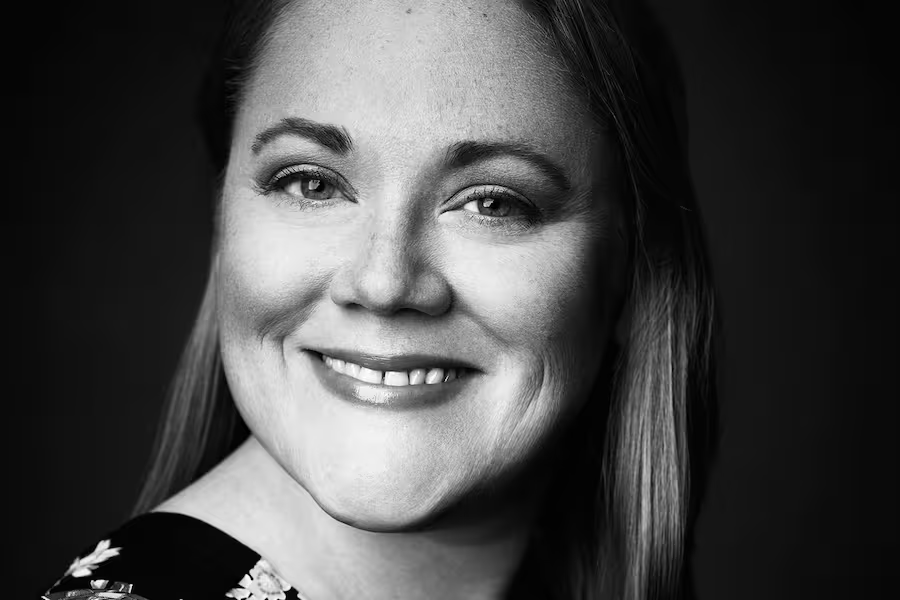
Interlochen Affiliation: AS 94-95 | IAC 96 | IAA 97-99 | IAC St 00-01
Interview Date: July 28, 2024
Eileen Bora attended the National Music Camp in the mid-nineties, studying voice. She continued her voice studies at Interlochen Arts Academy, graduating in 1998, and continued for a year as a post-graduate. She has remained connected to Interlochen as an engagement volunteer and member of the Engagement Council for six years.
This oral history is provided free by the Archives of the Interlochen Center for the Arts (ARTICA). It has been accepted for inclusion in Interlochen’s audio archive by an authorized administrator of Interlochen Center for the Arts. For more information, please contact archives@interlochen.org.
00:00:00 BRAD BAILEY
Today's July 28th, 2024. This is Brad Bailey here on the campus of the Interlochen Center for the Arts, conducting an oral history with
00:00:07 EILEEN BORA
Eileen Marie Bora.
00:00:09 BRAD BAILEY
Nice to meet you, Eileen.
00:00:11 EILEEN BORA
It's nice to meet you too, Brad.
00:00:13 BRAD BAILEY
So can you tell me your name again and spell it for me?
00:00:15 EILEEN BORA
It's Eileen, E i l e e n, Marie, M a r i e, Bora, B as in boy, o r a.
00:00:22 BRAD BAILEY
All right. Wonderful. Where were you born? And what was your childhood like?
00:00:24 EILEEN BORA
I was born actually in Pontiac, Michigan. I spent some time in Garden City, Michigan, and most of my youth was in Troy, Michigan. My childhood was happy. We struggled financially a bit when we were young, but as we got older and we moved to Troy, there were a lot more opportunities, and the Troy School District really provided a really well balanced education as far as math, science, and the arts, and it really helped foster me as a human and provided me opportunities to grow. I started playing flute when I was in elementary school, about eight years old, and I continued through middle school with that. And then when I was in middle school, that's when the show choir teacher was like, "Hey, you know, you've got a- you got a voice in you, and you should audition for Michigan State Honors Choir with these other folks", and I did, and that's sort of what led me to Interlochen, actually.
00:01:19 BRAD BAILEY
Wonderful. Wonderful. So let's first talk, though, before you got to Interlochen, what was your childhood like again? I mean, what- would your parents have any experience with music? Tell me about that.
00:01:29 EILEEN BORA
Both my parents are extremely strong music advocates and supporters. We always had music playing in the home. My father listened primarily to jazz, classic rock and folk music, and my mom listened to classical primarily. And so we went to the Detroit Symphony with them growing up. But we always had a musical home. My dad played guitar in the home. My brother learned to play guitar. We always sang along with the radio. We just had a very sort of musically accepting family. I wouldn't say anybody's- nobody was a trained professional. My grandparents all sang or played guitar. It was just something that we did kind of for family events and stuff. We'd sit around and my grandpa would play guitar and people would sing, and then my dad started doing it, and so.
00:02:13 BRAD BAILEY
And so what was your education in music like in school before you arrived to Interlochen?
00:02:18 EILEEN BORA
Well, we had, you know, general music and elementary school. I was in Montessori before I went to public school when I was in preschool, and that was highly music focused. You know, that's a well-balanced creation of human, independent human. But I was always singing and making up songs. So I had, you know, general music. And then I was in band in elementary school, and then I was in band in middle school, and I also was in show choir in middle school. And then when I was in high school, I was also in show choir, but I stopped doing the band because of scheduling purposes, and we couldn't afford me taking two private lessons. It was like flute or voice because I had gotten to that level where the flute lessons were going to be a lot more expensive, and I really at that point had transitioned more to voice because I had been to my first opera and things like that, and I had come here.
00:03:06 BRAD BAILEY
Tell me about your first opera.
00:03:07 EILEEN BORA
So I had heard opera, and I liked it, but I was more in musical theater kind of zone in middle school, as most middle schoolers are. But then we went to see Barbiere di Siviglia at Detroit Opera, which is Michigan Opera Theater now, and I thought it was great. You know, I knew a lot of the music from like Looney Tunes, which seemed silly, but I really liked it. And then we went back and we saw La Boheme and I said, that's what I want to do. I told my mom right after I said, "That is what I want to do with my life," and I think I was 14. So this place introduced me to the idea of opera and operetta - Interlochen - and then I went to see my first live operas, and I was like, it was a transformational..
00:03:49 BRAD BAILEY
Was that here or after you got- left Interlochen?
00:03:52 EILEEN BORA
I came to Interlochen first. So as I had mentioned before, I went in Michigan State Honors Choir as a middle schooler. And back then there was a program here called the All-State program, which was-
00:04:03 BRAD BAILEY
What year was this?
00:04:04 EILEEN BORA
That was 1993, like end of '93, beginning of '94, and University of Michigan had partnered with Interlochen for a long time, and there was an All-State program. And if you made it into the honors choir, then you could come to Interlochen All-State program without auditioning. You still had to pay, but it was a two week program, it was like an intensive. If you were in band, you were in the band here. If you were in the choir, you were in the choir here. And so orchestra and so on. So it was just a music program, but it was two weeks. And it was funny because my friend had come the year before in '93, and she was like, Oh, I didn't care for it. And it's so rigid and it's music all the time. And I was like, that sounds great. I don't know why you don't like it. And my mom said, "You can go to Interlochen? Oh my gosh, you know, I grew up in Kansas listening to Interlochen on public radio. And my gosh, I never thought that that could be something that, you know, a child of mine could do." And "oh my gosh, yes, you have to go."So I came in the summer of '94 for my first two week session, and I just- I bought in. I was totally sold, I loved it, I mean, I'm still friends with a lot of the friends that I had back then. I was like 13, you know, and we're still friends to this day. I mean, thankfully social media helps with that. But then I came back for another session of All-State in '95 for the two weeks, and I was awarded by Ed Downing, who wasn't president at the time, but he was kind of the head of the All-State program, and he awarded me a half scholarship to come to the eight week program as a high schooler. So I did that in the summer of '96. So those were my first three years. And within that time, that's also when I first saw my opera- my first opera performances and stuff. So they had the operetta program when I was here in the summer of '96 still. So I participated in the operetta program and the Gilbert and Sullivan, and it was just-
00:05:53 BRAD BAILEY
And how old were you in those summers? From 13- '93 to '96?
00:05:57 EILEEN BORA
So '94. Summer of '94. I was 14 going on 15, then 15 going on 16 and then 16 going on 17.
00:06:06 BRAD BAILEY
Got it, got it. And so were those the only summers you were here?
00:06:09 EILEEN BORA
Those were the only summers I was here. And then the eight weeks during- during the eight week summer, my parents came up to visit.
00:06:15 BRAD BAILEY
What year was that?
00:06:15 EILEEN BORA
'96?
00:06:16 BRAD BAILEY
96.
00:06:16 EILEEN BORA
My parents came up to visit for a concert, and I said, "I want to go to the academy. Please, please and thank you." And my dad just looked at me like I had hands growing out of my head. Like what? I- no, you can't. You can't move away from home yet you're only 16, you know?
00:06:32 BRAD BAILEY
Yeah.
00:06:32 EILEEN BORA
And my mom was like, well, maybe, you know, let's talk about it some more and we'll think about it. And so that would have been for my junior year and it just was too rushed. It didn't seem feasible at the time because '96 was the summer between my sophomore year and my junior year, so I worked on them that whole fall.
00:06:49 BRAD BAILEY
Yeah.
00:06:50 EILEEN BORA
And with the help of Janet Morris, in the admissions office-
00:06:52 BRAD BAILEY
Oh, wow. Okay.
00:06:53 EILEEN BORA
We kind of got them both on board, and I came here for my senior year, which was the year of '97-'98. So the class of '98.
00:07:00 BRAD BAILEY
Yes.
00:07:00 EILEEN BORA
And I came for voice and studied with Nicole Philibosian, amongst other amazing teachers here. And then I just didn't feel cooked. You know, I didn't feel ready. I needed those two years here. So I applied to be a postgraduate and I was accepted. So I did a post-grad year in '98-'99 and graduated with that in '99.
00:07:21 BRAD BAILEY
Wow. And so that's almost like a- almost a decade long, you know, relationship with Interlochen.
00:07:26 EILEEN BORA
Yeah.
00:07:26 BRAD BAILEY
And so, tell me about what that first summer was like. Who did you study with? And if you could sort of tell me the evolution of your studying from that '94 to '99? Who did you study with and how did you evolve as a musician?
00:07:39 EILEEN BORA
That's a great question. So in '94 and '95, we didn't have private lessons. It was just a choral experience and it was so long ago. I'd have to go back and look and see who the conductors were that we worked with.
00:07:51 BRAD BAILEY
Who is your direct -? And this was voice, right?
00:07:53 EILEEN BORA
Yeah, but it was choral.
00:07:55 BRAD BAILEY
Okay.
00:07:55 EILEEN BORA
So it was just all group stuff. But we did eurhythmics classes. We had a lot of classes, like group classes. So did Eurhythmics, we did choral singing. Hugh Floyd was conductor during that time, and he was also here during the eight-week program when I was here as a camper for the summer of '96, so I still got to work with him as he transitioned out of All-State. But we worked with a couple different conductors, but it was such a short amount of time to it was only two weeks, so it felt like a whirlwind. And, you know, at that time you're not really absorbing like, oh my gosh, these are the people I'm working with. So I was really just studying privately at home. My first voice teacher's name was Dina, and I, forgive me, but I forgot her last name. Then my second voice teacher was Judy Permin, and her husband, Bill Permin was sort of my acting coach, and that's where I primarily studied with in high school before I came here, and she really helped me prep to get an audition ready to come here. And then while I was here, my primary vocal instructor was Nicole Philibosian Gentry. And you know, we had classes with Ron Gentry, her husband, and then I had opera workshop classes with Mr. Nor- Jeffrey Norris. So those were my primary contacts for vocal learning. I also took dance here. I loved my Shakespeare class with Howard Hintze and my contemporary literature class with Gene Gaddy and Monsieur M for my French class, and Frau Barnes for my German class. You know, it's like all these teachers were so fantastic. And Elaine Broad with the Chamber Singers. And, you know, it was just like all these amazing teachers, but also professionals that really taught us how to raise the bar and to be supportive of our colleagues. And even though we're competing directly against each other, you can still be supportive and an uplifting and persistent right? Like it's okay you didn't get it this time, but keep trying, you know, keep going for it. If this is you, this is you. Like, just keep going no matter what you choose to do. I try to instill that in my students as well. You know, this may not be what you want to do for your life, but that doesn't mean you- you don't need to keep doing it. It's part of you. So you should continue doing it no matter as long as you can.
00:10:04 BRAD BAILEY
And so how about your evolution as a musician? How did that go?
00:10:08 EILEEN BORA
Well, after here, I went to Westminster Choir College for my bachelor in Princeton, New Jersey. I was a double major in music education.
00:10:16 BRAD BAILEY
WCC right?
00:10:17 EILEEN BORA
WCC!
00:10:20 BRAD BAILEY
I went to Princeton.
00:10:20 EILEEN BORA
Oh okay, neighbors. Yeah, yeah. And we could take classes at Princeton. And I swam in the pool there and used the library.
00:10:27 BRAD BAILEY
Yeah.
00:10:28 EILEEN BORA
Why not? Right. Yeah. Firestone library, beautiful library. So we had such a small campus, so I tried to use my resources well. But, yeah, I loved my time at Westminster. I was a double major in music education and vocal performance until my senior year, where I decided to just focus on the performance aspect of things because I had studied in Italy a couple of summers through the Westminster-Swarthmore- they had a Florence voice program, and we studied with some singers there and sang and learned the culture and the language.
00:10:58 BRAD BAILEY
Gorgeous city.
00:10:59 EILEEN BORA
Beautiful. I loved it, and that was another transformative moment in my life.
00:11:03 BRAD BAILEY
Oh, why?
00:11:04 EILEEN BORA
Just seeing how much opera and music was an innate part of Italian culture and was so respected everywhere we went, you know, we were treated like royalty and we were just college students. But, you know, we would sing a little bit at the restaurant and we'd get free meal and wine and people would, oh, sing this, so sing this. And it was just, it didn't matter that we weren't famous. It was just like, they just loved that we could make music. And it was like, wow, it really is appreciated. It's not a dying art, you know, because for a time, you know, people were saying, oh, it's such a dying art. It's a dying art. I don't think so. And I still don't think so. I tried not to think so back then, but that was a moment where I was like, this isn't a dying art. This is still part of people's lives. It's important. But before I went to Italy, I came back to Interlochen, and I worked in what was then High School Girls, which is now High School Lakeside. I was an administrative staff member as a unit leader for two summers in 2000 and 2001.
00:12:03 BRAD BAILEY
So it was a year after you graduated and then you came back the following year.
00:12:05 EILEEN BORA
Yeah, I came back the following summer. I was just going to be a counselor, but one of the unit leaders was not able to attend, and I knew the director and assistant directors of the high school division and the girls division, and they asked me if I would be willing to give being a unit leader a try. And I guess they saw that I was responsible and I was a little bit older than the other counselors at that point. So I loved it.
00:12:28 BRAD BAILEY
Only a smidge.
00:12:29 EILEEN BORA
Yeah, just a smidge. But, you know, because I had done the postgraduate year, I wasn't right out of, you know what I mean? I was a little older already, so I did that in 2000 and 2001 and that was amazing. Like again, friendships, bonds formed. I'm still friends with some of the kids from the honors cabin that I was like in charge of as their unit leader. We have a group on Facebook. And, you know, it's amazing how this place bonds people at such a deep level. So I did that for those two summers, and then I for the second two summers I went or one of the summers was I went right from Italy to here. And then the following summer I went to Italy again.
00:13:07 BRAD BAILEY
So in 2001 or 2-.
00:13:08 EILEEN BORA
2001 and then 2000- 2002, I went to Italy again.
00:13:12 BRAD BAILEY
You were at WCC during September 11th, I guess. Yes. Got it. Got it.
00:13:15 EILEEN BORA
Yeah. I was in my keyboard harmony class. Yeah, I was in my keyboard harmony class and somebody ran in and told us and we went into Seabrook Lounge, which was one of the dorms, had a big TV. It was the only one that had a big TV.
00:13:28 BRAD BAILEY
I hear- I heard that you could even see it from Princeton, actually, from one of the rooftops.
00:13:31 EILEEN BORA
Yeah, you could see the smoke. And I was supposed to be going to the World Trade Center that day for a conference with some of my friends, and we decided not to go, which I'm glad we did, obviously. But, you know, there's so many people that we knew that we were worried about in New York that were there. So, but Westminster showed the power of music again, like Interlochen does. We all came together as a community. All the faculty and staff and students gathered in the playhouse, which was the big performance space. And it's not very big, but it was the big one on campus, and we sang together and cried. And I'm getting emotional. But it was a scary day. I'm sure you remember. And yeah, it was just a strange- they canceled classes, obviously, for the day, and we all just communed and told stories about our families, and people tried to get ahold of their families. And it was just- it was a it showed the power of music because it was really bonding. And it's a memory that will stay in my head forever.
00:14:31 BRAD BAILEY
Well, of course, I think it rained that night.
00:14:33 EILEEN BORA
It did, yeah. Yeah. And we had we had candles out in front of all of our houses and dorms and everything, and. Yeah. And then the rain coming was just.
00:14:43 BRAD BAILEY
That was weird. Yeah. It was almost a weird purging. Yeah.
00:14:46 EILEEN BORA
Like, wash it away.
00:14:47 BRAD BAILEY
Yeah.
00:14:48 EILEEN BORA
Yeah. That was a crazy day. Yeah.
00:14:52 BRAD BAILEY
And so when you're looking back at your Interlochen experience, how did it prep you for WCC in some of your later experiences with music?
00:15:01 EILEEN BORA
Well, I will say that all of the choral works that I did here really set me up well. And my theory and sight reading and oral skills, you know, things like that really just set the bar a lot higher. I was, and I think that's one of the reasons I got in, because I became a very good sight reader through all of that. I was also in Michigan Youth Chamber Singers at Michigan- University of Michigan when I was in public school, before I came to Interlochen. Actually, I was still in it, when I came to Interlochen for my senior year. I would drive down to Ann Arbor with a couple other people that were in it up here and with Jerry Black- Dr. Jerry Blackstone. So again, high level of education, high level of music making. I had Michigan youth theory at University of Michigan as a high school student as well. So and I wouldn't I don't think I would have gotten into Michigan Youth Choir or Theory if I hadn't come to Interlochen, because I learned the skills I learned here as a camper really helped translate- well, the sight reading and, you know, watching a conductor and listening and using your own voice, not trying to diminish your own instrument for the sake of the group, but using it in conjunction with other voices, was something that I learned here, that I was taught some in my public school because I had great music directors. Dan Stevens was my conductor in high school and Maryann Williams in middle school, But different level here. Different bar. So just the listening and the understanding of how to pay attention to what you're doing with your body and how you're using your instrument in conjunction with the people around you. It's a different level of like, attuned-ness in your brain, you know.
00:16:45 BRAD BAILEY
And so talk to me about some of the people you met, like friends' names or experiences that you've met over the years and people that really stick out to you as collaborators and peers.
00:16:56 EILEEN BORA
I mean, I think anybody that I came to Interlochen with, I would consider a collaborator and a peer. I would be honored to work with any of them at any point. And I would say maybe, like if you want to name drop name. When I was a camper, Rosemary Clooney came to campus to perform, and I was always such a huge fan of her singing because-
00:17:17 BRAD BAILEY
Oh wow.
00:17:17 EILEEN BORA
I really loved jazz. I still love jazz singing.
00:17:20 BRAD BAILEY
She's fantastic, yeah.
00:17:21 EILEEN BORA
And she was such a card and she just- she was just herself innately like just no qualms about being herself on stage and I, I- it made me admire her even more. And then I got to meet her after and just thank her. And, you know, she was like, just keep at it, girl. You know? And I was I was just to hear that from her. I was like, oh my gosh. Yeah. Rosemary Clooney told me to keep at it. It was really inspiring.
00:17:46 BRAD BAILEY
That- that made an impact on you later.
00:17:49 EILEEN BORA
100%.
00:17:50 BRAD BAILEY
In what way? Like how? When do you think about that experience?
00:17:52 EILEEN BORA
When I'm like, I'm not going to do this anymore. When it gets hard. I mean, being a professional musician is a hustle. You're constantly applying for auditions and then getting the audition and then having to do a callback and you're up against, you know, maybe 500 people for one spot, and it can be defeating, all that rejection. But then when you get the thing, it's like, of course, totally fulfilling and worth it. But sticking through the "no thank you", you know, like or the not hearing anything back.
00:18:22 BRAD BAILEY
Or the-
00:18:23 EILEEN BORA
Polite "no thank you", or "we don't like you for this. But you know, maybe we'll hear you again for this next year" or what, you know, just those kinds of things. Instead of being like, oh, I can't do this anymore. I hear her voice going, just keep going, girl. Just keep at it, you know? And she at the time, her voice was a little bit husky. She was older, you know, and I just was like, yeah, I'm going to just keep at it. And I had several other like- when I was in Italy, Julian Radescu was like, your time is not now. Your time is in your 40s. It's going to be hard for you to stick with it, but just keep singing and keep teaching and keep at it. And so some instruments mature at different times.
00:19:08 BRAD BAILEY
So he predicted in the 40s for you.
00:19:09 EILEEN BORA
Yeah. And he wasn't the only one. I had several coaches and teachers and they were like, this isn't your time yet. These things are going to feel hard that you're doing right now. But then when you hit your late 30s, early 40s, it's going to feel so easy and good to sing these things, and that's when you know it's your sweet spot.
00:19:28 BRAD BAILEY
Give me detail like...
00:19:29 EILEEN BORA
Well, like, Donde Lieta Usci from La Boheme, for example, Si, Mi Chiamano Mimi, or any of the Puccini, right, or Verdi or Strauss or things like that, like the bigger, fuller lyric soprano kind of repertoire. It's not for a 20 year old to sing, really. You need a rich- a richer tone, a more developed sense of how to use your breath and your resonential space and your body to sing those things and have some life experience.
00:19:58 BRAD BAILEY
That was the question I was about to ask. Not just the physical instrument..
00:20:01 EILEEN BORA
It's not. It's a mental thing too, yeah. You kind of have to see some things and experience some things to be able to play some of those roles.
00:20:08 BRAD BAILEY
And have you?
00:20:09 EILEEN BORA
And I have, I mean, who hasn't? Well, hopefully people have experienced some life by the time they're in their 40s, but some people maybe haven't. But I think most artists have experienced some stuff by the time they're in their mid 40s. But yeah, I survived leukemia and the disintegration of my joints in my 30s because of the treatment for leukemia. So now I'm disabled, which makes it harder, also, to be a performer. I can't work on raked stage, I can't wear some of the costumes because I can't move in them. So, I've sort of taken myself out of the opera performance on stage in a full performance. But I do concert work and I am a member of the Chicago Symphony Chorus, proudly, for many years, AGMA union member, and I gig around. I sing with Chicago Camerata Orchestra for the last several years, and wherever I get hired, I keep auditioning. And luckily, I'm at the point in my life where I get recommended for things like, oh, Eileen's a great sight reader. She can jump in, you know, if somebody drops out. So I get added in sometimes late last minute and they're like, can you sing alto or can you sing? So, it's not what I thought I would be doing, but I still can sing. And I've been teaching since 1999, and I have currently have 36 private students and a waitlist, and I teach voice, piano, flute, and music theory privately. And it's extremely fulfilling. And I've had maybe five people go into either music education or music, and that's okay with me. Like, I don't need everybody to be a professional musician from studying with me. I just want them to find the fulfillment of their gift and their potential and find joy in making music, whether that's professionally or just something that they carry with them later into life. And I feel like it's a really great gift that I can teach, because I've always wanted to be a teacher as well as a performer. So, you know, when I don't find the fulfillment of having that full opera experience, I still get to perform with a world renowned orchestra and amazing conductors and fellow musicians on the stage with the orchestra and chorus. So I'm a very fulfilled human, and I get to pass it along to my students. And then I also personally find fulfillment because I work as a landscape subcontractor. So I work out- Yeah. So I work outside a lot and I help people create beautiful habitats. We sort of do a lot of nature restoration projects with people's homes in the city. So urban restoration and urban gardens, edible gardens, so like organic raised bed situations. And I teach people how to build them. And I've worked with kids on the South Side of Chicago, teach them about where food comes from, how we grow food from seed and what compost is, and beneficial insects. And we built a community garden together. And, you know, I taught them what's a weed and what's not, you know, so, you know, that's another kind of fulfillment that I've always done landscaping, but it is kind of an art and it's with nature and I feel extremely bonded between the two. I find restoration in coming back to nature, and I think that's something that's also sort of magical about Interlochen, is that it's nestled in this beautiful natural setting with the lakes and the trees, and all the arts are coming out of this; dance, visual art, creative writing, film, theater, music, you know, all of that. It's so important that it's in this environment. I don't think this could exist in a city, honestly, in a big city like Chicago or New York. I mean, they have great schools, music schools and art schools, but it's different, because here there's a quietness where you're allowed to explore your artistry in such a beautiful setting. It's inspirational, really, and I think that's also sort of helps make Interlochen magic, you know?
00:24:03 BRAD BAILEY
Let's get back a little bit to that discussion of, yeah, the people you met and tell me about who they were.
00:24:08 EILEEN BORA
Sorry, I got off topic..
00:24:09 BRAD BAILEY
No, no no, no, none of it's off topic. It's all on topic, actually. So yeah, talking to you about people. People you've met here.
00:24:16 EILEEN BORA
I'm so close with so many of my classmates, it's hard to talk about because I don't. I just think of them as like, my family. They're my chosen family. People like Ken Jones Jr., and Grant Clark, and Katrina Rehwoldt and, you know, the list goes on and on and on. I could go on and on about my Interlochen bonds, but I've traveled with them, I've laughed with them. I've cried with them, I don't know.
00:24:43 BRAD BAILEY
So tell me about some of the interesting experiences that you like to share, either during some of those summers in the academy that you still think about?
00:24:51 EILEEN BORA
That's a really hard question.
00:24:53 BRAD BAILEY
Well, there must be like a humorous moment, you know, how about this? What's your favorite place on campus?
00:24:59 EILEEN BORA
Oh, my favorite place on campus.. I really like being around the practice huts. I know that sounds weird. You know, some people think, oh, I want to be near Kresge while they're warming up. I like being near the practice huts on the lake. By the lake, listening to the water and hearing people practice their art. I think it's amazing to listen to people repeat and repeat and repeat and get better, and just have the fortitude to keep working on it until it's what they want it to be. Not for perfection necessarily, but until it's what they want it to be. And it reminds me of why I like to teach and why I like to be a musician. But there's something about listening to the water while I do that that makes me really happy.
00:25:46 BRAD BAILEY
So what's your favorite Interlochen memory?
00:25:48 EILEEN BORA
I think my favorite Interlochen memory is doing the performances of Princess Ida, the Gilbert and Sullivan operetta, in the summer of '96.
00:25:57 BRAD BAILEY
Tell me about it.
00:25:57 EILEEN BORA
It was just a laugh. It was a laugh, and it was such great music. But it was so many people. The level of ridiculousness that we just- the females just kept marching and marching and marching in, and it was like an endless stream of female singers, you know. And then we get on stage and it's full. It was meant to be that way. It was meant to be sort of silly, you know, and paradoxical and just Dude Stevens, and they were just hilarious. And their vision for creating that kind of satirical art, but also with great musicianship, it was so uplifting and fun. It was just fun. Did I have fun doing the opera workshops? Absolutely. But it was different because it felt more serious. It was one of the most joyful group music and making experience of my young high school years, you know? And it was just so like, wow, this doesn't have to be so hard all the time. It can be joyful and fun and silly and just- but precise and, you know, like the moves that we did and the costumes and the, you know, the singing. It was just- it was all beautiful art, but it was also funny and fun.
00:27:13 BRAD BAILEY
And so back to this question. What friendships have lasted for you from here?
00:27:20 EILEEN BORA
I mean, all the people that I was really close with here, I'm still really close with.
00:27:24 BRAD BAILEY
So any meaningful collaborations with people
00:27:27 EILEEN BORA
Artistically? Mmm.. No. So there was there were a couple people from here that also went to Westminster Choir College with me and obviously those collaborations, we were in choir together, so we were making music together still, like Layla Holveck, she was Cassavaugh at the time. She and I went from, we were All-State campers together, we were at the Academy together and then we went to Westminster together.
00:27:50 BRAD BAILEY
Wow.
00:27:50 EILEEN BORA
So we're like deep seated friendship and music making. You know.
00:27:54 BRAD BAILEY
You love each other, hate each other, right?
00:27:56 EILEEN BORA
No, but we love each other, you know? So. And she's on the West Coast, so I don't get to see her very often, but sometimes she comes back to Traverse City. They've got a house here, and sometimes we're here at the same time and we always see each other. We can. So that's one of those things. And then I went to Indiana University for my master's degree after Westminster. And my very good friend from the Academy, Grant Clark, was finishing up his bachelor's degree when I was a master's student. And so we got to be in operas together on that big main stage at The MAC at Indiana University. So again, it was like kind of a full circle moment, like we were creating opera and chamber music here, and then we were doing that again in a bigger setting at Indiana University with higher level and more people, you know, but we still were chosen and in the same spot together. So and we're still friends to this day to, very close.
00:28:46 BRAD BAILEY
And so what keeps you connected to Interlochen?
00:28:49 EILEEN BORA
Well, I think that this place is special in that it encompasses all arts areas. It's not just one thing. There are so many arts camps that are just music or just visual art. But I think the artists here are better artists because of all of the art being created together, because it really is a collaboration between the different majors, the different divisions. So, you know, you've got the film here, which wasn't here when I was a student, but it was in the works. So then the dancers and the actors and the technical design people, the theater technical design, costume designers, things like that. They have a different kind of outlet than they had just when they had theater and music, right? The composition majors can write film scores, you know, and the visual artists can do animation or editing or whatever. So it's like the collaboration between the departments is, I think, it's a really great thing about here that's unique. And like I said before, it's a magical place in that it's secluded in the northwoods of Michigan in this beautiful setting. And I mean, during the camp, it's camp, it's still camp. There's still camp activities and still fun. And then during the academy year, it's high school. It's still high school. There's high school events, there's dances. There's, you know, coffee houses. There's- people date. People don't date, you know, it's it's still high school, but it's also this, like amazing arts incubator. And it's hard for me to answer that question about the friendships, because the bonds that you form with people here kind of stay no matter what, right? Like, you may not have been in the same major, and it doesn't matter because you're all together.
00:30:36 BRAD BAILEY
And so you mentioned leukemia. Are you comfortable talking about that?
00:30:40 EILEEN BORA
Yes.
00:30:41 BRAD BAILEY
And so how did you feel with your music career with getting diagnosed like that? You survived it. I'm so glad. So glad. And no or not- and whatever you're comfortable with sharing.
00:30:53 EILEEN BORA
So it's a crazy story. I was training for a triathlon. I was working at a garden center. I was teaching private music. I was singing at a church choir, and I was in the Chicago Symphony Chorus. So I had a lot going on. Right? I'm a busy person. I like to stay busy, and I was feeling really light headed and not well. I was singing in New York with the symphony and we were singing at Carnegie Hall, and I just felt like I was going to pass out, and I was really lightheaded and, you know, got back and I couldn't get it together. And I have low blood pressure anyway, so I was like, well, you know, I'm training for this triathlon, maybe I'm just overdoing it, you know, maybe I'm not eating enough food or whatever, but I had a couple bruises that weren't really healing all the way. And so I made an appointment with the hematologist. But, you know, you have to wait. And I just felt worse and worse. Like on the Monday after I got back, I was like, I just am so like, I can't walk without losing my breath. And then that Wednesday, I was at my garden center job and my boss looked at me and was like, are you okay? And I was like, I don't feel well.
00:32:02 BRAD BAILEY
Yeah.
00:32:02 EILEEN BORA
I just feel so run down. And I'm a very pink skinned. Like, I have a lot of pink in my lips and in my skin tone. She was like, you look white as a sheet of paper. Like not healthy. So she called her doctor. I went and saw him. Went in for a chest x ray. Had some lunch. Went back to work. That's how I roll.
00:32:24 BRAD BAILEY
Yeah.
00:32:24 EILEEN BORA
I went home. Next morning at, like, 5:30 in the morning, that doctor called me and I was like, uh-oh. Because doctors don't usually call you at 5:30 in the morning. He said, "I'm going to tell you what it is when you get to the hospital, but we need to give you some blood and platelets. And meet me at the ER at this hospital." So I said, okay. So I called my boss at the garden center. I called my boss at my teaching job and my church job because it happened to be- I had all three in the same day and I was like, I don't think I can come in. I don't know how long it's going to take. Whatever. My boss came and picked me up and took me to the hospital, she was like, how are you going to get there? I was just going to take public transit because I live in Chicago. And why not? But she's like, no, no, I'll take you. So get to the E.R.. I walk in, I've got my little overnight bag because I'm feeling optimistic that it's going to be nothing.
00:33:10 BRAD BAILEY
Yeah.
00:33:12 EILEEN BORA
And they put me in a gurney and they give me blood and platelets, and they tell me that my hemoglobin level was a four. So just for reference, for people who don't know, usually they transfuse you with blood when you're about an eight, a seven or an eight. And that's really low. Typically somebody my age, my weight and everything in my 30s would have between a 14 and a 16 hemoglobin for healthy. So a four is like you basically are almost- don't have enough red blood cells in your body to keep you alive.
00:33:45 BRAD BAILEY
Yeah.
00:33:45 EILEEN BORA
And if I had gone one more day, I wouldn't have survived.
00:33:49 BRAD BAILEY
Oh, wow.
00:33:50 EILEEN BORA
So they told me I had leukemia. Of course, lots of crying happens. My boss stayed with me in the hospital till my- I called my family and they started driving from Michigan. They all got in their cars and drove to meet me at the hospital. And my very good friend Phillip came and sat with me in the hospital as well. And then the oncologist at the hospital I was at was wonderful. But she said, you know, because I said, where's the best place for the kind of leukemia that I have? Because it's really rare that somebody in their 30s has what I had, which was pre-b cell, ALL acute lymphoblastic leukemia. So I said, "Do we need to go to Sloan-Kettering or Loma Linda or somewhere in Germany?" You know, like we're like, listening like Cleveland Clinic, like, where do I go? And she said, "Actually, somebody I did my fellowship with has a clinical trial for people who are young adults with this type of leukemia at the University of Chicago. And I was like.
00:34:45 BRAD BAILEY
Great.
00:34:45 EILEEN BORA
Great. I'm doing it.
00:34:47 BRAD BAILEY
Yeah.
00:34:47 EILEEN BORA
Of course, my dad was like, well, I want you to be University of Michigan, because then you're close to home. And, you know, we talked it over and we all decided that the best place was University of Chicago and absolutely was. Doctor Wendy Stock saved my life. And all of the staff there, I mean, fantastic nurses and doctors there. And so I was in treatment for about three years, chemo every day, transfusions in my spine every couple of weeks, you know, lots of different medications. During that time, I was on some high doses of steroids to help make the chemo more effective, which then caused my bones to lose their blood supply, which is called avascular necrosis. Sometimes that happens, but usually only in one joint. I had it in six joints, so both my shoulders, both my hips, and then both my ankles are fused as well. So that was five years of surgeries. One- well I had two the first year and then I had one every year after that until I had all my surgeries. So I'm like Jamie Sommers, The Bionic Woman and this fall, fall of 2024, this September will be my ten years post chemo. My last dose of chemo. Thank you. And that's when they measure leukemia patients from being like, you're in a good shape for non-recurrence.
00:36:03 BRAD BAILEY
So that's great.
00:36:04 EILEEN BORA
I'm in good shape. I get checked up on all the time. I get my echocardiogram, get my labs drawn every year. But even though I'm disabled, I'm so grateful to be alive. And like we were talking before, it transforms how you make music.
00:36:19 BRAD BAILEY
Well, that's the reason I wanted to go into that. I wanted to, yeah. To understand how did that not only impact how you made music, if you want to talk about that?
00:36:27 EILEEN BORA
Well, I couldn't during the time because of the medications. I didn't want to damage my instrument. And I was, you know, vomiting quite a bit, which is not great for the vocal cords and, you know, hard to stay hydrated. And they basically have to kill your body and rebuild you. Well they did then. There's different treatments now, but it was difficult not to make music during a time when you're suffering and you normally would make music because you need that emotional outlet. I couldn't hardly even listen to music, which was really difficult. It just broke my heart that I couldn't do it. I mean, I played my flute and I played guitar and ukulele, and I played my piano, you know? I tried to make music with my other instruments, but for me, because even though flute was my first instrument, I think my most connected instrument obviously is my voice because it's with my body. But then after I went through all my treatment and I started coming out of the chemotherapy and all of that, I had to rebuild my voice, which the teaching helps with, right? Because you really have to stay on top of your technique to be able to teach other people how to do it. So I was able to rebuild my voice in a healthy way. And then also I was older, so my voice had matured already also. So it was interesting because I came out of it with a- more freedom, I would say, in my music making, because I was just like, I'm alive, I'm just going to make music, you know? That need for perfection lessened. I wouldn't say it totally disappeared because I do want to be technically perfect. However, if you listen to somebody like Maria Callas, she wasn't always technically perfect. Joan Sutherland wasn't always technically perfect, but always passion- Passion came through their music, right? Their music making their voice, you know, they told the story, and it didn't matter. That's what's beautiful about art, is that it's sort of, especially music, things that you don't, unless you're recording it, it happens and then it's gone. It will never happen that way again, ever. Because you'll never make music that same way with those same people ever again. It only happens that one time. So it's kind of a magic trick in its own right. So when you realize that freedom of that moment, it makes you able to express things and be a little bit more vulnerable for the audience. So you still have to kind of keep that slight because people get uncomfortable if they see you crying, but you need to have that vulnerability to let them in enough so they can feel really what you're feeling without crossing that line. So yeah, I would say that going through all of that in my 30s was really.. really helped my music and my teaching because I really try to instill that in my students as well. You know, I require that they either participate in our annual recital or in our annual competition. I'm like, did you do your best in the moment? That's all that matters. Did you feel like you made music and you expressed what you needed to express? I don't care if you missed two notes, you know. So the forte wasn't quite as forte as you had practiced it. It was still a different dynamic, you know, but because of the way I teach, I'm also very nitpicky with them technique wise, but I also want them to express themselves and not get bogged down in the technicality and make it computer music, because that's not what we're doing. We're making human music, and I didn't mention it before, but I had a rare tumor on my left kidney when I was a teenager and when I was in middle school. And that was also a transformational moment because, you know, when you're a middle schooler, things matter to you that don't matter to you when you're older. And it really made me grow up really quickly because it was another sort of weird- there's still less than 100 people in the world that have had that kind of tumor. Like it's very strange situation. So I guess I have an innate propensity for weirdness as far as.
00:40:24 BRAD BAILEY
And surviving.
00:40:24 EILEEN BORA
And surviving. Yes. And surviving. Yeah. That's the thing. Yeah. But that brought my family really close together, too. And I think that also enabled me to become a musician because there was less pressure to be.. it was more like, well, I survived. So whatever it is that brings you joy, that's what you should do, you know. And so that, I think, really helped me- allow me to become a musician and educator that I wanted to be because it was like my parents were going to support me no matter what. My family was going to be supportive because I had survived that. And then now I've survived leukemia. So it's sort of like, well, whatever makes you happy, whatever you feel like connects you to being a human being and keeps you alive, you know?
00:41:06 BRAD BAILEY
And how does Interlochen play in all of that? How did Interlochen, or the times you had here get you through those difficult days?
00:41:14 EILEEN BORA
My friendships in particular. You know, people calling me and sending me messages and cards and coming to visit. I had friends come over and they were like, "Hey, I'm in Chicago, can I come over and visit with you?" And absolutely, you know, and maybe we wouldn't have done that before if I hadn't been sick, but that really helped me get through, you know? And it was helpful for me also because I wanted them to see that I was still me. I wasn't just some sick person, you know. And I think that helps also. It just helps everybody in the community. But I've always been a volunteer at Interlochen since I graduated. I'm a class ambassador for both class of '98 and class of '99. So I help get people mustered for reunions, and we've done many reunion trips and things like that. So I enjoy bringing my class together and reminding each other what makes our group so special, you know? And I was briefly in- there was a kind of pilot program with the admissions office for a time in the early 2000s, called the Admissions Ambassador Program. So I was part of that, and that was more of a recruitment kind of tool. So I think the combination of those two things really helped me get noticed and asked to join the alumni board in 2012, and that was just as I was coming out of like the worst, because I was diagnosed with leukemia in spring of 2011 in April. And 2012, I was coming out of the worst part of my treatment, and I was asked to join, and I was really hesitant because I was sick still. I was still in treatment and I was becoming disabled, but I decided to do it, and I'm glad I did because it gave me another purpose besides just work, you know? It was something that I felt like I could make change, positive change in this place and use my experiences as a recruiter and as an ambassador for alumni to kind of combine, or I would say create a conversation between the institution and the alumni, because for a time there was sort of a division between- there was a felt division between, not in a negative way per se, it was just there. There wasn't as much communication. And and I was like, well, I feel like I could make a change in that. So I joined the alumni board. We did some things that were really beneficial to the institution. I think we proved our worth as a board. We raised money. We, you know, got some scanners for the archival department. We arranged some group reunions. We had the 50th celebration of the Academy, and then there was some changeover in the offices and the Office of Engagement was created. So then we created the Interlochen Engagement Council instead of having the alumni board so that it would be more inclusive of all the constituency of Interlochen. So parents and volunteers and staff and faculty and alumni.
00:44:13 BRAD BAILEY
Past, present.
00:44:14 EILEEN BORA
Past, present and future and different ages, different majors, different current employment, so that it was a really wide variety of skill set. In conjunction with the institution, we set goals and created a mission for the council to help be beneficial to both the constituency and the institution. And so I was on that until very recently until spring of 2023. So I was vice president for my last two years on the council, and I'm still a member of the centennial committee, getting ready for the 100th in 2028. So I think it's important to volunteer for things that you're passionate about. And I'm passionate about this place. I'm passionate about its mission. I've sent many students here. I've suggested it to people who weren't my student, but another teacher's student at my school and was like, that would be a place for that kid, you know? Not that it's not a place for everybody, because I think it is. It's welcoming to everybody. But there's a certain type of person that I think thrives and blossoms here, and I think alumni are able to recognize it. And so I always wanted to encourage fellow alumni and parents and the whole broader Interlochen family to recommend those individuals that would thrive here. You know, because I think some people get left behind in their school. I was fortunate where I grew up and my family situation, that I was able to have private lessons and great arts education and support. I mean, I was in theater and music and, you know, and I had all that love and support and not all kids do. And so when we recognize those individuals that have that ability or gift that would grow here and help them become the amazing humans they're going to become, it's amazing how somebody can just come here for two weeks and come back a changed- a transformed human with a broader perspective. People are from all over the world here, and different life experiences, different socioeconomic backgrounds and different family backgrounds. And that's so important to creating well balanced humans and not just artists, because a lot of people that go here don't go into the arts, and that's great because they're infusing the world with their abilities and their passion that was fostered here in whatever they do, so.
00:46:43 BRAD BAILEY
And so how would you describe Interlochen to someone who hasn't been here?
00:46:47 EILEEN BORA
I've been asked this before because I do sort of have an elevator pitch when I'm like trying to sell the place to a parent that's never heard of it. And I say it's a safe haven in the northern woods of Michigan for fostering growth, both artistically and emotionally, for all humans, because I think it does also help transform the parents as well. But I think of it as like a safe haven and an incubator. It's a place where things happen that you can't explain really well, except for I think people understand the word incubate. Right? Like so things grow in an incubator. So that's what I would say. It's a safe haven and an incubator in the in the beautiful setting of the north woods of Michigan.
00:47:36 BRAD BAILEY
So what is your hope for Interlochen's future?
00:47:38 EILEEN BORA
Well, I obviously like it to continue as long as possible. I would like it to continue because I think it's done a great job adapting as we as humans adapt. I'd like it to keep up with the adaptation and become more and more accessible to all humans that have the gifts and abilities to come here. So personally, I would love it if it could be, you know, you get in, you come. It's paid for. That would be 100% the most amazing thing.
00:48:15 BRAD BAILEY
Like Princeton?
00:48:16 EILEEN BORA
Well, like Curtis or Princeton. Yeah, like you don't have to worry about it. No matter what your background is, it's paid for. And that's something I think is feasible and achievable if people gather and really get behind that as a goal. Now that there's beautiful buildings, facilities on campus to house people and to create all of the art, and it's really ready for that next level of, you know, endowment, that it would continue on and continue on to provide for all people regardless.
00:48:53 BRAD BAILEY
And so what advice would you give future Interlochen students?
00:48:56 EILEEN BORA
I'm going to give the same advice that I got. Stick with it. Persevere. Be persistent. Be stubborn for what you want to do with your life, whether it's creating art or if it's becoming a doctor, nurse, lawyer, landscaper, engineer, electrician, stay at home parent- whatever you choose to be in your life, do that with passion and stick with it. Choose what you're going to choose and go for it. And it's okay if you change your mind. So if you start off doing one thing, it's okay to change your mind and try something else because the world's going to open some doors for you that you don't even know exist, and something wonderful can be behind those doors. So look for opportunities, stay networked, and persist.
00:49:50 BRAD BAILEY
And why does art matter in our world today?
00:49:54 EILEEN BORA
Art matters so much because it connects us on a deeper level. As humans, it expresses things that we don't have words for, and it is an outlet. It's a release. It's a comfort. It brings joy. It brings together so many different kinds of people, and especially during- I mean, there's fraught times throughout history every decade. But right now it feels particularly tumultuous and divisive, and art brings people together regardless. You can have people on either side of whatever disagreement that's going on at the time sit down and listen to a beautiful piece of music, and they're brought together. You know, you could have two people who were having an argument, they start hearing the Hanson Interlochen Theme, and if they're Interlochen alums, they're like instantly bonded and everything else doesn't matter for that moment or hopefully longer, you know, because maybe they didn't know they were both Interlochen alumni until that moment when they heard it come on the radio and they're like, hey, that's, you know, like, how'd you know that was the Interlochen- you know, it bonds people. Art, music, visual art, so expressive. You can stand there and just be absorbed in it, you know. Dance so expressive. I mean, there's really no art that doesn't express something that we can't express verbally.
00:51:21 BRAD BAILEY
Well, very well then.
00:51:22 EILEEN BORA
Yeah.
00:51:22 BRAD BAILEY
Thank you for your interview today.
00:51:25 EILEEN BORA
Thank you.
00:51:26 BRAD BAILEY
Anything else you'd like to add that you think we haven't covered?
00:51:29 EILEEN BORA
I think one thing I'd like to add is that the Interlochen Online and Interlochen College of Creative Arts are an incredibly amazing asset for this institution, and I was on faculty briefly for the Interlochen Creative Arts, I taught a voice class, and I loved it, and it brought people to campus that had never been to campus before. And I think that that's something else that I would like to see continue and be really well supported. It's a great resource for educators. Most of the people in my voice class, my beginning voice class, were educators and were choral conducting educators in particular, and they wanted to have better vocal technique and things that they could take back to their students. And they were people that hadn't been here before. So that alone, I think is a huge, because now they're more apt to recommend their students to come here as well. So that can be used as a recruiting tool. But it's also something that like, it's lifelong learning. And I'm a big proponent of lifelong learning, and I would love to see it if there was like a little retirement community village that was like an Interlochen retirement community village that was all about lifelong learning through the arts. I think that would be a really cool thing to see happen here in the future. So that would be the only other thing I would like to add to that conversation.
00:52:51 BRAD BAILEY
That's a great thing to add. Thanks. So it's a great thing to add. Well, thank you very much.
00:52:56 EILEEN BORA
Thank you Brad.
00:52:56 BRAD BAILEY
You know, for your interview here today. I hope you enjoyed it.
00:52:59 EILEEN BORA
I did! I was a little nervous but you made me feel very comfortable. So thank you.
00:53:03 BRAD BAILEY
So thank you, thank you. So today is July 28th, 2024. This concludes my oral history interview with-
00:53:10 EILEEN BORA
Eileen Marie Bora.
00:53:12 BRAD BAILEY
Conducted by Brad Bailey on the campus of the Interlochen Center for the Arts.
Copyright
Copyright to the audio resource and its transcript is held by the Archives of Interlochen Center for the Arts (ARTICA) and is provided here for educational purposes only. It may not be reproduced or distributed in any other format without written permission