
Oral History Interview with Doug Shively
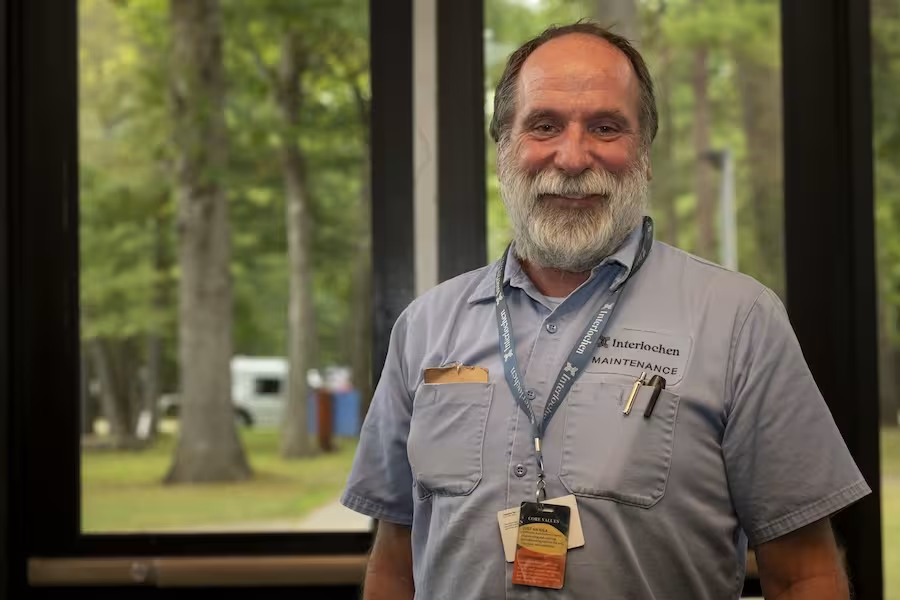
Interlochen Affiliation: IAC St 85 | ICA St 85-25
Interview Date: June 26, 2025
Doug Shively is the Carpentry Foreman with a distinguished 40-year career at Interlochen Center for the Arts.
This oral history is provided free by the Archives of the Interlochen Center for the Arts (ARTICA). It has been accepted for inclusion in Interlochen’s audio archive by an authorized administrator of Interlochen Center for the Arts. For more information, please contact archives@interlochen.org.
00:00:01 ELIZABETH FLOOD
Today is June 26 2025 and this is an oral history with Doug Shively, conducted by Elizabeth Flood on the campus of Interlochen Center for the Arts. Thank you for sitting with me and sharing your story today.
00:00:15 DOUG SHIVELY
No problem.
00:00:16 ELIZABETH FLOOD
So please tell me your name, your connection to Interlochen, and the years that you've been here.
00:00:23 DOUG SHIVELY
Okay, years go way back. My name is Doug Shively. I started here full time in the fall of '86 but prior to that, I worked two summers part time, so that's where I got my 40 years in this year. Prior to that even, my grandpa used to be the barber from '59 to '64 or five, we're not sure which. And I came with him and spent one or two nights here as a four year old. And two things I remember about that is the map building, where people would put their pins on the world map, where their was from, and I was fascinated with that, but they don't do that anymore. I kind of like to revive that. And I remember the wishing well and The Bowl. My aunt took me to some play there. I couldn't tell you much about it, other than the fact she had peanut M&Ms in her purse. My history goes back quite a ways. And my mom, she worked here as well, but she followed me here, and then both my daughters worked here as well, as food service, while I was here. I started, like I say, full time, 86 and still here. Probably got a couple more years to go yet.
00:01:41 ELIZABETH FLOOD
Wow, you have such a web. What is the wishing well? I haven't heard of that.
00:01:46 DOUG SHIVELY
It's still there. Used to be able to throw pennies and change or whatever in it, and it's just, I think, a flower pot now, but it's still there in front of Maddy building.
00:01:55 ELIZABETH FLOOD
Okay, so what do you do here? What is your job?
00:01:58 DOUG SHIVELY
I am a foreman of the carpenter crew in the Maintenance Department. I started out on Grounds for the first two years, and then they had one of the carpenters at the time get hurt, hurt his back, and I filled in for him while he was off, and then when he came back, I never went back to Grounds. I stayed right at a carpenter crew, and it's probably been 30 years ago, I was moved to the foreman of the carpenter crew, and been there ever since.
00:01:58 ELIZABETH FLOOD
What does it mean to be a foreman?
00:02:15 DOUG SHIVELY
You take care of the details with rest of the guys. I've had as many as 11 carpenters. I've got two right now, and we're interviewing for a third one. We just lost one. Generally have four people on the crew to take care of this whole campus, which can be quite a stretch.
00:02:50 ELIZABETH FLOOD
I imagine. So I'm imagining that every day, different variations are happening.
00:02:56 DOUG SHIVELY
Yeah, you never know. You can't plan nothing, because you don't know what's going to fall apart between here and there. And you might think you know what you're gonna do when you come to work, but if some fire broke out, you gotta take care of it.
00:03:09 ELIZABETH FLOOD
What are some of the more memorable projects or jobs, or things that have fallen apart?
00:03:15 DOUG SHIVELY
I've thought about this, there's a couple big jobs we've done. When Interlochen was getting ready to build DeRoy dormitory. If you get an old map, you'll see several H buildings and S studios that were in the way. We were going to move them. And they used to have Central State moving come in and move them. And I says, Well, I think we can do it. We might have to get Elmers to bring their low boy trailer in, but we'll jack them up and get them ready, and then have Elmers come in and back in and set it on. And then we'll take it where we need it and take it back off. Well, the first one we had to move was R-47 which is down on Emerald Beach, because they were selling the McWhorter Lodge. And so Neal Wilson built a trailer specifically for that one cabin. It was a small log cabin, but had a floor in it, so it wasn't too bad to do. And we jacked that up and we moved that right down the road, up on the hill, and reset it. Well, the next one we had to do was one of the H cabins up here, right where DeRoy sits now, and it was between two trees. So the first thing we had to do was jack it up and move it so Elmers could even get to it. So we took that little trailer, put it crossways of this cabin, and pulled it up, probably 25 feet or something, and set it back down. And I says, all we need is a bigger trailer. We could do this ourself. And that night, I called a guy there in Mesick. He had a trailer, just happened to have one. I figured if he didn't have one, he knew someone that might. He had one, and we went up there, and for 300 bucks, we bought it and brought it back here and cut it down to what would be manageable. And we proceeded to move all the buildings off from the site so they could build DeRoy.
00:04:59 ELIZABETH FLOOD
Wow.
00:05:00 DOUG SHIVELY
Yeah.
00:05:00 ELIZABETH FLOOD
That's a big job.
00:05:03 DOUG SHIVELY
Yeah, that was that was interesting, but it was satisfying, too, so. The other big job we had that was removing C-7 that used to set north side of Maddy building. That's where the vacant lot is now, and one time, long time long time ago, that was the maintenance building before they moved to Mallory-Towsley. That was the maintenance building at one time as well, before we are at now, but that was all done before I got here. But when we tore down C-7 that was a big block building, several add ons, weird shaped roofs, and we took down chunk at a time. We did a lot of it over Christmas break, when the students wasn't here, and then finished it off. But it was, that was quite a job, too.
00:05:50 ELIZABETH FLOOD
The first question that I usually ask is, what brought you to Interlochen? So what brought you to Interlochen?
00:05:56 DOUG SHIVELY
Well, I had a friend of mine. We was friends in high school, and his dad was Head of Maintenance Department here. His name was Clarence Robinson. And working the two summers here, the springs, he got, you know, seen what I could do and whatnot, and an opening came up in the fall, and he remembered me, and I interviewed for the Grounds position, even though I'd been on carpenter crew the, you know, the first two springs. It was Grounds position. I said, that's fine. That's quite a step up from where I'm doing now. And then he ended up hiring me and been here ever since.
00:06:33 ELIZABETH FLOOD
Do you have a favorite memory? Maybe that's different from a favorite job, but a favorite memory of your time here?
00:06:40 DOUG SHIVELY
Oh gosh, there's so many. I don't you know you'd come up with a favorite one-
00:06:44 ELIZABETH FLOOD
Doesn't have to be the single shining favorite, but maybe one that you that you think of fondly, or comes up often, or just one that you like.
00:06:51 DOUG SHIVELY
Well, recently, we built 40 wood easels for the visual art department over the last winter. And that was something that, they kept buying these little cheap, rinky dink things that kept falling apart on them wanted us to fix them. Why don't we just build something decent for the same price here? Actually, it was cheaper than do it that way, just the labor you had involved. But they ended up with 40 easels. I understand they put a insignia on them and numbered them, but I haven't even seen them in use today, but they're there somewhere.
00:07:25 ELIZABETH FLOOD
I've seen them. They look really beautiful.
00:07:27 DOUG SHIVELY
Well you know the little signs they have sitting out front that that wood sign that you can pull the top up into the road to direct people in or whatever. We made them originally for some doings they had there in Culver long, long time ago, and they was stored up in our warehouse. Never used again. And I says, Mindy, I says, "Could you use these?" And, "yeah!" We've brought them down, they've been in use ever since. So just stuff like that, you know, you keep an eye out for, you know, dual purpose, and get rid of some of that stuff out of our storage.
00:08:00 ELIZABETH FLOOD
Yeah, what else is in there?
00:08:01 DOUG SHIVELY
Lots. Sometimes we have a 10 year rule, if we haven't used it in 10 years, we throw it away.
00:08:08 ELIZABETH FLOOD
That seems to make sense.
00:08:09 DOUG SHIVELY
Yeah.
00:08:11 ELIZABETH FLOOD
I'm wondering if there's anything that you think the campus needs?
00:08:17 DOUG SHIVELY
Like I say, I'd like to revitalize that map building. That'd be something to, maybe even for the centennial!
00:08:25 ELIZABETH FLOOD
Who are some of the most memorable people that you've encountered at Interlochen.
00:08:30 DOUG SHIVELY
I did see Bruce Willis walk across campus, for whatever that's worth.
00:08:33 ELIZABETH FLOOD
Wow.
00:08:33 DOUG SHIVELY
His daughter was here, and she had her own room in MB, and I had to change the locks on that so she had the only key. Oh gosh, DuWayne Weaver, he was the head of the carpenter crew when I started. Oh, there's been so many people that's come and gone. Johnny Weaver, he was big, big guy. We used to load pianos onto a back of a doodlebug trailer, and we'd take them around, put them in the divisions in the spring. I remember one time Larry Prentice had gotten a hold of the piano and was down kind of in a hole a little bit and he couldn't quite pick it up high enough. Johnny come up behind him grabbed him around the chest and picked him and the piano up and loaded him on the trailer. Larry never let go of the piano.
00:09:23 ELIZABETH FLOOD
Wow. I have been wondering how anyone's moving all these pianos.
00:09:30 DOUG SHIVELY
Yeah, they farm it out now. Well, Grounds still do some of the bigger ones, but they don't move the piano near like what we used to. We used to get three semi loads in in the spring, and we had to distribute them to all the practice studios, and they have a company come in and do that now. I don't think they get three semi loads anymore either. I think they've cut down on that as well.
00:09:51 ELIZABETH FLOOD
Yeah, what has changed in the 40 years that you've been here?
00:09:57 DOUG SHIVELY
Wow. They built the DeRoy, they built Visual Art, Writing House. They've remodeled the dance building, that was pretty extensive there too. They built the Dow building, this building we're in right now, music building. There's just so many changes, and they's keep changing. They're planning on putting a tunnel in instead of having the crosswalk now. That's supposed to start August 4th, and that's going to be quite a change. Back when I first started here, they didn't even have the crossing guards. The students were on their own to cross the street there. It's probably been 25 years, at least, they've had crossing guards here now too, but. But now they're gonna have a tunnel, so they're not going to cross the road no more.
00:10:44 ELIZABETH FLOOD
Are you going to be working on making the tunnel?
00:10:46 DOUG SHIVELY
No, that'll farmed out as well. Most all them buildings I'm talking about they, they was all farmed out. We did the entryway to the food service. We built the security building, the Transportation and Security building, the main entrance, we built that. The two, ceramic studio and the drawing one down in the hole there. Both of them, we built both of them, start to finish. And we remodeled MB, both wings of that. And oh, we did Mary May Village, the five houses there and three garages, we did them in '08. When the rest of the country was shut down because of the housing crisis, we was busier we could be.
00:11:36 ELIZABETH FLOOD
Thank you so much for speaking with me today. I really appreciated and loved hearing some of your things. So thank you.
00:11:43 DOUG SHIVELY
You're welcome.
Copyright
Copyright to the audio resource and its transcript is held by the Archives of Interlochen Center for the Arts (ARTICA) and is provided here for educational purposes only. It may not be reproduced or distributed in any other format without written permission