
Oral History Interview with Claudia Polley
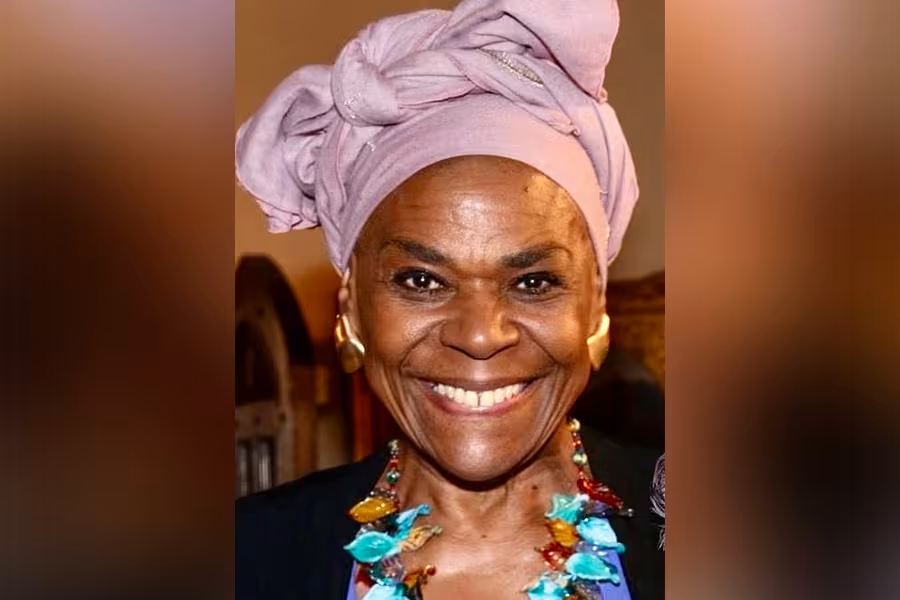
Interlochen Affiliation: IAA 64-67
Interview Date: October 18, 2024
Claudia Polley attended Interlochen Arts Academy in the mid-sixties, studying voice, choir, and drama. She is recognized for her years of expertise in cultural institution development, visitor experience analysis, and heritage/historic preservation management. Claudia is also an experienced broadcast journalist and classical musician.
This oral history is provided free by the Archives of the Interlochen Center for the Arts (ARTICA). It has been accepted for inclusion in Interlochen’s audio archive by an authorized administrator of Interlochen Center for the Arts. For more information, please contact archives@interlochen.org.
00:00:00 IAN JONES
Today is October 18th, 2024, and this is an oral history interview with Claudia Polley conducted by Ian Jones on the campus of Interlochen Center for the Arts. Thank you for sharing your story with us, Claudia.
00:00:11 CLAUDIA POLLEY
Well, it's my pleasure.
00:00:14 IAN JONES
So would you please just state your name, your connection to Interlochen and the years that you attended?
00:00:20 CLAUDIA POLLEY
Okay. Claudia Ann Polley, and I attended Interlochen Arts Academy starting in September of 1964, and then graduated in June 1967. I was a first, a violin major, and then switched in my junior year to be a voice major because I realized I was not the next Jascha Heifetz. And I learned here at Interlochen that people thought I could sing. So it was a pleasure to make the switch. And it was Dr. Johnson, and Dr. Maddy agreed to it, and it was a good move.
00:00:55 IAN JONES
So you literally found your voice at Interlochen?
00:00:57 CLAUDIA POLLEY
Quite literally, yes. Yes. He's been waiting to say that.
00:01:02 IAN JONES
Thanks. You sent me up so. Well, I couldn't, I couldn't. So take me back. How did you learn about Interlochen in the first place? And what drew you here?
00:01:11 CLAUDIA POLLEY
Well, I had not heard of Interlochen. I had not heard of the National Music Camp before then. I had been playing the violin since I was four, and I grew up in a family of classical music people. My grandmother taught music at Crispus Attucks High School in Indianapolis, Indiana, which is where I'm from, and grandma played the piano and pretty much all the string instruments. And my mother had played the violin. My mother and her two brothers had played instruments from very young ages. And so it was not unusual for anybody in our family to be able to play an instrument from being a kid age. And at Crispus Attucks, which I went to almost not by mistake, but because the Indianapolis public school system was still de facto segregated. When I graduated from eighth grade, and I had been in a special accelerated program in the IPS schools, and so pretty much everybody got to choose what high school they wanted to go to. Well, I wanted to go to Arlington High School, which was brand new, and they had an observatory, and I wanted to be an astronautical engineer. And because this was Sputnik, this was the space age. This was- and I knew all of that. And then I was good at math. So I thought I was absolutely going to Arlington High School. But no, these public school systems said, no, you go to the high school where you live. And that was Crispus Attucks, which was no big deal because my grandmother taught at Crispus Attucks, and Crispus Attucks was run like a private high school, even though it was the high school built for black students in Indianapolis to go to, but it was run very much like a private school, so they expected nothing but the best from you. Well, if I had gone to Arlington, I probably would not have heard about Interlochen because Dr. Maddy and the folks at Interlochen back in the day sent brochures to pretty much every high school in the Midwest, heralding the opening of not the National Music Camp, but of the Academy. And in the guidance department at Attucks, they knew me, they knew music, and they certainly knew my grandmother. And so they said this would be something that might be really great for Claudia. So they asked my grandmother if the family would be okay. And grandma, being the matriarch of the family, said, I think so. And so of course, she and my parents had everything decided long before I ever knew anything was happening. And so they then let me see the brochure. and it was wonderful and I got excited, although I didn't think I was particularly great at the violin, but I was better than some. So it was decided that we'd take a weekend and come visit the Academy campus. Because this is 1963, '64, the United States was not a- it was in the midst of the Civil Rights movement. And for my parents to decide that they were going to let their eldest child, a black girl, go into the northern woods of Michigan to a boarding school that nobody knew much about. They had to have some faith. So on their faith and the faith of Interlochen, which said, okay, you're good enough to get in. And I was in the first violin section, and this is- I didn't know, but Thor Johnson was going to be his, his first year was my first year, and it was just an extraordinary experience. And so we drove straight up 31, because that's the way you get from Indianapolis, Indiana to Interlochen, Michigan. And the rest is history.
00:05:02 IAN JONES
So you arrived on campus to Joe Maddy and Thor Johnson, both here. Thinking about Joe Maddy, you had a chance to meet him. What was your impression of Joe Maddy?
00:05:13 CLAUDIA POLLEY
Oh, well, he and Mrs. Maddy, because they were a pair. And Dr. Maddy, he was just a lovely old man who was brilliant at music, and whose brilliance also extended into the fact that he could convince people to fund his good ideas. And that's how the Academy came about. That's how National Music Camp came about, 50 years. Well, not 50, 40 years before the Academy. And so he knew how to make things happen. And it was just extraordinary. And Dr. Maddy and Mrs. Maddy were very kind and very caring about my coming because there were only three black students on campus my first year. Well, there were only 150 of us my first year, so they were particularly, I wouldn't say protective, they just wanted to make sure that everything was okay. And they thought I was a good enough musician, that I could go into the orchestra and do the first violin section. And I think that was as much that Dr. Johnson agreed to that because it was his orchestra. Let me tell you. And that year we had concerts every Sunday afternoon, a two hour orchestra concert. And that is more than most professional musicians ever do. And even though I didn't stay with the violin, having had that background of knowing the orchestra repertoire so I could sing anything because I had read it and played it in orchestra. And as my voice teacher at Juilliard said, you've played more playing the first violin in the overture to Figaro, then you will ever sing in your operatic career or your non-operatic career. So it was just wonderful. It was quite extraordinary. And Dr. Maddy provided an introduction to, not only the classical repertoire of the orchestra, but we had so many contemporary composers who came to Interlochen to show their stuff and to have us do it not only in orchestra, but in pretty much everything else. It was a testing ground. And we were those who were tested, and so were the composers who offered their their wonderful work. And not just composers, but everyone who came. It was an experiment, and we benefited from the faith that the adults at Interlochen had in the kids at Interlochen, that we could pull this off.
00:07:43 IAN JONES
Do you feel like you pulled it off?
00:07:44 CLAUDIA POLLEY
Yeah. Yeah, because when I went to Juilliard, which was not what you do normally after you graduate from high school. Most of the singers to Juilliard were in the master's program, but I had already played so much music. I had already been around so much music at Interlochen during my three years. I was not bored at Juilliard by any means, but I'd been through the repertoire. I'd been through a level of coaching and musical excellence, as well as dance, theater, drama just all in one. That was not easily matched on any level, even at Juilliard in New York City. Let me put it that way.
00:08:29 IAN JONES
You mentioned the switch from violin to voice. How did that come about here? What brought you to that decision?
00:08:37 CLAUDIA POLLEY
I wasn't going to be a Jascha Heifetz. And I was, I guess, used to being at the top of the, of the game. And Interlochen showed me that I'm not bad, but I'm not at the top of the game here. And also, I was getting taller. I'm pretty tall. And the violin was beginning just to be small for me. And my hands were larger and fingers longer. And so therefore it was vanity as well as musicality. But while at Interlochen and during my first year, I participated in choir and a little bit in drama and musical theater, and it was decided that I could sing. And so when I asked if I could change my major, Dr. Johnson, first of all, and then Dr. Hill, Barr Hill, who was my was the voice teacher, accepted me as a student and I passed all the tests, were being accepted as a voice major. And my parents said, okay, so that's what I did.
00:09:39 IAN JONES
From your time here, is there a particular performance or project or something that you did that's a particular standout out memory for you.
00:09:48 CLAUDIA POLLEY
Well, we performed so much, and I was lucky that in moving into voice, my voice was maturing and I had the same chops with my voice that I had with the violin. So I was very lucky. And also because I have a lower voice, I'm a contralto. I was able to do some extraordinary performances. I did chamber operas starting my first year as a junior, and I had a solo. My very first solo with orchestra was we did the Bach Magnificat at Thanksgiving in my junior year, and the alto solo is one hell of a, one hell of an aria, and it required extraordinary breathing, which I didn't realize was such a big deal. But I did it, and I will never forget having done that solo. So that was my first major solo, and my parents and grandparents drove up from Indianapolis because they didn't know me as a a singer, really. And they were pleased about having made the decision to let me change my major and move on. And then in my senior year, I did Menotti's The Medium, which was an extraordinary opportunity, a tour de force for a mezzo contralto voice. And then I soloed with orchestra a little bit, but I also did The King and I. That was our musical that year, and I was Lady Thiang, and I had two beautiful songs in King and I, and then I also did concertos with orchestra and then performed at graduation. And I was very lucky to be here and be able to move forward with my musical education and my musical growth as a musician, as a vocalist, at such a high level, which is what Interlochen is kind of all about.
00:11:35 IAN JONES
What did you learn here that had a significant impact on your life? How did Interlochen set you up for what came next?
00:11:41 CLAUDIA POLLEY
Practice and listen and learn and yes, practice. But we all practice. And that's just sort of endemic in everything a professional musician does. But it also- listen, learn to listen because there was so much to listen to at Interlochen. I mean, orchestra, band, choirs, because we also had dance and theater and visual arts. It was quite extraordinary to learn about being an artist in every possible way. Made you a better performer if you paid attention. And that has carried me through not only in music, but in everything else I've done. Learn to listen. Because I didn't stay in music, I went into broadcast journalism. But it's music, it's listening. And to do an interview. The best interviews I've ever done is because I listened and people said, well, how'd you learn that? I said, I'm a musician and you learn how to listen and you learn how to play in an orchestra with other people around you. And Interlochen taught me that. Actually, before Interlochen but Interlochen took it to a level that you don't get a lot of other places. Does that make sense?
00:12:55 IAN JONES
It does. It does. I mean, just personally, that's always been my experience from theaters. People say, well, how do you get this job with a theater degree? Well, you listen and respond, right? You work as part of an ensemble. It's all the same things. And that's why I think the arts are so valuable from an educational perspective. No matter what you're going to do in life.
00:13:15 CLAUDIA POLLEY
No matter what you're going to do. You listen and learn and then perform.
00:13:19 IAN JONES
Well, you met a lot of people during this time, a lot of people that you're still connected to. What lasting friendships came out of your time at Interlochen?
00:13:27 CLAUDIA POLLEY
Oh, friends that I've had for 60 years, especially my first year from being in orchestra, because being an orchestra was such an extraordinary experience under Thor Johnson and the level of excellence that we did every single week. That is unequaled anywhere. And those friends and orchestra from 1964 to '65 were my best friends. And when I went from Interlochen to Juilliard after graduating in June of '67, I went to Juilliard in that September. But I had all these friends from Interlochen orchestra who had gone to Juilliard two years in advance. They didn't know me as a singer. They knew me as a violinist, but I still hung with them because of our experience at Interlochen. And they kept saying, we don't know you as a singer, but I was fortunate at Juilliard to win the first vocal competition with orchestra, and so I was on stage with my buds from Interlochen in the orchestra behind me, and I couldn't have had a better claque, as you would say in opera.
00:14:33 IAN JONES
That's a wonderful story. So thinking about you mentioned you'd gone on to broadcast journalism. You've done a lot of different things in your career. How do you think your time at Interlochen influenced both your professional life but also your personal life?
00:14:48 CLAUDIA POLLEY
Pay attention. Listen and you learn. And that comes from being music. But the level of excellence we had here at Interlochen in those years that I was here was just so extraordinary. And I didn't realize how extraordinary it was until I went out into the rest of the world, both as a musician, as a broadcaster, as an arts administrator, as a museum consultant, which is something else I sort of fell into in a heritage preservation maven. That's an appropriate term. Listen. Just listen and and apply what you learn. And a lot of people will tell you a great deal if you allow, if you listen to what they say and if you just give them an opportunity to speak or to show you. So that's a basic mantra in life. Shut up and listen. Which I've not let you do much of.
00:15:44 IAN JONES
My job is to listen. That's good, that's good. Let's talk about some favorites. You're back on campus here for a reunion in 2024. What's your favorite spot on campus?
00:15:54 CLAUDIA POLLEY
Favorite spot on campus? Grunow Theatre, which is not the Grunow Theatre that I, that I remember, but it is still the building is still there or is it not? No. It's gone. The dance center is there now. Grunow, but that part of campus, because it was so beautiful, it was quiet and it was right on the lake and we got away from the hubbub. Now, how much hubbub do you have with 150 students? And now what is it, 550?
00:16:17 IAN JONES
573-ish, this year.
00:16:21 CLAUDIA POLLEY
But everything's relative. And I loved Grunow Theatre. I loved Fine Arts building because it was just a perfect spot to perform in. It's just a little golden place. Is it still called Fine Arts?
00:16:35 IAN JONES
It is.
00:16:36 CLAUDIA POLLEY
And our orchestra performance place is now Bonisteel Library. But that was JVS and that was where all the major concerts with orchestra took place. It's also where we played basketball. Interlochen was trying to be a fairly well rounded high school for kids. So we did have, you know, we didn't have football teams, but we did have, you know, intramural basketball, if you will. And there were some kids who really knew what they were doing. And I remember being a cheerleader for at least one year. And this was back in the day when we had petty pants. This is long before any of people listening were born, and so that was the way we were able to do it. But JVS had a wonderful place. I actually liked Fine Arts also, the old Fine Arts building. Is it now the percussion studio?
00:17:24 IAN JONES
The previous Visual Arts building? That would have been in what is now the Maddy Courtyard. So that building is no longer there.
00:17:30 CLAUDIA POLLEY
Okay. Yeah, it was just everything was an experiment in many ways. And so we got a chance to do things that, at least for me, I never would have been able to do as a kid back in Indianapolis. Although my life was pretty extraordinary because we got a chance to do a great deal, because my family was so deeply in the arts and in music. But still, being able to walk down the, the lane and go into a Fine Arts building that you have everything from oils to metalworking and people who knew how to do it and were brilliant at it. That was pretty extraordinary.
00:18:05 IAN JONES
How do you think it affected you being kind of steeped in all these different components of art? You had a discipline that you were interested in, that you were pursuing aggressively, it sounds like. What was it like to be around all of this other art with people who were trying to do the same thing, whether in theater or dance or visual art? How does that affect a person?
00:18:26 CLAUDIA POLLEY
Awe inspiring, because everybody was really good at what they did. And there were some, perhaps, who weren't as at a premier level of excellence as others. But everybody was damned good at what they did, and we respected each other for the amount of work we had to do because the academics were tough. We had college level academics, we had college level music or arts that we were all pursuing. So the fact that we made it through every day in just 24 hours was pretty, was pretty amazing. So it is something that you learn to go to your best level of performance, whether you were a performer or a visual artist or whatever it was. And that was the kind of the way everybody rolled at Interlochen. And I just learned to get with it.
00:19:23 IAN JONES
That's a good motto to have to have coming out of out of Interlochen. Yeah. Okay. So you learn to get with it. Well, what advice would you give to a current or a future student at Interlochen today. So someone's looking at Interlochen, they're not sure. What wisdom can you impart to them?
00:19:43 CLAUDIA POLLEY
Listen and learn. Experiment to a certain degree. That all depends. Everybody has their limits of their comfort levels. But at Interlochen, you're able to find your comfort level in arts of every imagination. And so experiment, figure out whether you do like this or you don't like it. You have the opportunities here to understand what being in an arts world really is about. And this last year I have not been back in Indianapolis. I hadn't lived in Indianapolis for 20 years, and I went back to help spearhead a program dealing with the preservation of an African American neighborhood that had really been torn asunder by, quote unquote, progress. So being back in Indianapolis and realizing that young students in the schools like I had, they didn't have the opportunities for and they hadn't heard, I was stunned. A lot of them didn't hadn't heard of Interlochen. And so I helped a young girl who plays cello. She was in the third grade and she was a cello player. And I said, oh, you really should know about Interlochen. Well, she came to camp here last summer and she came for four weeks, and now she went home and said, six weeks to her parents. I mean, this is- and it's, this is done. I am going for six weeks next year. And she is. And I realized that we just need to, you know, give kids like that who have the abilities that would help them thrive here at Interlochen to spread the word and get them interested, hopefully. And what did you ask?
00:21:17 IAN JONES
I started by asking, what advice would you give?
00:21:20 CLAUDIA POLLEY
Follow your dreams. Follow your your real dreams. Whoa. I don't think I'm good enough to do that. Well, you maybe are, so you should find out. And if someone has the opportunity to find out here at Interlochen. They should take their best shot.
00:21:33 IAN JONES
You know, Interlochen, you talk about it being a place where there are all these different arts, there's all this different opportunity to connect. And we were talking earlier about how the arts really can be a foundation for so much in a career. But why do you think the arts matter in the world today?
00:21:51 CLAUDIA POLLEY
It helps you develop a sensibility for life, a sensitivity to life that is a different point of view. And I'm not denigrating someone who goes to business school, or someone who goes to med school, or someone who does something else other than have a wonderful life in the arts. But the arts give you a different opportunity to see the world. And even if you're doing it just as a lover of the arts or an admirer of those in the arts, do it. Take the time to learn and to figure out what makes you smile, what makes you happy. That's arts based, because it will help you in every part of your life.
Copyright
Copyright to the audio resource and its transcript is held by the Archives of Interlochen Center for the Arts (ARTICA) and is provided here for educational purposes only. It may not be reproduced or distributed in any other format without written permission