
Oral History Interview with Tom Morris
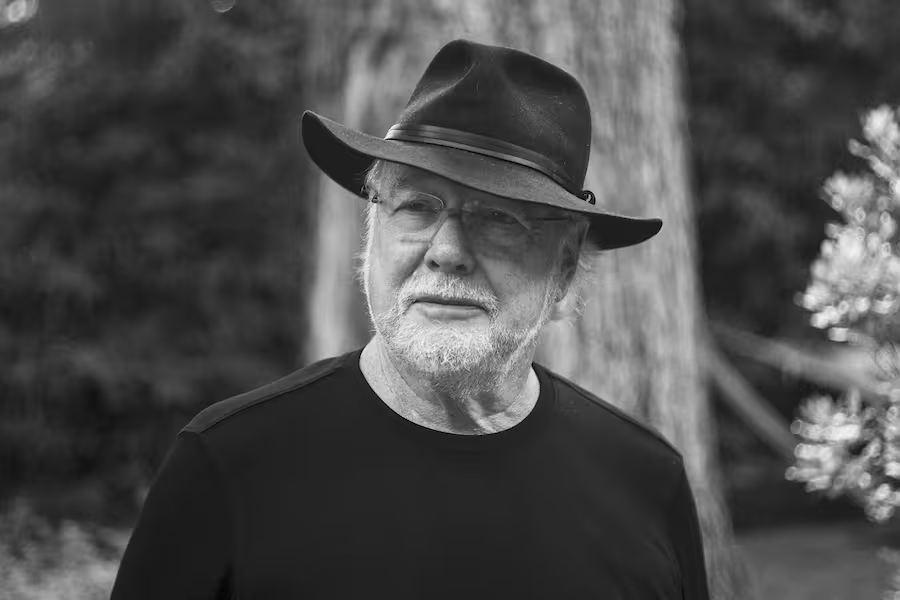
Interlochen Affiliation: IAC/NMC 59
Interview Date: July 24, 2025
Tom Morris studied percussion at the National Music Camp in 1959 and made his life in music. A longtime chief executive of both The Cleveland Orchestra and the Boston Symphony Orchestra, he also served as the Artistic Director of the Ojai Music Festival for 14 years. An accomplished percussionist, he is also a current member of the Interlochen Center for the Arts Board of Trustees.
This oral history is provided free by the Archives of the Interlochen Center for the Arts (ARTICA). It has been accepted for inclusion in Interlochen’s audio archive by an authorized administrator of Interlochen Center for the Arts. For more information, please contact archives@interlochen.org.
00:00:00 ELIZABETH FLOOD
Today is July 24, 2025, and this is an oral history interview with Thomas W. Morris conducted by Elizabeth Flood on the campus of Interlochen Center for the Arts. Thank you very much for coming in and speaking with me today.
00:00:14 TOM MORRIS
It's my great pleasure.
00:00:15 ELIZABETH FLOOD
Please tell us your name, your connection to Interlochen, and the years that your relationship has spanned.
00:00:24 TOM MORRIS
I'm Tom Morris, and my relationship with Interlochen started in 1959 when I attended what was then the National Music Camp for that summer. That was in the era of Joe Maddy. That was in the era of pre-Academy. It was called the National Music Camp, and it was an eight week session. This sounds corny, but it was transformative. It was magic, and it changed my life. I'm a percussion player, so I was here as a percussion player. I was in between my sophomore and junior year of high school, and I thought I was a very good percussion player. And at Interlochen, I learned that I was nowhere near as good as I thought I was. Those were the days of challenges, weekly challenges, and what I remember was getting here, and we all had to play the challenges, and we were rank ordered. And I came out number seven. And the top six percussion players were the ones who played in the top orchestra. I forget what they called it in those days. It was not the World Youth Orchestra. And then there was a secondary orchestra, and number seven through fourteen played in that. I was devastated that first week. So I practiced like hell, and I got myself up to number four so that I could be in the first orchestra. So it was an incredibly competitive but motivating place to really work hard. And I spent one summer at Interlochen- only one summer. I wanted to come back the following summer because it was so incredible, but we had a family trip that my parents had planned across the country, a driving trip, the next summer, which was a command performance. So I very, sort of, grumpily went on that trip. But that was my touch with Interlochen. And then I must admit that I went onto a career in the arts management business. I was the CEO of the Boston Symphony and the CEO of the Cleveland Orchestra. Ran the Ojai Music Festival, for 50 years all those, and I was basically off the radar of Interlochen. I mean I didn't initiate anything. I had memories and talked fondly of it. I never heard from Interlochen. I think it was in the 2000s or something, I started sending just a modest contribution 'cause I could, and I wanted to. And then in the summer of 2007, at that point we were living in Cleveland, Ohio, and we had some very close friends in Cleveland who had a summer home, cottage, up in Frankfort. And they were close friends, and said, "Please come up and visit us for, you know, four days, five days." So we came up and spent this time with them, and it occurred to me that this was close to Interlochen. And so I said, "You know, I want to take a little day trip and go to see Interlochen. I haven't seen it since 1959." And so we came over here. It was a beautiful day, and I remember walking into the center of the campus and being overcome with nostalgia because even though it was considerably modernized at that point, I mean, when I was here, it was a camp. I mean, it was rustic. And everything was sort of slightly run down, I mean, it was- it needed work. [Laughs] It was looking, sort of, much better. The benches were much more professional, and the new buildings. And of course, the Academy was here, so there was a lot of new building, but the feeling was the same. And I remember going over to the boys Camp, that's the way it was called, on Duck Lake and finding my cabin. I have a picture from summer of 1959 of our cabin, and it said cabin four. So I looked for cabin four. I don't know and I never asked, but I think they were all rebuilt since then, so it wasn't quite the same, but the feeling was the same. It was a moving, a surprisingly moving visit to me. And I had a very close friend who was on the board. I talked to her on just some point before the visit, and told her that I was going to be up here and we were going to go to Interlochen and see it. "Oh," she said. "You just won't believe it. It's in great shape." And so anyway, I went, and I got home, and the phone rang, and it was her. Said, "What did you think?" And I described my reaction, and she said, "Well, you should get involved. You should be on the board." I said, "Well I mean, I've never really had any relationship, you know? What does that involve?" She said, "I'll take care of it." And so the next I heard was from Jeff Kimpton, who was the president. She had talked to Jeff, and Jeff, who I did not know, called and said that Nancy Chalifour was her name, had described her conversation with me, and he said we should talk and see if that's something you might be willing to help us with. And that was all in July 2007, and Jeff had some business in Oberlin in late September and he called and said, "Can we have lunch?" And so I went out to Oberlin, and Jeff Kimpton and I had lunch, and he said, "You should come on the board." I said, "Well, sure. I mean, I'd be interested in that. I'm very touched by Interlochen. It's had an effect on me, and the effect hasn't gone away." And so the next thing that happened, I was asked to be on the board, and so in the summer of 2008 I came to my first board meeting. I had no idea what was expected of me as a board member. I mean, it was never explained to me. It was all very sort of casual. And I remember when it came time in December, I said, well, I guess I'm supposed to make a bigger contribution, but I didn't know what? And I had to call and say, well, what you know, what's the right thing to do here? [Laugh] That really started my reignition on a regular basis with Interlochen. And as it's turned out, this is my sixteenth year on the board. Board members have three year terms that can be renewed three times, and then you have to go off the board for at least a year, and then if the board so chooses, you can be asked back. And I did nine years, and then I did a 10th year, which is possible because it turned out to be Trey Devey's first year as president. And Trey and I are old friends. We've known each other, and I was very active in recruitment process to bring him here, and the board thought that they needed me to help in the transition for the new president, so I was made vice chairman of the board which meant I could stay another year, and then went off the board, and then they asked me back, and I've now done six years of the second tranche. So I always describe myself as not just a board member, but a very active board member. Interlochen is a place that I love. It had a huge effect on me, even though it then sort of went silent. We went mutually silent. It's a place that is completely unique in the world. What's very different about Interlochen today, which appeals to me, is that it's multidisciplinary, because I actually think in the world of creativity that's the essential nugget of spark that simply exists today that really has made these times, in my opinion, the golden age of creativity. And Interlochen already has multidisciplinary sort of culture. And so the combination of that with high school students who are very idealistic, they're not yet tamped down by the horrid reality of where they're going to get a job. It's just raw talent- makes it so exciting. And it's an honor to be part of this incredible place.
00:09:03 ELIZABETH FLOOD
What a brilliant introduction. [Laughs] You really spanned a lot there and that's gorgeous. I will ask you many more questions about your trustee relationship, but I wanted to first ask, how did you learn about Interlochen as a child? What brought you here as a camper?
00:09:21 TOM MORRIS
I grew up in Rochester, New York, and I went to a small private school, very small private school, that did not have a band or an orchestra. And I got infatuated with music at a very, very young age, and particularly orchestral music and band music of all things, and became a percussion player. And I studied percussion privately with the famous percussion teacher at the Eastman School starting in about 1953 or '54. I was eight or nine. William Street was his name. One of the legendary teachers of percussion. And I studied privately with Bill Street- had weekly lessons with him. He was an incredible sort of old school musician. He actually grew up in vaudeville and was the forty year timpanist of the Rochester Philharmonic. Wonderful character and a wonderful player and a great teacher. And one of my problems was I was studying percussion, but I didn't have any place to play because there was no school band or orchestra. And he, at one point, said, "Well, you know, there is in Rochester, an all city orchestra and band." And so I joined those two in 1956 or '57. So at least I started to have some playing opportunities, and it was Bill Street who told me about Interlochen. I also, in Rochester, again through my family, had met Howard Hanson, who was the longtime director of the Eastman School, and I also knew the founder of the Eastman Wind Ensemble, Frederick Fennell. And both of those people have had deep, deep roots with Interlochen. And if I'm not mistaken, Maddy himself was from Rochester. I think, I vaguely remember, I don't know. Makes a nice story. But the combination of Hanson, Fennell and Street brought Interlochen to my attention. They said, "You know, you should really go there." That's where I heard about it. I remember broaching the subject with my parents, who were sort of nonplussed with I'd never been away for eight weeks. So it happened, and what I remember is taking the train from Rochester, New York to, I can't remember if it was Detroit or Chicago. I think Detroit, and changing trains and taking the train, and the train stopped in Interlochen. You know, I had a trunk of all my clothes and stuff that was sent up ahead, but then I had this sort of case of percussion equipment that I lugged with me. And I remember getting off the train, and somebody picked us up in a bus and took us to the boys Camp. And I remember sort of unpacking in cabin four and then realizing that actually it was a good distance from where the Interlochen campus was. I do remember that first morning having to lug that big case of percussion equipment through the woods on the path they had to cross the street and come to the campus. It was, it was quite something. And Fennell didn't come and conduct that summer, but Hansen did come and conduct, and to be honest, it was my first experience with the theme. I actually knew the Romantic Symphony of Howard Hansen because of growing up in Rochester, and so I knew the piece of music, but I came to really hate the theme. [Laughs] It just somehow, you know, you played some big piece of something, and then had to play the theme. Little difficult.
00:13:14 ELIZABETH FLOOD
I haven't heard players talk about the theme as much as hearing it as an audience member. So that's...
00:13:23 TOM MORRIS
You know, I spent my career putting on concerts, and I am very proud to say that I have never organized a concert that started with the Star Spangled Banner. I'm sorry. For a serious concert of music, I just, it just doesn't make sense to me. You know, if there's an occasion of something that you need to do it, fine, but, you know to have to go to a concert and hear the Star Spangled Banner and then listen to Beethoven Symphony No. 1. It just doesn't make any sense! Any more sense than listening to the Eroica Symphony followed by Howard Hansen's theme. I just, I think it negates the concert experience, and so it was something that I remember groaning about it back then.
00:14:19 ELIZABETH FLOOD
You've named some of the big players in how you got here and who you know, but I'm wondering if there are any other memorable people that you met in your summer here that have stuck with you, or any lasting friendships?
00:14:33 TOM MORRIS
You know not really, with one exception. I just didn't keep up with them. There was one fellow who was a tuba player. His name was John Hildebrand, and he went to Harvard, and I went to Princeton, and in the 60s we met up a couple times in Cambridge.
00:14:53 ELIZABETH FLOOD
What are some of the places around campus that you have memories? Let's talk a little bit about the change, the transformation. What are your memories of campus from when you were here as a camper? And then, could you speak a little bit more about when you first came to return on that visit and seeing things? And then even how much things around campus have changed since then?
00:15:13 TOM MORRIS
The word primitive comes to mind. I mean, the percussion studio was in this little hut out behind The Bowl overlooking the lake, and it was really junky. Not very big. But that's where percussion classes and ensembles, you know, would rehearse. There was not a lot of percussion equipment. The Bowl, as I remember it was bigger, and not The Bowl itself, but the audience area was a little bigger and much more rustic with wooden benches. It was one of the prime rehearsal and performance spaces, much more so than, I think today, and Kresge was a lot smaller. It was there. You still saw the windows in the back, but it's been rebuilt a lot. But you know, in terms of facilities where you went to classes or you rehearsed, Kresge and The Bowl were about it. There were a couple studios and things for classes, but it was rustic. I remember Maddy Administration building, sort of, I remember how it looked, and you know, it was kind of eerie, eerie old school almost like the center of a camp. And I remember Stone Hotel and Cafeteria. I remember Stone Hotel particularly because at some point in the summer my parents came up to visit, to see the place, as did my grandparents, and stayed in Stone Hotel, I mean, that was it. That was it. You ate in the cafeteria. There was really not much else. It was a real camp. And that obviously had to radically change in 1963, '64 when the Academy started because you needed winterized facilities. You couldn't perform and rehearse in outdoor facilities. And so there was a radical transformation of building that had to happen in conjunction with that. It's always been interesting to me that one of the last new buildings to be built here was the music building when music was what started it. But there's a lesson in that to me. Interlochen did pretty well until- the music building's, what? Eight years old, something like that. It did pretty well up until that time with very substandard facilities. So having great facilities, I think, helps the experience and clearly helps attract people, but it's not determinative of the quality. The quality is something that transcends facilities, in my view, it's what happens. You know, I look at these spanking new facilities, you know, which are the envy of any school now, and it's wonderful and Interlochen deserves it. I don't find myself at all saying, "Gosh, I wish I had those facilities when I were here." It actually worked. And so other than that, that experience of arriving on campus in the summer of 2007 after all that time, everything was spruced up, I had the feeling that it wasn't rustic anymore. It wasn't fancy, it wasn't gleaming and polished, but it was attended to. And I still remember one of the, I mean, I mentioned it earlier, those benches in the circle. I mean just that or the benches in The Bowl, which were not old wooden benches, just gave a more permanent, professional feel to the place. And when you got to the center of the campus, yes, there was the monolith Stone Cafeteria, and there was Maddy, were pretty much the same, but Kresge was really a monster compared to what it was. What does it seat five thousand now or so? I don't know, whatever it is, but it was like two thousand. It was much smaller, the audience area and nowhere near sort of dominant on the landscape. And once you got outside of the center of the campus, there was a campus that went on and on and on. That's why it's this odd feeling of tradition and unchanging values and progress all at once.
00:19:39 ELIZABETH FLOOD
What do you hope for Interlochen in the next 100 years? What are some of the traditions and the values that you think are important to be carried into the next 100 years? And what are some of the things that, the absences that you hope are built upon in the next 100 years?
00:20:02 TOM MORRIS
I have a general view of institutions and organizations that you don't, in fact, look back a great deal, but that you build on the values that the organization embodies and have built up over time in order to frame the future. Most of it is looking forward, and we live in times now where change and uncertainty are simply facts of life. And I think the pace of change, just socially, is going to escalate as it has escalated. And it's tricky for any educational institution, particularly one like this, which is- I mean, we're not really training artists here. What we're really doing is igniting passion in the arts. And the way you ignite passion in the arts is by helping people experience the excitement of creativity, which is very much something about today and tomorrow. I mean that's what happened to me at Interlochen, and that's what happened to me in my professional life, working for a long time in very traditional organizations, the Symphony Orchestra and then spending the last third of my career running a major contemporary music operation. So the interesting question for Interlochen, which to me, is fundamentally a secondary school where teaching is rooted through the arts, which is about the most ideal kind of educational experience you can have, because the arts teaches you executive skills. It teaches all kinds of social skills. It teaches you to be comfortable with uncertainty and sort of gooey concepts. So it's ideally positioned for educating young people today. The interesting question to me is, yes, it has this glorious past, but that past is really more about the values of the place than what it has done. It's impressive all the artists who have come here, and it's impressive of the famous artists who have come through here, but I'm actually more impressed with the simple fact that this place has been going on for a hundred years, is growing, is attracting people like it never has before, about an ever widening circle of artistic experience, and I think that that's the secret. So if I had a dream for the future of Interlochen, I would hope that the breadth of what it embraces artistically here was dramatically widened. I would hope that the multidisciplinary nature of the school would be not a collection of different disciplines, but actually one discipline of interdisciplinary activity. It's a tricky one. You know, I was on the board of the Curtis Institute for a while, and Curtis is brilliant at training traditional musicians. And it is absolutely true that in the past a violinist needed to learn how to play Beethoven string quartets to be successful. It used to be that someone who wanted to go on to be a violinist could become versed learning and playing Beethoven string quartets. That was a necessary thing to learn, and in many cases it was a sufficient thing to learn for a career. Today, learning to play Beethoven string quartets for a violinist is still necessary for a career, but it is absolutely not sufficient. I think every musician should know how to improvise. I think every instrumentalist should know how to collaborate with a visual artist. I think all artists should be comfortable with technology. This is a place that can do that and uniquely so, unlike a music school or a dance school. That's what I see as where it should be heading, and that's very much based on the values that have been articulated about this place, that it's about solo proficiency, but also the concept of working with others. Absolutely, but in a much wider way than we even think today.
00:24:54 ELIZABETH FLOOD
What I'm hearing and what I heard from the people that I've spoken with today even , it has come up, is the definition of artist being like a way of being in the world, as opposed to-
00:25:06 TOM MORRIS
What you do.
00:25:06 ELIZABETH FLOOD
Yeah.
00:25:07 TOM MORRIS
Correct. It's a point of view. It's an experience. It's an attitude and learning to be an artist today, yes, it can train you to be a professional artist. It can also train you to be a philanthropist. It can train you to be an executive. I mean, you stop and think of an organizational theory where people are talking about how do teams work? Well look at a string quartet. Look at an ensemble. I mean, there it is. How do you work that out? What is leadership?
00:25:44 ELIZABETH FLOOD
I'm really interested in how your time as a camper has impacted your work as a board member.
00:25:52 TOM MORRIS
Ooh. I am struck at my work here as a board member, as sort of coming back into Interlochen, that absolutely everybody associated with this place who have been here not only talk the same about it, but they use exactly the same words, the words I used earlier in this interview: transformative, magic, changed my life, right? That's amazing, because first, it's unanimous, it's the same words, it's with enthusiasm, with passion. And I learned that when I was here, and it was rekindled when I became a board member and started being with a lot of other people who had associations with this place. I can't imagine any organization in the world who wouldn't kill to have that situation of unanimity of reaction. So as a board member and the work that I do as a board member, I actually can feel what this place is about because I've been there. I don't have to memorize words or slogans or anything. I know it, and I believe as a board member, and one of my jobs as a board member is I'm now chairman of the Nominating and Governance Committee of the board, which I've done for quite a long time, been involved with that committee. And one of the things that we stress with our board members is a board operates as a fiduciary, fancy word of you're operating at a very high strategic level, where your job is to oversee the preservation of the assets, the physical and human resources and financial resources. But you're also responsible for overseeing strategic direction. You are not responsible for operational questions. That's the job of the management and the staff. The clear distinction between the two. But having said that, I totally think that it is far easier to function as a fiduciary board member having had experience with the live operational life of having been here or seeing what's going on on the ground. So we encourage all of our board members when they're on campus to throw themselves into the life of Interlochen. Attend some classes, attend some rehearsals, talk to people, hear what they're saying, don't try and solve their problems. And the fact that I had had that one year experience here just gave me a jump start on that, but it's the grounding of my belief in the place.
00:28:53 ELIZABETH FLOOD
What advice would you give to current and future students at Interlochen?
00:29:00 TOM MORRIS
The first thing I would say is stay for as long as you can. I stayed one year. It was not ideal for me, and that was the Camp. And multiple years at the Camp is not just additive, it's multiplicative, whatever that word means. And of course, for the Academy, where you're dealing with sort of a curricular program through high school, being here more than one year or two years, I think, is really essential, and you just get far more out of it. People who are looking at sending children here, children who are thinking of coming here, get seduced early by the place and stay.
00:29:44 ELIZABETH FLOOD
Well I also wanted to point out, I found it really interesting that you were the one who brought Interlochen to your parents. From speaking with people, I've heard a lot about how Interlochen was a place that they felt they gained agency in the world as a child and as a being, and I think it says a lot about who is coming to Interlochen when it's the children who want to be here. And like what that does for a place. I've talked to people who wanted to come to the Academy, and so they did all the application work by themselves because they just wanted to be here. And I think that says a lot about a place.
00:30:24 TOM MORRIS
At a meeting yesterday we welcomed five new board members. We have a board of thirty-three people, have four or five new board members every year, and these five new board members at this orientation meeting were all asked to sort of introduce themselves to the group that was present for this, and sort of describe how they got here. And I'm head of the Nominating Committee, so I knew these people, but I was totally unprepared for what happened. Every single one of them, every single one of them, talked about how they had a child who had heard about Interlochen and browbeat their parents into coming. They didn't know anything about it. And if it was the Camp, they'd persuade the parents, "Okay, you can go to the Camp," and once they got here they started getting phone calls about, "I want to stay here for the Academy." It was the kids who drove it, and that's what drove these future trustees. I think four of them are now, their kids have graduated. So the relationship with Interlochen is now a family thing. And I mean that just can't get better than that.
00:31:41 ELIZABETH FLOOD
We're talking about engaging time and backwards and forwards of time. But this is an intergenerational place, like what you're saying of, that it's been around for this long, and that people are able to share this with their families, and then also, just when you're here, meeting people from different points in time is really a gift, and a lot of knowledge is passed down that way.
00:32:03 TOM MORRIS
And the fact that this magical place exists in one of the most beautiful places on Earth, but also one of the most remote places, is part of its magic. I have a belief that great culture and great institutions happen in non standard places best. There's a reason that the city of Cleveland, which is the 25th largest city in America, has arguably the best orchestra in the world and one of the best art museums in the world. Cleveland! Why is the St. Louis Symphony so renowned? In St. Louis? And the answer is because there is this focus in these somewhat out of the way places, and Cleveland is not one of the great cosmopolitan cities, it's a wonderful place to live, and it's a wonderful community and a wildly generous community, but there's a focus for not just the artists but for the public that supports it. I have a very snarky line that I've used because I lived twenty years in Boston, and Boston's a glamorous, wonderful city, and I've come to believe that living in Cleveland is actually a lot better than living in Boston. Visiting Boston is just fine. But stop and think that if the Boston Symphony disappeared tomorrow for some reason, the attitude of that community will be: That's terrible, but we still have Harvard. If the Cleveland Orchestra disappeared, it would be a death blow to the community, because these institutions are at the center of community self esteem and need. And Interlochen is at the center of Northern Michigan, and people come here just to come to Interlochen, and so the remoteness of the place is part of the magic.
00:34:09 ELIZABETH FLOOD
You're speaking to the impact of these arts communities on the larger community. It segues us well into my last question which is a very broad one, but why does art matter in the world today?
00:34:21 TOM MORRIS
Because it's ambiguous, because it frames questions, because it challenges. You can't talk about art as entertainment. That's different, that's commerce. Through my long career in running orchestras and festivals and putting on concerts, I've always said that the job of a great cultural organization is not to follow taste, but to lead taste. I believe, firmly, from my experience, that audiences and communities around art are created, not found. And the way you do that is by exposing people to culture and art that is provocative, is challenging, might be uncomfortable, might be enjoyable. It is absolutely fine to go to a cultural performance or an exhibit that you really don't like. That's acceptable. It's also acceptable to go to something that you do like. What's not acceptable is to go to something where you have no reaction. And we need things in our society that raise questions and people who experience art that challenges them to think and rethink simply makes people better in my view, I mean, I hate to put it in the blunt terms. So I'm a huge advocate that when you are in the world of music, putting on musical events, I've been known for programming, whether it's in the orchestra world or anywhere else with extraordinarily wide range of musics on one program or in festivals to provide contrast and perspectives and challenge and raise questions and not simply something that people say, "Well, that was nice." I love Beethoven's Fifth Symphony. 90% of performances of Beethoven's Fifth Symphony I can't stand because artists don't have something unique to say about it. It's a revolutionary piece. It should just jar you! That's how you have to think about this.
00:36:40 ELIZABETH FLOOD
Thank you so much for speaking with me today. It's been such a pleasure.
00:36:43 TOM MORRIS
Great! I hope it was okay.
00:36:45 ELIZABETH FLOOD
It was lovely.
00:36:46 TOM MORRIS
[Laughs]
Copyright
Copyright to the audio resource and its transcript is held by the Archives of Interlochen Center for the Arts (ARTICA) and is provided here for educational purposes only. It may not be reproduced or distributed in any other format without written permission