
Oral History Interview with Steve Tavener
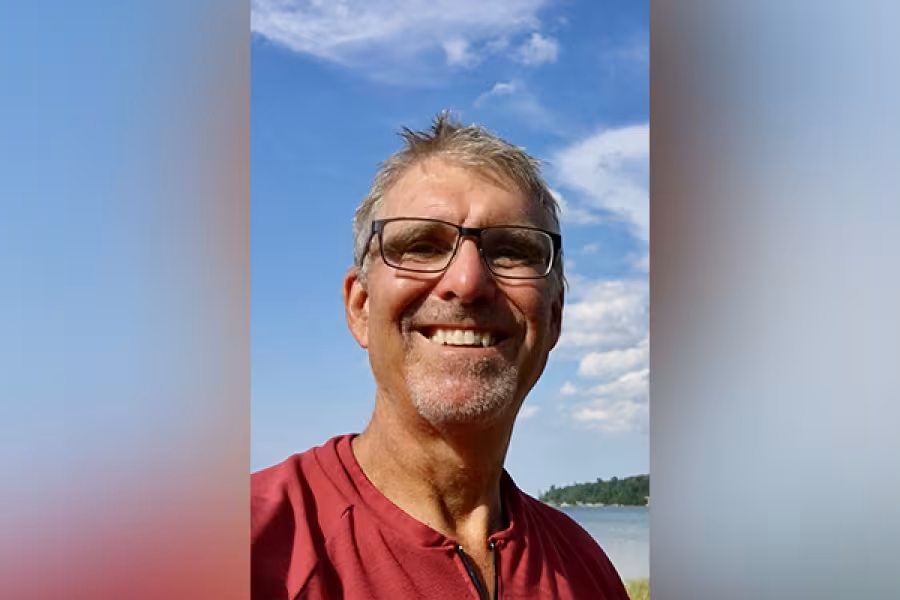
Interlochen Affiliation: IAC St 74, 06 | IAA Fac 73-76, 76-10
Interview Date: July 31, 2025
Steve Tavener taught science at Interlochen Arts Academy for 38 years, including 10 years as Division Chair for Math and Science.
This oral history is provided free by the Archives of the Interlochen Center for the Arts (ARTICA). It has been accepted for inclusion in Interlochen’s audio archive by an authorized administrator of Interlochen Center for the Arts. For more information, please contact archives@interlochen.org.
00:00:00 ELIZABETH FLOOD
Today is July 31, 2025. This is an oral history interview with Steve Tavener conducted by Elizabeth Flood on the campus of Interlochen Center for the Arts. Thank you very much for coming down and speaking with me today.
00:00:12 STEVE TAVENER
You're welcome.
00:00:13 ELIZABETH FLOOD
So please tell us your name, your connection to Interlochen and the years that this relationship spanned.
00:00:20 STEVE TAVENER
My name is Steve Tavener, and I grew up in Leelanau County, and my first memories of Interlochen would be my mother taking us to summer concerts in probably the late '50s, early '60s. She was a classical musician and loved music, and so she would gather the family up and throw us into a station wagon, and we'd go to Interlochen. So I have some very early memories. Two gentlemen by the name of Dick Parks and Carl Scheffler were both in the Math & Science department, and I became a little bit of both. Dick Parks was biology, and Carl Scheffler was geology, and I could teach both of those. And then my colleague Mike Chamberlin was hired at the same time, so we both came at 1973, so that's when my connection started as a teacher.
00:01:18 ELIZABETH FLOOD
Could you tell me a little bit more about what brought you here as a teacher and what that first year was like?
00:01:27 STEVE TAVENER
Well, I was really young: twenty-two, twenty-three. I grew up in Leland, as I mentioned, Leelanau County, so it was close to home. My family was close to home. My wife, also from Leland, so we like the idea of being close to home.
00:01:47 ELIZABETH FLOOD
What was the first year like? Had you taught? You'd been teaching before? This was your-
00:01:51 STEVE TAVENER
No, I was right out of- I have a master's degree, but at that time, I just had a bachelor's, just graduated. It was hard. Teaching is not easy, and teaching at first is hard. And I also, I just remembered this, I taught physical education, and I think it was probably one class of just boys because there was another woman here who taught the girls. And it was a required class, I think, for ninth and 10th graders at that point. I also taught a geology class. That's the Carl Scheffler connection because geology had been offered, and we continue to offer it, and I taught in anatomy physiology. I don't think I ever taught four, so maybe I didn't teach anatomy physiology the first few years, maybe that came later.
00:02:50 ELIZABETH FLOOD
And then how long were you teaching at Interlochen for?
00:02:54 STEVE TAVENER
Thirty-seven years.
00:02:57 ELIZABETH FLOOD
I've spoken to a few people who have taught here who were not familiar with the area, and I'm interested in what it was like to come and teach biology and geology and things relating to the land, already having that kind of relationship to the space.
00:03:17 STEVE TAVENER
Well, I think that's part of what I liked best, was introducing our part of the world to students from all over the world, from students from urban areas. And the department at that time had a heavy emphasis in natural sciences, meaning getting outside, not just experiencing them in the classroom but getting them outside. So for many, many years, we started out with tree identification, so kids could learn to identify fifteen or twenty common of our native trees. So when the weather was good in the fall, September, October, that was the first unit. Before we ever cracked a biology book that was what we did. Talked about the succession of the area and how things change over time, and why they are the way they are now in relationship to the logging that occurred here, which also is why the campus is where it is because of the preservation of some virgin trees, which are, a few, still hanging around. So yeah, it was a really good match for me, and it just kind of grew from there. Figuring out how to teach, but being in a good spot to start. It was a good time to be here. It felt like it was still the beginning of the Academy even though it had been here for ten years, you could still look back at the beginning. There were people here for a long time that were original, people that certainly left an impression on me.
00:04:49 ELIZABETH FLOOD
Like who?
00:04:51 STEVE TAVENER
Well, I can tell you what they did, and maybe as I speak their names will come or you might even be able to-- let's see, the visual artist, the ceramics person was original.
00:05:03 ELIZABETH FLOOD
Gene Parsons?
00:05:04 STEVE TAVENER
Gene Parsons, wow, that's impressive. So there was always a connection with the first. It was always still part of the exciting part of growing and beginning and starting and being on the coattails of the music camp, which at that time was pretty much just music, and before that, that's what it was, and watching the Academy kind of mature and grow until it wasn't necessarily on the coattails anymore of the Camp. It had its own existence, and existed on its own as a successful school. That was always a good time to be here and watch that develop.
00:05:47 ELIZABETH FLOOD
I know this spans a lot of time, but could you talk a little bit about how the atmosphere changed over the thirty plus years that you were here?
00:05:57 STEVE TAVENER
Well, I've always said that kids are more the same than they are different. So if you look at kids now, yeah, they're different in how they exist in life, but to the core they're still kids. So they're still the same. You got to figure out how to interact with them, which became a little harder the older I got, but still they're the same. The natural part of the campus was always a huge part, and I always felt that my department and people I worked with worked very hard to try to maintain the trees and the beauty of the north. The thing that I always loved as the school is I was surrounded by people that were highly devoted to their job and to the kids. Many came here from situations in public schools that maybe were more stressful and much of your job for many of the people that came here was disciplinary in nature, trying to keep large classes under control. Here, the classes were small. The kids were easier to help if they needed help. They didn't get lost, and that remained the same, and the discussions in faculty meetings often was the kids needed both academic and arts, and that they were shared equally. We needed to learn how to share the kids time equally. They can't be pulled too far in one direction, be it a string player practicing, or the other direction, be it a calculus student that's interested in taking an AP test. That somehow there has to be a balance between the two, and I always felt, for as long as I was here, that there was an equal emphasis. So it wasn't just an art school, it was a successful college prep academic school as well.
00:08:09 ELIZABETH FLOOD
I feel a bit like I'm asking a pointed question in this, but I feel like scientists get asked more about the fusion between arts and sciences than the artists do, but I'm just interested in what you think about that relationship between the arts and the sciences.
00:08:30 STEVE TAVENER
Well, as a faculty I dealt with parents. I wasn't highly involved in the recruiting of students, but any parents are going to want to know where they're sending their kids. It's a boarding school, after all, and these kids are as young as ninth graders. And I believed then, I learned, that there was a strong connection with science and math and many of the vocations; doctors, lawyers, architects. To be good at any of those fields, you need a creative brain. You need to be able to think out of the box. And so I could say to these parents that if you send your kids to Interlochen, there's arts, of course, and there's academics, and that's a perfect combination if you want your child to become a surgeon, for instance, or an architect. But it's also a great place if your child has an opportunity to someday perform in an orchestra. But it's hard to make a living in the arts, and if you take your talent as an artist, if you use your brain as a mathematician or a scientist the way you use it in your art, then you have a pretty good chance of succeeding, and hopefully your art will become a part of whatever it is you do with your life. My job wasn't to prepare students as an artist. It was to prepare them for, in my case, a biologist, but I was also the chair of the Math & Science department, so the math aspects of how you think as a mathematician is somehow, I cannot, I have no proof of this, but oftentimes some of the best math students were string players in an orchestra. Now maybe that's because of where they came from or how they were raised. Who knows, but there was always that connection.
00:10:36 ELIZABETH FLOOD
Do you have a favorite spot on campus? And with that also, could you talk a little bit more about the tree library? Because I was going to ask if you had a favorite tree.
00:10:46 STEVE TAVENER
Well I love water, and we're between two lakes, so the whole campus- with trees, between the lakes, even having a river between the two lakes, the Little Betsie, makes the whole place a favorite place. It wasn't like I ever went to a special place on campus, but I could go over to the boys side and have a thousand feet of undeveloped frontage. So I was blessed to be here, to work and to live here. In the last ten years I did have a pond put in, of all things, on campus. It's right at the end of the rotunda, right outside of where Dow Science used to be, and it was put in because I like little ponds. I like flowing water, and I met a guy who had a business, and part of his business was to teach people how to build their small, little pond. And we collaborated, and he had a class of how to build the pond, and the people who came to the class literally built the pond. And so I always worried about what's going to happen when I go, to my little pond? People would always say, "I love to go there and just sit." Well, I can report it's still there, and it's still a special place. So in some ways because of that history, that's a favorite place, and it's a favorite in particular because I maintained it, and then when I left it continued to be maintained, and I know that that might not happen, but it did.
00:12:42 ELIZABETH FLOOD
Wow. It's lovely to meet you. I love that pond.
00:12:47 STEVE TAVENER
My wife helped put the stones where they are and to plant many of the bushes where they are and try to figure out how to do the irrigation where it is, and it's still there. I even noticed there were still some fish. I thought maybe there was no fish anymore, but someone brought some goldfish, so.
00:13:02 ELIZABETH FLOOD
Can I poke you to say it in this conversation, to talk about the tree library around campus?
00:13:08 STEVE TAVENER
It started out with, to my knowledge, with a guy named David Milarch, and he had a history in horticulture and landscaping, and somehow it got into cloning of Michigan giant trees, state record holders. And he would clone trees or snip off the tips and plant them and grow them and figured that these trees are the biggest because they've got the best genetics. And so he would clone them, and then he would either donate or sell trees. I think in our case, it was probably donations, with signage. And he's still around. He's still pushing eighty, and I know right now when you go into his greenhouses, which are over in Copemish, there are hundreds, well thousands, literally, of Giant Sequoias, that is kind of a big thing of his. But he got involved, and I think there were, I want to say five or six champion tree clones that were planted on campus in various locations. And as I mentioned to you, as I was walking on campus, I said, I wonder that American Elm that came from Buckley, and it didn't look great when I left fifteen years ago, I wonder if it's still there. And I went back there, and I saw the sign and I said, "Wow." I walked up to it, but it was a sugar maple with an american elm sign, and I know that it was one of the original.
00:14:37 ELIZABETH FLOOD
Is there an Interlochen project or performance or activity that either you bore witness to or you helped facilitate in your time here?
00:14:48 STEVE TAVENER
I think one of the things that I looked forward to the most and loved watching it happen, were the very first Collage concerts that were initially very spontaneous. The idea of just showing the best of the best in a concert for the parents who were visiting, I think that was part of what it was. And the way to do this without making it too long is to have each division chair select that they thought would be the best representative of their particular art form at the time, and there would be no applause for each performance. You would just go right from one to the next to the next to the next. And that was always what I thought was one of my favorite concerts because it encompassed so many different areas of the new arts majors whether it was theatre, I don't know if the theatre program was here then. Well the theatre program was here, but whether musical theatre was here, I don't think so. Again, I didn't have anything to do with it, but that I thought was one of the most meaningful things that we did, different and new.
00:15:55 ELIZABETH FLOOD
Did you have any teacher moments? Any particularly memorable moments?
00:16:00 STEVE TAVENER
I was asked at some point to give a talk at the opening convocation. That was an honor given to faculty members going back a long time, and I considered it an honor to be asked. And I don't really know what to do in front of a crowd. I am not a performer of any sort, but I got up and I said what I needed to say, and one of the things I did, and I don't even remember how I made it part of my talk, was the Beatles 'When I'm Sixty-Four' and that was before I was sixty-four and it had to do with appreciating the history of your elders and things like that. And I even had the courage somehow to sing like the opening stanza or verse. But I also had the foresight of recruiting some of my students that I had had the year before, and I said, "Hey, I'm going to do this. Help me out?" And so yeah, they joined in. So to have me on stage, to have Corson full, and to have these kids pop up and help me out, was pretty special.
00:17:17 ELIZABETH FLOOD
I suppose that is a really lovely segue to this project that we're doing. This Oral History Project is part of the centennial celebration. So my question is, what do you hope for Interlochen in the next hundred years? Both as, what are the traditions and the values that you hope are carried into the next hundred years that have been part of the founding of Interlochen, and what are some of the things that don't presently exist that you would like to see as part of the next hundred years?
00:17:49 STEVE TAVENER
I never wanted the school to become an art school or to be thought of as only an art school. It's okay to be an art school, but it's an art school that has also very strong academics, and the two work together. And I never wanted the marketing or the ability to raise money to shift too far to the arts at the expense of the academic program, which I thought also would be at the expense of the art program. So I wanted the two to coexist and figure out how to coexist and make sure that the kids aren't pulled too much in both directions. And they were. That was always a challenge. The kids only have so many hours in their day, and you have expectations of, well how much should they practice? And how much should they study? And you had to learn to help the kids survive with that pressure. So moving forward, and I'm thinking of the Academy, not so much the program in the summer, so I'm thinking of the Arts Academy, for the future I hope that we continue to flourish as an academic and art school that work together.
00:19:11 ELIZABETH FLOOD
What did you learn at Interlochen, your time here, that has carried outside of your working time at Interlochen into your post retirement life?
00:19:25 STEVE TAVENER
The word tolerance comes to mind. Particularly in the intolerance that we live in now. But one of the things that was special about Interlochen then was kids didn't always fit in because of quirky ideas or the way sometimes the right brain works and makes the child work. And I always felt that kids could come to Interlochen and bring who they were and be accepted. And that was the case. It wasn't how long your hair was or what color your hair was or what kind of haircut you had, any of those things. You could look beyond that and look at the person. And I think I've been able to carry that into how I see people. The first impressions you have to be so careful about because they don't really tell you much. And working at Interlochen and watching my colleagues and students and interactions taught me that you have to know the person before you can really know the person.
00:20:30 ELIZABETH FLOOD
Could you tell me about some of the memorable people that you encountered at your time at Interlochen? I know we've been sprinkling names throughout.
00:20:39 STEVE TAVENER
The memorable people would probably be my colleagues that were close friends. That was my career. I mean, one of the questions was here, what kind of an influence did it have on my career? Well, it is my career. There was no before or after. So, people that I recreated with, that I knew as friends, they were colleagues. Whether it was in the Creative Writing department, Jack Driscoll or Michael Delp or some of those people. Michael Coonrod came the year after I did in the Music department, Dave Holland. These were all very special people that influenced who I was and helped me appreciate the arts. So it's hard to pinpoint. The question always leads me to my colleagues, not my students. Now, had I worked with juniors and seniors then my thoughts might be directed towards seniors who graduate. Where'd they go to school, and how successful were they? But that really wasn't my deal. My deal was ninth and tenth graders that came back, and my challenge was to remember their names the year afterwards walking up and down the hallway because they weren't gone, and they moved on into other areas. So Mike Chamberlin, for instance, who taught ecology, had relationships that lasted years and decades after they graduated that he would keep in contact with these special students. And that wasn't me. That was a difference between us. So someone like Mike, or somebody who worked with kids and then sent them off might have different answers.
00:22:25 ELIZABETH FLOOD
What was it like to switch those roles, the teaching and the administration? How was that work different for you?
00:22:34 STEVE TAVENER
Administration, in many ways, can be harder because you deal with really mundane issues that you're not passionate about, but you have to deal with them- like the uniform. If it's the uniform, I don't want to spend my time talking about what are we going to do this year? How are we going to enforce the kids? What are we going to do with the kids that are just pushing the limits? Blah, blah, blah, blah, blah. And to do this for every fall for fifteen, twenty years. It's the same topics that come over and over again. That's not teaching, and yet it's an important way to be involved. So I'm not saying I didn't like it. I liked having a leadership role and playing a role in making decisions, but it wore on me mentally more so than kids. And I think probably that's why Mike after fifteen, twenty years just wanted to do nothing but teach for a while.
00:23:35 ELIZABETH FLOOD
I love that answer about this was your career, and I'm interested in the elements, or if there were, what was the social relation to this place? Was there a social element to being an employee, to working here?
00:23:55 STEVE TAVENER
Of course. There's no such thing as a job without having a social aspect. We ate lunch together. Most of the faculty, in fact, the school paid for our lunch. We just went over there and ate, and not all faculty did, but the majority did, and oftentimes they sat together in little clusters. Way over there is the maintenance people, and way over here is this group of people, and yet there was a lot of, as a biologist, I'd like to say cross pollination. So you get to know people in all different areas of the school whether it's maintenance or housekeeping that you knew. That was the social part of working here. Outside, I went home and had a family and did my thing, and a lot of the friends that I did things with off campus were the same people that worked here as well. Let me just add something that I always felt very strongly about: because I was here shortly after it started, and the people that were brought on board initially, whether it was Joe Maddy or whoever the first people were, that group of people were amazing, and they made the school what it was and what it became. So if people came and they're trying to sell the school and the good things about the school, they should never forget the roots. And it's so easy to do, to forget the people that started, and that's kind of a cliche that, of course, people that are in their mid seventies like to say about themselves. That yeah, I mattered. I was here back then. But it was even before me that allowed the school to be successful, and the special group of people that they brought in, whether it was the first group of students, who were unique because they were really taking a chance coming to this school, or the faculty that came here to teach, and that alone made them pioneers, in a way, and made them unique. And of course, you can't duplicate that, but you need to remember it.
00:26:21 ELIZABETH FLOOD
I'm wondering if you have any advice for current or future students at Interlochen?
00:26:29 STEVE TAVENER
It was always difficult to tell kids what was the right way. If you wanted to be one of the best and get the best of the best jobs, whether it's to get into an orchestra, for instance. That's not easy to do. It's almost impossible to do. And to set that as your goal is maybe unrealistic, but if it is a goal, you're going to have to work really, really hard and have a tremendous amount of god given talent to ever make it. That might be a dream, but you have to remember that you have to be able to go on through life maybe not as a highly successful artist, but as a successful teacher of art maybe, or a successful lawyer who goes home and continues their art form, or a physician who in surgery has to make a quick creative decision to save somebody's life to be able to think outside of the box. So I would hope that young people that come here will never try to put all their eggs in one basket. That they need to work really, really hard, but they need to bring along with you the science and the math and the literature and some of those things that are also important.
00:28:06 ELIZABETH FLOOD
This is the broadest question on the question list. Why does art matter in the world today?
00:28:14 STEVE TAVENER
Because art I think is the one thing that can make you happy no matter what you're going through. You can fall back on your art, and it's so much more meaningful when you can do that to be happy and not have to worry about, am I going to make money doing it? It's hard to make money in art. It's easy to have art make you happy. So you can do whatever you want to make money and be successful and raise a family, and in many instances then be able to enjoy your art because you have the finances to, in my case, buy a camera maybe or a lens, and then to get on with your life and do what makes you happy. I think art is the one thing that can if you find your little niche or what it is in life, and art is a extremely broad field. It can entail almost anything. And that was always the nice thing about watching Interlochen grow from classical trained musicians and figure out how to accommodate Shakespeare and musical theatre and jazz and modern dance and all these other aspects or a combination of any of them. That I always love seeing that Interlochen grow and not be too judgmental as to their definition of what was worthy art because if it's worthy to the person, then in fact it's good art.
00:30:04 ELIZABETH FLOOD
Could you talk a little bit about your artistic exploration?
00:30:12 STEVE TAVENER
It started with just loving to be outside and capturing, in my mind's eye, a picture. So I gravitated to photography so I could get outside. I have a reason to get outside. I built several kayaks and stuff, so I do explore all the local areas, and most of my photography is more nature photography. Birds or whether it's loons or whatever, my picture needs to look like what it really is. And of course now with technology as it is, I could take a picture of a loon and I could make it look like a painting and do all sorts of funky things with it, and it doesn't look like a picture at all, but it's still art. And I have to remember that a good picture for me is not a good picture for somebody else because they like to do something else with it, you know, they might want to pop the colors or something in their own way to create whatever it is that they like. My love of nature, being trained as a biologist and getting outside into nature is what's driven my hobby of photography.
00:31:26 ELIZABETH FLOOD
I wanted to ask one more about some of the lasting friendships, and I guess I'm trying to poke at you playing basketball. Specifically because it was mentioned before.
00:31:37 STEVE TAVENER
I actually did think about something that I never brought up. So I'm here at twenty-two, twenty-three. I grew up in Leland, a little town, isolated, but I was an athlete. That I loved more than anything else: Sports. Didn't matter whether it was basketball or baseball or whatever, and I'm twenty-three years old, and I come here and I teach PhysEd. I got a PhysEd minor, and they needed a PhysEd teacher. And so these kids in the class, some are athletic. Some really can't even run. They've never run, they've never thrown a ball, they've never caught a ball. And it was like, wow, how can you grow up and not know your body in a way that allows you to throw and run and jump and do things? It was a real eye opener, and then I realized that, oh that's okay. I just got to figure out how can I make physical education meaningful to these kids? That was, it was like a wow moment for me at that age to see kids that jumping and running was not something they did, and maybe they do less now than they used to because of TV screens and computers and some of those things. They don't get out and play around like they used to. That was a big surprise to me. You adapt and you learn. Hopefully anybody who doesn't have an awareness of their body and what it can do will develop an awareness and do things later on in life. The first athletes that I realized were here were dancers. My gosh, they do amazing things with their bodies, and it probably never occurred to me going through high school in my teenage years that dancers like that were athletes just like me.
00:33:33 ELIZABETH FLOOD
Thank you so much for speaking with me today. I've really appreciated it, and I just want to ask: you came with lovely notes, if there's anything that I've skipped that you would like to make sure to mention?
00:33:43 STEVE TAVENER
Yeah I think I said everything I was thinking, and I appreciate your asking the questions.
00:33:50 ELIZABETH FLOOD
Thank you very much for your time.
00:33:51 STEVE TAVENER
Good job.
00:33:51 ELIZABETH FLOOD
Thank you.
Copyright
Copyright to the audio resource and its transcript is held by the Archives of Interlochen Center for the Arts (ARTICA) and is provided here for educational purposes only. It may not be reproduced or distributed in any other format without written permission