
Oral History Interview with Sara Ritchie Morgan
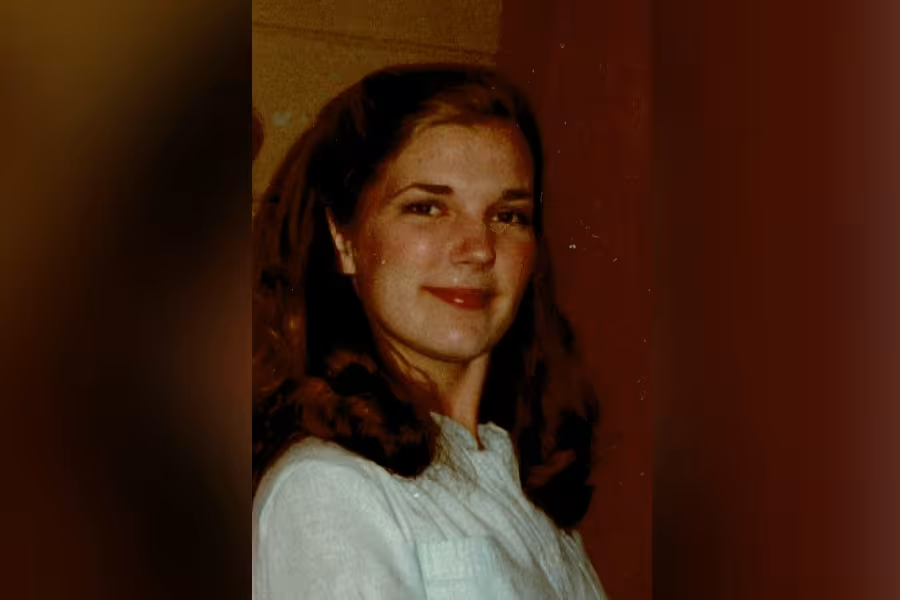
Interlochen Affiliation: IAC/NMC 80 | UNIV 83 | IAC St 84-85
Interview Date: June 28, 2025
Sara Ritchie Morgan studied violin and dance at National Music Camp as a high schooler, returning a few years later to study violin and voice under the University division.
This oral history is provided free by the Archives of the Interlochen Center for the Arts (ARTICA). It has been accepted for inclusion in Interlochen’s audio archive by an authorized administrator of Interlochen Center for the Arts. For more information, please contact archives@interlochen.org.
00:00:00 BRAD BAILEY
Today is June 26th, 2024, and this is an oral history interview with Melissa Niño, conducted by Brad Bailey on the campus of Interlochen Center for the Arts. Nice to meet you, Melissa.
00:00:11 MELISSA NIÑO
Nice meeting you, too.
00:00:13 BRAD BAILEY
So can you tell me your name and where you're from?
00:00:15 MELISSA NIÑO
My name is Melissa Niño. I'm from Venezuela.
00:00:18 BRAD BAILEY
What city? In Venezuela?
00:00:19 MELISSA NIÑO
In Caracas.
00:00:20 BRAD BAILEY
So can you tell me a little bit about your childhood growing up there in Caracas?
00:00:23 MELISSA NIÑO
Growing up in Venezuela, it was all about music ever since I was four years old, back in the days, teachers would go to community centers. I was in one of those places, I was kind of, let's say, discovered by some of these people. And one of the person that was teaching and leading this group was somebody called Emil Friedman.
00:00:44 BRAD BAILEY
Emil Friedman, okay.
00:00:45 MELISSA NIÑO
Which is a very famous music school. Well, a school as a whole in Caracas, Venezuela, but especially known by the music program. It's probably one of the best music programs in Caracas.
00:00:55 BRAD BAILEY
And could you spell that for me?
00:00:57 MELISSA NIÑO
Emil, E m i l. Friedman, F r i e d m a n.
00:01:04 BRAD BAILEY
Emil Friedman okay, great.
00:01:06 MELISSA NIÑO
And they wanted for me to be old enough to move to grade one. And once I was ready, I got a full scholarship to go to the school, and I moved from where I was to the Emil Friedman. It was just pure joy being- doing what I loved, which was music. It’s a very demanding, not only music school, but academic wise. And I grew up surrounded by El Sistema teachers, and at the same time, many international teachers. It has a very high quality music education, and students get an opportunity not only to get lessons, master classes, but in the future to go overseas to pursue the careers of musicians. And I happen to be one of those children.
00:01:50 BRAD BAILEY
And so what ages were you around that time?
00:01:53 MELISSA NIÑO
I started when I was four, but I got a scholarship when I was seven years old. So ever since I was seven years old, I was determined to be a musician.
00:02:04 BRAD BAILEY
And what was your support from your parents like at that time?
00:02:07 MELISSA NIÑO
Well, it was a lot of sacrifices. I grew up being an only child with a single mom, so that required a lot of time, work for my mom, be available to kind of move me around between rehearsals. school, friends, neighbors. I mean, it took a village to help Melissa to pursue the career of music.
00:02:32 BRAD BAILEY
So you mentioned that El Sistema, what- could you tell me a little bit more about the structure of El Sistema? What is that again?
00:02:37 MELISSA NIÑO
Yeah. Well, El Sistema, some people might know it was founded by Maestro Abreu.
00:02:41 BRAD BAILEY
Could you spell that?
00:02:43 MELISSA NIÑO
Abreu, A b r e u. Abreu. What is something great about Sistema is that not only it emits all social status, it has the purpose to provide music in ensembles and orchestras. When you work together pursuing music, rehearsing, there's a lot of values that come along with it that benefits the child, it benefits the community. It became such a phenomenon that many people, many countries overseas started to adapt El Sistema to their own needs, just like in the US. I'm actually right now one of the artistic directors of El Sistema inspired programs here in the States. So it's kind of like a full circle.
00:03:24 BRAD BAILEY
Where is, where is that program?
00:03:25 MELISSA NIÑO
In New Jersey, Trenton.
00:03:26 BRAD BAILEY
In Trenton. Wow. Yeah. Okay, cool. Where exactly? A school in Trenton?
00:03:30 MELISSA NIÑO
No, we actually have what we call nucleo. But we have more than 20 public school in Trenton, students that come to our program.
00:03:37 BRAD BAILEY
Okay, cool. And so tell me then, from you, you mentioned that at your school where you were at in Venezuela, you ended up having the opportunity to be able to travel overseas. So tell me about that experience and how you first came to Interlochen?
00:03:50 MELISSA NIÑO
My first experience apparently, was to come to Interlochen during the intermediate age.
I was accepted here. It was going to be my first time traveling. So I was a little bit too into music, and I left out my academics so they didn't allow me to travel. When I got into high school, I did better as a whole so I can come to Interlochen. And soon enough, I got a scholarship to come here to Interlochen. As a high school student, a violin major. And like I said to everybody, that trip changed my life as a musician, as a person.
00:04:27 BRAD BAILEY
So tell me a little bit about that first trip. What year was it and how old were you?
00:04:31 MELISSA NIÑO
I was 17 years old. And I remember coming here. I didn't speak English. It was a culture shock, starting with the music. As soon as you got here, you auditioned immediately. You didn't have time to prepare that much. As soon as I'm warming up, I'm hearing all these high school students who are phenomenal. I'm blown away. I'm a little bit scared, you know? At the same time, people speak English to me. I don't know how to answer. I'm checking in the high school division. The water tastes different. The food tastes different. I mean, you name it. Just by the first day, everything just changed too much. I didn't even have time. I feel sorry to say this to my mom, but I didn't have time to miss her, because every day, everything was so different. I don’t think that might happen to a lot of campers when they come here. The level was very high. The first rehearsal was scary because you see everybody sight reading, but they sight reading like professionals and you have to be arm to arm with these people. And it just takes a few weeks for you to be basically on the same level as they are. And that to me, not only showed me that I was able to do it, but I was surrounded by people that helped me, that supported me, that cheer me on even though I didn't understand 100% what they're saying. But I felt it. And, you know, that was inspiring. I didn't want to leave Interlochen. I came back and made sure that my English was better, that my skills were better. And then I auditioned again and I got a scholarship again. The following summer I came back to Interlochen, I enjoyed it even more because, you know, I was able now to communicate better. I was ready to compete, to be kind of closer to the front chairs in WYSO. So, you know, everything changed.
00:06:18 BRAD BAILEY
Tell me about the environment. What impact did the environment have on you as not just as a musician, but as a person?
00:06:25 MELISSA NIÑO
Let's talk about cultures. Part of our culture could be a little bit conservative. So when you come to a place like this where everybody is equal, when everybody has one thing in common, that is the love for arts, regardless which art you practice and everybody's accepted that you belong. It almost seems like a perfect world. Something that I never seen before. How everybody could be great at what they do. Accepted for what they do. And be happy about it. So that's why like going back to Interlochen was always- besides the music, personally, was a mind opening experience of we all can be different, but, you know, we can still share the same space regardless.
00:7:11 BRAD BAILEY
So after that third summer, what happened next in terms of your music career?
00:7:15 MELISSA NIÑO
Okay, so my third summer I was in college already. My second summer at Interlochen, when I came here, I met my future university teachers here from my undergrad and my masters. And my undergrad, I went to Arizona State University with Mr. Jonathan Swartz, and on my third year I was already a university student, couldn't be a camper. But he was still teaching here in the summer, so he was like, you know, come back because you need to have your lessons. So I came back and I worked at stage crew. Another eye opening experience. You know, one thing is being a musician, but another thing is knowing what happened backstage, how to take care of the instrument, how to move instrument, and seeing what happens at Interlochen when you're not a student. And the fourth year, I came back again. My teacher was still teaching here.
00:08:01 BRAD BAILEY
Wow. And so what you said you were- we gave you the opportunity to try to understand what happens when you're not a student here. Give me a little bit more information about that.
00:12:08 MELISSA NIÑO
To give you an example, just setting up orchestras. Just knowing how many chairs, how many stands each orchestra has. Where each orchestra is practicing, the time that the orchestra is practicing, and what type of piece they are performing so you might need to have a different type of setting. The needs of the conductor, conductor might have different preferences the way that they, you know, do their rehearsals. Weather wise, some of their rehearsals are in open space, like The Bowl. To be ready and move to resolve at the moment, you know, to quick thinking, all these little details that as a student to me, it was just - the orchestra was set there for me to play. That’s it. But it’s more than that. And watching the rehearsals as well, I’m always used to sitting in one part of the orchestra, the same section. Well that changes completely. When you’re doing stage crew, and you’re watching the rehearsal, sometimes you’re watching it in the back, you hear probably what the winds are hearing in rehearsals, so that as well, to me was an eye-opening. How sound was completely different depending where I sat on the orchestra. Which took me to take conducting classes at the university as well.
00:09:23 BRAD BAILEY
So you said you were a violinist?
00:09:25 MELISSA NIÑO
Yes.
00:09:25 BRAD BAILEY
So can you tell me about sort of like your practice as a violinist and how that improved over the time that you were here, those summers that you were here, not just as a high school student, but then as a college student?
00:09:36 MELISSA NIÑO
Well, first coming here, I realized, and this might sound a little cliche, but I realized that it is true when the teachers tell you to practice, sometimes we take it for granted. It's like, well, I don't feel like it. But the truth is the time of the day you're not practicing, somebody else is. So that means somebody else is improving their craft, is getting better at resolving a problem. And that also means that you might leaving things behind. When you grow older, because of the lifestyle we might develop, you don't have that much time to practice. So time becomes almost like a luxury, right? You don't have the five hours per day. Also, learning how to practice effectively. So I guess it's about maturing as well. Understanding what are the needs for you to get better at something, and be grateful for the time that you have, and take advantage of the opportunity and the time that you have as well, to invest on your craft to get better at what you do.
00:10:42 BRAD BAILEY
What prompted you to sort of go into conducting? You said that sitting back is- sitting in the back of the room during rehearsals, did that? I want to sort of clarify that. And tell me about your conducting career.
00:10:52 MELISSA NIÑO
Yes, it started with that. It started with me watching rehearsals in different places
00:10:58 BRAD BAILEY
At Interlochen?
00:10:59 MELISSA NIÑO
Yeah, at Interlochen and different places where I was at, and I was always just triggered, curious. And of course, the conductors that I have played with, each one of them has been so different. And sometimes, you know, as a musician, you might look at them. Maybe they are not the most clear people for you to understand. But there's something about the aura. It's kind of almost like a superpower. I had the opportunity to play with Neeme Jarvi. That's when the Detroit Symphony played with us. I didn't understand the way he was conducting. But there was something about his presence. You know, every time he stood up there, I felt like some kind of energy that just made me thrive and play better than I was already trying to do. So that to me felt powerful. Like how somebody can just stand up in front of so many people who are great and still have this ability to recharge, to inspire those musicians to continue to do the best they can. So I guess it was a mix of all those things.
00:12:00 BRAD BAILEY
As a result of those classes, what happened next with your musical career?
00:12:05 MELISSA NIÑO
Well, my musical career, it was slightly different assuming to what my teacher was expecting me to, to be. I know most of the musicians, especially performance musicians, violinists. Once you graduate from college, you are expected to audition to professional orchestra and play in a professional orchestra, which I did.
00:12:24 BRAD BAILEY
Which one?
00:12:25 MELISSA NIÑO
I played at the Arkansas Symphony Orchestra. I just wasn't happy with it. You know, I felt that I wanted to get to know the world. I wanted to grow. I didn't want to be, with all due respect, just a violinist. And I auditioned to go to Europe. There was this orchestra while I was doing my master's called the Jeunesses Musicales Orchestra, but it doesn't have that name anymore. It's called The World Orchestra, and it had- their headquarter right now is in Spain, but it used to be in Germany and Spain in between those two. And if you get accepted, they pay for everything. But you get to travel around Europe, play with musicians from all over the world in the best halls in Europe. So I loved that idea. And I remember I was doing my master's in North Texas, where-
00:13:11 BRAD BAILEY
Where was your master's?
00:13:12 MELISSA NIÑO
North Texas University.
00:13:14 BRAD BAILEY
North Texas. Okay.
00:13:15 MELISSA NIÑO
I study with Miss Julia Bushkova, who used to be a teacher here.
00:13:18 BRAD BAILEY
Yes. What was the name of the professor? I just want to clarify for the record.
00:13:20 MELISSA NIÑO
Julia. Julia. Bushkova.
00:13:23 BRAD BAILEY
Bouskova. Okay. Got it, got it.
00:13:24 MELISSA NIÑO
And I remember coming to her, and I told her, you know, I would like to try this. And she was like, well, go ahead. Prepare yourself. I got the spot and without thinking, I was just packing my luggage. And I spent probably two years like that traveling. I stayed in Spain for a couple of more years, in Madrid. I was playing with some of the orchestras there, but at the same time, I started getting into.. let me learn about recording, what does recording mean, with not only classical music, but different type of artists. I started doing musicals as well. And at the same time, I created my own trio. And every summer we used to do performances about women composers.
00:14:05 BRAD BAILEY
Was this in still in Madrid?
00:14:07 MELISSA NIÑO
Yes, I was in Madrid. I was already probably at that age, I want to do more for younger people. I was already thinking, I wanted to give kids what was given to me. So I was getting into the opportunities of education. That's how I started to get in touch with programs, music schools. They hear I'm from Venezuela, they ask question about El Sistema. That's how randomly this opportunity to go to Singapore happened. A music school reached out to me to help them build their string programs. And just like that, I took my luggages, took a plane and moved to Singapore. Built a string and chamber music program. And after I was done in Singapore, destiny moved in a very curious way that took me to Hong Kong. So I founded the- what is known right now as El Sistema Hong Kong. I found myself with few people from Hong Kong, well known in the, you know, arts department and some colleagues, musicians, and I developed the youth program over there, and I created the elderly program, something that hasn't been done before. And this is something was made at the needs of Hong Kong.
00:15:18 BRAD BAILEY
How long were you there for in Hong Kong?
00:15:20 MELISSA NIÑO
In Hong Kong, I was there for five years.
00:15:24 BRAD BAILEY
Wow.
00:15:25 MELISSA NIÑO
Yes.
00:15:26 BRAD BAILEY
Wow. And it's so unexpected, too. I guess because you never would have imagined.. Would you imagined your life would have taken you that route from Interlochen to all these places?
00:15:34 MELISSA NIÑO
Not at all. And if I'm honest with you, I wasn't aware of such places as Hong Kong.
00:15:40 BRAD BAILEY
Why is that? Tell me.
00:15:42 MELISSA NIÑO
Because I never looked further than that. But somehow, you know, destiny took me to that side of the world. And without thinking, almost spent ten years in Asia.
00:15:52 BRAD BAILEY
What year is this again?
00:15:53 MELISSA NIÑO
That was four years ago. 4 or 5 years ago. Right before the pandemic. There were a lot of protests, a lot of things happening, and we couldn't have class for weeks, for months. Everybody you know stayed at home. So it got to a point that I was thinking, maybe go back to something that's closer to my culture, be closer to my mom. Although she has been super supportive of my career and my decisions, parents also get older. And taking 15 hour planes wasn't that nice anymore. I interviewed in a few places in the States and Canada for El Sistema inspired programs that were looking for somebody like me and I fell in love with Trenton, which a lot of people find it very odd.
00:16:44 BRAD BAILEY
Well, I love Trenton. I went to school near there. I like Trenton, it's a great town.
00:16:49 MELISSA NIÑO
It is. And you know, it has potential. It has needs that I'm familiar with. I like to take programs that are not developed. I like to help them develop also because you can create your own culture. I left the States when I graduated from college, so I tell people that I took my violin and an empty backpack. Right? 20 years later, I'm back with my violin. But this backpack is full of experiences, and I'm ready to open up the backpack and provide all these experiences to a country that has been so good to me. So it's my way to also pay back to everything this place has given me. And destiny put me just in that position and that place happens to be Trenton.
00:17:40 BRAD BAILEY
I think you mentioned when we chatted earlier that you have a child here this year, or do you have a child?
00:17:44 MELISSA NIÑO
Yes, from my program. Okay, so I couldn't start immediately. I started online.
00:17:49 BRAD BAILEY
Okay.
00:27:04 MELISSA NIÑO
Ridiculous situation because I would wake up at 3 a.m. Hong Kong time so I could connect online and do the classes online.
00:17:58 BRAD BAILEY
Oh, so you'd already started the classes even while in Hong Kong during the pandemic?
00:18:02 MELISSA NIÑO
Yes.
00:18:02 BRAD BAILEY
Wow.
00:18:13 MELISSA NIÑO
Then I moved here in 2021. That's when we started in person and we basically reset the whole program. A lot of the students left after the pandemic. You know, it was really hard for everybody to restart again, even though it was really hard. Sometimes I call this a blessing as well, because sometimes maybe we need to pause, to rethink, to continue to improve and do things better. It's a string program and percussion. I wanted to add percussion just to celebrate the background of Trenton, which is mostly Black and Latin American families. And we started with ages from eight years old until 18. It is a social action program. I also wanted to make sure that we provide a high quality music standards for those who wants to be a musician. It was always my dream to trying to bring one of those students or those considering to be musicians to Interlochen. So we started to working with a few of them. And she was accepted to Interlochen. She's a viola player and now I'm back again, 25 years, to Interlochen. Just bringing her here, making sure she adjusts better. And I seen her happy. And it is such an emotional moment for me to see what she's going through. To bring her to a place like this. Because I do know it's going to change something in her. Interlochen changed my life, and I know you have heard this from a lot of people and how it changed my life in such a positive way. I want those students to also be part of this, hopefully to change their lives for better. So this is the first student. It is my goal to bring more. So I hope to have more generations of Trentonians here in Interlochen.
00:19:51 BRAD BAILEY
Wow, that's a beautiful story. Before today, when was the last time you actually visited campus?
00:19:58 MELISSA NIÑO
Oh, I was here last summer.
00:20:00 BRAD BAILEY
So before that, when was the last time you were here?
00:20:02 MELISSA NIÑO
Before the pandemic. I came here in 2019. And before 2019.
00:20:08 BRAD BAILEY
Or after 2019 to 2023.
00:20:12 MELISSA NIÑO
I worked, so it took me 10+ years, 15+ years, probably to come back.
00:20:17 BRAD BAILEY
Wow. So I knew that's what the question because I knew there was a gap in time.
00:20:20 MELISSA NIÑO
Yes, a big gap.
00:20:21 BRAD BAILEY
And so as you walk this campus and I think you've spoken to it a little bit, what was that experience like looking back on that little girl, you know, from Venezuela who came here for the first time in 1999? And now looking back, almost like 20, 25 years later, what does it feel like looking back at some of these places that you've, you've walked and, and dreamed and experienced.. How does it feel now, looking back at that journey and what that did for you?
00:20:50 MELISSA NIÑO
Well, it's a mix of emotions. You miss a lot of things. You wish to be a student again. You miss your friends. You reminiscence in those rehearsal times, those cold mornings, the food, the trumpet waking you up. But when I look at it today, you know, it brings a smile to my face. First, because the campus is big compared to 25 years ago. There are a lot of buildings now. It says that Interlochen continues to develop and continues to evolve. Anything that they had before, they have improved them.
00:21:27 BRAD BAILEY
The food?
00:21:27 MELISSA NIÑO
Yeah, I said, the food, the cafeteria. Yes. It has improved.
00:21:32 BRAD BAILEY
In what way? In what way?
00:21:34 MELISSA NIÑO
Well, they have more choices now. Healthy choices. Gluten free. You know vegan. Back in the days, you have a few things, of course you could choose, but there was not too many. Melody Freeze was your best friend. But I like to see the healthy choices which is connected to the farm that they have. I find that amazing that now Interlochen grows their own vegetables. The growth of many of the programs like film, that's one of my favorite programs now. Dance department, the new building. It keeps some of the traditions. But like anywhere you have to develop. And especially when providing opportunities to young students.
00:22:18 BRAD BAILEY
Who was your most memorable person here from Interlochen?
00:22:21 MELISSA NIÑO
You're going to get me in trouble. That's a hard one. That is a really hard one. I have a lot of people. I mean, from my counselors, the counselors play a really big role because these are the people you spend every day and make your life and your experience a good one. To the teachers, I mean, come on. I spend my next years with my teachers from Interlochen. I have this special person that is a celebrity in, here in Interlochen, Miss J. Berry, which happens to be somebody who took care of me my first summer, because when we ended summer camp in 1999, after the Les Préludes, all the kids returned to their homes, and there were three of us Venezuelans that we couldn't return home because plane tickets were not available until 5 or 4 days later. So she basically adopted the three of us. We spent 4 or 5 days at her house, enjoy the lake, eat pizza all day, and she was just so sweet to all of us. And then next summer was the same, to the point that J became more than just a staff at Interlochen. I always felt that J, to me, is family, almost like a mom, you know. When I worked at stage crew, she was my boss. And every time I come to visit Interlochen, I stay with her. I would have to say, if you talk about special people, she's one of those.
00:23:53 BRAD BAILEY
So what's your favorite place on the campus?
00:23:55 MELISSA NIÑO
Every time I come to campus, I do this weird thing that I need to hug a tree. I don't know why.
00:24:02 BRAD BAILEY
Hug a tree..
00:24:03 MELISSA NIÑO
Hug a tree. I need to get the energy. The Interlochen energy. I walk directly to Kresge and just stare at the lake view. I sit there for like ten minutes. That's always has been my view. That has been the place I say hello. That has been the place where I say goodbye, and that has been the place where I have this, like me, myself and I conversations. Ever since I was a child, sitting there looking at the lake, thinking, I'm coming back to this place.
00:24:34 BRAD BAILEY
What's your favorite Interlochen story to tell?
00:24:37 MELISSA NIÑO
These are very hard questions. I didn't say this to my students, but I make her read, you know that board at The Bowl?
00:24:45 BRAD BAILEY
What does it say?
00:24:46 MELISSA NIÑO
The quote that says when you hear the click, something ends but starts something else. I asked her to read the quote and she told me that doesn't make any sense. And I told her, I want you to read this again after the last concert. It will make a lot of sense to you. When you end a concert, that feeling that you have, it's really hard to understand. It's just magical that you have to experience to understand it.
00:25:13 BRAD BAILEY
How would you describe Interlochen to someone who hasn't experienced it?
00:25:17 MELISSA NIÑO
Interlochen is a place where people is passionate and is good at what they do, and get along regardless of their social difference, regardless of the religions, of the color of the skin. When everybody is so passionate about something, great things can happen. You will get that in Interlochen.
00:25:38 BRAD BAILEY
And so what is your hope for Interlochen's future?
00:25:41 MELISSA NIÑO
My hope, obviously, is for Interlochen to continue to grow. It's interesting you asked me this because last night I was thinking like, what would I add to Interlochen in ten years or so? What I would like to see and I started writing. It's funny, like I have a few notes here on my phone. Things that I will continue to add to Interlochen, and probably if they have it, that they could develop more.
00:26:03 BRAD BAILEY
Do you want to take the time to, to share?
00:26:05 MELISSA NIÑO
Let me share a few of them. I wrote the first one, I call it a wellness program. A wellness program, because I do believe musicians should be treated- artists in general, should be treated the same way athletes are treated. Taking care of their mental health and physically as well. You know, you practice for hours, you get tense, you get tired, you can get injured. This could be something to be considered. I don't know how to do it or maybe provide something for the students and the staff once per month where they go through a wellness check, like meeting a psychologist. massage therapy, looking at how the body is working, creating probably a stretching routine and workout routine depending on the instrument that they play. You don't have to wait to be sad or to be stressed or want to go to see a psychologist. You can go still when you're doing well just to maintain yourself. You don't have to wait until you can't move your neck in order to go chiropractor, you know? For Interlochen to consider a wellness program for their students and the staff as well, to keep them in the best shape. When you are in the best shape, you perform the best to your, you know, abilities. Then I added here like a conducting fellowship. I was thinking, you know, since there's so much talent and things continue to develop, probably provide these opportunities just like you do with auditions, when you recruit a certain group of students where they can work hand to hand with all the guest conductors, and perhaps have the opportunity to do rehearsals with the juniors or the intermediate orchestra to help them continue to develop as conductors. I'm always wondering what would happen if you started your conducting career just the same way you started any instrument. That was another thing that was on my mind when I was thinking. I think is something like an alumni summer camp. And this is, this is me reminiscing my days of Camp, thinking like, what if Interlochen could have 1 or 2 weeks of summer camp where those who were students at some point can return as adults and live the whole experience of being campers again? And perhaps in return, those alumni could also help students that are here during summer camp and have mentors for practice. And that's another class that I thought of. Maybe they have it, maybe they don't. But that's- I know how scary auditions could be. So perhaps having a specific class that is targeted to how to practice excerpts, how to prepare for auditions, how to record your auditions, how to dress up for your audition. That could be something great to help also students when they are getting ready to leave, you know, the college career.
00:29:13 BRAD BAILEY
That's a great idea. All wonderful ideas. Yeah. So what advice do you give to future Interlochen students?
00:29:20 MELISSA NIÑO
To future Interlochen students, take advantage of everything that is given to you at the moment. They have everything in their hands. They have the resources. They have a great faculty, a great staff. Take advantage of the opportunities that you have because one day you have them, the next day you don't. And time passed quite fast. And I always tell this to my students, do everything now. Don't wait till tomorrow. Take advantage of everything that is given to you.
00:29:57 BRAD BAILEY
So why does art matter in our world today?
00:30:01 MELISSA NIÑO
Art matters because art targets the human in you. The vulnerable in you. Arts allow you to express. Arts allows you to communicate, to feel, to heal. We cannot be or pretend to be a developed society if we ignore our thoughts, our feelings, our differences.
00:30:27 BRAD BAILEY
Well, thank you so much. That was fantastic.
00:30:30 MELISSA NIÑO
Thank you.
00:30:30 BRAD BAILEY
You know, is there anything you'd like to add that you think we haven't covered this hour or what do you what- Anything you'd like to add or sort of finish off the conversation with?
00:30:38 MELISSA NIÑO
Well, first of all, thank you for your time as well. I'm just going to make a call to all my alumni people out there to please connect, come back to Interlochen whenever you have the chance. Connect with the community, talk to people, bring your students. You know, let's keep this cycle rolling. Let's not let it fade out. Your heart is going to feel happy and you'll be healed.
00:31:02 BRAD BAILEY
Oh, wonderful. Well, thank you so much. You know, this concludes the interview with Melissa Niño here on June 26th, 2024, conducted by Brad Bailey on the campus of Interlochen Center for the Arts. Thank you very much, Melissa.
00:31:15 MELISSA NIÑO
Thank you.
Copyright
Copyright to the audio resource and its transcript is held by the Archives of Interlochen Center for the Arts (ARTICA) and is provided here for educational purposes only. It may not be reproduced or distributed in any other format without written permission