
Oral History Interview with Priscilla Haapa Hawkins
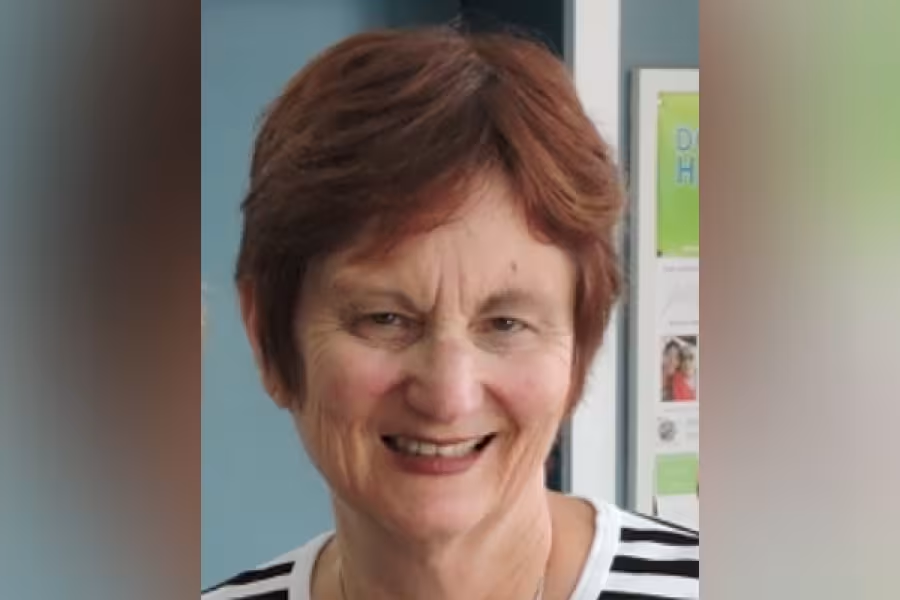
Interlochen Affiliation: AS 58-60 | IAC/NMC 62
Interview Date: July 3, 2024
Priscilla Hawkins studied cello for three summers at National Music Camp. She is the sister of alum Anitra Haapa Mercer.
<
This oral history is provided free by the Archives of the Interlochen Center for the Arts (ARTICA). It has been accepted for inclusion in Interlochen’s audio archive by an authorized administrator of Interlochen Center for the Arts. For more information, please contact archives@interlochen.org.
00:00:00 BRAD BAILEY
Today is July 3rd, 2024. This is Brad Bailey. I'm conducting oral history with
00:00:07 BRAD BAILEY
Priscilla Lowery Haapa Hawkins.
00:00:11 BRAD BAILEY
And so tell me your name and spell it for me.
00:00:13 PRISCILLA HAWKINS
Priscilla. P r i s c i l l a. Would you like my maiden name?
00:00:21 BRAD BAILEY
Yes.
00:00:22 PRISCILLA HAWKINS
Okay. My maiden name was Haapa, H a a p a. And my current last name. Hawkins, H a w k i n s.
00:00:38 BRAD BAILEY
Wonderful. And so where were you born and what was your childhood like?
00:00:41 PRISCILLA HAWKINS
I was born in a northern suburb of Detroit called Pleasant Ridge, Michigan. And I would say we had a very contented and a little bit like Camelot. You know, it was right after World War Two, but I knew nothing about that. So we were all having a great time and a pretty close family.
00:01:06 BRAD BAILEY
Tell me about how many brothers and sisters you had, and a little bit about your mother and father.
00:01:10 PRISCILLA HAWKINS
Two sisters. Anitra. She's 13 months older than me. And Kathe, who is four years older than me. Kathy was killed in an automobile accident when she was only 20 years old, so that was a very sad time. My mother, Lucille Mearkle Haapa, was a bit of a musician. We didn't see too much after, you know, she had a family, but she played some on the violin, I think the saxophone, and piano, and she sang. And she had a college degree, that was pretty good for those days for women. And she majored in Latin, so she was a Latin teacher. My father, Edward Haapa, his family came from Finland and Sweden. And we in our family grew up with a lot of the Finnish traditions. And that's why I enjoy going to Finland myself. So my father, he was one of these let's get going and get that college degree. He was the only one in his family and he started out at Suomi College, a small Finnish college in the Upper Peninsula of Michigan. And then he went to the University of Michigan and got a music degree, bachelor's. And then he also got a master's. And then he was a music teacher in the Ferndale Public schools. And along with that he became a stockbroker.
00:02:50 BRAD BAILEY
Wow. And so what was your first experience with music, personally?
00:02:56 PRISCILLA HAWKINS
I remember in school I actually started in third grade and I do remember some of that. We started in the Ferndale schools where they had strings starting in third grade, and I was given the cello to play. I think this was my parents, pretty much, idea because my two older sisters both played violin, and they had started in the school program too. And so it was my parents idea that I would play the cello, and I was very dutiful. And so I started playing the cello in school. And then after a year there, then I started taking private lessons. And so that was my first memories of the cello.
00:03:41 BRAD BAILEY
And what was your experience first like with Interlochen? How did you first come to know about Interlochen and how did that come about?
00:03:48 PRISCILLA HAWKINS
Well, it was my parents again. My parents met each other. They were both teaching school in Kingsley, Michigan, which is not far from here. And then my dad going to the University of Michigan. They knew about Interlochen. And so they thought, oh, that'd be a great place for the three girls to go in the summertime. And as my father had said, he's told me this all all through the years that he played the clarinet and the piano, but he wanted his girls to play the refined string instruments. So he never suggested we play anything else but one of the classical string instruments.
00:04:31 BRAD BAILEY
Okay. What year was that, coming here for the first time?
00:04:34 PRISCILLA HAWKINS
I think for me, it was 1957.
00:04:38 BRAD BAILEY
Okay.
00:04:38 PRISCILLA HAWKINS
Yes.
00:04:39 BRAD BAILEY
Was it for Camp or All-State or what?
00:04:41 PRISCILLA HAWKINS
It was for the All-State program, and I liked it pretty well. I can't say that I was totally enthusiastic about it.
00:04:50 BRAD BAILEY
How come?
00:04:51 PRISCILLA HAWKINS
The rules. I'm the kind of person, I think rules are great. You have to have them. And I do like a lot of that about Interlochen. But I was always the kind of person and still am, who likes to test the rules a little bit and see if I can do this or that. And I did that a lot with my father, too, in his demands that you practice your instruments or whatever it was. Yeah. So I think that was the one thing I thought, oh, they'll make us get up at a certain time and, you know, and things like that. So in the beginning, that's the way it was. And things did change.
00:05:29 BRAD BAILEY
In what way? In changing what way then?
00:05:32 PRISCILLA HAWKINS
I came in 1958 again. I really don't know if that was my choice or my parents. It was probably more them, you know. And then in 1962, I was here for the whole summer in the high school girls division, and I was still trying to get around some of the rules. And I got in trouble a couple times. But luckily they didn't send me home. So what I have found, though, as time goes along, you know, you mature and you change and I start to realize that Interlochen has rules for a reason. And they are very traditional, but yet they let you have some freedom. If you kind of open your eyes and see. Look at this beautiful place. Oh, look at this great cello teacher I get to study with. You know, it's all how you look at things. And I think that changed over the years in a positive way. And yeah, now I'm, like, totally enthralled with Interlochen. That doesn't mean that I think everything is great here. I think in life that there's not one thing that you do where, Oh, this is totally great. I wouldn't change a thing. I wouldn't, you know. I mean, if you're a real thinking person, there's always something there. But, you know, you weigh the parts that you maybe don't like so well, like at Interlochen, the challenges didn't like those. And you weigh that against all of the really great parts of being here at Interlochen, which I can get into now or later.
00:07:16 BRAD BAILEY
Get into now.
00:07:18 PRISCILLA HAWKINS
Okay. Okay. I think the last couple of days being here at Interlochen, I've been thinking about what would be the really strongest thing. I think that I remember in a positive way. And it's the music. Even now, when I listen to or hear on the radio, just some random piece, so many times I go- Interlochen. I think of Interlochen because that's the first place that I played it, you know. So there's a lot of musicians also know, you know, music can bring a whole set of feelings and so forth. And just since I've been around music all my life and in our family, we went to concerts all the time, you know, so we got to know a lot of the great music. But some of the pieces I especially remember are, let's see, Tchaikovsky's Fourth Symphony, of course, Les Préludes, the Meistersingers by Bizet.
00:08:19 BRAD BAILEY
And just to clarify, these are pieces that were you were here when you were here?
00:08:22 PRISCILLA HAWKINS
Yes, yes. At different times that we played. And that's what I remember.
00:08:26 BRAD BAILEY
Go through the list in total if you wish.
00:08:29 PRISCILLA HAWKINS
I didn't write everything down here. Tchaikovsky's Fourth Symphony and the Sixth Symphony. Tthe procession to the Meistersingers by Wagner. Those are just the ones I wrote down. But to me, that's what has really enriched my life. The fact that I've played this music and it means so much more, I think, to you, to a person that does to me when I played something and then I hear it and it's like, oh, it brings back, you know, so many memories. So I would say that is the main thing about Interlochen and there are lots of other parts also.
00:09:14 BRAD BAILEY
Well, no. Keep going. I'm listening.
00:09:15 PRISCILLA HAWKINS
Okay. Okay. Then I think in my mind the second thing would be the people here, you know, it's just amazing because you have here people who are all involved in the arts in all different ways and not just music. And that's the way I grew up. And so that's what's, you know, really important to me and is so meaningful in my life in so many ways. And it makes me want to oh, I have to go back and read more about Gustav Mahler or another composer. And so just walking around Interlochen now is just brings back all those memories of how it always was whenever I came here. And I think that was one of the parts that I just really loved. The people, they're interested in the same things that you are. So it's easier to make friends and to concentrate on how you learn so much from other people who have some similar interests and so forth.
00:10:22 BRAD BAILEY
So tell me about your sister, Kathe. Do you remember any her experiences here or at all?
00:10:28 PRISCILLA HAWKINS
I don't think that Kathe and I were ever here in the same years.
00:10:34 BRAD BAILEY
Well, tell me about her musical experiences or anything that you remember from her musically?
00:10:39 PRISCILLA HAWKINS
Yes. Okay. Kathe was a good violinist. She was a very strong personality and she also liked the world of fashion. And so what Kathe did is she went to Michigan State University and studied music for two years. But then she decided that she might want to do something else, like maybe in the fashion industry. So she went back home, lived at home that was in Pleasant Ridge, Michigan, and she started working at Jacobson's. That's an old store in in Birmingham. It's not there anymore of women's fashion. And then she applied to the Toby Coburn Fashion School of Design in New York City. And I remember the first time she applied, she didn't get accepted, but the second time she did get accepted, but it was two weeks after she was killed in the automobile accident. The Detroit area, north of Detroit. We had the cruising.. some of you people may be listening to this will remember about that cruising down Woodward Avenue. That's what we did for fun. And our dad would not let us listen to rock and roll at home. And so-
00:12:07 BRAD BAILEY
Why not?
00:12:08 PRISCILLA HAWKINS
Oh, he wanted us to be refined. And, you know, he came from a family where, as far as I can tell, there wasn't any music there. His mother, I never met her, but his mother did encourage him to play the piano. But as I mentioned before, he wanted his girls, me and my sisters, to play the refined instruments. So he was all into orchestra music. Classical music. That's the best stuff, you know, he would say. So our mother, she realized we were teenagers, and yeah, sure, we liked rock and roll. So when my dad was gone, she would let us listen to rock and roll at home, but otherwise we had to go out cruising. It's one of the reasons we did it in that in the cars up and down Woodward. And that's what my sister was doing that night when she was killed. And she and her girlfriend had met two boys that I think they kind of knew. They got in the car with these two boys, were driving around, it was raining. One of the boys just made a mistake in judgment and he drove out. He was on a side road, drove out into a fairly busy highway, and it was raining. And so maybe he did not see the car coming. And so the car ran into him. My sister was the only one who was- she was thrown out of the car. These were the days before seatbelts.
00:13:41 BRAD BAILEY
Oh, goodness. What's Kathe's last name again?
00:13:42 PRISCILLA HAWKINS
Yeah. Haapa.
00:13:43 BRAD BAILEY
Haapa. How do you spell that?
00:13:45 PRISCILLA HAWKINS
H a a p a.
00:13:48 BRAD BAILEY
Got it. I'm so sorry to hear that.
00:13:50 PRISCILLA HAWKINS
Yeah. And another little thing I'll tell about that, too. So my dad wanted to establish a scholarship, and the scholarship was in my sister's memory was done through Ferndale High School, because that's where we all went to school. And it was to provide a scholarship for a student to go to Interlochen in the summer.
00:14:15 BRAD BAILEY
Wow. How long did that scholarship last for?
00:14:19 PRISCILLA HAWKINS
Let's see. I remember exactly about that when my dad decided because he didn't like how they were administering it or something at Ferndale High School. So that would probably be that was probably at least 25 years.
00:14:35 BRAD BAILEY
Oh, that's a long time.
00:14:36 PRISCILLA HAWKINS
And then he took the money out of there, and he gave it to my daughter, Shanda Lowery Sachs, who played in Detroit Symphony. Well, not yet, but she was going to be. But I gave it to her to buy a viola.
00:14:51 BRAD BAILEY
Okay. Yeah. Wonderful, wonderful. So what did you end up doing? And what was your life after? Where'd you go for college?
00:14:57 PRISCILLA HAWKINS
University of Michigan.
00:14:58 BRAD BAILEY
Okay.
00:14:59 PRISCILLA HAWKINS
Studying music.
00:15:00 BRAD BAILEY
All right. Great. Tell me about that experience.
00:15:02 PRISCILLA HAWKINS
Yeah. I'm glad that I did get a degree at the University of Michigan, because it's meant a lot over the years. It actually has helped to me, you know, because I know even out there in California, where I've lived now for many years, people will go, oh, University of Michigan music school, you know. So it has some prestige.
00:15:23 BRAD BAILEY
Where in California do you live?
00:15:24 PRISCILLA HAWKINS
We live in a small town called Lee Vining, and it's near Yosemite National Park.
00:15:31 BRAD BAILEY
Okay.
00:15:32 PRISCILLA HAWKINS
Yeah.
00:15:33 BRAD BAILEY
Wow.
00:15:33 PRISCILLA HAWKINS
It's a pretty remote place, but we did live in Davis, California.
00:15:37 BRAD BAILEY
Of course, which is near the University of California Davis.
00:15:40 PRISCILLA HAWKINS
Yeah, yeah.
00:15:40 BRAD BAILEY
So what?
00:15:41 PRISCILLA HAWKINS
Okay.
00:15:42 BRAD BAILEY
Oh, yeah-go ahead.
00:15:43 PRISCILLA HAWKINS
Yeah. So I didn't have to think too much about if I was going to major in music, because that was the main thing I knew, you know? So I decided, okay. And so I got a bachelor's degree in string education. So basically I was a string specialist then after that. At the University of Michigan, I think was a little bit too big a school for me. I think I would have been happier in a smaller school.
00:16:16 BRAD BAILEY
Like your sister went to?
00:16:17 PRISCILLA HAWKINS
Yes. Uh huh.
00:16:19 BRAD BAILEY
Yeah. Yeah. Yeah.
00:16:20 PRISCILLA HAWKINS
Yeah I know. Anitra really liked her college years. So, yeah, I mean, it's a huge school. And also, this didn't help- that first year I was at the University of Michigan, they did not have the new music school, which they have now out on the North Campus, and that was quite the pain hauling things around. We had to go in like in the middle of Ann Arbor, a couple different churches and then some other building that was a music school. So my second year, then they had the new music school built, so that was a little better, but still had to take the bus out to North Campus. And yeah, I think the bigness of it was just a bit much for me, but I stayed there. I had thought about transferring. I stayed there because I thought it was getting a pretty good education. But I will say about cello playing that I learned the most about playing the cello from my very first teacher for the first five years. That was Arlene Seaman, who lived in Detroit. And then the other place I learned the most about playing the cello was after college. That's when I really became interested. So college was just okay, college is over now. Let's go into life.
00:17:34 BRAD BAILEY
So what did you play here at Interlochen?
00:17:37 PRISCILLA HAWKINS
What instruments I played?
00:17:38 BRAD BAILEY
Yeah.
00:17:38 PRISCILLA HAWKINS
Cello.
00:17:38 BRAD BAILEY
Cello? Okay, but so did you feel like you learned a lot here?
00:17:41 PRISCILLA HAWKINS
Yeah. No, that's a good question. I don't think I practiced a lot during those years. It came fairly easily to me. I did take some private lessons. There wasn't a teacher that I, you know, was especially fond of. But, yeah, I think more than just learning the cello, I just learned the beautiful classical music, you know, and that just was like an entrance way for me into classical music. And then later after college and all through the years since, you know, I then have become more interested in practicing and playing different chamber music and so forth.
00:18:28 BRAD BAILEY
And so for life. You mentioned after college you went into life. What was life like for you? What did you do these past 60 years?
00:18:36 PRISCILLA HAWKINS
Well, yes. Well, first I taught a strings in Detroit Public Schools. That was my first job. In those days, Detroit had a really good music program, you know, and I know they're trying to bring things back. And Detroit Symphony is working on that, too. But yes, I went around to seven different schools driving around and taught strings. And so, you know, cello being of course, my main instrument. But in those days, as I recall, I mostly had violins in the school programs. So I did that for three years. And then I realized that I really preferred to teach private lessons and to play. I wanted to play in orchestra. And there are a number of different orchestras, like in those days, there was a Detroit Women's Symphony, and I really enjoyed in playing there. And I guess that's the end of that sentence.
00:19:32 BRAD BAILEY
No, no, no. So you taught there for how many years in Detroit Public Schools again?
00:19:35 PRISCILLA HAWKINS
Oh, that was only three. And I just voluntarily decided to quit. Yeah. So I started teaching privately, and that's what I mostly love to do. I love working with the students. And so through the years, as far as my cello education, what I did is I went to a lot of master classes, of some of the best cello teachers in the country and went to American string teachers conventions and specially went to, you know, cello classes where you learn about, you know, a lot of specifics. And I took notes. I had all these little books, and I took notes in there, and I remember thinking, oh, yeah, I really want to be the best cello teacher that I can. And then I thought, oh my gosh, I've learned all these new things from all these cello teachers. How am I going to ever remember this when it comes time to teach a specific student? And I kept looking in my little books and kept using all these different ways to teach on the students. And it's there. I mean, finally, I got to a point, well, probably probably about 30 years ago, where I can just pull out of my bag, you know, what a specific student needs to do. And so I have found when I get students who really are willing to practice, they make a lot of progress.
00:21:05 BRAD BAILEY
And so for the past few years, that's what you've been doing, teaching privately?
00:21:09 PRISCILLA HAWKINS
Yeah, that's what I've been doing. And also, so I was- we lived in the Central Valley in California. And during that time I was principal cellist of Bakersfield Symphony and the Tulare County Symphony.
00:21:22 BRAD BAILEY
And Fresno was in that area, too.
00:21:23 PRISCILLA HAWKINS
Yes, Fresno and I played some in Fresno also.
00:21:27 BRAD BAILEY
Wow. And when did you move out to California?
00:21:29 PRISCILLA HAWKINS
That was the year Shanda was born, in 1972.
00:21:33 BRAD BAILEY
'72.
00:21:33 PRISCILLA HAWKINS
Yeah.
00:21:34 BRAD BAILEY
Talk to me, then about some of your experiences here at Interlochen. You know, in terms of, like, what was your favorite place on the campus?
00:21:42 PRISCILLA HAWKINS
The waterfront.
00:21:43 BRAD BAILEY
Well, how come? How come?
00:21:45 PRISCILLA HAWKINS
I love to look at water, and it's so peaceful to me. And I was just in the old part of the dance studio. The old dance studio. And that's where I took ballet. That was my elective. The one whole summer I was here, and I thought I always liked that ballet class. And I realized, you know, one of the reasons, because of the windows, you could look outside at the lake and the trees and yes, I love nature, so I always like that. The waterfront. Okay. I will say the cafeteria, because that's where usually with my friends, we would sit around and seemed like we usually would have time after, you know, we ate, and girls, you know, laughing up a storm all the time and, you know, all the fun things that we did.
00:22:39 BRAD BAILEY
Is there a memorable person that sticks out to you during your time here?
00:22:42 PRISCILLA HAWKINS
I didn't feel like I had a lot of friends. I'm much more outgoing now, but I was kind of shy in those days. But there was this one friend that I had, but I haven't kept in contact with her over the years. Who, I think she was a piano major. So I didn't see her that much around. But we would meet at the wishing well and we had a good time.
00:23:10 BRAD BAILEY
What person made the greatest impression of you?
00:23:12 PRISCILLA HAWKINS
I think of two people. Roger Jacobi. I think he knew my dad also, but he was a real supporter of me and my sisters. So I just remember him always being supportive and recognized me, you know. And then also in college, I had some contact with him, too, because he was a counselor of mine for a while. And I remember he was a very caring person. Okay then there was, well, cello teacher who a lot of cellists would remember here. Oliver Edel. He was a gruff type guy. I didn't necessarily think he was the greatest cello teacher for me, but I do remember he was very supportive in the All-State program especially, I remember. And he would always give me the benefit of the doubt. Benefit of the doubt as far as where I sat in the section.
00:24:09 BRAD BAILEY
Got it, got it, got it.
00:24:10 PRISCILLA HAWKINS
Personally, I prefer to sit up towards the front of the section, you know, and I tell my students that now, you know, you don't want to be in the back kind of hiding out in the back of the section because you're farther away from the conductor. You just don't get it. You can't hear as much back there. And one other person I want to mention too is Orion Dalley. Now, he was the conductor of the Michigan Youth Symphony, which me and my sisters all played, and we would meet every other Saturday during the school year. And he was a real booster of me and my sisters also. And we even have a picture, was in the newspaper of, oh, upcoming Youth Symphony concert. And here's the three sisters who play string instruments, you know.
00:25:01 BRAD BAILEY
And so when looking back on this experience, what does Interlochen mean to you personally and professionally? Because you mentioned there were some good things and maybe some other things. So if you don't mind giving us a a whole picture of what this place means to you?
00:25:15 PRISCILLA HAWKINS
Yes. It has very much meaning to my whole life, and there's certainly little parts which I have mentioned, but I think the big picture is the location is so beautiful here. And, and I do love, as I mentioned, the outer doors. So I think that Dr. Maddy chose a very good location. And then it's like there's music going on all around you everywhere. Where else can you go, you know, where you have that. And you learn to deal with different people and, you know, different teachers. You learn how to stay on schedule and be where you're supposed to be, you know, at a certain time. And at least right now, I think the food is great here. I don't remember how it used to be, but I think it's pretty good right now. We've been eating over there in the dining room.
00:26:16 BRAD BAILEY
No, it's been good. So how would you describe Interlochen as someone who hasn't experienced it?
00:26:22 PRISCILLA HAWKINS
I tried to do that a lot with my students over the years, you know, while teaching primarily in California. You know, of course, Michigan seems like a long ways away, but I tell them that this is an experience that could change your life. It could help you decide, do you want to go on at all with music or theater or dance, whatever your area of the arts is? And the reason it could very possibly change your life is because they have it all here. Like, it's not perfect, but you have a place where you're hearing music all the time, you're learning about it, you're going to classes. It's all like little parts of the whole that could make a big change in your life. And I'll just mention too, all the years I taught in Davis, California, I had some really good students. I finally got one student to come to Interlochen just from all the talking about it. And again, she was not a girl that practiced much, but she had the musical and theater, you know, ability, and I could see that about her. And she was quite open to new things. She finally came here and guess what? Changed her life. She went on to major in cello at Indiana University, and now she's living in Los Angeles, and she's got some very different program that she has. I haven't experienced it, but that she and her boyfriend, who plays trumpet have thought up, and I know she's doing some alternative cello things to also along those lines. I'll mention it changed my daughter's life, Shanda.
00:28:22 BRAD BAILEY
In what way?
00:28:25 PRISCILLA HAWKINS
I was the one who always was getting her to practice. I could see she started when she was about five. I could see that she had a talent. There was no question about that. I could see she had a talent that I didn't have. She very rarely needed to practice. She was the greatest sight reader, and I remember that when she was in sixth grade, I said, back there in California, I said, well, Shanda, you want to sit down and we can play some violin and cello duets. And she did. And I mean, my mouth just hung open that she was sight reading these things, the rhythms, all the notes and, you know, everything. So I knew she had that. But the place that we were living then, there wasn't much music there, and there weren't any other kids who were at her level at all. And I know that she needed to be challenged by people who were doing better than she was. So we got her to come to Interlochen for summer. That was between seventh and eighth grade, and I could see things started to change. But then when, through under a lot of duress, I got her to come to the Arts Academy for sophomore, junior and senior years. And she loved it. She was so glad to be out of the town that we lived in and playing music. And then she went on to college, majored in music, switched to viola, and then after her bachelor's degree, she went on and got a master's degree in viola performance. And then she said to me, she said, "You know what, Mom? What I want to do is see if I can play in the best orchestra that I can, one of the best orchestras in the country." And I said, Okay, you know what that means." And she says, "yes, practice." So anyway, I mean, Interlochen is what made all the difference there. And she is a total supporter of Interlochen.
00:30:39 BRAD BAILEY
Wow.
00:30:40 PRISCILLA HAWKINS
Yeah.
00:30:41 BRAD BAILEY
Wow. Well, thank you so much. Is there any future advice you want to give to any future Interlochen students?
00:30:46 PRISCILLA HAWKINS
I think just take advantage of every opportunity you have. I didn't always through the years, but I do now. Every advantage. We all know that, you know, as performers we get nervous about, oh, if I do that, I might mess up or, you know, that kind of thing. So try to let that go away and not let it get in your way of taking advantage. Like just if somebody says to you, oh, why don't you go audition for this summer music program or something like that, do it because you just never know. Maybe you don't get chosen right away, but maybe one year or two years later you do get chosen. So be open and willing to do what comes along.
00:31:40 BRAD BAILEY
And I ask your sister this question, which is the last question: Why does art matter in our world today?
00:31:45 PRISCILLA HAWKINS
Um, I think it brings people to live with their own soul. You know, it brings kind of inwards. You have to go inward with art. You see art, you experience it and all, and it's something that you can take in. You don't have to. But so many times. And that's really the case here at Interlochen. There's your opportunity to take in something that you are doing for yourself, not just something somebody else is doing. You know, and then you have meaning in your life. And I really think that it encompasses, you know, your whole body. It's something that you did yourself. And you make a contribution to yourself, to your family and to your world.
00:32:42 BRAD BAILEY
Wonderful. Well, thank you so much. We'll have another opportunity to chat with your sister shortly, but I want to thank you for your interview today. So today is July 3rd, 2024. This is Brad Bailey concluding an oral history interview with:
00:32:56 PRISCILLA HAWKINS
Priscilla Hawkins.
00:32:59 BRAD BAILEY
Here on the campus of the Interlochen Center for the Arts. Thank you so much, Priscilla. It was wonderful.
Copyright
Copyright to the audio resource and its transcript is held by the Archives of Interlochen Center for the Arts (ARTICA) and is provided here for educational purposes only. It may not be reproduced or distributed in any other format without written permission