
Oral History Interview with Pat Kessel
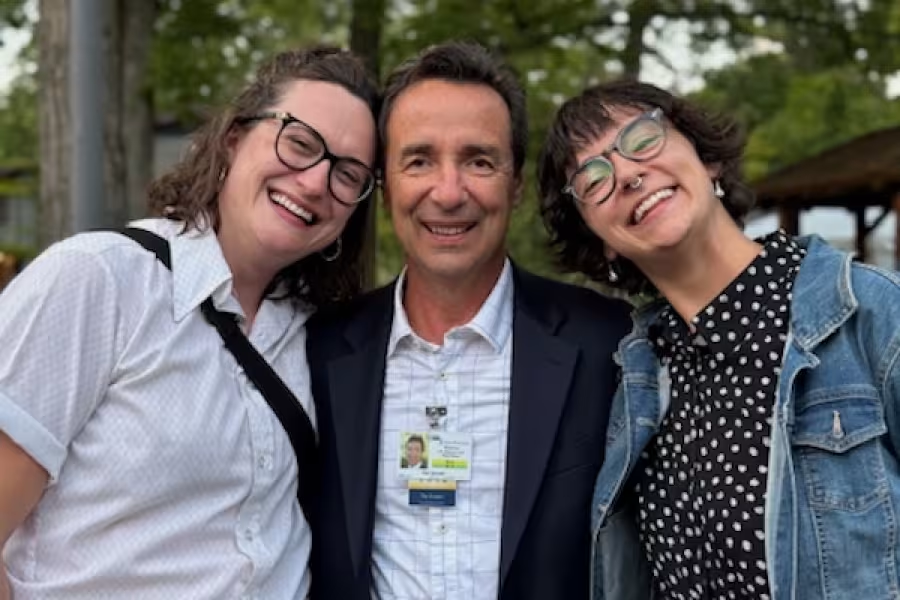
Interlochen Affiliation: ICA St 91-25
Interview Date: July 17, 2025
Pat Kessel is a Camp and Academy parent and a 35-year employee of Interlochen.
This oral history is provided free by the Archives of the Interlochen Center for the Arts (ARTICA). It has been accepted for inclusion in Interlochen’s audio archive by an authorized administrator of Interlochen Center for the Arts. For more information, please contact archives@interlochen.org.
00:00:00 ELIZABETH FLOOD
Today is July 17, 2025, and this is an oral history interview with Pat Kessel, conducted by Elizabeth Flood on the campus of Interlochen Center for the Arts. Thank you very much for your time today. I'm excited to speak with you.
00:00:13 PAT KESSEL
Yeah, I'm excited as well.
00:00:15 ELIZABETH FLOOD
So to begin, could you please tell us your name and your connection to Interlochen and the years that you've been in relation?
00:00:23 PAT KESSEL
Sure. I'm Pat Kessel, VP of Finance and Operations at Interlochen Center for the Arts. And, I started in the fall of 1991, and I actually have planned my retirement, which will be May of 2026, so this will be my last year. So excited to retire, but super happy to be here for, I guess that would be, over 34 years.
00:00:47 ELIZABETH FLOOD
Congratulations.
00:00:48 PAT KESSEL
Thank you.
00:00:49 ELIZABETH FLOOD
So what brought you to Interlochen?
00:00:53 PAT KESSEL
Sure. I was working in Illinois, Central Illinois, for for-profit, a large corporation, and I got a job in Traverse City at Chef Pierre Sara Lee. And came up and had never been to Michigan before, loved the area. And probably about a couple of years in, I remember coming to Interlochen, and it was much different back then. It was in the late 80s. I remember driving in and seeing, it must have been a Sunday, because everybody was in their whites, and kids going up and down the road. And I pulled in and they had looked like, set up for how they set up for Collage in the summer, and we have some things in the mall area. And I'm like, wow, this is really interesting. And I’d been living up here a couple of years, and didn't even know about the place. It was fascinating to see that. Long story short, I was looking then to get a job, because my job was transferring back to Illinois, Chicago, Sara Lee had a corporate office down there. So I said, yeah, I really like it up here. I remember visiting Interlochen, and I had talked to a few people that were working out here, and they were looking for a controller on the finance side, so I applied not having any experience in the nonprofit realm at all, and got lucky and got the job. And I would say a lot of people in the area at the time knew about the music camp, but had no idea that since '62 we had an academy for students. People would say to me, "Well, what do you do during the wintertime, you know, when the camp's not going?" I'd say Well, there's a year round school, and that happened for probably, oh, fifteen, twenty years. And so I'm always shocked that as world renowned as Interlochen is, in my view, that even some of the locals still didn't understand that we were a year round facility. So we've gotten much better at that over time, but that was kind of my introduction to the institution.
00:02:44 ELIZABETH FLOOD
I love how the uniforms mark time, and that you knew as a Sunday in memory about that. What - were you just coming to visit?
00:02:52 PAT KESSEL
I was so new to the area. On weekends, I would drive around, I would go north, I would come south. And it was funny, because what I really thought it was, is this, like, like a detention camp for kids, because they were in uniform, and they were kind of in lockstep, and this is when they were a little more flexible on walking along J Maddy, which, you know, the old highway, and so that was really curious. There was no front gates or anything, and it was just basically anybody could come in and walk around. Probably not the safest idea for a camp, but very welcoming. It didn't feel dangerous at all when I pulled up. It was quite the shock. And there was, there wasn't a lot of signage back then, either, and people walking all over, parking all over, there wasn't much structure to it. And so yeah, that was kind of my introduction, and not really had a huge background in the arts. I grew up with a family, there was five of us kids, and the three girls were the art side and the boys were the sports side. But I always liked the arts, so I was really intrigued by that, and hoping that my skills on financial management would help support the school.
00:03:58 ELIZABETH FLOOD
Could you talk a little bit more about the changes that you've seen. Maybe, could you first talk a little bit more about what the campus was like when you first got here? You said already that there was much less signage, different gates.
00:04:10 PAT KESSEL
Yes. I mean, people were parking right in front of the Maddy building. It was just a little bit of a free for all, honestly, so if you taught or had an office in a space, you would park up right next to where you were. Nobody seemed to mind it. Things weren't kept up as much. My second year here, there was a tough meeting with the board. We had a big deficit. Here I am, one of the people in charge of the financial situation. I'd been here, yeah, about a year, and it was a, it was a tough year. So we had a loss, I think it was about a $1.2 million and it would equate to maybe five or six million lost in today's numbers. So big, big time, you know, financial issues. And so, without getting into the details, there's several upper management people that lost their jobs because of it. Luckily, I wasn't one of them. So it was kind of the wake up call, I think, for the institution, and saying, we have to do better on financial management. For example, so the son of Joe Maddy is Dick Maddy, and he was an instrument maker, and he'd make violins and violas, and he was the controller basically before I started. And so what the institution used to do was to say, hey, you know, for example, Dick, you're pretty good with numbers -Not that any of this was his fault, but just that they didn't hire professionals in marketing and fundraising, in finance. They would hire professionals in the arts, of course, but they always had folks do double duty. So Dick was working in the repair shop, but he was also helping manage the books. And so when I came in, it was all - you probably don't even know, but there was this green ledger paper that all of the accounting was on, so it was non computerized, right? And even though when I started in '91 I'd worked on computers in my previous job, but that was the corporate side, and so the institution was just getting into computers. So, my first job was to pull together all the information related to all the assets, so all of the instruments, all the buildings, all of that had to be computerized to say how old is it? Keeping track of everything to make sure it's still here every year, that type of thing. So that was a big introduction. And then, of course, we put in accounting systems. So just from that standpoint, I would say that, you know, the art side, for the facilities they had, the teachers were doing phenomenal things because they were in the basements of dormitories, teaching music in these little studios with the soil pipes from the bathrooms up above. And every time they'd, you know, flush, there would be noises and you know, and they have to stop their lesson. And so, you know, that went on for quite a bit. So I've seen the faculty kind of struggle with their space. And you know, since I've been here, we've put over $90 million worth of infrastructure into the institution. And so, back in early 90s, we have an issue, how are we going to deal with it? And so to get out of that, we decided and the board agreed to take on some debt, because really there was no debt here, like didn't have a mortgage on any of the buildings or anything. And so they agreed to put an influx of cash. We borrowed $16 million and $8 million of that was just what we call deferred maintenance. So, everything that we hadn't fixed, the leaky roofs and the boilers and the windows, the parking lots, all of those things that had been pushed aside to kind of help balance the budget, and say, "We'll worry about that next year," like an old car, like you, continue to not want to put any money into it. And so that was kind of the beginning of the new era of putting money back into the institution and getting more professional fundraisers, and then over time, being able to build a good base. And kind of my main goal was, how do I build this really good foundation financially for the institution, and also create better space for teachers and students, for performances, for rehearsals, for practice, so that they can concentrate more on their skill set and their discipline than worrying about the issues that were related to kind of the subpar spaces that they had before. Unfortunately, the school started as a music school. The last building, well close to the last building other than the Dance Building, was the music building. And finally that came through. I saw, we worked with five different architects over the years. We, of course, canned the first four, and then we finally put it up in 2017, so it took a long time for music to develop. Our biggest building at the time. It started out actually almost twice as big, but we couldn't afford to build as big as we wanted, but it's still a fantastic space. And then after that, was the dance building, and the architects wanted it near the writing house in that big field, what we call the Opera Field. I was never in favor of that. That goes back to way back when I first started there was a master plan that was completed in 1990 from Sasaki, and so they had these mapped out, and they wanted the lake to be more for viewing and not really have a lot of programmatic space. And so, we talked to the alums from the dance, and they said, "We love the lake," so we incorporated the new into the old and built that space thanks to donors and thanks to great, you know, department heads and the dance area. You know, if you seen that, you know how great a facility that is using the lake as the backdrop and then building the dormitory next to it, and then actually using it for programmatic and residential life, versus just having a place to look at the lake. And so that was a big change, which I was excited about to see, that we've convinced the new architects to move it out and not just have a bunch of black boxes up in a field away from the beauty of the lake and the woods. So, yeah, there's been a ton of changes over the years. We never had, what we call, like an emergency or rainy day fund. For example, we had one, we had Covid. How do we prepare for those times when maybe it's an economic struggle throughout the world? Maybe, you know, we have a lot of international students and faculty, if there is issues with them traveling and all of that, what do we do if we can't have a full academy or full camp? And so years ago, we started building a reserve fund, and just like you would if you're saving for retirement, you start putting a little bit away. And so now we've got a great fund in there for that. We also have a Catalyst Fund for new projects like Interlochen Online, so we can put investment into that to see how we can spread the word and, you know, help teach students through online versus being here. I guess the other big thing is our board sophistication is way, way better, not that that the folks earlier on weren't great people, but they weren't as sophisticated as the current group, and we just kept raising the bar for that, which then allows us to raise more money, allows us to offer more financial aid for the students, and then allows us to get the best faculty and staff in here too, because then we can afford to then pay them what they're really worth. And even in this area there's a saying when I first moved up, is, "A view of the bay in Traverse City is worth half the pay." And so, that has kind of gone away, but that was similar to what a lot of the Northern Michigan salaries were, was that you're in a great place, you're going to sacrifice on the money side. And so we've switched that around so that we try to pay competitive salaries for both Camp and the Academy in order to really bring the best people in, and we had great people back then. They just were sacrificing. And it's maybe a different era where people maybe aren't as willing to sacrifice that, and they really probably shouldn't. And so those are some of the big changes I've seen. I would say, from the performance standpoint, we've always been super solid, super great on, you know, the Orchestra and the Band. I would say what's probably improved: Theater was always great, but we can do better costumes, we can do better sets. We have the money, you know, better lighting systems and all of that to make them really, really professional. And so that's really improved that, although they were fantastic earlier, too. So I would say the one thing that's been consistent has been the arts and the excellence related to that. But probably slightly better, just because they don't have to deal with some of the issues. This allows them to have more time to focus on their art without being distracted by whatever it might be, whether it's a poor facility, whatever it might be, whether it's just adding air conditioning and not being in a place that's super warm. There was no air conditioning anywhere on campus when I first started, so I think it was at least close to 10 years before we actually put any AC in. The new buildings were getting it. And so that's helped as well, and not people out in the 90 degree weather, and that's another distraction. So that's all helped.
00:12:57 ELIZABETH FLOOD
One of the first things I noticed when I came here this summer was the design of the new buildings and how it fits, especially the music building, how it fits so beautifully with all the trees that are around and the architecture, like, looks like a tree. But when I was getting tours of all the buildings, that the design is so for the use of the medium in which the students of the building are working with. And I just was really, as also an artist, like very appreciative that that is so tangible throughout this campus, is that building for the artists who are here to work in spaces that are best suited for them.
00:13:39 PAT KESSEL
And that and that was, that was a challenge. The architects did a great job and working with staff and working with faculty on kind of what they needed. I've been on campuses where you see, okay, that's the old section. Here's the new section. And they almost took out on the music building, they almost, because of cost, took out the tree structure on that overhang, and I was like, "We have to keep that. We have to keep that." And then, if you look at the Visual Arts and the windows, the northern light that you get from the north side where they have the drawing classes, and all of the things that they put into that. I think the architects did a really good job, and there were several. Cornerstone, the local architect did a great job, but we had somebody from Boston do the Dance Building, for example, because they had done some other projects across the country. There was one called Jacob's Pillow that they had just completed, and it was fantastic. And so, we brought them in, and they integrated the old studio there that's directly connected to the new studios. And so, I think we've done a good job overall on that and the feel of it. I remembered we built DeRoy, the Film and New Media building and a trustee - We try to keep, for example, as many trees as we can, and we try to incorporate it in, and I remember taking him for a tour, and he hadn't been here for a couple of years, and didn't realize that this was a new building. Thought it was an older building because of the way we integrated it, too. And I said, "No, this is only two years old." And he said, "Oh, I thought this had been here for quite a while," because, you know, we left the Pines and the Oaks nearby, and we integrated it into some of the practice huts that were still close by that could have been torn down easily, but we kept those. So overall, there's been some things that I think some people might complain about, but it's not easy to do. It's not easy to integrate that and still kind of have that feeling. So that's been, I'm very proud of the fact that the group has been able to pull that off.
00:15:33 ELIZABETH FLOOD
Do you have a favorite or favorites, spots on campus? Where do you like to wander through or to sit?
00:15:42 PAT KESSEL
Luckily, I know campus, because I'm charge of Operations too, so I know basically the whole 1200 acres, and then have been involved in like, do we add to this? Do we save this for just the ecology classes and all of that. If I go back, I mean, there's spots on all sides of campus that I love. You know, some of my favorites are probably more towards the Lakeside. So, I worked with the Corson family in developing Dottie's Dock and Corson Park. And I knew Tom Corson, and I remember going on the golf cart ride with him and trying to envision kind of what he was looking for, you know, in honor of his wife, Dottie, and she used to come down while he was a board member and read on the lakefront. And I love to go down at lunch and sit there and look at the lake and kind of knowing the history of that. And then, you know, we've got the Riley Road project that we did, a combination of a project between Visual Arts and the Ecology classes. And then we've got the boardwalk on Bridge Lake. And it's just, it's a fantastic like nature space. And then on the Pineside, there's a great trail that, if you're looking at Lochaven, and you kind of take the road up there, and there's some great paths that where the Little Betsie comes into, you know, because Duck Lake is connected to Green Lake by the Little Betsie River, and just knowing that and how that ecology works. So I convinced the board to do a sustainability initiative. And so we put that in one of our goals right before, was that in about 2014, and so then that was the impetus to get our sustainability program going. And so I've been part of the Green Team, and I was the one that hired Emily Umbarger, who's doing a fantastic job with the greenhouse, and you name it, the beehives. And so when I look at that project, I have a lot of memories there. I remember going over that property, and somehow there was a private owner for that little area in the middle of campus. We didn't even realize until we did some research, so we ended up trading some property for that so we could build a greenhouse and not have somebody build a private home right in the middle of our campus. Most people don't know that part of it. And I would, you know, give Emily like 99% of the credit for then creating what we have, and she's been fantastic. Then allowing students to not only learn the arts, but then learn enough about the ecology. So, my oldest daughter graduated in 2008, one of her roommates was a great theatre student, but she went into ecology because of the classes that she had here, and she's doing that for a living now. And so she's in Texas helping save wetlands and that type of thing. So, it's really cool to see that side, not just the arts, but what the institution brings as a whole for everyone. And I think we've even done better over time with like The Interlochen 5, and how we really look at, from the Academy standpoint, how we kind of create the full person, not just their arts, but the academic side, the ecology side, just like being good stewards of the earth. So it's been really fun to see that added. There wasn't a lot of that when I first started either. There was consciousness. We had a great science teacher, Michael Chamberlain, who was a huge advocate and was here for a long, long time, and Steve Tavener, who really helped push the ecology. And so anytime we were going to build a building, or we were looking at taking trees down, we would convene with that group. It was there, but it's a little more, less formal than it is today. So I don't want to say it wasn't there, but now that we finally get the board behind us, so then we can get some budget dollars behind it. We can then really take off with it. So that's been really good as well.
00:19:18 ELIZABETH FLOOD
Okay, could you talk a little bit about your kids and about your kids coming here?
00:19:21 PAT KESSEL
Yeah, that was where I was want to go too. So before that, I met my wife here. So that was the start of it. I think she started in maybe '93. So we met, and we became friends first. And so we actually lived close by each other in Traverse City, so we used to hang out a little bit. Long story short, we got married in '96. She had a daughter who was four at the time, my daughter Jody. Immediately knew she was an art student, right? She memorized a poem in kindergarten, and, you know, got up in front of the whole school and was not nervous at all. And so she was a theater kid, right? And so she did the local playhouse. She went to camp here, and then she graduated here as a Theatre major, and she went to Western for Musical Theatre. Decided not to do it for a career. But anyway, so as I was coming into my own here, and then all of a sudden, having a family, and then in '97 we had our daughter Allie, and of course, seeing her older sister, they were seven years apart, being in the arts, so she jumped right into that. And so then she went to Camp, and both graduated at the Academy. So 2008 for my oldest, Jody, and then Allie is 2015. Allie was the first class of the Singer Songwriters, and so we started in 2012/13, when Courtney Kaiser-Sandler came in. Of course, they're still connected. And my daughter just moved to Chicago, and she's trying to still make it in the music business as a singer songwriter, and she's in a band in Chicago. And my oldest daughter is out in California at a school, Antioch, does recruiting for that. And my wife, at the time, she was in marketing here, and so she was involved in all of the shows and promoting the shows and bringing in the artists. And so I got a chance, through her and through my job, to meet a lot of the guest artists coming in as well. And probably one of the highlights is meeting Aretha Franklin. And so part of my job at the time was to take the final payments to the artist. I remember going in her dressing room and talking to her and giving her a pile of cash for the last deposit, and she is talking to me and counting out several thousand dollars worth of -like she was a bank teller. We used to do more, like after show greetings, the artists used to be more favorable to that, they aren't as much anymore. So our kids got to, you know, meet performers in the backstage, and that type of thing. So it was really, really fun. And one of the highlights, too, was Van Cliburn came back. And he's got a great history here. And so he came back maybe it's 2003 or 2006, I can't remember, it was in that range, early, 2000s and so he came, you know, with kind of his last time on campus, and then there was a big gathering in the President's home at Norpines, and got to talk to him, and talked about his history. And so that was just like, he's a legend, and just to be able to see that, and in knowing that his history with with Joe Maddy and the institution. So that was, that was definitely a super highlight. But, you know, I think what kept me here so long is that I got so connected with my children here through Camp and Academy, and then, you know, we used to host parties for the folks that were in their programs. And so getting to know a lot of the parents over time was always super great. Basically, I mean, I was in all the way, and my appreciation for the arts grew every year. I can't imagine still kind of being in that corporate side. It's been a blessing, really, and a privilege to work here as long as I have. So it's, you know, it's stayed connected. And the thing that I've been amazed at is the connection that my daughters have with really people all over the world because of the connections with Interlochen. Even if they weren't super connected here, like, say they were in Music and somebody else was in Theatre, but then, like, "Hey, you know, yeah, I kind of remember you, but yeah, feel free to crash on my couch." Or, "Hey, I know somebody if you're looking for a job," you just, those connections, I think are, I don't think people understand how much that helps them. And you know, whether it's their career or whether just reminiscing, but at the end of the day, the arts world is still kind of small, and so when you have connections all over, I think it really helps.
00:23:49 ELIZABETH FLOOD
I'm really curious about how having your daughters go here and meeting your wife impacted your work in making this place run?
00:24:01 PAT KESSEL
No, that's great question, and I think I've used a lot of that. Especially being a parent. I have a great appreciation for what the faculty go through, kind of what they need to support what they're doing. And so I've been a real advocate of investing back into the institution. And there's finance people who are just always looking to slash and burn and just keep it super tight, and it's all about managing expenses. And I look at it differently. I look at it a little bit more long term. I look at it as how do we invest to make the institution grow over time so they can have what they need to support what they're doing. And so it's been a huge help. I mean, the insight just from putting my parent hat on is the things that you understand way better than if you were just looking from the outside in. The other thing that was really a great experience for me; so we had trouble with finding somebody who could help on the fundraising side. And so we went through quite a few folks, and at one time, I was asked to lead that group as well. So I did that for almost three years. It was an interim thing that was supposed to last about a year, and then it was two years, and then it was two years and eight months. And so, what I learned from that as well was like understanding what it takes to manage that group, what it takes to raise the money that is then used to support. So, and then also having the responsibility of the 1200 acres and what is needed from that aspect. So, trying to have a really well rounded background of what I do versus sitting in my office working on spreadsheets. And right now the financial part of my job is probably only 25% of what I do. One thing I've done over the years that I've really enjoyed is that I'll eat at a different table at lunch all the time. So I'll sit with the math instructors. I'll sit with the artistic folks that are in there. So I've got a really good relationship across the board with those groups, and just to sit and listen and understand some of their challenges. It could be a simple thing, that there was a change of how the scheduling is, or whatever it might be. In the last few years I've done the Advisor Group in the Academy. So we meet with the students once a week, and most of the admin people, you know, a few years ago weren't even invited to do that, and we say, "We want more connection with the student relationship." And so that's been fantastic as well. I've had freshmen the last two years, and it's really interesting to see them come in and and see the Academy side of things, you know, as a fresh start freshman. That connects you more to the institution, and going to the community meetings and seeing what's happening with the student life. And then, so, getting that perspective, not just from my kids perspective, but other students that are coming along. I like to play basketball, and I still do that a couple times a week, and I like to do it with the students during the Academy. And so in the 90s, I knew a student, Bill Zheng, who I played with and he was friends with a couple folks. And of course, I was way younger back then. So we'd do things in the summertime. He was here for both camp and Academy during some of the time. And long story short, he became a board member. So here it is a student that I used to know that I was admin with, and then he was a board member for nine years. From China, moved to Detroit, he worked for Chrysler. He did really well, And he used his art, he was a visual artist, and so designing vehicles and designing different things for Chrysler over the years, and he works from other car companies as well. So just looking at that whole big picture of that Wow! Student and board member, a friend. And, you know, building those friendships. I've had a lot of great friendships with people on the board as well. A great friend, the chair of the board, Glynn Williams, and we like to fly fish, so we'll do excursions. We did a crazy event when we had- they had a board meeting right before Covid hit, and we went out sail fishing. 20 foot swales, but just having that connection to folks that are volunteering their time, on the board side, to support the institution. Not only do they volunteer, but they give very generously to the institution, and supporting that. In Glynn Williams case, he had a daughter who was in Theatre. My daughter in Theatre, they actually did a couple things outside of Interlochen together. And so having that bond and seeing, you know, those two kids grow up, all these things wouldn't have happened without me being at Interlochen. I couldn't have stayed in a job where I'm doing the same thing every month or every year. I love the perspective that you get- When you look at a nonprofit, and you look at what I think we do for society in general, we can look at long term and when you work for a for profit, a lot of it's short term gains, and a lot of times it's short term thinking of we have to keep our share price at this you know, and the shareholders are going to be mad. You know, Vision 2028, and even looking further. We're doing a master plan now, how do we look out another 20, 30, years so that we can make sure that this is sustainable? And that's one of my main goals: Is I want this place to be here forever, and it needs to be, I feel comfortable with that we're going to be able to do it on the artistic side, but you do need the financial wherewithal and the base and the keeping up the property and that type of thing. So you don't have to go down the road where you start spending your endowment. And so I think we're in great shape. Who knows what the future will bring, but I think as we look at it, I'm pretty amazed at what the institution's been able to do over time. And there's a saying of you overestimate what you can do in the short term and underestimate what you can do in the long term. And I think as you put in and you put the plans in place, and you see things grow, you're, as I am, like quite amazed at where we've come from and where we are today. I truly believe we'll get to the point where we will meet any student's financial need to be able to have them come. And so that's how we work our program for Camp and Academy. If your parents can only pay $10,000 then that's what you'll pay, and we'll have enough money to pay the difference. And that's our main goal going into 2028 and we're ahead of the goal right now, and so that's going to be a game changer as well.
00:30:17 ELIZABETH FLOOD
You definitely touched on this already, but I just want to pull it apart as the last kind of two questions. What do you hope for Interlochen in the next 100 years? As this project is for the centennial, so looking both forwards and backwards, and so I'm interested in what of the traditions and the histories are you- Do you feel strongly about preserving for the next 100 years? And what do you hope is here in the next 100 years that you aren't seeing right now, as you just spoke to some of the financial needs of students being one of the things that you're like actively working on for the centennial?
00:30:56 PAT KESSEL
Yeah, one of the things I think we've done over the years is that we've increased student collaboration. For example, when we added film and we added singer songwriter, and we've upped our game on student composition. So, you know, somebody does a film and then they're able to use actors from the theatre group. They're able to coordinate with a singer songwriter who writes a song for it, or a composer who writes a piece for that. And I think we've done better, when I first got here, it was more kind of siloed, and dancers were dancers, and a violinist was a classical- you didn't collaborate with a singer songwriter to have violin in your piece, that type of thing. And so I think tradition is though, key. I mean, I think if you just look at the place and you look at like the old practice huts, they should always stay here. The uniforms for the Camp side of things, I think that it separates the different families, the ones that don't have as much as the others, so it kind of neutralizes that. It's a safety thing. It helps make sure the kids are safe, and we know who's a visitor, who's not that type of thing. The good news is that we've done a lot on the capital side. There's always new stuff to do, and we're looking, but I'd say, kind of keeping our core of what we have, I think, you know, definitely keeping the Camp and the Academy as they are, really respecting and understanding the history, I think everybody should understand that piece of it, And at the same time, knowing the world is is changing, and so making sure, like, if we look ahead that we can modify, and not necessarily have to completely change what we're doing, but to be able to kind of change with the times without really skewing. I mean, if you look back in history, we used to have the accordion as a major, right, and some things- that when we first started Jazz, and people like, Whoa, we're only classical. We're not jazz. And you're like, what? But people forget, like, how it's evolved over time. I remember we talked about Singer Songwriter for five years. Do we really want to do this? It's kind of popular music. Do we really want to do that? Why are we doing that? We had a little bit of conversation with Film when we did that as well. And so we've had changes. And I think if you change, but you kind of morph it into what we're doing -because I remembered researching the film group. So Idyllwild is kind of one of our competitor schools out in California, and they had a Film program, the only one in high school in the country. And so I went out there, investigated that. How's the program going? What kind of space did they have? I think with some of that and not kind of continuing to grow, you have to be careful, because costs go up, salaries go up, tuition goes up. We don't want to hammer too much on the tuition side, because want to make it as affordable as possible. But I think we always have to look at how we're going to grow. For example, we have ballet and dance, but do we do hip hop? Do we do other types of dance that aren't rooted in the ballet side, and now we're kind of throwing that around, As we do it, some of the changes, hopefully they're organic, that do have to happen, because I think we do have to continue to grow to a certain extent, and that could be something that helps us. So, you know, for example, Interlochen Online. So that really came about because of Covid, and knowing that we had to go online to do our summer camp that year. Of course, nobody thought about that 50 years ago, right, there was no online to be found. And so as we do that, I think what it does is that it gets our name, it gets our program, it gets our reputation out there. And that's, for example, that's super scalable, and I don't think it really messes with tradition.
00:34:30 ELIZABETH FLOOD
Thank you so very much for speaking with me today. Is there anything else, any other stories or memories or things you'd like to share?
00:34:37 PAT KESSEL
I think we get students that come in that are so focused on practicing the piano or the violin so much that they don't interact. And my advice to that type of student is that that's going to pay dividends, but also connecting with your fellow students is going to pay huge dividends that you can't even imagine at your age right now. Could be twenty years later. It could be thirty years later. It could be five years. And so really advising them to make the connections as much as possible, as well as still doing your discipline. I know the kids are super busy. I think skipping that part, which some of them do, is not a good thing. Really, at the end of the day, it's all about that human connection. And the folks that I've been able to work with, spend time with and recreate with, that's probably been the most rewarding, and seeing where the institution has come from. Yeah, because it was in pretty dire straits. I guess I'll tell one quick story. When I first started, to give you an idea how bad it was. So I was having trouble finding people under accounts payable, which is basically the person who pays everybody, you know. Pays all of our vendors for instruments and food and electricity and all of that. I was doing a lot of just on my own, and so we basically had zero money here, and I brought my own printer in from my house, and I remember setting it up myself and connecting it and doing all the vendor payments. I had to use my printer here for two and a half years. It finally broke down, and the IT guy said, "You know, we should probably give a little bit of money for that." I think he gave me $50 or something for using it. When I go back and see how far we've come, it's pretty amazing. Just from an overall, how do we support ourselves? And some of the, you know, the tours we've done, some of the things we've been able to do, that then we've had the financial resources to do. And whether it's Miami or New York or LA or some of the places that we visited to get our name out, get an experience for the students -just to throw that in as well. I've got a fun perspective on that piece of it that a lot of folks don't. But there's a lot of people that have been there a long time. I mean, I've got a lot of friends that are faculty and that taught here thirty, forty years. They're still in the area. And so I run into them, we reminisce. And so that's been fun. Or one of my favorite things is to always wear my logo gear when I'm out and about. And so every time I go, every time I travel, I was in Chicago seeing my daughter, and I ran into somebody at a church, and it was like "Oh, my aunt works at Interlochen," and like, half an hour before that, my daughter ran into a classmate at a coffee shop. I recommend everybody wearing the logo gear, because when you're in an airport or you're in a big city, somebody's going to come up to you and it's going to be a great conversation. And hey, it'll help promote the institution, too.
00:37:31 ELIZABETH FLOOD
Thank you so much. Pat. It's been such a pleasure to talk with you today.
00:37:34 PAT KESSEL
Yeah, you're welcome. Thank you.
Copyright
Copyright to the audio resource and its transcript is held by the Archives of Interlochen Center for the Arts (ARTICA) and is provided here for educational purposes only. It may not be reproduced or distributed in any other format without written permission