
Oral History Interview with Mort Achter
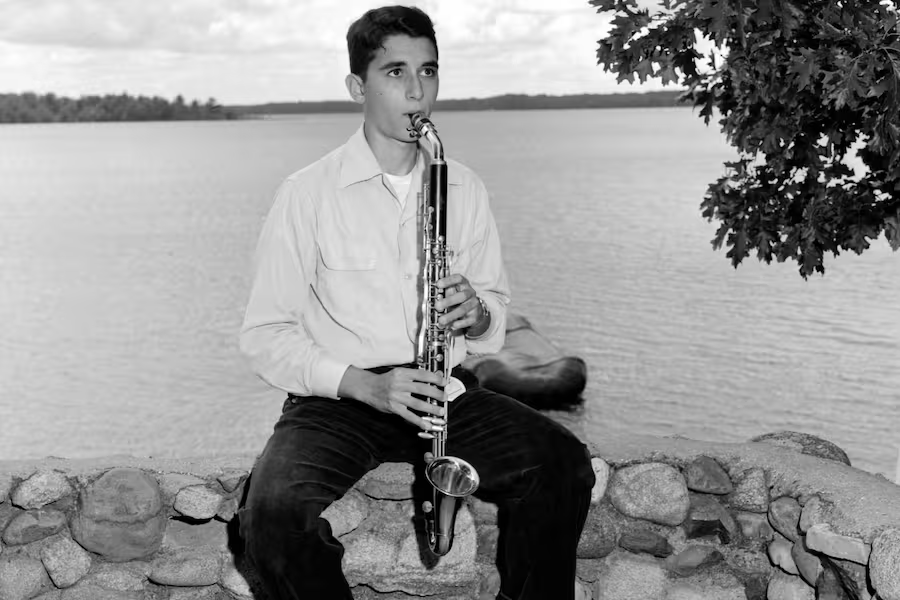
Interlochen Affiliation: IAC/NMC 48-55 | UNIV 56, 59 | IAC St 57
Interview Date: June 19, 2025
Jay Morton Achter attended National Music Camp as a Junior camper, attending for eight summers, studying piano and then ceramics, before focusing on clarinet. He returned to camp to continue his studies in the University division.
This oral history is provided free by the Archives of the Interlochen Center for the Arts (ARTICA). It has been accepted for inclusion in Interlochen’s audio archive by an authorized administrator of Interlochen Center for the Arts. For more information, please contact archives@interlochen.org.
00:00:00 ELIZABETH FLOOD
Today is June 19, 2025. This is an oral history interview with Mort Achter, conducted by Elizabeth Flood on the campus of Interlochen Center for the Arts. Thank you for sharing your story with us and your time today, Mort.
00:00:15 MORT ACHTER
Certainly.
00:00:16 ELIZABETH FLOOD
To begin, could you please tell us your name, your connection to Interlochen and the years you attended?
00:00:23 MORT ACHTER
Certainly. My name is Morton Achter. Morton is the full first name, although I go by the nickname Mort, and the nickname actually started up at Interlochen when I was young. Before that, I preferred the Morton to Mort. But anyway, I attended Interlochen starting in 1948 as a Junior camper. I continued on through the Intermediate Division, the High School Division, and at the time, one year in the University Division, which was then affiliated with the University of Michigan. I took some courses and gathered some credits from that summer Interlochen, and the credits came back to me when I eventually transferred to the University of Michigan as an undergraduate years later.
And certainly my connection with the University through Interlochen was an important factor for my deciding to transfer to Ann Arbor. After my student days, I continued my career at the Camp on the staff for several years. The first year of my staff service was on the stage crew, which between you and me, I didn't particularly care for, particularly lugging harps around all the time. And after that, I worked for many years for the music library, which I did enjoy. In fact, when I was a camper on scholarship at Interlochen during my high school years, I worked in the Music Library as part of the work study program, and I enjoyed working in there and getting to know the various people, the librarians, and so it was sort of a natural fit during some of my staff years. And then finally, I think, my last year at Interlochen, I worked for what I believe was a short lived institution called Interlochen Press. This was a dream of President Maddy, Joe Maddy to publish music and also mainly to publish his textbooks, which by that time were perhaps a little bit out of date, but nevertheless, we had a catalog, I still have a catalog of Interlochen Press's holdings, and, which included one of my own compositions, believe it or not. I really lost track of Interlochen Press. See how long it lasted, whether it is, I'm assuming, a long time since it's since it went out of business. So that was my career at
Interlochen. I stopped coming to Interlochen when I entered graduate work at the University of Michigan. By that time I had too many obligations, and frankly, some ways to make money in Ann Arbor during the summer, so I stayed down there, but I continued to come up for weekends to visit. I still had of course lots of friends and associates from my Camp years, as well as the my staff years, and as long as I was in Ann Arbor, and later, when I came back to Ann Arbor to complete the doctorate, I came up Interlochen quite frequently to visit. And then much later in life, my wife was on the administration at Ferris State University in Big Rapids, not too far from Interlochen.
And I would come up to visit occasionally, just to wander the campus, believe it or not, at that point, we're talking now about the late 90s, early 2000s there were still some friends and associates from my own years at Interlochen, so it was always fun to come up and attend a concert if I could, and just sort of bask in nostalgia for the place. So that's my association with Interlochen. Since moving to Maine, I've been back a few times. As you probably know, my wife and I have donated some funds to Interlochen over the years, and we're certainly anxious to see the Camp, I should say, the Camp I still call it in a weak moment, the Camp to see Interlochen prosper. And I'm looking forward, certainly, to the 100th anniversary coming up in a few years.
00:04:43 ELIZABETH FLOOD
Wow, you've had so many varied roles and positions here and gotten to experience so many different things. I'm wondering how did you learn about Interlochen in the first place, and what drew you here? I heard a little bit of your story in the interview with IPR in 2020, but I would love to hear it again from you now.
00:05:03 MORT ACHTER
Actually, I didn't hear about Interlochen, my parents did. And that was because the summer before I started at Interlochen, I went to a boys sports camp in the Adirondack Mountains in New York, and I had a wonderful time there, and wanted very much to go back. My parents, particularly my mother, was a little bit disappointed because during those eight weeks in the Adirondacks, I didn't have to practice one minute. And I also came back as the camp boxing champion. Which was a new direction. So, one of my father's business associates informed him about this arts camp in northern Michigan that they looked into. And my parents made a deal with me: I would go to Interlochen the next summer instead of a sports camp in New York, and if I didn't like it, didn't like Interlochen, I could return to the sports camp the following summer. Well, I went up to Interlochen, and the rest, as they say, is history.
00:06:10 ELIZABETH FLOOD
Do you have a favorite memory in specific from your time here over the many years that you got to spend here? Or is there one experience that when you think about your time at Interlochen has come up often in conversation or in your memory?
00:06:25 MORT ACHTER
Well, there's so many memories and so many people who I've been associated with over the years. I would have to say that my two best memories, I'll give you two best memories of Interlochen, are, first of all, the exposure to music, music, music. Being able to attend a concert or a recital practically every night, and hear what is considered the masterworks or the most important pieces of music many times over. For example, I had became very conversant with the four Brahms symphonies because they were always alternated along with "Les préludes" in the final concert. So they became some of my favorite pieces of music. And the other memory, of course, is people, people who I was associated with, individual people who a few of whom I'm still in contact with after all these years. So I would have to say that those, those are my two enduring, I was going to say enduring, but also endearing as well as enduring, memories from my years at Interlochen. The people I came into contact with, and the exposure to not only music, but also theater through the productions that were done up there, but certainly exposure to repertory that I would have not received if I hadn't attended Interlochen for those many summers.
00:07:53 ELIZABETH FLOOD
Could you tell me about some of these memorable people that you came in contact with?
00:07:58 MORT ACHTER
Well, first of all, there are the founders names that are still there, such as Maddy, Giddings, some of the early vice presidents like George Wilson and Don Gillis. I met a couple of important composers, musicians, professional musicians, who came up to visit, people like Morton Gould, who I was interested in because we shared the same first name. I mentioned Don Gillis, who was both a Vice President and a composer of American music, various kinds of American music, lighter stuff, but he was quite popular at the time. Another person who I actually became friends with until he passed away, was the composer and Broadway orchestrator Robert Russell Bennett, a name you may or may not know. He was famous not only as a composer, but for orchestrating Broadway musicals, starting with George Gershwin. He did most of the Rodgers and Hart, most of the Rodgers and Hammerstein shows, a lot of the Lerner and Loewe shows. He was a pretty big deal, and he was a wonderful gentleman. And I got to know him, he got to know me, I, and my music. I will always remember him because he was so kind to me. But those are some of the people that I remember, as well as some colleagues, contemporaries, a few of whom I'm still in touch with.
00:09:24 ELIZABETH FLOOD
Do you have any particular experiences that you could speak about in relation to Joe Maddy? Any impressions?
00:09:35 MORT ACHTER
He was a remarkable man. Obviously what he established has lasted and lasted very well. My last memory of him, unfortunately, was of him in University Hospital in Ann Arbor, when I went to the hospital to actually visit another friend who was recuperating, and I knew that Maddy was in there. Obviously I had known the Maddy's, both Joseph and his wife, for many, many years. I took a chance and went to his darkened room, which was down the hall, as it turned out, from a friend I was visiting, he saw me and said, "Oh, Morton, come in." And this was probably the longest conversation I had with Joe Maddy during all my years at Interlochen, in the years that I had known him. Probably gave me too much information about his ailments, but I listened patiently, and it was a nice it was a nice time. Unfortunately, not too long after that, he passed away, and I remember writing a note to Faye, the widow Faye Maddy, and I received a very, very nice note back from her, a personal note. It was not something that was mass produced. She remembered when I would always meet at the Maddy reception. At the time, my family lived in Buffalo, and she always said to me, "Shuffle off to Buffalo!" That was her favorite expression. So I had a nice relationship with the Maddy's. And also their granddaughter, Gwendolyn Maddy was a was a friend of mine, and Dick Maddy their son, I knew reasonably well. He was a repairman, an instrument repairman up at Interlochen, mostly specializing in stringed instruments. And I got to know him a bit. So it was a good family, and I certainly admired so much of what they were able to accomplish. Interesting little fact that you may probably not aware of, but originally when Maddy was looking for a site for what became the National Music Camp, he also considered a location in Maine. And the reason for the Maine location: it was on the Eastern Seaboard, and it was closer to more population centers along the Eastern Seaboard, but he was offered the lumber yards, as we call them, in northern Michigan, and that's where it eventually ended up. But, but for that, it could have been the National Music Camp in Maine, northern Maine, rather than northern, Northern Michigan.
00:12:15 ELIZABETH FLOOD
Did you have much theater exposure or experience prior to Interlochen?
00:12:21 MORT ACHTER
I was probably in a couple of high school plays. There was another important dimension
of the Interlochen experience, was the exposure to theater and participation in theater, both on the stage and behind the scenes. And it developed, obviously, into an interest that has continued throughout my life and is still with me today. I do more theater making today than I do music making because of where I live, and you're probably aware of that. Again, I can thank Interlochen for the practical, hands on experience that I had in the theater productions. Jim Harvey, for example, was one of my mentors up there. The Harvey Theatre is, of course, named after him on the campus. And I met some other good people who I learned a lot from, and I continued with even after I stopped coming up to Interlochen for the summer.
00:13:21 ELIZABETH FLOOD
Was there any project or performance that you were either in or bore witness to that you think about or is memorable to you?
00:13:30 MORT ACHTER
With theater, I think, I was in two major productions up there. One as an Intermediate and one is a High School. The Intermediate production was a work by Molière, and it introduced me to the works of Molière, who I hadn't known about beforehand. The High School production was The Taming of the Shrew, by Shakespeare, and it was a good production. I had one of the leads. I don't think I put it on my resume, but I certainly have a particular fondness, and it led me to Shakespeare. And as it turned out, that my PhD dissertation was mostly on Shakespearean opera. So, you might say that this was a good introduction to The Bard. The Molière was a comedy called The Doctor in Spite of Himself, which is occasionally done. But again, I had the lead, I was the doctor in that, so it was a good snoot full of Molière, as it was in The Taming of the Shrew. I was not the tamer of the Shrew. I was the secondary male, somebody named Lucentio, who got to woo Bianca, the younger sister of the Shrew. And I was very lucky because my Bianca in the show was a beautiful young woman. The production was fun, not just because of her, of course, but it was a good cast, and it was well directed by Jim Harvey. You asked about music productions. I think the one music production that I looked forward to, not as a participant, of course, was “Les préludes” at the end. During my early Intermediate years, I played in the master orchestra, played clarinet. You know, one of 7000 clarinets in the orchestra. But I found it much more rewarding to sit out in the back of The Bowl and just sort of drink it in, and drink in the spectacle. So I certainly remember that, and when I hear Les Preludes still played, just as when I hear the Interlochen theme played by Howard Hanson, I get involuntary goose bumps. I still sort of react to it because both of those pieces of music, the Interlochen theme as well as “Les préludes,” meant so much to me in the years at Interlochen.
00:16:03 ELIZABETH FLOOD
So you just mentioned The Bowl ever so briefly. Tell me a little bit about a favorite spot here on campus and why it was a favorite spot when you were here. I know campus has changed very much over the years, but-
00:16:16 MORT ACHTER
I know it has, and The Bowl has changed too. When I was up there, there was not the fixed seating that there is now. It was park benches under the trees. It was much more rustic. In fact, when I first started at Interlochen, it was the original Bowl still, that you can see in photographs. And then there was a makeover during my time at Interlochen. I was disappointed when I saw the new Bowl, so to speak. And it's been made over at least once or twice since then, I believe. But certainly The Bowl, the Interlochen Bowl, is sort of the heart of the place. My very first summer at Interlochen, a brand new place called Kresge Auditorium had just opened. You asked about people I met up there, I actually met S.S. Kresge, the founder of the Kresge fortune, the Kresge business, who came up for the dedication. He liked children, the Juniors, Junior boys and the Junior girls were trotted out, and I was among them, to meet the man. But certainly The Bowl was a favorite place. Another favorite place of mine, which is unfortunately no longer there, was at the time, the third performance venue for concerts after the bowl and Kresge. It was something called The Shell. And I was fond of The Shell because during my one year on the stage crew, I was assigned to The Shell, I was in charge of The Shell. Which, I had my own little facility. I had my own office. It was a good place to do work. Take occasional snooze during the day, but I had very fond memories of The Shell. It's up near where the old saw mill used to be, so it's removed a little bit from the main plaza certainly of campus with Kresge and The Bowl. But those were my favorite spots. As far as the woods were concerned, I remember during my camper days, I enjoyed exploring the woods behind the boy camps. It was much wilder. It was, it was very difficult to do over on the what we call the girl side, because there was, it was much more populated and much more built up than on the other side. So I did have my favorite spots around campus, but I probably put The Bowl at the top of the list.
00:18:54 ELIZABETH FLOOD
Could you speak to some of the lasting friendships that formed from your time at Interlochen, so the people that you are still in contact with, or you had long friendships with.
00:19:05 MORT ACHTER
Well, during the camping days, came Christmas after camp, you got the obligatory Christmas cards from everybody that was in your cabin. Often these were short lived friendships, particularly if the individual did not come back. Yeah, I'm still in contact with a number of friends from my days there. I sort of became reacquainted with another gal through an article in Crescendo a couple of years ago. I don't know if you're aware of the name Ginger Lane. She's a few years younger than me. We were casually acquainted at Interlochen. I remember her because she was a dancer, a very fine dancer. She was also from Chicago, by the way, and she also had very, very bright and attractive red hair, so she sort of stood out in the crowd. But I lost track of her until this article appeared in Crescendo about a year and a half ago, that I didn't, knew nothing about her backstory, that she was a Holocaust survivor. Also, unfortunately, she suffered a debilitating ski accident in the 80s, which confines her to a wheelchair. When I heard about this, you know, my heart just went to pieces. So I have since been in contact with her through Interlochen. I spoke to it may have been Cathy or maybe the archivist, Eileen, about getting in touch with her, but Ginger contacted me, and we have since had an occasional back and forth. So that was a surprise. She is a remarkable woman, but she's one who just sort of come back into my orbit recently. Obviously, we had the shared experience of Interlochen and shared friends, quite a few emails back and forth. We talked about common friends and so forth. So that was certainly unusual experience, reestablishing contact with Ginger. She was also the cover girl and at least one of the magazines that Interlochen produced, if I remember correctly, because she was very attractive, very photogenic. And you may or may not know that I had done a lot of archival work with Eileen in the library. She was put in touch with me, maybe through Cathy, because of my many years. A couple of years ago, she sent me photo archives from all the years that I was up there to have me identify as best I could, the people in there, and some people I recognize, some I didn't. It was fun doing it, and hopefully it was helpful to the archives. I've met her once, Eileen, the last time we were up there, I looked her up. She has a sort of a bailiwick in the bottom of the big library. That that was fun to do, certainly brought back lots of memories as well.
00:22:14 ELIZABETH FLOOD
What a beautiful gift to be able to recall for people within, through the archive.
00:22:22 MORT ACHTER
Well, it was difficult. Sometimes she also provided, which was very helpful, the listing of that year's faculty and staff as well as students. So if I had difficulty, remember now I knew that fellow from the High School division, but I could go to the listing and with a little bit of patience I would usually find out who he was or so forth. It was also interesting to see some of my acquaintances when they were much younger, when they were, say, juniors, and I would not have been associated with them at that point, because I was a couple of years older.
00:23:00 ELIZABETH FLOOD
How has Interlochen continued to be a part of your life? I'm hearing through friendships and through meeting new people. But what are some of the other ways that Interlochen has stayed with you?
00:23:12 MORT ACHTER
We have visited. We were there two or three summers ago, and that's when, when I met Eileen and also saw Cathy up there. Met Trey for the first time, or maybe was, no, actually I've met Trey twice, your president. One earlier visit we were up there that we saw him. My wife is from upstate Wisconsin, so we could arrange a nice trip. We flew into Traverse City, and this was the first time I'd actually flown into Traverse City, as opposed to going to the airport to meet people. Rented a car, spent a few days on the campus, and then I took the cross across Lake Michigan ferry for the first time, which is something that was kind of fun, and then visited her family in Wisconsin. So it worked out very nicely that way. The other way, as you probably know, we've donated to various projects and causes on the camp, and I'm pleased that we're in a position to do so. So, and we will probably continue to do so. There's a couple scholarships in my name. In fact, I just got an email this morning from somebody who was setting up meetings with my scholarship recipients in the course of the summer. Actually, somebody from Illinois, from Glen Ellyn and a gal from Miami. So I look forward to talking to these young people.
00:24:49 ELIZABETH FLOOD
I was wondering if you could tell me a little bit about your experience working at Interlochen Press and what that was like. I know you mentioned some of the contents of it, but I'm curious to hear a little bit more about that.
00:25:00 MORT ACHTER
Well that was probably the easiest job that I had Interlochen. My boss was the former head of the music library, somebody who had been in Interlochen a long time named Lyman Starr S, T, A, R, R. And Lyman had been my boss when I worked in the Music Library, both as a camper, as a High School camper, and then as a staff member for a few years. So we knew each other quite well, and essentially it was a two person operation. Lyman and me. And my job was in the morning to go to the post office, the Interlochen post office, since we had our own post office box different from the from the camps, bring back the day's mail, which hopefully includes lots of orders for for the products that we had to offer, and then fulfillment. But I also did other things, because by this time, I was well known around campus, and knew the nooks and crannies. I knew where various things were buried, if you will. You might be getting at is the USIA film that was made up there the one summer, the information film, I think the final title was Music in the Forest, but this was done by the State Department about this arts camp in northern Michigan for youth, and it was used, frankly, as a propaganda piece. And they sent out a professional filmmaking company from New York actually, and I was their liaison on campus. And I worked with them, was the first time I learned something about filmmaking, which I found interesting. There was the director and there was a sound man and there was the chief cinematographer. They did not like camp food, so they insisted on eating off Camp and took me with them. Or actually I took them with me, since I had the car. And so I ate very well that summer, thank you. But as I said, I learned something about filmmaking. It was an interesting group to work with. When they wanted, for example, working we find a nice shot of moonlight over the lake. So I would direct them to probably the roof of the Minnesota building. They would do it in the daytime, but then they could darken it so it became moonlight over the lake. But it was a lot of fun. It was either that summer or the summer before that I did that, and then they showed the film the next summer in Kresge Auditorium. And I was also in the film, in a number of cameo roles when they needed somebody. I got an awful razzing from the conductors, the faculty conductors on Camp because they showed somebody sitting in Kresge auditorium that was me with a score conducting, you know, while there was a group playing, but unfortunately, the audio was off from the video, so that I was conducting wrong. And I got a lot of teasing about that, good nature, teasing, but I was a little bit embarrassed by that, because it was obvious that I didn't know what I was doing, but that was an interesting thing. And again, working for Interlochen Press.
00:28:30 ELIZABETH FLOOD
I hadn't heard much about Interlochen Press at all yet, so I didn't realize that there was also video liaison happening.
00:28:39 MORT ACHTER
This was, as I said, Joe Maddy's child, and I think he had in mind the principal reason to publish his textbooks, which were, by that time a little bit long in the tooth. He was a music educator, and he wrote methods How to Play the Saxophone, for example, and they probably, and I don't know this for a fact, and I'm certainly not making up making light of Maddy's contributions, they were probably superseded by more contemporary or better works, that's my guess. But I remember my boss, Lyman, complaining all the time that he didn't want to publish Maddy's stuff, but there was a certain obligation to do so, because he was the boss, after all.
00:29:28 ELIZABETH FLOOD
I have a little bit of a larger scope question,
00:29:31 MORT ACHTER
Go ahead.
00:29:32 ELIZABETH FLOOD
which is, why does art matter in the world today?
00:29:38 MORT ACHTER
Why does anything matter in the world today? There used to be, and I assume it's still on the back of Kresge Auditorium, in the back of the stage, it talks about the universality of the arts, and that even though people and nations and factions can disagree, art seems to be for those who are willing to accept it at its value, it can be a way of ameliorating some of the more awful things that are going on today. Going back to the ancient Greeks, you know, art has played a life more than a lot of temporary politicians or isms that appear and then fade. And I think that's the way it will always be, and I certainly hope so if art has any healing power, which is it is sometimes claimed this would be a good time for it to heal. I don't want to sound superficial about it. It's hard to go much beyond that without getting into personal belief systems, which I do not want to do. Obviously, art has played a very important part in my life. I'd like to think that I'm a better person because of it. I spent my professional life as a teacher, and I'd like to think that the information I have passed on or encouraged in the arts fields has been useful, the continuation of knowledge. I'm still making art with the local theater, directing, which I enjoy doing and apparently my audiences do too. I do have another music gig coming up in October, which I'm pleased about. It will get me back to the piano, which I've neglected. One of my neighbors here where I live is a retired Metropolitan Opera chorister. He was in the Metropolitan Opera Chorus for 30 years, something like that, marvelous bass singer. And we've become friends, and we've performed a number of times together, and we've done a program of Gilbert and Sullivan. We've done a program of Italian art songs. We've done a program of operetta favorites from the heyday of operetta. We've been asked to do something coming up in October, so it would be good to get back to the keyboard and work with him again. In my small way, I guess I'm still making, making art, if you will.
00:32:09 ELIZABETH FLOOD
Very much so. That's really exciting.
00:32:11 MORT ACHTER
I'm looking forward to it, yeah.
00:32:13 ELIZABETH FLOOD
What do you hope for Interlochen in the next 100 years, as we come up on celebrating this centennial? What do you hope for in the future?
00:32:25 MORT ACHTER
I don't have a crystal ball, so I can't tell you what Interlochen will be like in the next 100 years. I hope they continue doing what they've been doing best, that is inspiring younger people to pursue the arts. Certainly did with me. I did not start out as a music major, as you may or may not know. I started out as a chemical engineer in college. Yet it was my continuing love for the arts, for music, theater, that eventually made me decide that chemical engineering was not for me. Interlochen continues to inspire young people to present good art -when I say art, music as well as theater as well as visual art dance to a receptive public. It certainly is a wonderful resource for the greater Traverse City area in terms of what you're able to do. I would hope that this would continue, and that the campus continues to, if not grow, but certainly remain stable and be financially stable and be able to attract good young people and also make it affordable, make it affordable for them, and that's one reason that we have a scholarship up there, so that we can give back to some young people what I was able to benefit from when I was their age. That's what I hope for Interlochen, and for the next 100 years, and you and I will check in 100 years from now and see what has happened.
00:34:11 ELIZABETH FLOOD
And hopes for hundreds more, continued on. Do you have any last memories or thoughts or stories or any tiny excerpts that you'd like to share,
00:34:21 MORT ACHTER
Oh plenty.
00:34:21 ELIZABETH FLOOD
before we close out.
00:34:23 MORT ACHTER
Yeah, but you would be here until next Saturday. My wife sometimes accuses me of living in the past too much, but much of that good past was, of course, the years that I spent up at Interlochen. [Cheese] My wife just prompted me from the back because I remember I told her the story called The Summer of the Cheese, of the american cheese. One summer, this is when I was a camper, somebody donated to the Camp - we used to say a box car full of American cheese slices. So that summer, the cuisine was extremely American cheese heavy. And of course, it was a favorite item to complain about the camp food anyway. It was not like Mama's cooking. It was institutional cooking, and I don't remember it as being particularly bad. It was just institutional. It was not like what you're going to get at home. But that summer, the two things happened. First of all, there was the cheese and it was a particularly rainy, wet, cold summer, so the level of grumpiness around camp was particularly high. And then on top of that, every single meal we had had some sort of cheese in it. I mean, it was very creative, from the whoever the dietitian was or whoever the chef was, but after a while, enough was enough, and there broke out, I remember once in the Campus Center dining room, there, a food fight to end all food fights. I mean, this was really wild. I mean, not not violent. Weren't throwing tables or chairs at each other, but a lot of cheese stuck to the walls that day. I mean, it was, it was frustrating. But I do remember the summer of the cheese. Perhaps a few of my contemporaries from that summer probably would have been when I was a High School camper. So this would have been in the mid, mid 1950s when that happened. But I do remember that incident. Not one of the better memories, perhaps, of Interlochen, but still. I used to enjoy sailing, on I guess that's Duck Lake. I learned how to sail, which I continued through college, and I was a good swimmer. I took life saving up there and became a Junior lifesaver. And I loved swimming in the two lakes. I loved going to cookouts or sometimes overnights at the sand dunes in Lake Michigan. We would go there quite often. And this is before the sand dunes became part of the National Lakeshore, so it was a lot less structured than it is now. But that certainly is a happy memory of my time. In fact when I was back the last time, or maybe the time before that we went to the sand dunes to refresh my memory. Have you been to the sand dunes? It's a remarkable spot. I used to enjoy overnight canoe trips, were a lot of fun. We would go on some of the faster-moving streams around Interlochen. These are overnights, and they were usually for better -first of all you had to be able to swim because there was inevitably a capsize. And I used to enjoy those very much too. So those are some of my fondest memories, certainly when I was younger in the camp, by the time I got into high school, two things happened, you didn't have time for that 'cause it was a much more structured existence, and I discovered the opposite sex, so that it was another interest.
00:38:16 ELIZABETH FLOOD
Thank you so much for speaking with me today. I learned so much from you and about Interlochen through this conversation, so.
00:38:24 MORT ACHTER
It's a remarkable place. Listen, summer camp is summer campus is summer camp. I'm trying to think if there are any other embarrassing moments up there. Yeah, there were plenty, but I'm not going to tell them.
00:38:36 ELIZABETH FLOOD
Well, if you decide you want to sometime, send us an email, and I'm happy to talk again and again. But yes.
00:38:43 MORT ACHTER
I will do that, it's been delightful. It was a pleasure talking with you, meeting you. I wish you well in this enterprise of yours. I hope you enjoy it. I certainly have enjoyed chatting with you.
00:38:55 ELIZABETH FLOOD
Lovely speaking with you.
00:38:56 MORT ACHTER
No problem, stay well.
00:38:59 ELIZABETH FLOOD
Likewise, goodbye.
00:39:01 MORT ACHTER
Bye, bye.
Copyright
Copyright to the audio resource and its transcript is held by the Archives of Interlochen Center for the Arts (ARTICA) and is provided here for educational purposes only. It may not be reproduced or distributed in any other format without written permission