
Oral History Interview with Michelle Chapin and Emy Zener
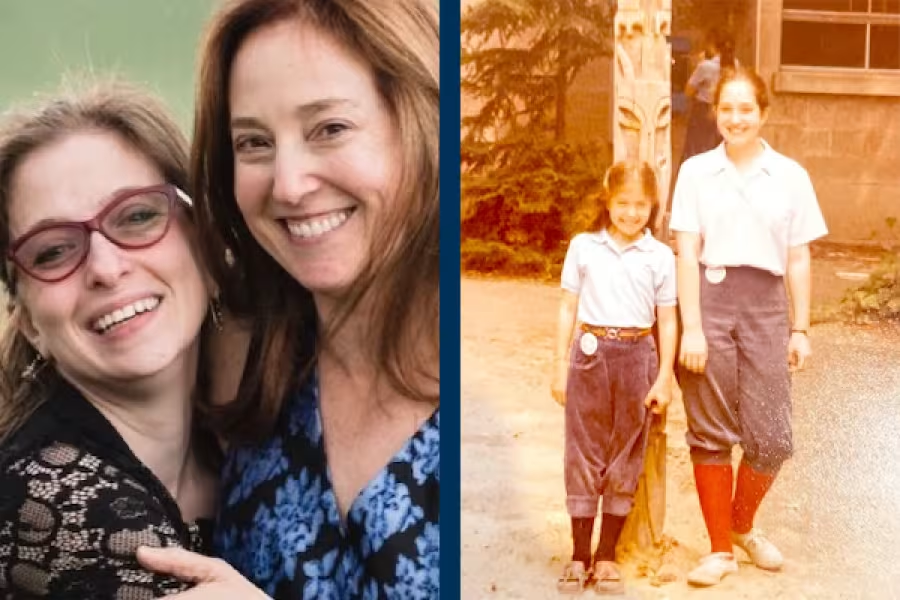
Interlochen Affiliation: IAC/NMC 81-86 (Michelle) and IAC/NMC 83-88 | IAA 88-91 (Emy)
Interview Date: June 27, 2025
Sisters Michelle Chapin and Emy Zener both attended National Music Camp for six summers study. Emy continued her studies at Interlochen Arts Academy.
This oral history is provided free by the Archives of the Interlochen Center for the Arts (ARTICA). It has been accepted for inclusion in Interlochen’s audio archive by an authorized administrator of Interlochen Center for the Arts. For more information, please contact archives@interlochen.org.
00:00:00 ELIZABETH FLOOD
Today is June twenty seventh, 2025 and this is an oral history interview with Emy Zener and Michelle Chapin, conducted by Elizabeth Flood on the campus of Interlochen Center for the Arts. Thank you very much for spending this time with me.
00:00:14 MICHELLE CHAPIN
Our pleasure. My name is Michelle Chapin, and I was a student at what was then National Music Camp at Interlochen, from the summers of 1981 through 1986.
00:00:27 EMY ZENER
I'm Emy Zener. I was a student at National Music Camp also from 1983 to 1988 and then I spent three years at the Academy, class of '91.
00:00:40 ELIZABETH FLOOD
So how did each of you learn about Interlochen originally?
00:00:46 MICHELLE CHAPIN
So, I came here first, and my father, our father, had come to Interlochen when he was growing up, as did our aunt, and so that was how we learned about it.
00:00:55 EMY ZENER
Which is actually a kind of interesting story. So our father, Ron Johnson, he's no longer alive, but he was here in the '50s and '60s, and he was an Intermediate and High School camper, and then he was on the radio staff. And then our aunt came a little later. And the way that my father wound up here, is when he was growing up in Chicago, our grandparents were very good friends with Mike Wallace, who had come here, I guess, in 1939 or something. And I believe it was Mike who, he knew my dad as this kind of awkward, weird kid. And Mike suggested that my dad come here to Camp. So that's what started our family's connection. He went here, my aunt, and then Michelle started at Camp in '81, and was here for six summers. And I started Camp in '83 and was here for six summers, and then I went to the Academy for three years.
00:01:52 ELIZABETH FLOOD
Do you know what your father did here when he was at Camp? Or what did you both do when you were here?
00:01:58 MICHELLE CHAPIN
So our father, I believe -- he certainly had an interest in theater tech, whatever the state of theater tech was when he was here a long time ago. So I remember at home, we had seen he had built a puppet theatre at home, and that was after coming here. I don't know if he ever did anything like that here, but he was really interested in sound design, and lighting.
00:02:18 EMY ZENER
He also did, I think he did chorus, he did the operetta. He actually did operetta with Dude Stephenson, which we both did as campers as well.
00:02:27 MICHELLE CHAPIN
Yeah. So when I was at Interlochen for my six summers, I started as an Intermediate. I played the piano, I sang in the choir. The whole time I was here, I did operetta. The whole time I was here an Intermediate and High School, and then in High School, I also did musical theatre.
00:02:43 EMY ZENER
So I started as a Junior camper. I was nine, and I was a theatre major. They called it drama at Camp. But in Juniors I did dance and theatre, and I played the oboe, but not in any ensembles. And chorus. Then I was a theatre major, both at Camp and at the Academy.
00:03:05 ELIZABETH FLOOD
Did you hear any stories that made you want to come from your father or from Michelle? Like, what was your impression, coming to Interlochen?
00:03:14 EMY ZENER
I had heard about Interlochen my whole life. And it just sounded like, oh it's this magical amazing place. When Michelle started, I was too young. I was seven when you started here. So I couldn't come until I was nine. So I went to a different camp. But Interlochen in my head was this like, amazing -- I had this vision of what it looked like, and there were lots of trees and stuff. But it was a place that I always knew about.
00:03:44 ELIZABETH FLOOD
What was your first year like here, your first time?
00:03:47 MICHELLE CHAPIN
Oh it was magic. I met my oldest friend the first day that we were both here as Intermediate Girls. We were twelve years old. We were going to take out -- they had these rhythm sticks that you could check out from the, what's the name of the building?
00:03:59 EMY ZENER
Braeside?
00:03:59 MICHELLE CHAPIN
Braeside. Right. And just go like, bang on things with them. And she was checking out the same things. Her name is Naomi Landman, and we met, and we're still really close friends. I'm now fifty five, so it's been a long time. But just being around other kids who were really motivated to do things and to learn and excited about what they were doing, it was magical.
00:04:20 ELIZABETH FLOOD
Do you have a favorite memory from your time here at Interlochen?
00:04:25 EMY ZENER
Well, I grew up here. So, I mean, six summers and then three years of high school. So it's like, do you have a favorite memory from your childhood? But one thing that I was mentioning to Michelle before, as a Junior, we had to go to concerts every night. So it became kind of boring, and was like, how do you get through it? But I look back, and there were guest artists on campus whom I saw live, who included Ella Fitzgerald, who else?
00:04:54 MICHELLE CHAPIN
Count Basie.
00:04:54 EMY ZENER
Count Basie.
00:04:55 MICHELLE CHAPIN
Yo-Yo Ma.
00:04:57 EMY ZENER
Canadian Brass, King Singers. Yeah, I saw Ella Fitzgerald in concert, and I was like, I know it's another boring concert I have to sit through. But when I think back, that was something just that I took for granted. I'm blown away.
00:05:14 ELIZABETH FLOOD
I'm struck by the fact that you are sisters. My little sister's coming to visit next week.
00:05:20 EMY ZENER
That's great.
00:05:20 ELIZABETH FLOOD
And I was wondering if you had any memories of being together or interweaving at Camp? Or was it so busy and things were different, things were happening that you didn't see each other.
00:05:32 EMY ZENER
I used to try to hunt her down. She was my big sister, and she was cool. And so --
00:05:38 MICHELLE CHAPIN
Thank you, I never heard that then. That's great.
00:05:40 EMY ZENER
I thought she was cool. So I would like look for her in places. And occasionally, when I was an Intermediate and Junior, you would come to visit, down in Intermediates and Juniors,
00:05:54 MICHELLE CHAPIN
I remember that.
00:05:54 EMY ZENER
And that was a really big deal. So we were never in the same division at the same time, but I do remember the sightings of my big sister were, like exciting on campus when I was a camper.
00:06:01 MICHELLE CHAPIN
I also remember you coming backstage after the musical theatre productions, and that was really fun.
00:06:06 ELIZABETH FLOOD
Do you have any favorite memories from your time here, or ones that you returned to?
00:06:10 MICHELLE CHAPIN
It's hard. I mean, I didn't spend as much time as Emy did here because I wasn't at the Academy, but those six summers, I looked forward to them all year. I mean, I started a calendar countdown when I went home in September, and counted down until June when I could come back. I don't know if there's a single thing. I mean, some of the things I remember sitting in the back of Kresge on a Sunday morning. We're not religious, and the religion part of it didn't matter to me, but being able to look through those windows and hear the pines rustling and see the lake and just have some peace, that was very spiritual for me, regardless of the religious content of the service. Those were really special times. The friends I made here were wonderful. I mean, just hanging out. I remember sitting and having Melody Freeze ice cream with my friends on the lawn, right? Or sitting and getting our trays from Stone and going and sitting on the lawn and just goofing around. But with people that we really connected. It was really magical.
00:07:08 ELIZABETH FLOOD
Could you tell me some more about some of those people that you met? You mentioned one friend who's still in your life?
00:07:14 MICHELLE CHAPIN
Yeah. I had a couple of friends named Bryant and Jason that we sang in the choir together. We did operetta together. And we were all nerds. And we would make what we call these pun ropes. So we would sit at lunch and one person would make a pun and somebody else would riff off of that to make a pun, and we would see if we could keep the same rope going for the entire summer, which was ultra nerdy, but there were enough of us that it was really cool. I remember going down by the lake. I had a boyfriend named Mark, which was very exciting.
00:07:42 EMY ZENER
I found them there once.
00:07:45 MICHELLE CHAPIN
He's a cellist, but we would go for walks down by the beach. That was nice. I think one of the other things that was really special to me was doing the operetta with Dude Stephenson, which I did every year that I was here. Because we did Intermediate and High School operetta. And our father, as Emy mentioned, had also done the operetta with Dude Stephenson. He was an institution. I thought he was sort of one of the trees that just lived here. And he was around for a long time.
00:08:05 EMY ZENER
Dad also was in Intermediate chorus with Ed German.
00:08:07 MICHELLE CHAPIN
Oh wow, I didn't know that. Ed German was my conductor as well. Yeah.
00:08:15 EMY ZENER
I still sing, in New York. I sing in a chorus. And my chorus training – I was in Junior chorus. I got the Junior chorus scholarship one year. That was a big deal. And Intermediate chorus, everything I learned was from then. And I look around at these adults that I'm singing with, and some of them are not sitting straight in their chairs or holding their music up, and I get this like Mr. German would not allow so my choral training from Camp has come with me. When I was at the Academy, you couldn't take interdisciplinary courses. So as a theatre major, it was still a straight drama program. There was no musical theatre. There were Shakespeare shows at times, like Midsummer Night's Dream and Twelfth Night, where I got to sing. I was the person who would sing in the Shakespeare shows. But we couldn't do interdisciplinary classes at the time.
00:09:15 ELIZABETH FLOOD
Could you tell me a little bit about how you got to the Academy? Like what made you interested in, what brought you?
00:09:22 EMY ZENER
So Michelle was four years ahead of me in school. And as I recall, she really wanted to go to the Academy, and our parents said, "Well, you know, try high school at home for a year." And she did. And it was a good enough match. It was okay. And for me, it was the same thing. And the year I spent in high school at home -- we lived in suburban New York, and I was coming into the city every weekend to go to Manhattan School of Music prep division, and I was in the school play, but it was just not, it was not what I wanted. I was like, I really want to go to the Academy. So the next summer I was here, that was the summer of '88, I auditioned while I was at Camp, and got in. Yeah, I wanted to go, like, early.
00:10:10 ELIZABETH FLOOD
One of the questions on the list is, tell me about a favorite spot here. And so I'm wondering about what you learned being an Academy student, versus did you have a favorite spot when you were a camper and then did that change as a student?
00:10:23 EMY ZENER
I didn't have a favorite. Well actually I really liked the Junior Girls beach, which I guess is not really there anymore. There were these benches, in the sand, that were built in and I remember having a sleep out there at least once, probably more. And I liked coming back there throughout my years here. Actually my senior picture in the yearbook that I took a look at today is at the Junior Girls beach. But I had two favorite spaces as a student. So the campus is really different during the year. And I think this is my first time back here during the summer but I never wanted to come back during the summer because it always felt like all these people are going to be intruding on my space. I can't tolerate that. My favorite spaces to go were Kresge stage at night, and it was empty. There was nobody around. And Kresge was only used for graduation. So during the year, you could go into Kresge in the dark, go up on the stage, and I would dance around and sing on the stage with those big windows, with the whole of Kresge just empty. And that whole stage to myself, and that's one of my favorite places in the world. The other spot doesn't really exist anymore, but it was behind Grunow theatre. We still used Grunow when I was here. The other theatres hadn't been built yet. And behind Grunow, there was a little kind of grassy, sandy area that looked down over the lake. And there was a bench there. That was my other favorite place.
00:11:59 ELIZABETH FLOOD
The benches that punctuate this campus are so magical, for lack of a better word, but how they are placed and what they are highlighting is really nice.
00:12:10 MICHELLE CHAPIN
I think one of my favorite places was in the woods, sort of behind what was then Intermediate Girls there were a bunch of practice huts, those stone huts where there's all these little rooms. Not being in them, practicing, that was not my favorite place, but when you walked through the woods, and again, you could hear the wind in the woods, and then all of these sounds of all of these different instruments, of people of all different levels coming out at once. And it's somehow --
00:12:10 EMY ZENER
It's magical.
00:12:13 MICHELLE CHAPIN
Playing together, right? It's cacophonous because they're playing in different keys and playing different things, and they're stopping and starting, but the whole sound was just so special. And anytime I walk by one of those huts like today, it's just, I have to stop and listen, because it's just it brings back so much. It's really feels like home.
00:12:55 EMY ZENER
I have another favorite, not a favorite place exactly. So I lived in what was called Brahms and I think it's now McWhorter, as a student. So I could look kind of out over the lake, especially from Brahms. And in the winter, the lake would freeze, and I don't know if, with climate change, if it's still the same, all of a sudden, all of these little -- they looked like almost phone booths, would appear in the middle of the ice. And they were ice fishermen. And they would be in their ice fisherman hut thingies. Fishing! All winter. And the lake would thaw from the edges, and the huts were still there. I always wanted to know how they get off the ice. And I never saw it happening. I also remember a time when I was working food service at the Academy one night, and I was stocking the salad bar with disgusting kale that was used as decoration, and we'd stick it back in the disgusting bucket of blue liquid and take it out for the next salad bar. Well, it's a very long story, but the basic part of it is somebody was knocking on the outside door into Stone, somebody who I didn't take very seriously. And I kind of ignored it, and she kept knocking, so finally I ran over, I was like, what's going on. And there was a fisherman who was out on the lake, and he was drowning, and he drowned. He had been drinking apparently. I remember, she just screamed, there's a guy in the lake in a boat and he's drowning. And I remember running into the food service office and picking up the phone and just dialing zero, which connected me to the other room, to the Stone desk, and they're like, “Interlochen Center for the Arts, how may I help you?” And I was like, “There's a guy in the lake and he's drowning.” And so I guess they took care of it. Eventually the red and blue lights were flashing down by the lake, and the guy drowned. Yeah. And there was this thing, like, you're not allowed to walk out on the ice. And I was a very rule following student. I talked to my classmates now, and I had no idea the [bleep] that was going on when I was here. No concept. Like, I knew people smoked on the TJ toilets up the vent. They'd say, you know, let's go venting, or go to the vent. I don't know the right way to say it. And that was a big deal, but there was so much going on, and I was so clueless.
00:15:28 ELIZABETH FLOOD
You were studious.
00:15:29 EMY ZENER
I was studious. I also got to live in lower Brahms because I was a good kid. One night there was an eclipse, and my roommate and I, so we had, there were hall phones in the rest of the dorms, and we had our own phone in our room. Which was really cool. So I called before sign in, and I asked my hall counselor, can we go outside to see the eclipse? And I got a yes. So we went out to see it. And it turned out that night, a ton of students snuck out of their dorms to see the eclipse, and they all got into a lot of trouble. And we didn't get into trouble because we asked first.
00:16:12 ELIZABETH FLOOD
And that's the story that every parent wants to hear. Like confirming that if you just asked, everything might be okay.
00:16:21 EMY ZENER
The funny thing is, my own daughter, she just finished her first year at Oberlin. She didn't come to Interlochen, but her roommate is an Interlochen grad, and she's meeting tons of Interlochen people. So she's like, yeah, I don't say my mom went to Interlochen anymore. I say my roommate went to Interlochen. That's so much -- but she's even more rule following than I am.
00:16:45 ELIZABETH FLOOD
Who are some influential or memorable people that you encountered along your way?
00:16:51 EMY ZENER
So there's influential and memorable, and then there's like positive experiences. I'll mention the name Jude Levinson, anybody who was there in my time in theatre, or even not in theatre, knows all about Jude, who eventually left, I think, before she got fired? She was memorable. David Montee and Robin Ellis. David ran the theater department for many many years. His first year was my first year. So he was a young, I think thirty four year old guy, whom I thought was like this total grown up, and now thirty four it's like oh my god you were so young. But he was very formative for me. And another person who had a big impact on me was Marlene Leuty, who is now Marlene Robinson, who I knew from Camp. She was the head of Intermediate Girls when I was a camper, then she was my hall counselor, and I was her hall assistant. The little dorm assistant person. And Marlene had a really positive, kind of parental but not quite more like big sister, somewhere in between, effect on my life. I remember I was having a hard time, and she took me out to see Rain Man at the movie theater. And I believe that was the day of the big San Francisco earthquake. And we came back and found out about the earthquake. Okay, so a few other things. So there's a TV in the MB lobby, and we would gather around the TV to do the Jane Fonda work out every night on our VHS. So what made me think of the TV is, between my first and second year, they replaced the curtains in the MB dorm rooms. And they were these, like light brown and dark brown, and it looked like an abstract snow scene. They were really ugly, but I was like, all right, it's an abstract snow scene, and different browns and white. Then my senior year was the war in Kuwait. And I remember going into the MB lobby, seeing on TV, and I was like, oh my god! The soldiers are wearing our curtains! It turned out it was surplus army material. It was camouflage. But I was like, why are the soldiers wearing our MB curtains? And that was our abstract snow scene. It was desert camouflage.
00:19:24 ELIZABETH FLOOD
That is epic.
00:19:25 EMY ZENER
It was special.
00:19:20 MICHELLE CHAPIN
I remember doing facials, in big air quotes, in the cabin with my friend Naomi, and the only tool we had was Noxzema, and so we would put -- you don't even know what Noxzema is because it doesn't exist anymore. It was face cream for teenagers with acne. It was just it had a cream,
00:19:48 EMY ZENER
It had a really special menthol smell.
00:19:49 MICHELLE CHAPIN
Yeah, and it was kind of tingly because it had menthol. So we would put it on our faces, and then let it dry, so it was now a mask. And then we would take it off and we would pat it back on wet. It did absolutely nothing but it entertained us. I also remember, when I was in High School, I slipped and fell I did something to my hand. So I had a hand that was, I don't remember if I was in a cast or something but I couldn't get it wet. And I had very very long hair, and we had these teeny, tiny little sinks in the cabins, and so Naomi would help me wash my hair in sink, which was, I mean, my head wouldn't fit in the sink they were so small. So that was also, that was an epic adventure when we did that.
00:20:25 EMY ZENER
The cafeteria, certainly is full of memories. Speaking of curtains they had these hideous '60s curtains. They had probably had been there since, like 1950. So maybe '50s curtains. And we always would talk about, you know what? Let's sneak in and let's steal the curtains and make Sound of Music dresses out of them. They just need to go. But the cafeteria, I started drinking coffee when I was fourteen, in that cafeteria. And it was like really watery coffee, but it was like I was grown up. Because I got to live away from home and I was drinking coffee. And we would sit in the cafeteria after dinner until they would kick us out at our theatre table in the corner. Drinking coffee, and eating Chex cereal from mugs. That was like. And sometimes there was a microphone in the front of the cafeteria, and people would go there and make announcements. And I remember one time somebody saying "Okay everybody, here's your chance. Everybody asks if the school is like Fame? Get on the tables and dance." And I don't remember how far that went. But it was our, you know, yes we go to the Fame school, but different. And another thing I remember, and I was actually talking with somebody who worked in the Alumni Office today about it, who had the same thing. Being fourteen years old, having a major at high school. I remember sitting around having very philosophical discussions with my friends. Which usually were about, what is art. But I remember us talking about, what do people in high school do when they don't have a major? They just like go to school? I don't understand. They're so unfocused. We definitely lived in a bubble. And we took ourselves very seriously. And life is not like Interlochen.
00:22:13 MICHELLE CHAPIN
But at the same time I think Interlochen is a place that nurtures people within that bubble and if you didn't have that bubble an awful lot of artists would not become the people and the artists that they are. So --
00:22:23 EMY ZENER
Absolutely.
00:22:24 MICHELLE CHAPIN
There's time to learn how to live in the real world.
00:22:26 EMY ZENER
That's true. Well I know that Camp had a huge impact on who you were, and certainly going to the Academy, I feel like it saved me in a lot of ways. It was not always a healthy place. Really not always a healthy place but I definitely am glad that I went. And when people ask me, "Are you glad you went?" I say I'm really glad I went, and I wouldn't send my own child. And luckily my own kid had no interest because she didn't like leaving home. So, I didn't have to make that decision.
00:23:00 ELIZABETH FLOOD
I'm interested in the fifteen year olds talking about what is art, and then that definition versus, you've talked about some of the things that you've carried from your time here to into your lives now. And so I'm interested in maybe rehaving that conversation a little bit? Like what is, what are you, what is art to you now? Or why is art important? What is your making like in your life now?
00:23:24 EMY ZENER
I work as a psychotherapist. And I was gonna become a dance therapist, but was convinced to go to social work school instead just career wise. Certainly, in my work as a therapist, I use my acting training every day. And when I say that to people they're like oh, so you're acting when you're a therapist? And it's like, well, no. It's like being in a scene, but the stakes are much higher. And having that third eye and analyzing a script. I worked in a hospital, an outpatient of a hospital, and I'd get a chart. And I would look through the chart, and it was kind of like analyzing a script. And I understood so much about who these humans were from reading their charts, in a way that I learned as an actor. And I consider myself an artist still. The only art that I really do on a big level is singing, sing in a chorus in New York and we do some pretty major stuff. But I'm not happy unless I have multiple multiple forms of expression. So I dabble around. I've done visual arts a lot. I did writing, I actually came back here for a week at one point and did a writing workshop for a week. I don't dance anymore because I'm old and my body's broken. But dance is and movement is a really important thing to me. My husband's an actor. And my daughter's going into stage management. So, everything. What is art, what is -- what role does it play in my life. I live in New York City, it's everything.
00:25:11 MICHELLE CHAPIN
Yeah, I think for me that answer is a little less direct, but it still has definitely played a role. So I'm a pediatrician. And I think what I've taken from Interlochen really is an openness and an ability to listen well, because there were such a variety of people here who really had important things to say. We thought we were really important. You know we were --
00:25:31 EMY ZENER
Yes, we were called America's Gifted Youth, which is --
00:25:33 MICHELLE CHAPIN
But that ability to just be present and listen well serves me every single day when I do my work. So I continued to play the piano and have intersected with other Interlochen alumni, I found a new teacher, and it was great. And we were chatting a couple of weeks in, and lo and behold she went to Interlochen. And lo and behold she was in Emy's class.
00:25:55 EMY ZENER
She was a classmate of mine.
00:25:52 MICHELLE CHAPIN
Go figure, right? I mean, it just the Interlochen people show up. I think the other thing that I didn't realize at the time but a lot of what I loved about being here was the being immersed in nature, even though we were so busy doing all of the artwork. And that sort of, was a harbinger of, I didn't know it was a big interest of mine, but it became a very important thing to me. And a lot of where I find spiritual meaning in life comes from an intersection of outdoor experiences and some kind of art. Whatever that is. Poetry, whatever it is. But when those things intersect, that's my happy place.
00:26:28 EMY ZENER
I agree about outdoors. When I talk about Interlochen, the campus. The place itself, is as important to me as my experiences just being.Being here. Being in the pines. The leaves in the fall. Leaves in the fall are incredible. The smells. The air. The physical place itself, even with all the changes it's undergone, it's still at heart the same place. And it's my most important place in the world.
00:27:02 MICHELLE CHAPIN
I think, where Interlochen is creates this cocoon that really contributes to artists being able to come here and kind of pupate, right? Kind of be intensely involved in their own development and others development. And if you were to transplant this to Lincoln Center in New York City, right, there would be other things maybe that you would have access to, but it would lose so much. There's something about being removed here and in such a beautiful setting that's involves all the senses, right? You sit in Kresge listening to a concert and you hear the wind. And you feel it on you, and you see the waves, and all of that together is what makes the magic happen here I think.
00:27:39 EMY ZENER
It also creates the intensity during the year. Fairly small school, on this giant campus, and with weather that at least back then, we'd get up to twelve feet of snow per winter, I don't know about now.There was definitely a feeling of isolation, in a bubble. And that added to the intensity. Without really contact with the outside world. Which is part of what makes it really special. It also makes it not always good, but overall it's part of what makes it so special. Oh, one of my favorite things. Mike Chamberlin was the ecology teacher. And his class was one of my favorite academic classes I've ever taken. And if you talk to people who were here at the time they'll probably say the same thing. So ecology, it was almost all done outside. So we would go snowshoeing and look for owl pellets. We would go wading through rivers and learn about rivers. We did wild edibles. And we'd go out into the woods, and we would collect wild edibles and we had a wild edible feast. We went bird banding. We went and camped on the sand dunes and banded birds. Mr. Chamberlin had such an effect on so many people's lives. That's how I learned to appreciate the outdoors. We learned about all the birds. So he would drive in these, I swear, these buses they were from the 1930s. There were these green school buses that were open on the side. And we would go in the bus, and everyone's like, oh boy, we're putting our lives in danger, partly because Mr. Chamberlin was driving. And also these buses. And any time you saw either roadkill or a bird, you were supposed to yell out either bird or roadkill. Because he would just stop. Wherever we were. And as he was driving, he would be looking all over the place. Which was part of the danger. But yell bird, he would stop right there, we'd have to all get out really quietly, and have to go find the bird. And roadkill! We had to identify the roadkill. He had a whole bunch of stuffed, not stuffed animals like a teddy bear, but stuffed animals. And he also led trips. I never got to go on the trips, but except for the one. Hugo Trepte would lead camping trips, I think. But such an effect on my life. I started college, and I had written in my whatever, I was like I want to major in theatre and maybe ecology. And I got to college my first year they gave me an advisor who was in the ecology department. And it was all about, like, rocks. It was, just a normal ecology class. I'm like, but, but, oh, we're not gonna go outside and do wild edible -- and I was like, forget it. I'm so not interested.
00:30:34 MICHELLE CHAPIN
I don't know if you remember but you came home over Christmas break one year, and I came home from college at the same time, and you had a chemistry assignment. And so, I don't remember what the assignment was. We ended up making a video --
00:30:48 EMY ZENER
Of a rap.
00:30:49 MICHELLE CHAPIN
Yes, it was a rap song, a video where -- hi I'm a proton. And I am an electron. Together with the neutrons we're the atom family. We thought we were so clever.
00:30:57 EMY ZENER
I remember the whole thing. And also I was like, Dr. Strange Pork or something.
00:31:05 MICHELLE CHAPIN
Oh yeah.
00:31:05 EMY ZENER
I was Dr. Strange Pork with some funny accents and we did some chemistry experiments and we -- and our dad did a video. He was big into video. And so the assignment was
00:31:16 MICHELLE CHAPIN
Not that, I'm sure --
00:31:18 EMY ZENER
Go home over break and do some project involving your art form. Now I was the only one who came back having done anything. But I came back with this video of Dr. Strange Pork and Igor, and the atoms rap. He was so excited and I think he showed that video to classes for years. He was a marvelous chemistry teacher. Really good chemistry teacher. We did chocolate chip cookie labs, we did shampoo labs. But he also was teaching chemistry as we did it. He was fabulous. Jack Randall.
00:31:52 MICHELLE CHAPIN
So you were mentioning that our father was into video, but he was certainly into audio when he was here. He worked in the radio station before there was NPR. So it wasn't Interlochen Public Radio. It was whatever it was. But they used reel-to-reel tape? Right? And so we grew up hearing him say "nickel-rotney-morph-kazooim." Which is backwards for music from Interlochen.
00:32:15 EMY ZENER
That was just a thing that we heard our whole childhood. Nickel-rotney-morph-kazooim.
00:32:23 MICHELLE CHAPIN
Yeah.
00:32:23 ELIZABETH FLOOD
That's so beautiful -- also that that's a sound that could not leave both of you.
00:32:29 MICHELLE CHAPIN
Here we are fifty years later and it's still --
00:32:31 EMY ZENER
In a duet.
00:32:37 ELIZABETH FLOOD
I'm still reflecting on the difference of season, that a season makes here.
00:32:41 EMY ZENER
Yeah. And the feel on campus is very different.
00:32:45 MICHELLE CHAPIN
The summer, and I'm seeing it here today, but it's what I remember, too. It's intense, but it's bustling. Right? You are here to accomplish as quick as you can and grow as much as you can. You know the folks who come here to do orchestra, I mean, back in the day, it was eight weeks now its six, but they would say they would grow two years in their training in those eight weeks.
00:33:04 EMY ZENER
And there was a motto that I hope they don't still use, do more in less time. That was a big motto at Camp, do more in less time. Thinking about it now, I'm like, I don't know. But it was a big thing at Camp. It wasn't at the Academy.
00:33:20 MICHELLE CHAPIN
Yeah. Well, I think even not having attended, there was a sense at the Academy of really having more time to take a little space in that cocoon. That there wasn't constant pressure to perform. You know WYSO, again, back in the day, they did a full length concert every single week. Right? And I don't know if they're still doing that. It was amazing, and that's how they learned. But I don't think you can stay in that pressure cooker environment as a tween and a teen for a whole year. Right? So it was a separate space. And I think this whole place takes a breath when summer is over. Summer is amazing, and the rest of the year is a different amazing. Yeah.
00:33: 54 ELIZABETH FLOOD
Could you remind me when the last time each of you had visited campus? And then I'm interested in what you've seen transform. You were noting some of the things.
00:34:03 MICHELLE CHAPIN
Yeah. So I was last a student here in the summer of 1986, and I was here briefly in 1992. But I haven't been here since then. So, and I was really excited to come here. In fact, this is how we ended up here. I'm in Denver Emy lives in New York and we wanted to meet for the weekend and
00:34:19 EMY ZENER
For her fifty fifth birthday.
00:34:21 MICHELLE CHAPIN
Yeah. And so we decided to come to Traverse City and spend a day coming back. Because I wanted to come back for years to see it. I've been reading about all these changes but I couldn't quite imagine what it was. And walking around the campus today, it's been this amazing combination of this is really different, but that's the same. This is the same. So the Melody Freeze is still there and the Wishing Well is still there. And Kresge, that was the first place we went to. There was an orchestra rehearsal and we went and just plopped down in Kresge. Ok, we're here. This is still home. But it's really exciting to me to see how the campus has grown and improved. The Dance Building is gorgeous. The theatre buildings are gorgeous. There's so many facilities now. The, oh my gosh the Creative Writing House. I mean, there's all these beautiful places. I remember when I was a camper in the mid 80s, that jazz was just starting to be acceptable for the musicians. It was not really like you couldn't come major--
00:35:14 EMY ZENER
In 1928--
00:35:15 MICHELLE CHAPIN
I mean, the same way that we were still wearing knickers in the 1980s right? I think there were a lot of things that had just not been updated for a really, really long time. And seeing this campus now, clearly we are in the 21st Century. And they have beautiful facilities to support the artists. But the sense of the place hasn't changed.
00:35:37 EMY ZENER
For me, so I've been back many times. The last time I was here I think was 2017 for a reunion. When I brought my daughter which was really special. I have a picture that I took of her dancing on Kresge stage as a silhouette and she was ten, that I adore. So I've seen a lot of the change over the years. It's definitely very different. I remember, I guess it was around when the thirty year plan came out. Or the changes and stuff. It was soon after I graduated I think. And we were all up in arms. They're gonna turn Interlochen into McDonald's. They're they're making it a shopping mall. What are they doing to our school. And coming back over the years, I think the first time I came back and there was some major change, it upset me. And then I guess I went into the it was the theatre, the Harvey.And saw all the kids. Now they're doing musical theatre, which is a very different vibe than we used to do. But I realized, you know what, even though it's not Grunow, this is their Grunow. It's not the buildings. Even though the place is so special, it's not the buildings.And now they're just getting better facilities to do it, and that's great. And I stay in touch. The reason I joined Facebook in the first place was not because I had college friends or grad school friends or anybody who I, who was that important to me to keep in touch with, but I joined because of my Interlochen peers. And you know, we all communicate online, and even people I wasn't close with, we're like siblings.
00:37:26 ELIZABETH FLOOD
Unfortunately, that's like the greatest Facebook ad you could have ever given I feel like. No no no, that's not --
00:37:33 EMY ZENER
Down with Meta, down with Meta. It's not about Facebook. Really. I promise.
00:37:38 ELIZABETH FLOOD
The desire for that connection and then the way to do it. This leads really nicely into a question which is -- so this whole project is about the centennial, and kind of looking back and forward in that. And so I'm wondering, what do you hope for Interlochen in the next hundred years? And what I mean by that is, what do you hope they carry from the traditions and the histories of this place forward? And what do you hope that they have that they haven't been doing or would be a new thing for them to carry into the next hundred years.
00:38:15 MICHELLE CHAPIN
You know, when we were growing up, our grandparents, my father's parents, in their house they had a book called Joe Maddy of Interlochen. Which I remember reading over and over and over before I even came here. And I haven't read that book in a very long time. But what I remember--
00:38:32 EMY ZENER
It's on my nightstand.
00:38:33 MICHELLE CHAPIN
Okay, what I remember of that book was he saw a need to create a protected place for young artists to be able to come and grow outside of the hustle and bustle of what else was going on. And that was the 1920s, right? And I think that need very much still exists. And Interlochen serves that purpose. We're in an environment right now where science and arts and all kinds of things are under attack. And who knows what'll happen in the next hundred years, but that need for a protected place for adults who are going to stand up and create that protective bubble for young artists, whether they go on to be professional artists or not, is still really important.
00:39:15 EMY ZENER
I definitely agree with that. So one change that I think is starting, that I would like to see continue to grow, is focusing on the mental health of students. And I'm saying this as a mental health professional and as somebody who went through the intensity here. When I was here there was no focus. You know, I think people went off to see a therapist once a week somewhere in town if they had problems. But that was about it. And oh my gosh, we all needed support. So I know somebody who has joined the board, and I remember having a long talk with her, she's actually a pediatrician, about the importance of bringing more mental health focus to the school, and I know that's something that she is working very hard on. So I want Interlochen to continue to be the magical place it is, with continued focus as well and growing focus on the well being. Mental health of the students.
00:40:18 ELIZABETH FLOOD
Those are both such beautiful things to carry into the future. And this is where I was like -- its a backwards pivot a little bit, but I was curious. I know you both mentioned them in the middle of some of your experiences, but I was wondering if there was a project or performance or something you bore witness to here or participated in that is a really like standout memory for you.
00:40:45 MICHELLE CHAPIN
Oh, there are a bunch. And I wasn't here nearly as long as you were. I got to fly in the production of Peter Pan.
00:40:52 EMY ZENER
That was so cool. Was so cool. I was so jealous.
00:40:55 MICHELLE CHAPIN
So that was super exciting for me. There were some choral things that we did. We did the Mozart “Requiem” one summer.
00:41:05 EMY ZENER
Wow.
00:41:06 MICHELLE CHAPIN
That, it just felt super meaningful. And I don't even remember if it was Intermediate or High School choir that we did it in.
00:41:17 EMY ZENER
That would have been High School.
00:41:12 MICHELLE CHAPIN
Probably. Yeah, that was really magical. I have these really, these memories of operetta dress rehearsal. So you have, like, the whole world standing around in costume, right? Because they were the cast of millions. And Dude Stephenson like walking up and down and inspecting the line of all of us there. I don't know if it was Pirates of Penzance, there were so many of them. But I just remember Dude with his cap walking up and down the line and inspecting all of the choir people, even though we didn't have titled roles, and just because the whole production was so important to him, right? This was probably Intermediate operetta, but he cared. And it had to be right. And he did it with a twinkle in his eye. Always. That was really great.
00:41:52 EMY ZENER
Let's see. For me, I mean certainly from Camp, the chorus experiences and a few acting teachers at Camp. And seeing Count Basie and Ella Fitzgerald. Gosh, I wish I could remember the others. At school, my favorite shows that I was in were Midsummer Night's Dream. I was Peaseblossom the fairy. Waiting for Godot, I was the boy. My absolute favorite role that I did here was The Crucible. I was Mary Warren in The Crucible, and I remember those of us playing the girls in Salem and the person playing Tituba, we all on our own, went out into the woods late one night, like on a weekend night when we were allowed out later. And I think there was a full moon, and we had like, red Kool Aid or something, and we were passing it around like it was, we're drinking the blood. And we had this whole ritual going out and dancing in the woods like the girls, you know were accused of doing in The Crucible. And that,that's just very Interlochen to me.
00:43:03 ELIZABETH FLOOD
Thank you so much for spending this time with me. And do you have anything else that you would like to have recorded or say or share?
00:43:15 EMY ZENER
This is kind of an embarrassing story, but hey, I'm being recorded, so why not. So I live in New York City, and I sing in a chorus called Master Voices, and we do like, all kinds of musical theatre and choral and stuff. So this was, maybe it was before COVID. I'm in my neighborhood walking my dog. And I live in Washington Heights, I see somebody walking their dog with an Interlochen sweatshirt on. So I run over, and I was like, "Hey, did you go to Interlochen?" And she was like, "Oh yeah, I did." So we start talking about it. She's like, "Do you still do your art form?" Whatever? I was like, "Oh yeah, I'm in this chorus, and, you know, I do some stuff." And I said the same thing to her. I said, "How about you?" And she's like, "Oh yeah, I'm still acting and directing." And so we finish our conversation, and I start to walk away, and I was like, oh my god, wait a minute. Was that Vicki Clark? Vicki Clark is going to star in this show that I'm starting rehearsal with the full cast with tomorrow. Oh my gosh, and I didn't recognize her. So I pick up my little dog, and I run halfway down the street yelling, "Hey lady in the Interlochen sweatshirt!" And she turns around, she's like, "Yeah?" And I was like, "You're Vicki Clark, right?"And she's like, "Uh huh." And I was like, "Oh, I'm in Master Voices and we're doing Lady in the Dark, we're rehearsing tomorrow." And she's like, "Oh." So we walk along going up to Fort Tryon Park, and we keep walking and talking more about Interlochen and stuff, and we get to the park, and she's like, "Okay." And I was like, "Okay." So my dog and I walk away. I was like, oh my gosh. So the next day in rehearsal, I see her, and I was like, "Um, hi neighbor." And I gave a little wave and walked away. And we've since worked with Vicki Clark again. But I think I said hi neighbor again. But the uniform when I was at the Academy, had just switched to being just all blue. Anything but jeans or sweats, but all blue. So it wasn't corduroy anymore. And you had to wear dark blue on the bottom, I think light blue on the top, but you could wear dark blue sweaters or red sweaters. They no longer have a uniform. But for many years after high school, I did not wear blue. And I've gotten to the point in my life where I'm okay wearing blue.
00:45:45 MICHELLE CHAPIN
Yeah. I don't wear knickers though.
00:45:50 ELIZABETH FLOOD
Thank you so much for this time. I've really enjoyed getting --
00:45:53 EMY ZENER 46:00
This was really fun.
Copyright
Copyright to the audio resource and its transcript is held by the Archives of Interlochen Center for the Arts (ARTICA) and is provided here for educational purposes only. It may not be reproduced or distributed in any other format without written permission