
Oral History Interview with Mary Ellen Newport
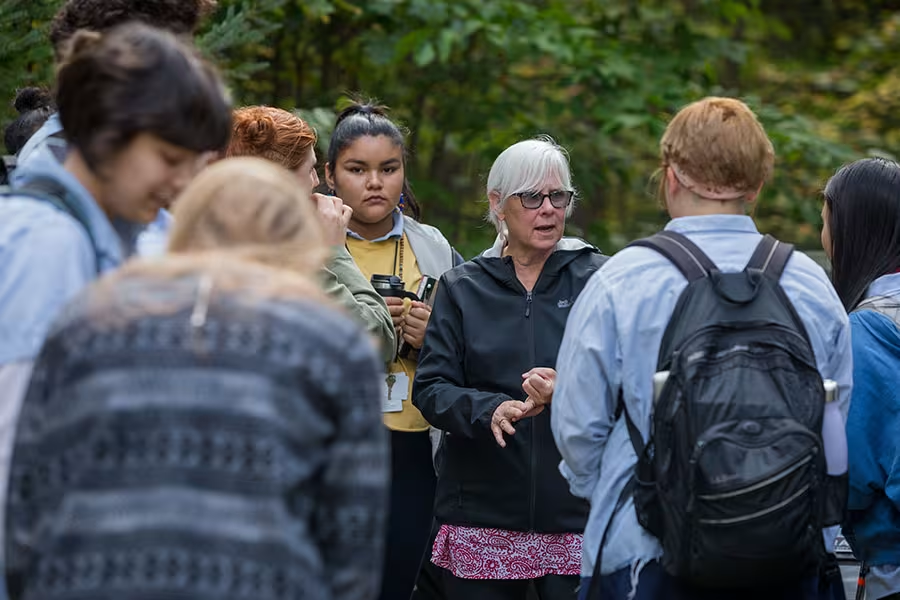
Mary Ellen Newport (center) leads a class at Riley Woods during the 2017-18 school year.
Interlochen Affiliation: IAA Fac 11-24, 25-26
Interview Date: July 16, 2025
Mary Ellen Newport is an evolutionary biologist interested in conservation. She retired after 31 years of teaching, the last 13 of which were at Interlochen Arts Academy.
This oral history is provided free by the Archives of the Interlochen Center for the Arts (ARTICA). It has been accepted for inclusion in Interlochen’s audio archive by an authorized administrator of Interlochen Center for the Arts. For more information, please contact archives@interlochen.org.
00:00:00 ELIZABETH FLOOD
Today is July 16, 2025. This is an oral history interview with Mary Ellen Newport conducted by Elizabeth Flood on the campus of Interlochen Center for the Arts. Thank you very much for your time and coming down here today. Would you please tell us your name, your connection to Interlochen, and the years that you've been here?
00:00:20 MARY ELLEN NEWPORT
I'm Mary Ellen Newport. I'm retired faculty from the R.B. Annis Math and Science division, and I was here 2011 to 2024.
00:00:32 ELIZABETH FLOOD
What brought you to Interlochen?
00:00:35 MARY ELLEN NEWPORT
Ted Farraday brought me to Interlochen. Ted was the Vice Provost for Education Programs at the time. I was Assistant Head of school at Olney Friends School, a little Quaker school in eastern Ohio, and he was on the accreditation team, and so I met him in that experience, and we had a lovely time. I made them steaks in my living room, and, you know, we had a really good down home time at Olney Friends School, and the rest is history. I really enjoyed working with him. I think it was just a really good fit for me. So I came in as the Director with the idea that I would teach a couple classes. And so I started out teaching biology, and then that all evolved, and I switched over to teaching ecology. And then we created the collaboration with Indiana University articulation program where kids will get college credit through Indiana University for taking a high school biology class. And so that was Advanced Bio, and I did that the last four or five years that I was here. That was great. That was so much fun. So I taught ecology and advanced biology, and now I'm coming back to teach a section of biology to our new students, our youngest students in the fall.
00:01:54 ELIZABETH FLOOD
What kept you here?
00:01:56 MARY ELLEN NEWPORT
Once I got here and like understood the surroundings, the environmental surroundings, I was like oh, they're gonna have to carry me out in a box. This is where I belong. I'm at home here. I've lived in beautiful places and studied all over the world and led groups all over the world, but this is home now for me. So I'm very happy here, not going anywhere.
00:02:21 ELIZABETH FLOOD
So what are some of your favorite spots around campus?
00:02:25 MARY ELLEN NEWPORT
The Math and Science division is supported by the R.B. Annis Education Foundation; and a school parent back in the '80s, Chuck Angus, his daughters were students of Mike Chamberlin's. They were both four year students. One of them was a creative writer and one of them was a musician. It was so important to his daughters, their identity and their growth and their development was really fostered and celebrated and nurtured at Interlochen for four years. Chuck was on the board of this foundation, the R.B Annis Foundation, and he saw to it that the Math and Science division is now an endowed division from the R.B Annis Education Foundation. They're actually one of the bigger, well certainly the primary contributor to any program in the academic area at Interlochen Arts Academy. So Chuck and I developed a relationship as me being the Director of the program, and I administered the funds that he so generously provided. And he always wanted me to have a little mad money, so he would give me twenty-five thousand here or fifty thousand there. So I always had a little pot of money to play around with, and so we're always doing cool things. So back in whatever the teens, the twenty-teens, we created a computer science course. Interlochen had not offered that, but we had a young faculty who was very interested in like offering something like that, and so Mikky Davey took on a whole extra section of teaching just so she could offer a computer science class. And then that's all morphed into a makerspace. My mad money was able to fund a makerspace, which is a beautiful facility that we still have in the library. Then Covid happened, and so I had this pot of money sitting in the bank. So that's story number one. Story number two is we were approached in 2016 by Wilsonart, which is laminate company, and unbeknownst to me, laminate contains wood chips. And so Wilsonart's very interested in the health and the well being of forests. And so they were looking for a project, an education project that they could fund that would integrate art and science. Hm, I wonder where they should go. So they approached Interlochen Arts Academy, and over a series of three years we received fifty thousand dollars a year for projects, and I collaborated with visual arts teachers at Interlochen Arts Academy, Mindy Ronayne and Johnny Hunt, and we created courses. We invited guest artists, and we had fun in the woods making art and doing science. But again, Covid occurred, and I had this pot of money that couldn't bring a guest artist to campus, and there's always pressure to spend, you know, you don't want to leave a pile of money sitting there, even though, you know, we could foresee bringing guest artists in the future.
And so what I really needed as a teacher was I needed access to the northern end of Bridge Lake. It's a perfect laboratory for forestry. There's a old logging pathway that comes down off of Riley Road heads south, and on the west side you have a pine plantation, and on the east side you have a native forest. And so it's this great place to study biodiversity. It's this great place to study regeneration of a natural forest. And so we just really went with it there, and that became my primary classroom. The maintenance guys built us a beautiful bridge over a creek, so now kids could both walk out there and walk back. It's a mile, you know, if you can walk to Tom's, you can walk to Bridge Lake. So it's a really beautiful location, and the only access we had to Bridge Lake was walking basically in this little seep. And so you could kind of bushwhack your way over to the lake. So with this little pot of money I had, I designed and built a beautiful boardwalk in an overlook facility, and so now kids can go out there and stand there and see loons and swans and ducks and stars. I took a group of Audubon folks out there this past spring, we got fifty-one species of birds that are migrating through, so it's a fantastic facility. It's almost, in terms of birding, it's almost too intense for a beginning birder. It's just like [mind-blown sound effect] but it gives you full access to Bridge Lake, and we can go out there even in the middle of the winter and hop on the lake and walk around and like see things that you could normally not see. It's just great access to this. It's just a pearl in an already beautiful study location for ecology, science, chemistry, geometry, you know, all kinds of academic subjects can be addressed in this beautiful location. The other cool thing about the Riley Road location is people in the community use it all the time. I'll go get out there with my dogs and the kids are out there with their fishing poles, or I'll meet some other citizen out there tromping through with their animals, their dogs. I meet faculty and counselors know it's a great escape. I'm really happy that it's so well used and really well loved.
00:08:27 ELIZABETH FLOOD
I'm curious what natural things, beings, what first caught your eye? What did you notice/what do you want to point out to people about this landscape and about Interlochen as a place?
00:08:41 MARY ELLEN NEWPORT
Well, the first thing I do with my students is I situate them on the globe, and so we learn the cardinal directions, and we learn about latitude and longitude. And then when you realize that with the 45th parallel, we're halfway to the North Pole. This is where we are in space. And then we zoom in. And then the other thing I do- Google Earth has this wonderful Projects program. I don't know if you've ever played around in there, but I have them go in and put a place mark where they're from, and draw a line between there and Interlochen. And so we end up with Interlochen as the center of all these striations, lines all over the planet. And so kids really know where they are, but they also know where their classmates are from, and so just situating ourselves in space I think is really the context. And those are great skills to have, like north, south, good skill to have, know where you are. And people will say, "Oh, I never know my directions." Well it's because you've never been taught. It's a skill anybody can learn. So I situate everybody in space, and then we go to the mitten. We look at the hand. Where we are is at the intersection of the southern deciduous forest, the northern boreal forest, and then we're on the edge where the dunes are coming over from the lake. And so we have these three serious biomes intersecting right at Interlochen Arts Academy. And so the biodiversity here is tremendous when you have so many different habitats that are out there. And so, for example Riley Road, you walk through a pine plantation, you walk through a maple, hemlock, beech forest, and then you walk into the riparian zone where you have a whole entirely different vegetation. I really feel like the point of science education is just helping people notice what's out there. Just observing. And so that's my primary goal. It's like what I want to do for the whole first semester. And so documenting the biodiversity is really important because I feel like if you don't have any knowledge, if you don't have eco-literacy, you can't develop a love for the natural world. And that's really my primary goal as educator, is how do you love the natural world? Because you won't fight for what you don't love. So it's really, really important to me. Now more than ever. But it's also overwhelming, and so we chop it up. Okay, let's do trees, and let's do vegetation, and let's do frogs. We have nine frogs that we can easily hear in northern Michigan. There's a way to teach the calls. You'll never see them, right? You'll never see them. You might see a wood frog, but it's so easy to go out and hear them. And so we make a device in our minds to how to memorize what calls are associated with which species, and then we document it all and send it into the frog inventory data set. Same with birds. There's a wonderful app called Merlin, and so all the students download Merlin, and they download eBird, and I teach them how to use the apps. And again, there's so many birds migrating through this campus in the spring that it's almost overwhelming for a new birder. And you can't stand in the forest and point out all those different birds. It's just too many, and so I try to empower them with Merlin and okay, that bird witchedy, witchedy, which. Witchedy witchy witch over and over and over again, that's the common yellowthroat. To give them those mnemonic devices to identify different birds calling, and this is why I'm not ever going to leave this place. It's such a fantastic intersection of art and nature and science and just beautiful locations. We're twenty miles from Sleeping Bear Dunes, and so I would take kids on field trips out there. Have you been out there?
00:12:56 ELIZABETH FLOOD
I did. I went a few weeks ago for the first time.
00:12:58 MARY ELLEN NEWPORT
So I have a weekly volunteer gig at Sleeping Bear, and I'll go to Platte Beach which is one of the most popular destinations, and you walk five hundred meters down the beach and you're there by yourself. And then behind you are the intact dunes and all the different, again, biodiversity and amazing things that you can only see in northwest Michigan on the dunes. So the other amazing thing on campus is the interlochen, is between the lakes. We have Duck Lake on the east and Green Lake on the west, and they're connected by a beautiful little creek, the Little Betsie. Little Betsie flows from Duck Lake. It flows west into Green Lake and comes out the bottom of Green Lake, and it flows all the way to Lake Michigan. And so Interlochen Center for the Arts is the headwaters for the Betsie River. And although they're not native, they're not invasive, the DNR has been releasing salmon in the Great Lakes as a sport fishing enterprise. And they swim up the Betsie River, they swim through Green Lake, and they swim into the Little Betsie. I wish you were going to be here in the fall, because they are trying to jump over the beaver dams in the Little Betsie and lay their eggs, spawn, and then leave their protein package bodies there for the bear and the eagles to enjoy. [laughs] Everything is connected! Fish are fertilizer, you know, fish are protein packages coming out of lakes and oceans, and it's really easy when kids can see spawning fish in the beautiful, clear creeks that we have that yeah, that's connected. They come all the way through this river, and they come all the way out of the big lake. They've grown up there. Now they've brought all that energy and that biomass up into our little ecosystem. And so it's such a privilege to teach here. It's just amazing. And again, as part of helping them read maps, and Denny Albert made this amazing map that shows the forests and ecosystems before white people arrived of the entire state of Michigan. And so you can see all these different forest types, and you see as you approach a waterway the beech-maple gives way to beech-maple-hemlock, and then gives way to cedar swamp. And again, it's all a matter of just being taught to see things. And then going from the biome to ecosystem to habitat, and you can learn that out of a book and never put it into your brain, but if you like, "Oh, we're in a riparian zone that means I should look for a common yellowthroat." I mean that's as good as it gets, and then make art about that. And that's the other thing that we've done extensively.
00:16:04 ELIZABETH FLOOD
I don't mean to ask you this question, but I want to ask you about the question, about what it means to get asked about the relationship between art and science. Because I don't feel like artists get asked about the relationship between art and science as often as people who have one foot more in the science realm. And so it seems quite obvious that through observing there's so many paths to that. So I'm just curious about what your relationship is to being asked the question about the relationship between art and science.
00:16:40 MARY ELLEN NEWPORT
Well, that's the privilege of being at Interlochen because everything is connected to art here. And if you want to interest anybody in anything, of course you're going to go through the doorway that they're interested in, right? And so how do we spark that love of science? And it's so much easier to do it with science than math. It's kind of a challenge, you know? It's like, okay this equals that. How am I ever going to use that? And for me, it's not just ecology, but ecology is sort of a gateway to deeper levels of science. Ecology, to me, leads immediately into photosynthesis, and photosynthesis leads us into respiration, and then photosynthesis and respiration lead us into evolution and endosymbiosis. And so because everything is literally connected you have to start where people are. And so for me starting with the art- the music students are so good at those frog calls and the bird calls. I had a student transcribe twenty different bird songs for violin! The directions that they'll go even without an assignment. They'll just take it and run with it. I love the work of Gerard Manley Hopkins. There's a poem of his Kingfishers. In the middle of the poem it says, "Each mortal thing does one thing and the same:/Deals out that being indoors, each one dwells,;/Selves-goes, itself; myself it speaks and spells,/Crying. What I do is me: for that I came." And to recite that poem on the bridge over the Little Betsie. I've had kids memorize poems. And then, years later, I go to a concert of a local band and find out that Allie Kessel has integrated that poem into folk song, you know, and just weeping in the audience. So, so pleased and touched. And so those kinds of experiences- Why wouldn't you integrate art and science? Why wouldn't you put the science and the art, and this the art into the science. It's just such a natural meld.
00:19:03 ELIZABETH FLOOD
You mentioned some of the performances, projects that have come from your classes, but I'm wondering: are there any projects or performances or activities that have either come from your class or from the surrounding campus that are memorable to you.
00:19:22 MARY ELLEN NEWPORT
So every year we do an Earth Day program. And so Interlochen Arts Academy has a community meeting, and every year we're asked to do a community meeting presentation for Earth Day. The kids are in charge of planning that. I don't bring in guests, so, you know, I always want them to be performing, and I know that I'm kind of building up to that in the first semester. I know that we're going to have something, so I want them to build a body of work that they are going to share in April, which is the Earth Day community meeting. And so kids are writing songs. They're doing dance movement. They are building sculptures out of their bodies. They're explaining projects that we've done. Let's see this past, past Earth Day the students wanted to focus on a tree planting project that we have been doing for many years. And the tree planting project is called ATREP: Assisted Tree Range Expansion Program. And the idea is that things are going to get warm, so we might help trees migrate north. And that's what we've been doing on campus. So we've planted hundreds of ATREP trees on campus, and so the kids are always involved in that. And of course to set that all up you have to talk about climate change and invasive species. And so that project alone can create a semester's worth of content and field trips and activities. And sometimes we'll get the whole school involved in the tree planting, and we've had some really cool experiences. My last year, so that would have been April 2024, a student created a video of trees literally physically walking north, and then another student had a narration behind it, and then a third student had a musical background for it. The art behind it is something I cannot teach. I can't do any of that. They're putting it together and making it happen, and they create this five minute film. It's completely collaborative, and it weaves in all the themes that we've been working on all year, and it communicates to the student body. Can hear a pin drop when these student presentations, you've got five hundred kids in Corson, and they're just transfixed by their colleagues' work. And then somebody else is up there kind of weaving a narration, and somebody else's pulled their band up, and they write a song or recite a poem. And then Allie Kessel's performance of her version of Kingfisher. Her little song, and that was just a peak life moment for me much less a teaching moment. The other thing that happens is we keep a spreadsheet of all the alums who go off to study in math and science in our department, and I did a word cloud of their different activities and majors and careers. The biggest thing that pops is environmental science. I'm really proud of our whole department and the way we've really helped kids. Not everybody is going to be a career artist. It's just not for everybody, and so to give them a passion and to give them the tools and the interests, and they keep on doing their art. They manage to weave art, whether they're trained in it or whether they're, you know, pulling in something that they've learned from a colleague that enhances their career, and enhances the world around them because they're just better communicators. I think artists are great communicators, and they have a more holistic view of how to present to an audience. How to engage an audience, and again, how to introduce the natural world to people in a way that's engaging and lovely.
00:23:44 ELIZABETH FLOOD
Via the the tree project and you talking about the Google Maps project about space, I'm wondering about time and how time fits into some of your lessons broadly. Because I'm thinking about a lot of the conversations I've had with other folks who have been connected to Interlochen have been about the tradition and the intergenerational experiences here, and how that relates to some of the natural relationships too, being like this tree has been here for who knows how long or people do know how long, but a long time. And so I'm wondering about time relating to your class.
00:24:31 MARY ELLEN NEWPORT
Time. First of all, I've mentioned my predecessors Michael Chamberlin and Steve Tavener. There's a long line of people. Just the fact that we teach an ecology class for high school students is pretty unique. It's not in a standard curriculum, and so I feel there's that little arc of time since there's been an Arts Academy here that it's a serious tradition. I just think people really value it. And when we actually had the dedication for the boardwalk on an alumni weekend and a hundred people showed up. We couldn't fit them all on the boardwalk. It was really great. And it was crappy weather and everything, and so some of those old instructors showed up and celebrated with us. And so there's that little sense of time. Then the next sense of time that goes along with the mitten is that, you know, the glaciers wiped everything down to the bedrock ten thousand years ago, and so we've been building an ecosystem for ten thousand years. That's kind of a manageable amount of time for students to wrap their heads around. Because I think, you know, once you go past a hundred, unless you use those numbers all the time it's really hard to think about that. And so time and space, we look at maps, and we look at where the ridges of glacial debris had been deposited, and then scraped back down to the bedrock and the accumulation of wind and water wearing down rock creating this wonderful little sandy Interlochen. And the glaciers scraping out Duck Lake and Green Lake. And even in a shorter term sense of time, it's the hundreds of years since those lakes have been dammed. They didn't always used to be that deep. They were just kind of shallow, mucky ponds that would dry- it wouldn't dry up completely in the summer, but they would certainly get very, very shallow. The use of land by the Native peoples here, you know, they used this place as a resort. It was a really fun place to come to hunt and fish and hang out, and then they would leave for the winter. They were snowbirds. So that sense of time, that's like a short term sense of time that we play around with, but putting everything in the context of photosynthesis and respiration and climate change. Where's all this carbon dioxide in the atmosphere coming from? Then we have to go back to two hundred million years ago. Two hundred million- that's how many zeros. That's eight zeros. Okay. What does that really feel like and look like, and where did all this fossil fuel come from? Why aren't we making more fossil fuel? There were no microorganisms to digest those carboniferous trees, and so they just got buried and compressed and heated and turned into oil and coal, and, you know, petroleum. And over, maybe, like hundreds of millions of years the accumulation of all that carbon dioxide in the atmosphere becoming embodied in plants and compressed into fossil fuels. So we have ten to the eighth. We have eight zeros behind that number. And now, in hundreds of years, two zeros, we're going to take all that carbon dioxide that was stored in plant bodies, and we're going to pump it all back into the atmosphere in a couple hundred years. And then you say, what could possibly go wrong? And so that sense of time is really important to the way I think about biology. Going back even further, like who invented photosynthesis? Who invented respiration? How did life come about? And so now we're back into billions, and so trying to build hundreds, ten thousand, a hundred millions, billions, and try to not just wreck everybody's brain with- I think everybody needs to know about photosynthesis. It's so important, it's so cool too. It's not violating the second law of thermodynamics, but it's like an interruption. It's like, okay, things are not becoming more chaotic, they're becoming organized. And that's what photosynthesis allows life to do, is to become organized and to be alive. Yeah so that's time, time and space. You've summarized my syllabus.
00:29:08 ELIZABETH FLOOD
[laughs] I guess more directly to the centennial project,
00:29:14 MARY ELLEN NEWPORT
Yes.
00:29:15 ELIZABETH FLOOD
The question is what do you hope for Interlochen in the next hundred years? What of the traditions do you hope are carried into the future, and what would you like to see be happening at Interlochen in the next hundred years?
00:29:31 MARY ELLEN NEWPORT
So I think the primary tradition, the thing that Interlochen has gifted the world with, is our students. They're the centerpiece of everything we do. And I feel like the graduates that are, again, nurtured, inspired, networked here. That is the most important tradition, and that's what I want to see is that the primary focus on creating and supporting artists of every stripe, but people have something to say. And I feel like we've done that, and I think that's what I hope we continue to do, and to give them the the collaborators. I think collaboration is like key. To give them something to say. To help them be bold, now more than ever, and to give them the means of expression however they want to do that if they want to be an activist, an artist, an artivist, whatever means they're going to- a scientist, a bench scientist. I feel great hope for the world being touched by Interlochen alums. I think we are doing a great service for the world, for humanity by, again, nurturing, and teaching, certainly teaching, but high school is such a weird time to be a person. And sometimes it's just like getting you through ninth grade just intact as just a whole person who knows that they're valued and cared for. So I feel like that keeping the student at the center of everything we do is the tradition that I hope going forward into the future that Interlochen can continue. And then we have this amazing campus. I'm so sad there putting in another parking lot. It just kills me. We have a huge housing shortage in northern Michigan, and they're talking about housing. I wish they would ask me. I have opinions about how to do that. And so caring for this twelve hundred acres is another legacy that Interlochen Center for the Arts has, and I feel that I know there are people on the board who really, who value that, who value this amazing location and recognize it as the nurturing, healing, vital, inspiring place that it is. And so that is definitely my hope for the future of Interlochen is that we cherish and we care for and we protect this beautiful campus.
00:32:19 ELIZABETH FLOOD
Thank you so much for speaking with me today. Do you have anything else that you would like to note?
00:32:27 MARY ELLEN NEWPORT
I would just like to say that it's really interesting being an academic teacher at an arts school. It's not that we're in second place or anything like that, but we're definitely in service to something else. And the academic teachers face pressures from students and administrators and parents to be all things to all people. So you've got to provide an algebra curriculum for kids who haven't had any math. I had a student from Macau who hadn't had science class since fourth grade. And then we also have kids in here who want to go to med school. And so holding that container for academic programming is really challenging and so rewarding. And so I just want to shout out to the academic teachers who are inspiring. They are hilarious. They get it. They know what the game is here, and they just keep on plugging away trying to meet every kid's needs. All of us are working really hard to meet the kids where they are, get them where they need to be, just create that little scintilla of interest. Shout out to the academic faculty. That would be my last comment.
00:33:58 ELIZABETH FLOOD
Thank you so much for speaking to me today.
00:34:00 MARY ELLEN NEWPORT
You're welcome. Nice to meet you.
Copyright
Copyright to the audio resource and its transcript is held by the Archives of Interlochen Center for the Arts (ARTICA) and is provided here for educational purposes only. It may not be reproduced or distributed in any other format without written permission