
Oral History Interview with Lynn Sanders
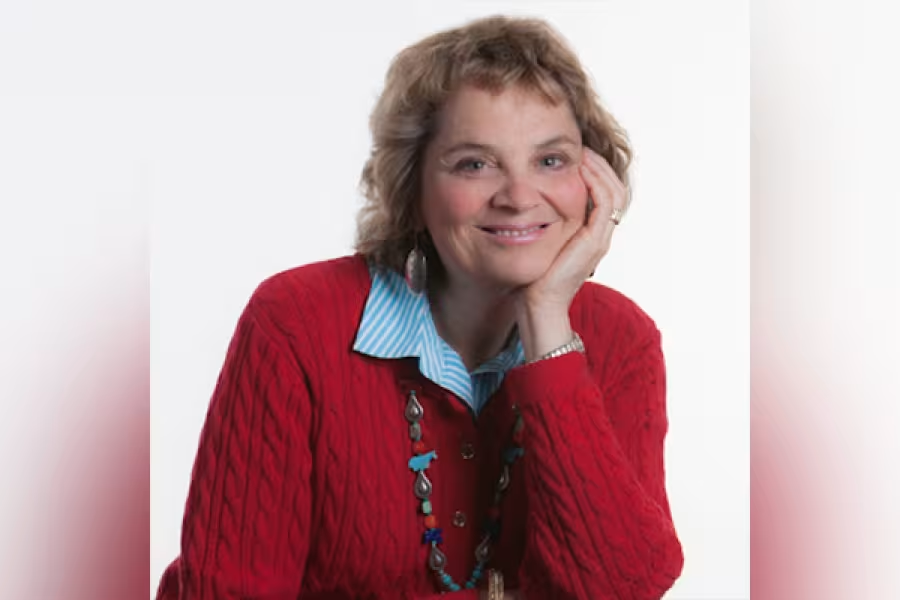
Interlochen Affiliation: IAC/NMC 65-66
Interview Date: June 28, 2025
Lynn Sanders studied piano, drama, and dance during three summers at National Music Camp.
This is an Oral History interview with Lynn Sanders, conducted by Elizabeth Flood while walking around the campus of Interlochen Center for the Arts on June 28th, 2025. It begins leaving Apollo Hall and walking down Frederick Stock Avenue towards the Opera Field.
This oral history is provided free by the Archives of the Interlochen Center for the Arts (ARTICA). It has been accepted for inclusion in Interlochen’s audio archive by an authorized administrator of Interlochen Center for the Arts. For more information, please contact archives@interlochen.org.
This is an Oral History interview with Lynn Sanders, conducted by Elizabeth Flood while walking around the campus of Interlochen Center for the Arts on June 28th, 2025. It begins leaving Apollo Hall and walking down Frederick Street Avenue towards the Opera Field.
00:00:00 LYNN SANDERS
So my Camp name was Lynn Cheryl Bogan, B-O-G-E-N.
00:00:05 ELIZABETH FLOOD
And yes, could we start there with when were you here? And what is your affiliation with Interlochen?
00:00:13 LYNN SANDERS
Okay, I was a camper here in 1965 as a Junior, in 1966 as an Intermediate, and I am also an alum parent. Our son, Andrew, went to the boys camp years later in the Intermediate division. He was there for one summer, and I took one of your adult classes while he was in Camp for like a week. It was a chamber music class, and I was in the piano area. So I have a lot of different experiences, but Camp was very profound for me.
00:00:45 ELIZABETH FLOOD
What brought you to Interlochen? How did you find out about Interlochen?
00:00:49 LYNN SANDERS
I was only an eleven year old kid, and I was playing piano, and I loved the arts and drama, and my parents found Interlochen. There weren't computers, of course, in those days, so somehow they found Interlochen for me, and they said, "Would you like to go to this wonderful camp in Michigan?" And I had never gone to an overnight camp. I said, "That would be great!" And I got strep throat right before Camp, so I was taking all these medicines in order to be healthy enough to get to Camp, and I had to bring the medicines with me on the train, because there wasn't a regular way of getting here other than the Interlochen Express. So everybody on the train was exchanging sandwiches and snacks and having fun and talking. It was like how Harry Potter trains are, but there was no Harry Potter. And we got here, and I was exhausted and not feeling so great, and I remember writing to my dad that the medicines were making me sick. At the beginning of my time here, I was spending some time in your infirmary. And my dad wrote me a postcard back, because we weren't calling that time, and he said in big letters, "If the medicines make you sick, stop taking the medicine!" Very ordinary, you know, logical thing to say. But I quickly recovered. I was embarrassed that I was having to take a nap the first day because everybody was there in the cabin. I was sleeping. But I had so many wonderful times here. And I took beginning ballet. I was a drama major. I got to play Dorothy in our class for the Wizard of Oz. I was taking piano ensembles, and it was the first time I ever played an electric piano, so I was very excited that you could plug it in and nobody could hear you while you're in class, and you could practice the passage, and then the teacher would say, "Okay, now you can all unplug your pianos," and we could all play together perfectly because we had practiced. And there was also a fantastic course called Music Talent Exploration. Interlochen was only an eight week camp then, it wasn't like it is now, three weeks. So after four weeks of Music Talent Exploration, where you could try a little bit of every single instrument in the orchestra, which I thought was fantastic, then you could pick your favorite and study that one instrument for the rest of the time. So I love the oboe, and I got to learn oboe, and I just loved it so much that when I got home, I asked my parents if I could learn oboe and piano, but they said, "No, you have enough with the piano." So that was the end of that, but I got to play a tuba- even one note. I loved the harp, I loved the clarinet. It was just so fun. And then I took beginning ballet, and I had arts and crafts, and then of course everyone took swimming. And the big thing was that everyone wanted to pass the twenty minute swim test. I don't know if you have that now, but if you did, you got a star on your name badge, and if everyone in your cabin got a star, then you got some kind of prize. So the twenty minute test meant you had to swim without stopping, without putting your feet down, for eighteen minutes. Then you had one minute where you needed to do the back float and one minute of sculling in the water, and if you did all that, you got a star, so I did. It took a lot of practice, but you felt just so proud of yourself. Also, then we had fantastic field trips. We went canoeing, and years later, when I came back to visit, we went to the same canoe place here, and it was the same owner, and I asked her how much it was for a canoe, and I told her just casually, "The last time I was here, I was a camper at Interlochen," and she said, "Oh, you're a repeat customer! I'll give you a discount," which I thought was funny. And then we went to see Gwen Frostic at Gwen Frostic's studio, and she said something that was really profound, that I never forgot. Years later, when I came back to visit Interlochen and I visited her studios, and I saw her again, but she told us all a story. We were all seated at her feet, and she said, "One day I got a complaint from someone who bought one of my books, and what was it about? Because some of the pages intentionally did not have words." So Gwen Frostic was a very famous artist, and she was also a writer in Interlochen, and so she thought very carefully about where she put words on a page that was beautifully crafted with images of nature, you know, from trees and flowers to animals. But she also recognized the importance of not having words on certain pages so that your mind could really breathe with the pictures. So she'd say some poetic words on a page, and then the next page could be blank. So the woman called and said, "I think I need a refund because some of the pages in this book don't have words. So this isn't right," and then she explained to the customer that she did that intentionally. I don't know if the woman still got her money back or not, but I thought that was really profound, that you could write and then let people pause, just as you would in music, you'd have a rest. So you have a rest on the page, just gazing at the nature pictures, just admiring what's around you and appreciating the beauty of nature while you read a book. So I know I'm going on and on, but I just had so many wonderful experiences here, and it was my first time ever being away from home. So I remember my mother and grandmother coming to visit with a sibling, but mostly we would write postcards back and forth. Oh, so as a Junior, you had enforced rest period. Every day, you had to stay in your bunks for about an hour, and I don't think anyone slept, but this was your time to read or write postcards. And our cabin, I was in cabin five as a Junior, and cabin three is Intermediate, our cabin somehow created the idea of doing a pulley system. I don't know who thought of this or who created it, but it was basically a series of like ropes with clothespins, and so you could write a note to someone in your cabin and somehow pull the rope across the room to somebody's bunk bed, and be able to communicate, because we weren't allowed to talk. So it was so fun! So we got to have time to just talk through writing, and that was my time to catch up with family and write, because nobody was making phone calls or anything like that, and we all shared the chores. I'm sure they still have the capers chores like raking the sand to make the sand look beautiful in front of your cabin, you know, or cleaning the bathroom sinks or toilets. But it was just a really wonderful feeling of camaraderie with kids from all over the country. And I thought it was really a clever idea that everyone got to wear the same clothing. Everyone wore corduroy navy blue knickers below the knee, and according to your age group, you wore different colored socks, so Juniors were navy blue, and then you'd wear a light blue shirt during the week and a white shirt on Sunday. And I realized later, that's why no one ever judged anyone else by their clothing. You just enjoyed each other. I'd like to tell you a little funny incident about an activity at Interlochen. So as a Junior, we had certain activities like the first week, we got to meet Mrs. Maddy, and there was a tea and cookies greeting for all the Junior girls. You came in by cabin and you went up to her, she was sitting in a chair. She had white hair. We got to shake her hand and say hi and have tea in beautiful china cups, yeah, and have cookies. So you felt really appreciated here. And one of my favorite memories, which I mentioned to Ian, was I was just walking in the woods and really loving walking next to the tall pines, breathing in the scented air, hearing the music of people practicing outside. I love the outdoor cabin piano practice rooms because I could open a door and be right with nature and play. And I just happened to be walking, probably back to my cabin, and who should I see right in front of me? Dr Maddy! And he didn't know who I was. I wasn't in orchestra, I was a piano person playing, you know, piano, and doing drama and dance. But he looked at me, and I just looked up at him, and he just said, "Hi." Just hi, because he didn't know me. And I said, "HI!" back. And then he went on his way, but I felt so excited, and, you know, enthralled and honored, that here's this man who's the head of this whole Camp, and he acknowledged me, he noticed me, and he was willing just to say hi, you know, and pause in the woods. So I never forgot that. And then that summer, I was thinking, I'm going to look forward to coming to Camp. And I used to even lie in bed dreaming that I was a bird and I would fly over to Interlochen, because we lived on the south side of Chicago, and it was a big trek. That's why my parents didn't drive me here. I took the special Interlochen train that was an express, where everyone from the Chicago area would go on it. So that next year, I was just thinking about coming back to Interlochen and flying there in the nighttime. And then I got a newsletter. The headlines were that Dr. Maddy had suddenly died, and I was shocked. He was the first person in my life who had died, and I just didn't know how to handle it 'cause, you know, I was going back to camp the next summer, which was 1966. So I would cry a lot, you know, because I was just sad that he was gone. I came back the next year, and it was different without him, but still Camp carried on. It was still so wonderful. And I was now an Intermediate, because when you're twelve you could pick whether you want to stay as a Junior or be an Intermediate, and I decided I want to be with the older kids. So the second year, I was in cabin three. And I loved the kids I was with. And what was, I think, significant, which stands out most of my mind was when I came back home. So before Camp was over, they had like a little party, and I was keeping a diary- Which one thing that was fun I wrote down was the bandersnatcher hunt. I don't know. Do they have such a thing now? And I don't know who created these crazy things. So they said that there's this animal, like a lizard, with a big green head, and you all have to go out and look for the bandersnatcher, who knows about that? And then someone else said that there's a way of getting your wish here. How do you get a wish when you're at Interlochen? Well before you go to bed, you stand on your right foot and you go clockwise, you hop on one foot and you say, "Rabbit, rabbit, rabbit," three times as you're going, circling three times. And after that, you go to the left side and you say, "Tomorrow, tomorrow, tomorrow." I don't even know what this means. And then you don't talk to anyone, and then your wish will come true. So we had crazy things like that. And the last day or two, everybody was signing autographs on pieces of paper with typical Camp things like, "Wherever you are, remember you" and "Too late to be forgotten [2 L8 2B 4gotten]" you know, different little things. So I came back on the Camp train, and my mother was waiting for me, so I was excited, and I asked, "How is Zayde doing?" That's the Yiddish name for my grandfather, who had been ill. I had been sending him postcards, and my mother replied, he's in heaven. And I was just shocked. This is now the second person who I just learned died, and this was my grandfather. And I was so upset because no one told me while I was at Camp, and my mom said she didn't want to spoil my last few days at Camp, because obviously I would have been very upset. On the other hand, I felt really upset I missed the funeral. I missed all the services and people who were coming together to honor my grandfather. So I had mixed feelings, like, I still wish you would have told me, and then I didn't come back to camp for many, many years. So I was twelve. My brothers were going to have a bar mitzvah soon. You have that age thirteen, but our family was moving that next summer from Chicago to Highland Park, and so there were other activities in the family, and Interlochen wasn't on the agenda anymore. So it took many, many years till I was an adult and I got married that I thought, you know, I really just want to visit Interlochen. I haven't been here in so long, and it just always felt magical. I had kept in touch with some of the kids from Interlochen. In fact, one girl named Susie Weiser. I don't know where she is now. She lived in Highland Park. We were in the south side of Chicago. She invited a group of us from the cabin to come over to her house for an overnighter after Camp. And so there were, I don't know, maybe five or six girls got together and just had fun. And then it wasn't until I came back to visit, and I just fell in love with being at Interlochen again. And we were living first in Highland Park, and then we lived in Winnetka. Whenever we could come to Michigan, I made it a point to visit Interlochen. And of course, I'd have to go see my cabin, just to see it and look and see if there was the plaque that had our camps year, 1965, with our names on the plaque. So one year I was, and I don't remember when it was, I was going to cabin five, and this girl asked, "What are you doing here?" You know, I'm grown up. And I said, "Well, I used to be in this cabin." And she said, "Really? My mother used to be here." I said, "You're kidding." I said, "Who was your mother?" I said, "It was 1965," and she said, "Penny Knuth." I said, "I know Penny! She was in my cabin!" So we look on that, and of course, you know, we found the plaque. And this girl, her name is Georgina, I think it's Rossetti, is a violinist or violist, and she talked with me, and she's Penny's daughter, and she ended up now becoming a professional musician. Her mother, Penny is a professional and I connected with Penny on Facebook, and she just posted how her daughter is doing some big concert. So I thought that was such an interesting coincidence, like a spiritual connection. Oh, here's someone from your past as a generation ahead, saying hello. So loving Interlochen so much, it'd be natural I wanted my children to come here. I have two boys, and our youngest son was into violin. Our older son studied percussion, so he wasn't really into Camp as much. So I invited Andrew to come be a camper, and so years later he became an Intermediate boys camper, and he really loved it. I asked him if he could send his memories. He loved the Melody Freeze a lot. And he was so sweet with the girls that when he would go there, if there was one girl behind the counter, she would give him complimentary Melody Freeze desserts. And he did something that I thought was really amazing. He was in the orchestra, and as you know, you get to move up in chairs depending on how well you play. So he outperformed everyone in his younger orchestra group, so he got to be moved up to the a little bit older group. He was in the last section, last rows, but I was so proud. We came to visit one year, and he was performing with the orchestra, with the older orchestra, and he was very proud himself. So all in all, I feel like the experiences I had, both as a camper myself and as a parent, and then later my son went to another camp, and I came here for the adult music Camp to treat myself, to have piano lessons and plays duets with other professional people, which I just adored. So I feel the experienced as a camper, as a parent, and as an adult student have added up to really enrich my life forever, and I certainly always recommend Interlochen to people I know who have children looking to find a camp for their children. I had taught piano until more recently, and I had recommended Interlochen to my students. And I think what I love about Interlochen is it's all the arts coming together. So even though I didn't take drawing or painting, you can walk along the pathways. You can see people doing art. You know, even if I wasn't a professional dancer, I could enjoy dance, and I can enjoy people doing dance, and I could participate at my level. The other thing I love that I think served me well is that I learned to stretch myself, my inner self. So we had concerts, student concerts, and I had been in piano recitals from a teacher back home, but these were bigger recitals with more people, and I did save at least one or two programs where I was performing in a program with piano. I got to, as I said, play Dorothy in The Wizard of Oz just for our class, but people would believe in you, and I got to experience new things. And the twenty minute test taught me I could persevere after a challenge and get my star on my badge. I could pass a twenty minute test. And just have really fun. One other memory that comes to mind, they're all pretty vivid. This, I think, was also as a Junior, they had Sadie Hawkins Day. Do they have that now? So Sadie Hawkins Days from a cartoon where the girls chased the boys, and then they grabbed them, and then they're the boyfriend. So in Camp, what they did was they had this special day where the boys were taught to just run wild in the forested area, and the girls were to run after them, and then whoever you could tag on the shoulder, you didn't have to grab him, but tag, they were now going to be your husband, [laughs] temporarily of course, and you would go through this mock wedding ceremony. And I don't even remember the boy's name I tagged. And then the boy immediately, of course, wanted a divorce. [Laughs] They had divorce court. I don't remember anything about the divorce, but and maybe this boy just ran away after we got supposedly married, but it was just the fun of it all. We did these crazy things that everyone participated in and had fun. I think everybody really loved Camp. And what I also love was that it's in the woods, so you're breathing in this scented pine air, you're feeling very exhilarated by the beauty of nature, and then you're creating your own beautiful art in whatever you do, and you're feeling acknowledged and noticed that you can do whatever you want here. You could stretch and learn and grow together, and everyone's here for you. I love that. Now you know, they also had report cards. In camp it was just eight weeks, so we had two report cards every four weeks. And I just remember my Junior report cards, because my parents would actually would tease me, make a little fun of this report card, because not only did you get grades from each of the classes, but you got the counselor's comments about you. How you were doing in your cabin. And for whatever reason, I'm a pleaser. So I had learned on my own how to give back massages to my mom, so during our rest period where you're supposed to be lying in bed, I offered to give my counselor back massages. [Laughs] So she gladly said yes. So many times, I would give up my rest period to do a back massage for the counselor. And then she wrote on my report card: "That if there was one word to describe Lynn, is that Lynn is good." And I felt actually embarrassed by that because my father, who became a psychiatrist, who was a doctor, said, Lynn, "You're always being too good for other people. You need to be good to yourself. You don't have to spend your time at rest period giving her a massage." And I said, "I know, I just like doing it," and then the bell would ring and time would be up, and you know, I'd spent it that way. But I kept that in mind, I remembered it because I still work on that quality. I love doing good for others. I love doing service, and I'm also working on being good to myself. Oh, so you know that all the cabins are not heated or air conditioned. So they told us all to bring a trunk filled with not only clothes, but four woolen blankets. So we used those woolen blankets, all of us. At night, it got very cold, and you go to sleep to taps, and you hear the bugler playing, and it's very cozy, but you had to make sure you had all your blankets on. And then in the morning, there was "Reveille." You had to get up very early and make sure that you're ready for inspection, that your cabin was neat and everything, but it was fun because it was a team spirit. And there were also services every Sunday morning. I'm Jewish, so it wasn't a Jewish service. It was like a non denominational service, which was fine, but I still wanted to do something that was Jewish, so they actually had a tent, I don't know if they have that now, for kids who are Jewish, where you could actually go on a Saturday morning, which is Shabbat, and attend a Jewish service under a tent with all the age groups coming together and having a short prayer time. So I like that they acknowledged my religion, but I could go to the group service and enjoy being part of the group. But I still feel very connected to Interlochen, and I always think of Interlochen is my heaven on earth. So no matter where I go, Interlochen is always in my heart, even though I'm not flying here to my dreams all the time like I used to imagine, I really did, Interlochen stays with me wherever I go, and I'm very passionate about sharing stories of Interlochen and encouraging other people to know about Interlochen. And I'm also, I'm also passionate about bringing the story of its founder to the world. I am a children's picture book author. I'm an award winning and best selling writer and author, and I've written other books and self published them, doing all the crowd funding on my own to raise the money, because they're important stories. I've written a book called Dancing with Tex: The Remarkable Friendship to Save the Whooping Cranes, based on a man who's saving all the world's cranes. His name is Dr. George Archibald. His nonprofit is called the International Crane Foundation. And then before that, I wrote a book for kids called Social Justice: How You Can Make A Difference, which was a work for hire by Capstone Press. So it an important book for kids to learn how they can make a difference, create their own nonprofits and do good in the world. I highlighted five different stories of kids who did just that, created their own nonprofits. So my idea is that kids need to know their value, and by creating stories of inspirational leaders from a kid's viewpoint, kids will realize that they can do good and will spread more positivity in our world. Most people, I think, don't know the name Joseph Maddy, and I don't know how much people know about Joseph Maddy, the founder, who even attend this Camp. Even though I just said hello to him, I collected every book there is on Joseph Maddy. I learned all about his background, and I know he's deserving of having a children's story written about him, because children read children's books. They don't always read adult books, and that children's book would also educate families who are gathering books for the kids that this is a special place, and it's here because of one man who had a dream and had faith, belief, and perseverance in that dream to make it come alive for generations to come. And it is, to me, like a little mini United Nations with flags of all the different students are here from different countries, where people can come together in peace and enjoy their passions, love what they do, and care about one another. Can't think of anything better, and that's why Interlochen is my heaven and earth. My vision is to bring Joseph Maddy's story out into the world so more people can experience Interlochen. I just love it here. I just love it.
00:26:37 ELIZABETH FLOOD
Do you have a favorite spot? Like, is there a spot that you would like to sit in front of?
00:26:42 LYNN SANDERS
My cabin, or the other favorite places I like to be around the pianos. I like the fact that we could be outside in a cabin, playing piano. That was very cool for me. Whenever I've come here on visits, I like to look for the pianos, and we are often here at the end of a season, so the pianos are no longer in the cabins anymore. Because of weather, they don't keep the pianos outside.
00:27:10 ELIZABETH FLOOD
When was the last time that you were here?
00:27:12 LYNN SANDERS
It was 2022. We got a golf cart tour by Margaret Beery, which Ian Jones arranged for us. I didn't even know who she was, and she started talking about Dr. Maddy and the Camp, and I got so excited, I took my phone out and I started recording her. So I have stories still in my phone from September 2022 that Margaret Beery gave me, which is a gift, but that was the last time we were here. So it's been a little over two years, September 2022 it's now 2025. But she was like a walking encyclopedia, and she knew him, and she knew everything, so I kept my phone on. I don't want to quote anything incorrectly, but she was talking about why Dr. Maddy thought of making it a practice at Interlochen in the orchestra that you could move up in chairs without the adult making that decision, and that was because Dr. Maddy had experienced as a kid, as a younger person, where he was in an orchestra and they didn't let him move up in chairs because the adult said, you know, his age wasn't right or something. So he wanted kids to live up to their potential, not by whatever someone else said. [Speaking about the challenge system] I was not in an orchestra or band, so I didn't have any of that feeling, and I had no anxiety playing in piano ensembles, because we were all just practicing and playing together. That was fun. But my son, who was in orchestra, he said it was a little anxiety provoking that you would stand at the back of a room so no one would know whether it was Player A or B performing. And then the students would raise their hand to say who was sounding better, you know, who's performed better, and then that person would move up in their chairs. You know, at that time, also at the end of Camp, you could go to, I think it was, Stone Student Center and look at all these different pictures that the photographer picked, and then you could pick which ones you wanted to buy. So I did buy pictures during each time, but no one walked around with a camera. No one had a video machine. There were no cell phones. If you were sick, you know, you went to the infirmary, and if it was really bad, they'd call your parents or something, but you were really self sufficient here. One of the girls in the cabin next to me, as an Intermediate, ended up going to my high school, Highland Park High School, and we got to be friendly, so I saw her. Her name was Janet Brusslan. Most of the kids I didn't see again, but still, we had that wonderful time together. You don't forget it. I also remember the ending of Camp where they were giving out scholarships and girls or boys, whoever, they were screaming as they raced down the aisle to get their certificate that they got a scholarship to come here. So I was thinking, wow, it's so fantastic. I wasn't really thinking about the cost, because my parents had covered it those two years I was here, and then later I didn't get to come back for a while.
00:30:22 ELIZABETH FLOOD
What was it like to share this place with your son?
00:30:27 LYNN SANDERS
I was so excited to share Interlochen with my son, Andrew. I just wanted him to have the same types of experiences I had, where I loved my classes, I enjoyed being with my cabin mates, I love learning. He also really enjoyed Interlochen. The hard thing for him, I think, was feeling like that he was studying a lot, which he was in violin, and he wanted to kind of relax more. So you mentioned earlier, some of the kids in orchestra felt anxious, and he wanted just to not feel as pressured. So he did go to a YMCA camp after this, but what Andrew did that made him special, was he took his violin to the YMCA camp, and he played with the adult male violinist who was at camp to entertain the kids. He played with the professional and had a wonderful time on his own terms, playing violin, and I think that, whether he realized it or not, the experience of just performing at Interlochen gave him more confidence, so that it wasn't a big deal. And then later on, what we did, Andrew and I, is I would call senior citizen homes, and Andrew and I did performances together, and he would play different pieces from his Suzuki repertoire, and I'd accompany him on the piano, and the seniors would clap, and he loved it, and afterwards, they'd stand up in line to hug him. And one funny thing happened, I'll tell you, when we were playing together, one time, he forgot where he was in the song, and I'm playing piano, remember. So I think from this confidence he had, he just decided he'd improvise, and he just kept playing, and I was totally flabbergasted. I didn't know what to do. He just playing and playing, so I just stopped. And I figured everyone will think that I'm making the mistake, but that's fine. He's going to keep playing. And eventually he found his way back into the piece, and I could continue playing, and we ended it, and people were clapping. They were very enthralled with him. He started learning violin at age four, so he had a lot of skill even before coming here. And I think just being here reinforced that ability to play and have confidence.
00:32:52 ELIZABETH FLOOD
We could go to the piano rooms?
00:32:54 LYNN SANDERS
Yeah, let's do that. Wow, listen to them play. Sounds like Gershwin, some of it. See what's so neat about this is you have your privacy playing piano, but yet you get the trees with you. Here's one. You used to sign up on a sign up sheet for the time you wanted the cabin. Did you know that? So that you would reserve your time. And actually they checked for your report card or piano ensembles that you did you practicing. That's good accountability. So let's just hear how it sounds. Let's hear a little music. [Plays the piano]
00:35:15 LYNN SANDERS
[Walking out of the practice cabins] So this, oh The Bowl! Okay, yeah, we had The Bowl, and it was just green wooden benches. It wasn't that comfortable. Sometimes in the evening you got really tired, you know, I was a kid. I was eleven, but it was always really fun to be sitting out and you can, you can watch the stars. And then the other, Kresge, so I think that was there as well because I remember I loved the saying across the top arch about music being the universal language. So that always impressed me. This is nice, you can walk along and just hear music wherever you go. I tell people about this, they think this is just amazing.
00:35:56 ELIZABETH FLOOD
And yeah, to try and describe to people how much music there is around every corner... [Laughs]
00:36:03 LYNN SANDERS
[Music swells] I just call this my heaven on earth. Yeah, you could see, you walk in the woods, and there's music coming out from the trees wherever you go, or people are practicing whatever they do.
Copyright
Copyright to the audio resource and its transcript is held by the Archives of Interlochen Center for the Arts (ARTICA) and is provided here for educational purposes only. It may not be reproduced or distributed in any other format without written permission