
Oral History Interview with Lisa Kearns
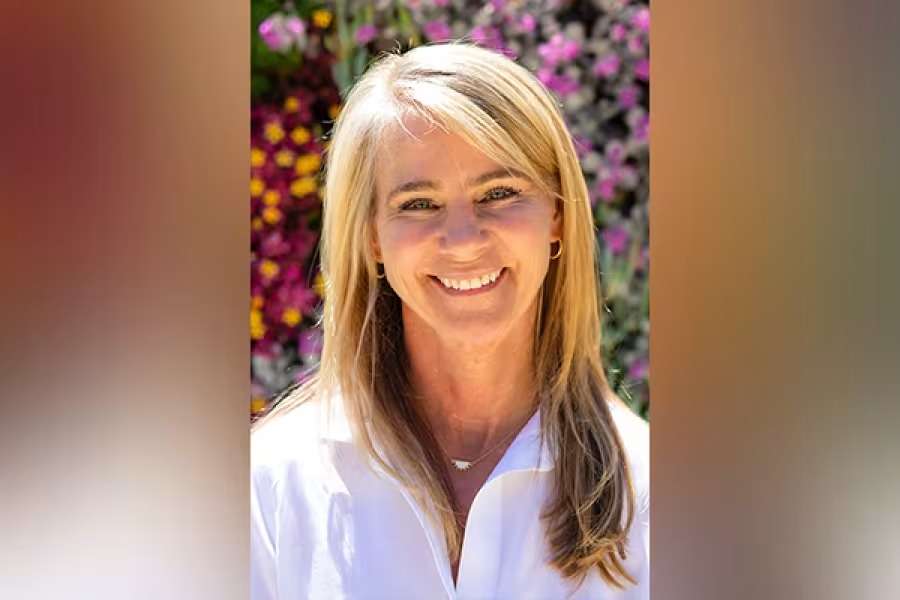
Interlochen Affiliation: Camp Parent | Academy Parent | Interlochen Trustee
Interview Date: July 24, 2025
This oral history is provided free by the Archives of the Interlochen Center for the Arts (ARTICA). It has been accepted for inclusion in Interlochen’s audio archive by an authorized administrator of Interlochen Center for the Arts. For more information, please contact archives@interlochen.org.
00:00:00 ELIZABETH FLOOD
Today is July 24, 2025 and this is an oral history interview with Lisa Kearns conducted by Elizabeth Flood on the campus of Interlochen Center for the Arts. Thank you very much for coming in and sharing your story today.
00:00:13 LISA KEARNS
It's absolutely my pleasure. Thank you for having me.
00:00:16 ELIZABETH FLOOD
Please tell us your name, your connection to Interlochen, and the years that this relationship has spanned.
00:00:22 LISA KEARNS
My name is Lisa Kearns, and my relationship to Interlochen is through my daughter, Charlotte, who is an Academy graduate. She was here for all four years at the Academy. I am also honored and privileged to be on the Board of Trustees of Interlochen Center for the Arts, and I am in town actually for a board meeting. So it seemed very fortuitous that I could have a chance to talk to you today, and I'm flattered by the interest.
00:00:48 ELIZABETH FLOOD
Okay, so how did you first learn about Interlochen? What brought you and your daughter here?
00:00:54 LISA KEARNS
Great question. We're from California, and Interlochen, as people know, is in the middle of Michigan. I sometimes talk to my friends back home in California and have to use the mitten. You hold up your hand and you show them where Interlochen is up by your pinky. And so it seems kind of an out of the way place for someone from California. However, my niece actually came through Interlochen and did a couple of years here as a camper, and then as a student, she was one of the first film students, and she lived when DeRoy was being built. And her mother is also an artist, and so she watched Charlotte, it's my daughter, grow. She's been a theater kid for her entire life, so by five when she was demanding that we go to theater, and she wanted to go backstage, and she wanted to meet everybody, and she wanted to interview them and find out how they got on Broadway. And she's just a big personality and a big, bright light. My aunt Susan said, "You know, there's this special camp that's out in the woods of Interlochen, and she should look into this." So Charlotte was five. So she came here as a Junior camper and stayed I think at that time it was six weeks. I think she was all of eight or nine. I don't know. She was tiny, and she'd never been away from home for that long, so she called every day and cried and cried and cried. And I thought, okay, what are we doing? Why did we send our kid to the middle of the woods? Over that course of time, she developed into a stronger version of herself, even at age eight. And then she ended up winning Camper of the Summer award. I know, she came home with this big plaque, and evidently she had won everybody over, and, I know. With the crying every day that was the last thing I expected, but that lit a fire in her and this became her very, very happy place. So Charlotte was the kid, and you'll hear this from a lot of students at Interlochen, they kind of stick out at home. Charlotte was the kid who was singing show tunes, and people thought she was really weird. Like I said, there's a lot to her. She's just vibrant and big, and at home that was kind of scorned, and yet at Interlochen that is embraced. And even during the Camp sessions she just felt seen and heard and very at home. This was her place. These were her people. And so she came back every year. So she did all her Junior summers, then she went into Intermediate. The way the summer program works, there's Junior campers and there's Intermediate campers and there's High School campers. And so when she went to her last year of Intermediate, we came to pick her up, because they have all sorts of performances for the parents, and someone said to me, "Well, congratulations on Charlotte's acceptance the Academy!" And I said, "What? What are you talking about?" And then it turned out that Charlotte had applied to the Academy as a camper and had gone through the audition process and had not consulted her father or me, and had been accepted as being artistically ready to attend the academy. So I thought to myself, wait, I'm sending my fourteen year old- first, it was hard enough sending my eight year old, now I'm sending my fourteen year old to boarding school in Michigan. We're not a boarding school family. I know some people that just becomes the course of their family, that kids go to boarding school. That was not us. She's the third of four children, and she's always paved her own way. But my husband and I talked a lot about this whether this was the right decision for Charlotte, and given, like I said earlier, that she was not thriving at the school where we had her at home just because her art was so much a big part of who she was, and the schools around us, which were lovely and they had art as a part of the curriculum, but she wanted art as intertwined and interspersed in all of the curriculum, and that's what Interlochen offered her. And so we realized our job as parents, to be good parents to her was to get out of her way. Because the kid you're going to send to boarding school is the kid who applies to boarding school on their own, right? The kid who's ready for boarding school. And so Charlotte came to boarding school and did the four years through. And at Interlochen when you're a four year student there's a lot of privileges that come with that. That was very important to her that she got the dinner with Trey Devey at the end of her four years here, which only the four year kids get. She ended up becoming the president of her class. And she eats and sleeps and breathes this- and then she every school year would get out in May, and she'd say, "Okay, well, I'm gonna go to Camp at Interlochen." I said, "No, sweetie, you need to come home. You can't live at Interlochen for four years. You actually need to come home." So unfortunately, she'd have to come home every summer and spend time with us, but then she would come skipping back to campus in August each year to start the new school year. This definitely changed the entire direction of her life and mine as well, because it's interesting having a fourteen year old, a fifteen year old, a sixteen year old, being schooled across the country. And so I was actively involved in her experience, and I think that's why I was eventually put on the board, because I love this place, and I just wanted it to be the best it could be for her, but more importantly, for all the other artists in her life. And it's hard not to fall in love with Interlochen when you spend time on campus. It's a really, really special place. So like I said earlier, it's a privilege and honor to be on the board even though Charlotte has now graduated. So I think I bring in the parent perspective, and I also bring in a perspective from someone in California. I think that's my value add here. So I also study mental health. I'm a licensed clinician, and so I think there's also that piece too, because these are high school students, and it is interesting developing into an artist away from home. It's hard enough at home, but to do that in an environment that's far away from home can be more challenging. And I also really am a strong believer in that genius and madness are strange bedfellows, and so these artistic brains, in my opinion, are the best brains there are, but they're different. And I think to feel everything as intensely as Charlotte felt, I'm imagining that's what her peers felt too, I just wanted her to have the supports in place in case she needed to talk to somebody. So that's why I think I'm on board, and why we've endowed a counseling position here at the Academy, so that kids can have- they have extra resources available to them in case they need them. That's the long, long answer to the first question. But that's how we got involved, and that's why we stay involved.
00:07:14 ELIZABETH FLOOD
Okay, I want to kind of pick apart some of the last things that you said just a little bit slower. So how did you get involved as a board member? What was your introduction to the board?
00:07:28 LISA KEARNS
I think they were building the Dow House. And Trey is a lot like my husband. He is brilliant, and he is gentle, and he is visionary, and he was in California, and he came to us and was explaining that some of the dormitories here are tired. They have been around a long time, and they had this vision for building a new dormitory specially for kids like Charlotte who had been here for four years. And they showed us some plans, and we were so excited that we became early financial contributors to the effort that was happening there. I think, also, they were looking for geographic diversity and being from California, as I mentioned, I think was attractive to them. That's a market. There are a lot of kids come from California, but a lot of kids don't know about Interlochen. Well, most of them have now learned about it, but think that was part of it, and I think they wanted my perspective as a former parent in terms of what's the lived experience of the kids at the Academy, and then after the Academy. So Charlotte is interesting in that she didn't go on to get her BFA. She ended up going to Stanford, and she's studying economics, and she thought her path was going to lead her into finance. She got to Stanford and couldn't shake her theater piece of her persona and ended up double majoring. Now she's majoring in theater and performance studies and economics because she just couldn't stay away. And I think it's part of her entire- it's part of her soul. And so it's a perfect blend. A lot of the Academy kids, they're going to stay with their art all the way through. So I think that was maybe attractive as well for some of the parents whose kids might want to go a more traditional route and not go into conservatories. So I'm guessing those are the reasons I'm maybe fortunate to sit in this seat, but it's a privilege. It's a nine year commitment, actually. The board you do three, three year terms, and to understand just the vision of Interlochen is not slowing down. It's really exciting.
00:09:24 ELIZABETH FLOOD
You introduced some of your passions with the board, but could you talk a little bit more about what you do?
00:09:30 LISA KEARNS
Oh, absolutely. I am a licensed marriage and family therapist. I'm also a social worker, and I also have a master's in clinical psychology. I love school. And I do suicide prevention. So, my passion is working with high schoolers, I'm not doing that anymore, but I worked to do suicide prevention in public schools in California for about fifteen years, and to be completely honest with you, it just got very, very, very heavy, and I felt like I was reacting all of the time. And so everyone asks what your Covid project was. Well, my Covid project was studying for the GRE and applying to a PhD program. So I started my PhD during Covid, and I'm now studying purpose in adolescence. And so my hope is to one day take those lessons and sort of infuse them into the high schools early on, and so that we can prevent the suicide- sort of tackling anxiety and depression levels in high schools from a different approach, rather than putting children into hospitals. I want to instill in them the concept of purpose and helping them understand their lives and that their lives are purposeful, and how they can identify their purpose earlier on, and then maybe everything else will make sense, and it may alleviate some of that angst. It's a hard time in life. I mean transitioning into your young adult version of yourself, or even prior to that, your very young adult version of yourself, but if I can sort of help them with that transition, help people adjust, and kind of open their eyes to different opportunities and ways to live. I saw it in Charlotte early on because I think artists have purpose that they're aware of they just don't know how to channel it. I actually did my master's thesis at Interlochen by researching purpose through artistry. And Camille was so kind. Camille is the provost here. She invited me to campus. I went to a community meeting, and I asked the kids if they would be interested in talking to me about their art and about where they see their future and who they are as humans. And I put a QR code up, and I went back to my room thinking, okay, maybe fifteen of them. Well, there were three hundred of them that were willing to talk to me and tell me all about their artistic journey, and so I was able to interview fifty-five of them. And it was fantastic. I came to campus two weekends in a row and sat in a room and just got to hear their stories, which I think you can identify with. It's qualitative research, and it's where my heart lies because I love people's stories, and I love to understand what makes them human and what makes them an artist and what they hope to do with their artistry. And so I've written a thesis, which is actually being considered for publication, all about purpose through artistry. And so it's an unexplored field, and I think that we could do some work in helping artists understand that, the big picture of how their art can improve the world and help them understand, like my daughter, she went in thinking she wanted to study economics, but you can't take the artist out of yourself. I just wanted them to embrace that side of themselves and realize there are ways to incorporate art into whatever they choose to do for the rest of their lives. I hope that answered your question, but that's what I'm doing.
00:12:45 ELIZABETH FLOOD
That opened so many new doors in a beautiful way. One of the things I was speaking with the interview prior to yours was about being an artist as a way of being in the world, not necessarily as a means to production or like capital kind of identity. It's like, oh no, I'm an artist through all that I do. What you just said beautifully highlights that as well. Could you speak a little bit more to what you do as a trustee member and how these things kind of go together?
00:13:12 LISA KEARNS
So as a trustee member you are put on a series of committees, and they're smaller groups in which we address the goings on. Our job as the board is not to get involved in the day to day functioning of the institution. We are more about the vision. We're more about the long term success. So I currently sit on the DEI committee. I'm proud to represent diversity, equity and inclusion with respect to Interlochen. I'm also on the audit and risk committee, less for the audit, more for the risk. I think just because it is a Camp with a number of children, and then the high schoolers themselves, as we talked about earlier, with the risks that come from running a high school. And then the last committee that I sit on, which I'm also thrilled about, it's a celebratory committee, because in 2028 we're celebrating our 100th anniversary, as you well know, and so I'm part of the party planning. So I get to use my skills and my interests and my passions. What I bring to the table, I think, is the perspective of the student and the perspective of the parent and the perspective of the mental health professional. And then just the excitement for 100 years of an arts institution is a very long time. It's incredible. And so to be able to be part of that planning process for all of the celebrations that are going to happen throughout the world as we lead up to the 2028 birthday party. So that's what I do as a trustee. And then we have meetings four times a year, one time on campus, we're all here. And most of the work is done online. Zoom makes everything very easy and convenient, but the magic comes when we all gather together on campus, and then I also get to walk in graduation, which is such an honor. And there's a big week of events that lead up to graduation. If you've not been here for graduation, I recommend anyone who's listening to this to come to campus for a graduation ceremony because you can see someone playing their harp, and then you can watch someone's visual art, and then you can listen to them read some of their creative writing, and then you can watch a theater performance, and then you can watch the dance. I mean, you can see all of the art in the way that it manifests on this campus and the students in all our glory. And it's an honor, like again, I keep saying that word, but it's such a privilege to be associated with this institution and with these artists. It's truly one of the greatest joys of my life.
00:15:32 ELIZABETH FLOOD
You've gotten to bore witness to many projects and performances throughout your time here. I'm wondering if there are any that stick out in your mind as particularly memorable, or the ones that you return to when thinking about Interlochen?
00:15:47 LISA KEARNS
Yes! I want to talk actually about a student that I interviewed for my thesis. Her name is Sol Álvarez, and she was from Nicaragua, and she was a camper in 2022, and then she came and did her senior year at the Academy. Her thesis revolved around the political turmoil of the country of Nicaragua and how her consciousness interacted with that. And she builds artistic interactive art so that the audience can learn to care about issues that don't necessarily pertain to them. So her artwork relies on the viewer and their responsibility to remember the atrocities of this war. So interviewing her was unbelievable because she'd also gotten threats from the government of Nicaragua not to return as an eighteen year old because her art was so powerful. And so to see her was so moving for me and powerful for me, and the institution obviously recognized that too because they've profiled her quite a bit. So that's one example of the type of artist that comes to the Academy, first of all, and the art that is created at this Academy that's having such an impact that a country would actually tell an eighteen year old that they weren't encouraged to come back. Just it's a fascinating and terrifying and horrifying reality that this young woman was living. So that's one example, and another one was when we went to the David Geffen Hall performance for MUKTI. Well, they took 131 Academy students to New York. And then, they had a partnership with a New York Philharmonic and fifteen youth development organizations in New York, so organizations that have sent students to the Academy in the past. And so it allowed the students of the Academy to interact with the recipients of these scholarships. And then they also let the students work alongside with the New York Philharmonic when they performed. So as a violinist sitting next to the first chair violinist of the New York Philharmonic, that experience, I think, first, was transformative for the musicians themselves. They brought a full orchestra, and then they worked alongside the New York Phil, and then they also had some theatre kids come and perform a really powerful piece. They built the sets at the Academy, and then they developed the costumes, and then they wrote all of the- I mean, it was just such a collaborative experience and transdisciplinary experience. And so even if you weren't on stage performing, you perhaps put together the costume that the main person was performing in. Oh and also in the lobby of David Geffen Hall they had all sorts of exhibits of visual arts that had been brought in by other students. So it was just such a showcase of what Interlochen does and is, and it was sold out! The whole hall in New York City was a tribute to Interlochen, and it was just such a beautiful, beautiful experience. We're also going to do a similar thing with Yo-Yo Ma as part of a 2028- it's going to be a performance in Boston in March of '26 and that's leading us up to the 2028 anniversary as well. Again, the fact that Yo-Yo Ma is interested in collaborating with Interlochen students is just so powerful and such a tribute to all the work that's being done here. So I guess those are three examples. There's a human example, there's this lived example of an entire hall full of people paying money to come watch Interlochen perform on stage, and then this upcoming series of events that are going to happen to help us celebrate our birthday.
00:19:29 ELIZABETH FLOOD
I'm really interested in how your professional work of interviewing these students, how that played with your understanding of Interlochen as a parent, and then how both of those things impact your work as a trustee member now. I didn't know about your work with interviewing the students for your master's, that's so interesting! And really kind of compounds or adds a new layer to being a parent and knowing the students here, and so I'm just interested in that vein.
00:19:58 LISA KEARNS
Well, it's funny because Charlotte, when they had auditions- the beginning of the year, they set them up each semester so they audition maybe the first two weeks of school, and then everyone knows which shows they'll be performing in. So then they have rehearsals all the way through the semester. She called us that first week and she says, "It's so intense. It's so intense." And I'm thinking, okay, how intense can it be, Charlotte? I mean, you were Annie. You performed with the San Francisco Symphony, like she had done a lot before she got to Interlochen. And she said, you just need to trust me, it's just so intense. These people are so, so talented. So I came back to campus to check in, and she was not kidding. I mean, the quality of students at this institution is like nothing you've ever seen before. They performed Cats last year. Obviously they got a standing ovation, but it was such high quality. I talked to a teacher here whose job was to help them understand cats movement, and so their homework when they first got their assignments as to which role they were going to play was to watch cat videos, believe it or not, to learn how to move like a cat. But that's the kind of attention that they're playing. It's not just memorizing lines, and here's how you're going to dance, it's you are going to become a cat on stage. And so to bring it full circle, Charlotte was experiencing something that I didn't give enough time or space or credibility to in the fact that the quality of the students here is so high and the expectations of the faculty is so high that it does get a little overwhelming and nerve wracking. And these kids are perfectionists. Of course, it all works out. They all end up getting a role, and then they've also been taught that there are no small roles, just small players. So for Charlotte, her whole experience here was good for me to see just how well she was being educated, not just as an artist, but as a human being. And, as a parent, that's really all that you really want, right? Is that it's wonderful that my daughter's talented, but it's more important to me that she take her talent and go out and do good in the world. You're entrusting them, right? You're giving them your fourteen year old and saying, "Okay, I hope this works!" And it did, and it didn't just work. Charlotte's experiences here, even throughout Covid, frankly- I have four children, and they were all at different schools during Covid, and Interlochen's approach, even to a pandemic, was heads and shoulders above the others. It was incredible. I mean, granted, they are located up in northern Michigan, so they had the advantage of all the acreage in the space, but at the same time, the teachers and the faculty and the staff understand that they're building young people, and they're building young people who are going to go out and impact the world, and I think the responsibility of that weighs very heavily on them. And so as a parent, I was reassured over and over and over again every time I came back to campus and watched Charlotte literally become the best version of herself. I don't think that could have happened anywhere else but Interlochen. So that's what I try to share with other friends of mine who are considering sending their children to Michigan for boarding school, which is a big ask of a lot of parents. I can tell them I can't imagine Charlotte being the version of herself that was accepted into Stanford and is really doing great things at Stanford if she hadn't had her grounding here.
00:23:21 ELIZABETH FLOOD
Do you have a favorite spot on campus? Do you have a place you like to return when you come to visit?
00:23:26 LISA KEARNS
I actually learned about this from one of the students. Her name is Tiffany. She was in Charlotte's class. There's a swing that's kind of on, it's on a part of campus that's used mainly during the summer. So it's the Camp's, where the High Schooler's camp. It sits right on the edge of the lake, and you can swing in it. You can sit quietly in it, but you can watch the lake, and you can look out across and it's so quiet, especially when camp's not in session, that it's a very lovely meditative space. There's also a beautiful, beautiful bench that was built next to the Dow House, which is dedicated to Claire Corson, who unfortunately passed away. She was a trustee with me, and she was a wonderful woman, and Corson Auditorium is named for her family. It was designed by a student. It's a bright orange bench that, again, allows you to look out over the lake. It's a little more active over there because there's students coming and going, but anywhere where I get to look at the lake and just reflect on what's happening and what's lovely about that space too, is it backs up to the practice cottages. I'm sure there's a different term for them, but they're literally scattered all over campus, and students can rent them, and then they go in there with their instrument, or they go in there with their recording and they practice. And so if you walk down the road in between them you'll hear someone singing opera in one, and then you'll sit here someone playing the bassoon in another, and then you'll hear someone on the piano in the third. So these practice cottages are very close to where the big, beautiful orange Corson bench is. So it's such a beautiful connection between the beauty of this place and this space and the work that's being accomplished here by the students. So you can hear someone singing, and you can look at the lake, and you can just kind of be embraced by all that is Interlochen.
00:25:15 ELIZABETH FLOOD
So as you are on the celebration committee, you are very familiar with this project, which is for honoring the centennial. So what do you hope for Interlochen in the next 100 years, both as, what are the histories and traditions that have built this place that you hope are carried into the next 100 years? And what are some of the new things that you would like to see built, physical structures, or, I mean, built in many ways in the next 100 years?
00:25:44 LISA KEARNS
That is a great question. It's a very interesting time with AI becoming sort of the new way of being. And I think it could be also interpreted as somewhat scary, if you're an artist thinking, Well, wait, AI can do this easier and better and more quickly. I want to tell you to pause and stop as your brain goes into that space because I disagree with that completely. I don't think that AI will ever be able to capture the artistry with the same depth and emotion that the students here are able to put out into the world. There's just such a rawness and a realness in the art that's being created here that I don't think can be replicated. And so I'm not worried. I think we are going to have to figure out a way to incorporate technology. I think they've developed some new majors here. I know they have music engineering, and I think we're going to have different ways to attract students here that are going to help them incorporate technology into their art, but I don't think it's ever going to replace the power of someone on stage performing. So my hope is that Interlochen, as we move forward- I think there's two ways to look at it, right: It's entirely looking forward and just imagining what the world will be like. And the other way is to look backwards and reflect on where we've been, and I hope that Interlochen does both. I hope that it can share its collective history and help it steer itself as it moves forward, but I hope that it could also be open to the possibilities of what the world's going to look like. I don't think that there will ever be a world in which we don't need art, and I think, given everything that's happening in the world today, I think we need art more than ever. And that was the biggest takeaway I got from speaking with the students, is their recognition and understanding that art is needed now more than ever and a responsibility that they feel to put that art out into the world, which I felt very comforted by. I myself am not an artist. I raised an artist, and yet I'm such an appreciator of good art and also a benefactor of it. I love to feel, and I think I don't ever get the same feeling through any other methodologies than through art. So I just hope that Interlochen can recognize the power it has and to use that power wisely. Again, learning from where they've been and bringing that forward. I hope that they can grow. I hope they will continue to take risks. I hope they can embrace kind of the weirdness of this place too, to be completely frank. Like I said, my daughter at home was the weirdo that was singing show tunes all the time that was kind of ostracized, and yet here she found her place. And so I think being open to these kids who may not fit into nice little boxes back at home, they can come here and be so empowered to be their full authentic selves. I hope that Interlochen always is open to that piece of the human experience, and I trust that it will be. I see Interlochen getting even more important. Growing in its reputation as well. We have partnerships with the New York Philharmonic or partnering with places in the United States, and I'm assuming that's going to continue in and around the world. The other thing that I really hope Interlochen does is it learns from the students themselves, because I feel like the faculty here are first class. They've worked on Broadway, they've played in orchestras, they have created art, they've done it all. And yet the students- this is why I was initially attracted to working with adolescents is because I believe that before your brain is fully myelinated, before your frontal lobe is fully developed, that's where the magic happens. That's why I feel like when you're young, you're not quite I call it plasticized up front. You take risks that don't happen any other time in your life, and it's almost like fireworks are happening in your frontal lobe, right? And I hope that Interlochen really harnesses the power of these kids and their ideas and their visions for what the world could look like and incorporates that into the long term planning, and I think they're actually doing a pretty good job of that.
00:29:58 ELIZABETH FLOOD
Could you speak to some of the memorable people that you've met in your time with Interlochen thus far, some of the lasting friendships that you've found?
00:30:07 LISA KEARNS
With Charlotte being a four year student, I got to know the parents of her friends. And what's really, I think, connected us more than anything else is just kind of a, first of all, pride in our children and who they've become as people and as artists, but more importantly, also just a kind of a relief and comfort from knowing that Interlochen exists and that they were accepting of our children and embracing of our children. It's hard to understand unless you have a child who's an artist that doesn't fit anywhere else, and then they find Interlochen, and then the feeling that comes from watching them bloom. And so as a parent, that's all you want is for your child to have a life that's rich and rewarding, and also you want them to feel seen and to have some agency. And all of those things are happening here at Interlochen, so I'm not really answering your question, but to say any parent who sent their children to Interlochen can identify with what I'm saying here. So those parents have become good friends of mine, and what's lovely is Charlotte's now two years out of school, but I'm still deeply connected to them, and I think I always will be. A lot of them are off in New York pursuing their dreams, and it's so exciting to cheer for them and to just watch their worlds open up to them as they build more confidence and they carry themselves out into that space. So aside from all of Charlotte's parents friends, I can also talk to the faculty here. I'm very close with Gulshirin Dubash, who's one of the faculty members here. She was actually the woman who told the kids to watch cat videos. And she did more than that. She is the teacher here who during parent teacher conferences, she usually has a line that literally goes out the entire room. She'll have people waiting half an hour to talk to her. She is no nonsense. She has very high standards for these kids, and I think she challenged Charlotte more than anybody else during her time here. And she made her think, and she made her understand her privilege and her responsibility. She asked for a maturity that some of the kids didn't quite have yet, but she didn't just ask for it, then she eventually started to expect it, and as a result the kids responded. And so I think with educators like that, they're just understanding that they're going to be here for four years, but then they need to go out in the world and become good people. That's something that Gulshirin does very- Gulsh is what they affectionately call her- is something that she's done there. And then, of course, Trey, Trey Devey is the president of this place. He's done such amazing work for Interlochen, and he is the perfect representation of all that Interlochen is. He was a conductor himself. He also worked at Boston Consulting Group. So he's done a lot of different things. He just sleeps, eats and breathes Interlochen, and he's so excited to be taking us into our 100th year. And I couldn't think of anyone better to be at the helm of the institution, other than him, just because of his passion for all things Interlochen. And then I also come here, and I meet people- the woman who actually checked me into the Stone Hotel, who is a woman who lived locally and is just so interested in what's happening on campus. And that's another thing that Interlochen does: It does a really good job of making itself a part of the larger area, Traverse City area, and that people, once they've raised their children or they've retired from their careers, they can come to Interlochen and also find a home working as an usher or volunteering at the information booth. Everybody wants to tell you their story, and everyone wants to talk about their experiences here. It's kind of intoxicating to spend time with the person who picks you up in their golf cart and takes you to your room, wants to tell you all about their experience with their trumpet, and everybody feels so proud to be associated with this place that it doesn't have to be Trey. It could be, like I said, the person who checks me into the hotel or drives me in the golf cart, they've all been instrumental in, no pun intended, in making this place a special place that it is.
00:33:54 ELIZABETH FLOOD
I just want to, person to person, highlight your parental pride in a way that when I went to see the Intermediate band performance my second week here, I started crying because I was just thinking about how I hope all these kids who are doing beautiful things have people telling them how proud they are of them. Because they're doing beautiful and hard and big things. And I just wanted to say that it's been really lovely to hear you speak about your daughter in such prideful ways.
00:34:23 LISA KEARNS
Thank you. Thank you. Yes, I am proud of her every single moment. And I want to talk to you about, a little bit, the word hard is exactly right. It is hard. It's very hard, kind of, to be an artist now, when people look at you like, "What, you're never going to make any money. You know, it's such a competitive world you're going into, why would you do that?" And so I think you want to also applaud them for their bravery and applaud them for understanding this is who I am, and maybe it doesn't fit into the way that the world expects most people to be, but I want to be the best version of me and to have people pay homage to that, it's really important. And I think that's what's so lovely here is that Interlochen does that. Interlochen is so proud of its graduates, and Charlotte is always welcomed back to campus. She is always encouraged to meet up with her classmates wherever she ends up. And the alumni network that they have here is so powerful. Actually, Ken Fischer, he is a life trustee. He had a birthday party for himself. And I think he turned eighty-five, I'm not sure, but he basically asked people to make donations to Interlochen instead of giving him birthday gifts. And so that gives you an idea of how much- and he met his wife here, so he can tell you his Interlochen story. Those are the type of people who are out in the world just trying to promote Interlochen and to also share the pride, like you mentioned, about these kids coming here and doing the hard things and staying committed to their art and making sure that it stays alive and put out into the world. Because, like I said earlier, it's very needed right now.
00:36:01 ELIZABETH FLOOD
Yeah, you've touched upon it throughout, and this is the broadest question on our question list, but why does art matter in the world today? And I kind of want to add an addendum to this of- and how can we support these young artists?
00:36:18 LISA KEARNS
It's interesting because that aunt of mine who introduced us to Interlochen that- she played the oboe, and she has a bumper sticker on her car that says, "Hug an oboist." So I think it might be as simple as that, just go hug an artist. No. I think it also speaks to your earlier question, is letting people know how much we appreciate their art, especially letting them know we appreciate how brave it is to make art. And to verbalize that and to encourage and applaud, especially young people who are doing these things. Why does the world need art? Like, how much time do you have? But really, I feel like we are a world in need of empathy and understanding, and I think art does that. When I spoke about Sol Álvarez earlier, her art helps people understand a lived experience of war and to put yourself in somebody else's shoes, I think is incredibly powerful. I think art expresses what words cannot, you talked about earlier, about watching the Juniors perform and how it can make you emote in other ways that you wouldn't otherwise. I mean to be brought to tears by somebody's performance is so profoundly powerful. I also feel like art also challenges and it questions things. It makes you wonder why are things done a certain way? And Charlotte was part of a group of kids that they took out on a tour, is what they called it, and they did a piece on gun violence in schools and performed it in New York City. And the conversations that happened in the lobby afterwards were incredible because people think about it, but to have a space in which they could share their feelings and then their hopes and plans for how to combat it was really powerful in that those conversations wouldn't have happened without their performance. I also think that art holds our history together. I mean, there's photos of Interlochen as it was and where it's going, and I think that our history can be really held. I have a daughter who studies art history, and she also studies chemistry so she can do art restoration. So they just recently, as you know, renovated the Notre Dame Cathedral in Paris to bring it back to its glory. It's such a tribute to where it came from, and people wanted to hold space for that, but at the same time, it also- art, I think, allows us to see our future and allows us to see a bigger and brighter future. And so I think we can go from Notre Dame into whatever the AI future looks like, and to take art as the through piece for all that I think could be really powerful and beautiful, and that's what I hope Interlochen is going to be at the forefront of. I also think there's one last thing, the connection that comes from art. I think that Charlotte was a theater kid, but she dated a boy who played the bassoon, and her best friends have done all sorts of different creative pieces, and so I think there's a respect, also, that comes from being an artist. Doesn't matter how you perform or what you do. It's kind of like athletes, right? They all sort of understand how much work it takes to become an elite athlete, just like artists understand the work and the time and the frustration that comes from getting to the elite places. And so I think that there's just a humanization and a connection that comes amongst the artist community.
00:39:37 ELIZABETH FLOOD
Thank you so much for speaking with me today, Lisa. Is there anything else that you would like to say?
00:39:42 LISA KEARNS
No, I think I said more than I thought I would, but you made this very easy. I appreciate you encouraging me to come share my experience with you.
00:39:49 ELIZABETH FLOOD
Thank you so much for your time. It's been such a pleasure.
00:39:52 LISA KEARNS
Well, thank you for your time, Elizabeth.
Copyright
Copyright to the audio resource and its transcript is held by the Archives of Interlochen Center for the Arts (ARTICA) and is provided here for educational purposes only. It may not be reproduced or distributed in any other format without written permission