
Oral History Interview with Ken Fischer
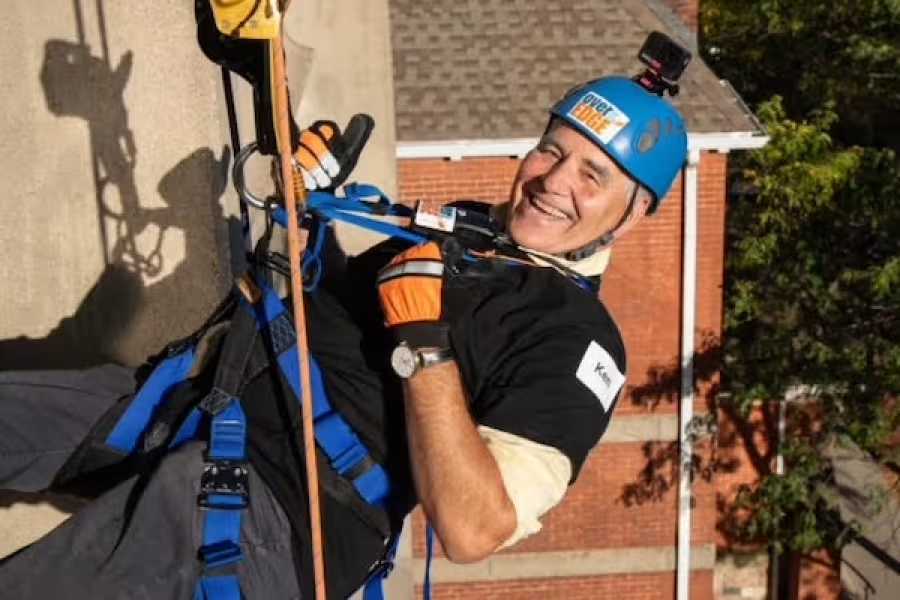
Interlochen Affiliation: IAC/NMC 55, 57-58, 60-62, IAC St 66
Interview Date: July 18, 2024
Ken Fischer spent five summers under the stately pines studying horn at National Music Camp. He is a proud Camp parent, Camp uncle, Camp grandparent, and lifelong supporter of music and Interlochen. He is also President Emeritus of the University Musical Society at the University of Michigan and an Interlochen Life Trustee.
This oral history is provided free by the Archives of the Interlochen Center for the Arts (ARTICA). It has been accepted for inclusion in Interlochen’s audio archive by an authorized administrator of Interlochen Center for the Arts. For more information, please contact archives@interlochen.org.
00:00:00 BRAD BAILEY
Today is July 18th, 2024. This is an oral history interview with Ken Fischer, conducted by Brad Bailey on the campus of the Interlochen Center for the Arts. Nice to meet you, Ken or Mr. Fisher.
00:00:12 KEN FISCHER
It's great to meet you, too, Brad. Thank you.
00:00:14 BRAD BAILEY
So can you tell me your name and spell it for me?
00:00:17 KEN FISCHER
It's Ken Fischer F i s c h e r.
00:00:21 BRAD BAILEY
So tell me a little bit about where you were born and what your childhood was like.
00:00:25 KEN FISCHER
I was born in Washington, D.C., December 28th, 1944. One of three kids who were born in that decade, had an older brother and a younger brother. Older brother born in '43. Younger brother in '49, all Interlochen people. And my dad was in the service. We lived in Fairfax Village on the, you know, near the Maryland border. In 1949, '50, we moved to Detroit. So I lived there [Washington DC] from '44 to about '50.
00:00:54 BRAD BAILEY
And yeah, tell me more about your childhood and how, yeah.
00:00:56 KEN FISCHER
What I'm remembering is I went to kindergarten there, but we moved to Detroit and I had first grade there. I think what's significant is that my dad was the first in his family to go to college, and was able to help pay his way to Rutgers by being the accompanist of the Rutgers Glee Club. And so dad understood, we I mean, we later learned this, both the instrumental and intrinsic value of music. He married a woman who never aspired to be a professional musician, but played a bit of violin, and they both sang. They were members of churches and they sang in the choirs. My dad was also an amateur organist, and this will prove, you know, interesting to Interlochen later, as mom and dad endowed a scholarship and had as a preference, you know, if organists need, you know, support, we're happy to have this go in that direction. Plus, they met a guy named Robert Murphy who was an organ teacher here, and he had been my counselor. They were inspired by him. And so there was motivation, both because of the instrument and because Robert Murphy was a teacher. So the Gerald J. And Beth Fischer Scholarship has been in existence for quite a while.
00:02:09 BRAD BAILEY
So talk to me then, about you said your parents- Rutgers is in New Jersey.
00:02:13 KEN FISCHER
Correct. Dad, first in his family to go to college. His dad was a cigar tester for General Cigar Company. His mother was a homemaker, I think neither graduated from high school. They had background in German, Fischer and Stroup. And so he lived, I think he may have lived at home. My mother grew up in Elmira Heights, New York. Her mother died when she was emerging teenager and the father was a carpenter, Leon Buckley. And he wasn't sure what to do with all three girls. And my mother was the youngest. And when she was moving into her senior year of high school, they had her go live with Dorothy Buckley, his sister, in New Brunswick. So dad and mom met in high school, and then dad went to Rutgers, mom went to Pratt Institute to learn a bit about homemaking. And then the war came. Dad had hoped to go to graduate school at Princeton, study with Arthur Burns, and that was all sidetracked with the war. And dad was in in the Navy, served in the Pacific. And when he came back with a couple of kids, graduate school seemed not to work out. So we worked in Washington, DC until about 1949, '50. When we moved to Detroit, dad got an offer from Robert McNamara, who at that time was the head of the Ford division at Ford Motor Company. Dad became the controller. And then, as McNamara moved up to the presidency of Ford, dad moved up in finance, became the assistant, became the treasurer of Ford Credit. And so our life as kids was really 1950 to 1967, when dad got a job offer to move to New York and become a vice president of PepsiCo. And by that time, all of us kids had gone to Interlochen. Dad was made a board member, sort of, after we had our experience with Interlochen. But he represents the first of four generations of our family that have had an affiliation with Interlochen.
00:04:20 BRAD BAILEY
The first of four. Yeah. And so, yeah. So talk to me about his- because I want to, we're going to get into your and your brother's relationship with Interlochen. But I want to, you know, understand your father's relationship with Interlochen. What was the first time, because he had clearly had some musical background before?
00:04:33 KEN FISCHER
Yes.
00:04:34 BRAD BAILEY
Can you give me an idea of what his musical background was?
00:04:37 KEN FISCHER
Well, he was an organist, a singer, a pianist. And as I was saying, they understood intrinsic and instrumental value. But intrinsic had to do with it's good for you. You know, you're going to meet people, you're going to have discipline. And so we all started in piano and it was the sort of thing, of course, our kids are going to start piano in the second grade, which we all did. And then you'll start an instrument when you're in the fourth. Jerry played clarinet, I played cornet, my little brother started playing cello. And in 1954, why don't we have Jerry go to Interlochen Junior Boys Division and we'll send Kenny to Camp Haza Witka, a recreation camp not far from here, where you can learn to shoot rifles and swim- a recreation camp. So I had that experience. Jerry had Interlochen, and the folks said, next year, Kenny, I think Interlochen is a place you belong. Which is then when I started out in 1955, Cabin 7, an extraordinary cabin.
00:05:42 BRAD BAILEY
Well, so what was your father's role here at Interlochen, which introduced you to the whole family to it?
00:05:46 KEN FISCHER
Well, I mean, dad was just a dad, but he loved it. We loved it. He saw what was happening to his kids as we cried going home. You leave Interlochen here and for the until you get to Cadillac. The kids in tears. Okay, so something's, something's happening up there. They knew that. And so that began in 1954 with Jerry's being here, a sense in our parents, this is something special. Our kids are gaining a lot out of it in all kinds of ways. They're meeting interesting kids from around the country. It was mainly around the country then, we hadn't become that international. Ann Arbor was the home of Interlochen until 1962, when the Academy started, and they moved stuff up here year round.
00:06:31 BRAD BAILEY
What do you mean, the home of Interlochen?
00:06:33 KEN FISCHER
Interlochen's offices, everything. The camp was run during the academic year in Ann Arbor, in a second story building at the corner of State and North University. Then in 1962, when they began a winter program, that's when Interlochen moved its enterprise, you know, its finance and its admissions moved up here.
00:06:55 BRAD BAILEY
But the physical camp during the year was-
00:06:57 KEN FISCHER
Always here from 1928 on. So Joe Maddy was conductor of the Ann Arbor Symphony. He was a professor at the University of Michigan. You know, he was operating out of Ann Arbor in those early years, and he died in 1966. So it was just four years after the Academy had begun, and I was ineligible for the Academy because I graduated high school in 1962, and the academy began that fall.
00:07:27 BRAD BAILEY
And you would have went?
00:07:28 KEN FISCHER
I don't know. I was a good athlete in my high school. We were state champions in swimming in 1961. I don't know. I had a robust musical life and was involved in track and swimming. I just don't know. But it certainly was intriguing when I got to graduate school in 1970, I was part of- In 1966, I was a part of a group that were actually was studying the prospect of a college up here, because we were all studying. We were students in the study of higher education and had a little task force we thought was, this is an interesting idea to think about. And, you know, my mom, my mom was a homemaker. And, you know, she was the one that supervised our music education back home. She drove us to Ann Arbor for lessons once we started instruments and were serious about it. She had us study with the professors at the School of Music in Ann Arbor, who were the major clarinet teacher, the major horn teacher. My little brother was the first string player in the family, so Norm started studying cello locally. We all studied piano. Then in 1957, a tail-ender sister came along. None of us had expected, we thought this was the family, three boys. But when my brother was 9, I was 12 and my brother was older brother 13. The folks had a family council and announced that we'd have an addition to the family, to which my little brother said "A dog?" My older brother said, "exchange student?" and I said, "adoption?" None of us could believe this 41 year old woman would actually be having a baby. And so she arrived on December 7th, 1957, delivered at home by my dad and me. I was 12 years old at the time. There just wasn't time for the ambulance to come and get my sister to Ann Arbor's Saint Joe's Hospital, so I had an experience with childbirth when I was 12, and it was my little sister, who's now 67 years old and Associate Director of the School of Music at University of Wisconsin and a pianist, collaborative pianist. In fact, all my siblings and I married professional musicians and all of our kids have something to do with music. Our son was the first marketing and partnership director of iTunes, and he now runs the App Store at Apple. But there are guitar shop people. There are people that run music camps, but they all have a connection to music in some way. Performers, sales people about music or my kid, you know.
00:10:07 BRAD BAILEY
Wow. And so let's step back a little bit to the early camp days that you had here. How did your father first, after he moved from the Washington, DC area to southern Michigan, how did he first come to learn about this music camp about four hours north of Ann Arbor?
00:10:23 KEN FISCHER
I think they might have first heard about it when we lived in Detroit for one year. And I'm recalling that somebody named Watts, our neighbors in Detroit had some connection to Interlochen. But then when we moved to Plymouth, I can't remember exactly. There's a woman named Karla Herbold, who was our babysitter. I mean, she's only a few years older than we are. But, you know, when you're a kid in grade school and a junior high kid can babysit for you. So Karla Herbold has been a board member here, and it's a pretty sophisticated town, Plymouth. We had our own symphony there. Dad was the president of the symphony. He was also president of the school board. So this is a guy deeply engaged with the community, a servant to the community, and very effective at what he did.
00:11:09 BRAD BAILEY
And so explain that.
00:11:11 KEN FISCHER
You know, you're a kid, you're not exactly sure why dad's going out at night and what it's about. So dad's not the guy that would go out and play softball with us, and that he was not an athletic person, but he was the organist and assistant choir director at our Presbyterian Church. He became president of the symphony and then became president of the school board. And when you're a kid and dad's going to a school board meeting, you don't understand until later that he was instrumental in the Plymouth Canton School Board purchasing a huge amount of land on which there are now three huge high schools. But back in the late 50s, he said, they may not love me now, but they're going to love me in 50 years when this looked like a really smart thing to get this land, this farmland cheap and think to the future, and that's dad as a finance guy, was that kind of person on boards. Let's think ahead. Always kind, always listening to other people. And when he gave the speech at the opening of the first high school, I had a principal look at it and she said, Ken, this is amazing. This was written 50 years ago. I mean, it's right on target now for what we need in leadership, in boards and understanding of what kids need. She said, this is really enlightened. I'm so glad to see it. And for me to understand, you know, in my 60s, this is my dad and a highly respected educator was saying this guy knew what he was doing. And we are thankful for his leadership here in Plymouth.
00:12:49 BRAD BAILEY
When did he pass away?
00:12:51 KEN FISCHER
Dad died at 69, in September of 1987. I was just starting out my job in Ann Arbor, so dad never had an opportunity to participate in the work that I did for the last 30 years. Yeah, he had prostate cancer back then. The prostate cancer was pretty tough. They didn't have the kind of treatments they have now. So yeah, he died as a young man. My brother died at 71. My grandfather died in his mid 60s. Two of them with lung cancer, one with prostate cancer. And I'm now 79. So I'm- I've lived well beyond these guys.
00:13:27 BRAD BAILEY
Wow. So how did he then get you all your first, your older brother to come to that first year of Camp after he found out about it. How did he then get- Jerry was your oldest older brother?
00:13:38 KEN FISCHER
Yeah.
00:13:38 BRAD BAILEY
So how did he get Jerry to sort of come to the camp?
00:13:41 KEN FISCHER
Well, I think dad and mom would do some research. They would go over to Ann Arbor and talk to people about it. They had people who had sent their kids here and they thought it would be a good idea. There was something then called talent exploration. Really cool concept of every week you can try a different instrument. Now Jerry was learning clarinet, but why not study the harp, percussion, the bassoon? So talent exploration was a really cool concept when you think about it. And I think his first year, 1954, I just don't know what he was studying. I do know that he made a big impression because he was the only kid who was shaving in 1954. He was fifth grade. And if you knew my brother, dark complexion, had a beard, real mature kid. He was my older brother.
00:14:32 BRAD BAILEY
Is he still alive?
00:14:33 KEN FISCHER
Jerry died at 71, in 9- in 2015. Yeah, it was very, very sad. He was my best friend and older brother and trailblazer. He went to Interlochen one year. I went the next. He went to the College of Wooster. I went the next year. He majored in religion. I majored in religion. He got involved with concert presenting. I got involved in concert presenting the next year. Trailblazer, we're very different. But you like your older brother, he likes his college, he likes his major. And it just made sense to me. But I've carved out my own life. But he's very special. He was a board chair here, to which we may get to in terms of experience, but yeah, he had a great experience in '54, came back in '57 and was first chair clarinet most of that summer in the intermediate band when I played French horn in the band. So we were in the same band. Ken Snapp was the conductor. Great stuff. We had a place called The Shell near where Corson would be now, and I started to make lifelong friends there. For the guys that came here in '57, we came back here last year all hitting 80. We've stayed in touch that whole time, from the age of 10 and 12 up to our 70s and 80s now.
00:15:54 BRAD BAILEY
Wow. And that's a question I want to ask about. What are some of those friendships? Talk about the cabin. Do you talk about some of those friendships? How do they impact your life?
00:16:03 KEN FISCHER
So let's start with 1955. I had two counselors, one a legendary guy named Lee Kabutti. He was a basketball coach in Champaign-Urbana and a really fine and successful basketball coach. And he came up here, and Lynn Dougherty was my other and he was a, he was an athlete. His dad was Dr. J. Kenneth Dougherty, a renowned coach. He was the Olympic decathlon bronze medal winner in 1928, became the coach at Michigan. Coached Don Canham, a legendary guy. But anyway, his son Lynn came here as a counselor. I couldn't have imagined having two better guys. Now, there were 12 of us in the cabin. Seven of us became honor campers, and having 7 in 1 cabin was unusual. One of the things I remember about that summer is that there was a coach from Michigan, swimming coach named Gus Stager, who came up in the summers with his family. In fact, we had a number of Michigan coaches up here working with their athletes during the summer who were then counselors and got education credit for counselor in training programs. But I want to imagine what it meant to have the man in 1955, Gus Stager, teaching me how to swim, who in 1960 was the Olympic swimming coach for the United States, who between I think '58 and '62, in four of those five years, he had NCAA championships. I was in Plymouth at the time swimming for the Plymouth High School team. These guys are just four years older and they were our inspiration to win the state championship in 1961. Smallest class-a high school in the state. We won it. So those friendships I carried the percussion instruments for a kid named Mike Bresler, who was a junior boy, but a good enough percussionist that they put him in the intermediate band. Ronnie Stowe played clarinet in the intermediate band. Then this is the wonderful story. There was a six foot tall 14 year old kid named David Posen, High School Division. Told Dave, you're just starting out on trombone. We're going to have you play in the intermediate band. 99% of kids that I know who are six feet tall in high school, being told you're going to play in a junior high band would scoff at it. Posen's the kind of guy who said, hey, 60 more kids I can meet. Be a big brother to. Well, those four guys, we all came back together last summer. I was turning 79. Dave is 82. Mike is in his late 70s. Dave Posen is a doctor with 4 or 5 best selling books. Mike Bresler, emergency room physician, taught at Stanford, still playing percussion. Posen still playing the trombone in the local orchestra. Then he got Ron Stowe, who went on to law school and has been a trustee and had a marvelous career. And he and I agreed. As we got older, if any one of us has a job where we can do something good for the arts, let's do it. And on July 1st, 1986, he was named vice president for Washington affairs for Pacific Telesis Group. Called me up, hired me the next day and said, "Fisch, we got a budget. We can do good stuff for the arts. As long as you look at it for the interests of the company. So we have to keep that in mind. But imagine the good that we can do being enlightened." There's all kinds of stories about how we made a big difference in Washington, because you have an enlightened arts guy controlling money, but we knew that we had to look after the best interests of the company. We did some sensational things. I'm not sure now is the time, but that is the quality of friendship begun in 1957, '55 and '57 because I met Ron in '55. That extends well into the 21st century, because these are the guys that gather at Interlochen for- last year, it was, you know, for the four days in the second week of July, and three of us came the year before, but we also brought 16 of our friends from back then. And I've got their names and I organized it, and some of them said, Fisch, we're coming in a day early because we want to climb The Dunes. We want to swim in Lake Michigan. We want to canoe down the Platte, just like we did when we were 12. And we did it- organize that. Now, I had an ultimate purpose. Let's get all these people back because they have resources. They love the place, they need to start endowing scholarships. They need to start remembering this place in their wills. If they got cash now, give them the joy of supporting kids. And they've had a chance each year to hear Trey Devey and to know of Trey's deep commitment. If a kid wants to come here and has the talent, we want to be sure that we can support that kid. It's what inspired my wife and me to have the Ken and Penny Fischer- It's now an endowed scholarship because a friend of mine matched what we put up, and it's now an endowment. And, you know, it was a staff here that said, you know, "Fisch, you've got a planned gift for $100,000 bucks. Isn't it nice that when you die, that's going to do some good? Why don't you do a percentage figuring out what that would be, what the draw is going to be after you die and start giving that now, and you can enjoy these kids?" And so that's what's happening later this afternoon, we're going to meet our scholarship students, as we have done for the last few years, which brings immense joy to us to meet these kids. And just it brings me to tears each time as they meet us, have their little thank you. We had a Serbian kid who couldn't speak English very well and wrote it out and had two of her buddies that could speak English better there to support her, but she read this in English and we just broke down because she had wanted to communicate. And what happened then? We took a selfie. The kids got a hold of the selfie, sent it to their teacher in Serbia. She put it in the newspaper and it got huge coverage over there, because kids were able to tell their story of what it meant to be here, and told a little bit about Penny and me who met here. We had our 58th wedding anniversary, you know, 2nd of July.
00:22:33 BRAD BAILEY
Your first year was '55? Or, it was '55, '54?
00:22:37 KEN FISCHER
My first year was '55. But let me just mention one thing about the cabin.
00:22:41 BRAD BAILEY
Sure, sure.
00:22:42 KEN FISCHER
So we had 12 kids in the cabin. I was the youngest, but every one of them swam the lake. That's a big deal. I was just learning how to swim. I was the one kid that hadn't yet swum the lake. But my two counselors said, "Fisch, we'll be there. We'll row with you. You want to give it a try? We know you can do it. And imagine if we can say every one of our 10, 11 year old kids in this cabin swam the lake. And Gus Stager, the swimming teacher. He'll be really proud of you." So I did. It took me a long time, but what a life lesson that was, you know, got these other guys, they're all rooting for you. You just need to have the will to do it. You can swim and we're going to be there for you if anything happens. So. And they were rowing, you know, and I made it and made a huge, huge impact on me to be able to join the rest of the gang. And I, with six others, got an Outstanding Camper award, which was very meaningful. When you're a ten year old kid and you have a sense of what that means and your buddies were getting it as well.
00:23:46 BRAD BAILEY
So and that was the question, like you drew a wonderful sort of timeline and trajectory of your relationships with people here back in the 50s, and how that impacts your relationships today and how that impacts current students today. And so I want to sort of go back into, like you said, that was impactful for you. How does that impact you now having swam the lake and sort of achieved that? What lessons did it teach you about life that you sort of use today?
00:24:12 KEN FISCHER
Well, man, First of all, other than my family, no institution has had a greater impact on me than Interlochen. It's just so clear. I met my wife here. Our kid went here. Our grandson went here. Our dad started everything out. So you also have to understand, I was first horn here in 1961. Had a chance to play the horn solos in Les Préludes.
00:24:41 BRAD BAILEY
Is that your second year?
00:24:42 KEN FISCHER
No, this was my fifth year. I was in high school, so I came in '55. Then family went on a trip in '56. '57, '58, I was here in intermediate. Then 1959, we did a family trip. '60, '61, '62, I was in the high school division now in 1960.
00:25:00 BRAD BAILEY
And these are for the camp for the summer?
00:25:02 KEN FISCHER
This is all camp. I never went to the academy. You were here for eight weeks, which never seemed enough time. Things are very different now. But eight weeks was perfect, but I had success as a horn player in a way that it's a tough instrument, but when you can play these solos, it was a big deal for me. I came back in 1962. I'd already graduated from high school, but we were going to the White House that year, and I was imagining playing first horn in the White House. Kennedy, White House. How cool would that be? When a whole bunch of sophomores came up who were much better than I, who all wanted to be professional horn players, and they cleaned my clock. I mean, they were so good. And I never aspired to be a professional horn player, and I didn't practice that much. But in 1962, I was able, at the last minute, they added a sixth horn player. At the final audition, I dropped a couple of seats and was not going to go and resigned myself to, you know, I spent a whole year working on hoping that I would come and it looked like I wasn't, but I had a lead in the operetta. Okay. And a couple of days before the trip to Washington. They said, we're going to add three instrumentalists; a trumpet, a horn and a violin or something. I don't know how that happened. I didn't do anything to work it, but it happened, and that was one of the most profound Interlochen experiences to be at the White House, performing for John F Kennedy. You might want to hear his four minute speech without a note that he delivered that day. Will never forget it. And it was all about hard work and how more people attend symphony orchestra concerts than go to baseball games. And then he said, "Kids see that place? That's called the Oval Office. I can't be here physically in attendance. I'm going to be there in the Oval Office. We're opening every window and every door, because I don't want to miss a note from your program." And it was an internationally conceived program with composers from all over. Then he greeted us at the Rose Garden and in effect said, "So, kids, what are you doing for lunch?" He said, "Come to the White House. You're going to have spaghetti. You're going to pick it up in the State Dining Room. And if you don't mind, do you guys mind eating on the floor of the East Room? Because we're serving spaghetti and it's just going to be better on the parquet floor if you spill the spaghetti, rather than the green room or the red room." So I had lunch with Kathy McNamara and Peggy Rusk. Kathy is the daughter of the Secretary of Defense. Peggy was the daughter of the Secretary of State. And why were we having lunch? They were our hosts, the children of the cabinet. And those two happened to be my age, and I just happened to sit with them. There's a photo of that eating lunch on the floor of the East Room of the White House. I want to tell you about an incident that I write about in my book, and I'll give you a copy of my book, because I've got a bunch of Interlochen stories in there. But this one was profound. So I grew up in Washington and we made visits there. So when, after the performance we went to various monuments. I'd been to the Washington Monument, I'd been to the Jefferson Memorial. So I stayed on the bus and kind of curled up in the back. Joe Maddy boarded that bus, kind of relaxed, didn't know I was there, but I was awake and I just heard him mumble about the Academy was starting. Look at where we are now. Where's the future? Just dreaming like Joe Maddy would do. And I'll never forget tuning in to that guy's ability to imagine things. I wish I'd have had a recorder to put it down, but my memory was talking to himself and imagining we got an Academy started. Just been at the White House. What's next? And he died four years later.
00:28:57 BRAD BAILEY
And you were by yourself?
00:28:58 KEN FISCHER
By myself.
00:28:59 BRAD BAILEY
Did you ever reveal yourself to him?
00:29:01 KEN FISCHER
No.
00:29:02 BRAD BAILEY
So you were sleeping, like, below the seats or just sort of-
00:29:04 KEN FISCHER
Well, you know, you're in a bus and you're back and you're curled up.
00:29:08 BRAD BAILEY
Who is he talking to?
00:29:09 KEN FISCHER
Himself. It was just to himself. Which I had never experienced, that sort of thing. But I'll never forget it. It was a memory that I have, and it didn't take that long, but I didn't reveal myself to him. He didn't know anybody was there.
00:29:24 BRAD BAILEY
So you said you mentioned something happened in '61. I didn't want to skip over it. There was something happened?
00:29:29 KEN FISCHER
So in 1961, so 1960, I had been the first chair in the B orchestra. And there's a memorable photo of the French horns taken in 1960 on the deck, sun deck. And I happened to be the tallest, so I was first in line. And then it goes on down there. A bunch of people that I know that are still in that 1960. So that's 64 years ago. That photo was the camp promotional photo for the following year. It turns out Penny Peterson from Mason City, Iowa, had that on her bedroom door as she was hoping to come to Interlochen. And she tells me that when a boyfriend came upstairs and pointed, you probably meet some guy like that pointing at me, and I should show you that photo. Anyways, people were posting it even recently. So anyway, during that year I was first horn in the Michigan Youth Symphony, and the piece we were playing that year was Sibelius Second Symphony, which has a great horn part. So I come up to audition in 1961, and I know my horn teacher, Marvin Howe, was his name. So I went and had my audition. I didn't think it was all that hot. I walked down and I'm listed as first chair. Give me a break. I go and talk to him and I say, "Hey, Marvin, Mr. Howe, I don't quite get it. I didn't have that good an audition." And he said, "No, it wasn't that good an audition. But Ken, you know the way it goes the first week, you're a friendly guy. You know where the music goes, you've been around. You'd be a good guy to sort of orient everybody." And what he didn't say was, and at the end of the week, when there are challenges, you'll find your rightful spot. What he didn't know is that piece we auditioned and played the first week was Sibelius Second Symphony. I could play it upside down and backwards because that's what I'd been studying all year, so I remained first chair. First week. Second week. Third week. Fourth week. Then a kid named David Pinkow, aspiring to be a professional horn player from upstate New York, beat me out the perfect week to beat me out, because who was conducting? Howard Hanson, the dean of the Eastman School of Music and the guy who wrote the Second Symphony, which is the Interlochen Theme. So he had a he had an opportunity that week to play for Howard Hanson. Where did he want to go to school? Eastman School of Music. Where did he end up going? Eastman School of Music. Now, I had always thought that Hanson might have been so impressed to give him a scholarship. He said, "No, Ken, I had a teacher that had hoped I might go there, So. So it wasn't -I was so happy to go, but it really wasn't Howard Hanson greasing the skids. I actually, you know.." and then the next week, a guy named Terry Fox beat me out. But then seventh week and eighth week, I won it back because nothing would mean more to me than play solo in Les Préludes and Brahms First Symphony. I don't know if you know it, but it's got a great horn going da da da. And that was the culmination of a great summer. Met my wife there.
00:32:40 BRAD BAILEY
Talk to talk to me about how you met her.
00:32:42 KEN FISCHER
Oh, man. So it was my fifth year. We're in line. I see this good looking woman. You're just looking over the girls, and I'd like to meet her. Well, then I find out she's sitting second chair, flute next to Nancy Howe, who was like a fabulous flutist, hard to beat. And I was able to look down at her because I got intelligence about her from a counselor and got into cahoots with her stand partner so that I, I arranged on Friday to take the music that she'd be challenging on to her in the hotel basement where we had practice rooms and we got to talking and it was very nice. I sat on the bench with her and she was taking piano lessons as well as flute, and I worked up my courage and said, "Well, Penny, if you're not busy tonight, I'd love to take you to the concert." "Oh, I'm so sorry. I already have a date." Crushed. I said, "What about tomorrow night?" She said, "Yeah, I'm free." So I took her to a band concert on Saturday night. It was our first date. We went together the rest of the summer. Had a very tearful goodbye because she was going to Mason City, Iowa, the home of Meredith Wilson. Big band town. And I was going to Plymouth, Michigan, just down the road four hours. Did we know when we'd see each other again? What happens? Telegram comes two days after we get home. "Kenny, this weekend my dad's driving to a conference in Chicago. Any chance we can meet? -Penny" Man. So I took it to my parents. They had met Penny, loved Penny, loved her parents. Hey, let's pile in the car. Let's all go to Chicago. And Penny and I agreed to meet at 1:00 on the steps of the Natural History Museum, the Field Museum. And at 1:00, I'm down at the bottom of the steps. Penny is at the top of the steps in a dress.
00:34:37 BRAD BAILEY
How old were you?
00:34:39 KEN FISCHER
16.
00:34:39 BRAD BAILEY
16.
00:34:40 KEN FISCHER
Penny was in a dress. I'd never seen her in a dress. It was just knickers. And out of Hollywood. I'm running up the stairs. Penny's running down. We greet in the middle and hug. And that began a serious relationship. For our last year of high school, I went to visit her at Christmas. She came to visit me for a swimming meet. Then during college we went to different schools. We had our ups and downs, and in the spring of our sophomore year we said, you know, we really need some time together. Let's go to school together. University of Iowa summer school. And we lived right next to each other. We did everything together, took a couple of classes and that sort of deepened and cemented. So for the next two years, let's be committed to each other. Then in her final year, our final year of college, she was the flute soloist on a State Department tour by the University of Iowa Band to Europe and the Soviet Union. Flute soloist playing Hanson's Serenade for flute in a band. And then we got married July 2nd, 1966. Now there are three, three days in a row that we celebrate.
00:35:50 SPEAKER_S3
How old were you at that point?
00:35:51 KEN FISCHER
21. So these three days are we met on the 30th of June, 1961, had our first date on the 1st of July 1961, got married on the 2nd of July, 1966. So we, every five years we'd come up here, get photographed by a tree, stay at the cottage for a week and celebrate these anniversaries.
00:36:14 BRAD BAILEY
So every five years you've done this since..?
00:36:16 KEN FISCHER
Well, we'd come up more regularly than that, but we had a photograph taken of ourselves every five years by a tree.
00:36:22 BRAD BAILEY
How long have you been doing that?
00:36:24 KEN FISCHER
Well, we ended it 25 years because the tree seemed to get smaller. We seem to get a little bigger. So we said maybe we should, but we've got some of these photos they're nice to have. I got one of them in the book, and I got to get you a copy of my book,
00:36:40 BRAD BAILEY
Please, absolutely. So what did you learn at Interlochen then? You know, you've mentioned a lot of different things, but I would love to get an overarching sort of theme here. What did you learn in Interlochen that became- later, that became significant? Like the most important thing, one of the most important things you've learned.
00:36:56 KEN FISCHER
You learned to work hard. You learned to show an interest in other people. You learn to be a good citizen. And what that meant here is you didn't get into trouble. You practiced hard. You got to know a lot of people, and you stay in touch. And all of these things are fundamental to who I am now. My purpose in life right now is to make connections, connect people. I do this with my students, young professionals, people I run into when I start asking questions. Oh, you're going to be heading to the University of Virginia to- I got some friends there. Would you like to-? And then we do a lot of connecting like that. I mean, back then in one summer, I'd be exposed to 24 symphonies. We'd present and perform eight that we would rehearse, but then we had site sight readings of other symphonies and tone poems. It would be symphonies and tone poems, 24 of them. I've never since then had that kind of opportunity. So, you know, in the job that I have at the university- had at the University of Michigan, I'm presenting the Berlin Philharmonic, Vienna, Detroit, the Concertgebouw, and-
00:38:08 BRAD BAILEY
In Amsterdam?
00:38:09 KEN FISCHER
Yeah, I mean, the Concertgebouw Orchestra would come to Ann Arbor on tour. You can't imagine the joy of, hey, I've heard, I mean, I performed, you know, Frank Symphony, all the Brahms symphonies, Beethoven, Grieg. So the repertoire that I learned in band, orchestra and chorus, because that's what I was performing up here. I didn't study theory or anything that was, you know, orchestra, band, choir, operetta. I mean, I loaded it up. I just loved it all. But do you think of the repertoire, I then sang Gilbert and Sullivan in college. Kept up my horn. At 12 I started playing in the brass choir, which would play 15 minutes before the church service. I fell in love with brass music, started my own group called the Goliard Brass Ensemble.
00:39:01 BRAD BAILEY
Okay, here, where?
00:39:02 KEN FISCHER
In Ann Arbor, 1966. I just, you know, I want to play brass, get some folks together. And we called ourselves the Goliards because the Goliards were a band of roving students in 12th and 13th century Europe, known for rioting and intemperance. A description of the University of Michigan student of the late 60s. Anyway, three of us moved to Washington in 1970. We formed Goliard East, and I just loved brass music since then, the guy kind of got tired of brass music. So I formed a madrigal group, Sunday afternoon Madrigal Singers, and we were together for, you know, maybe ten years. And we did, you know, people would hire us to be entertainment.
00:39:45 BRAD BAILEY
In Washington D.C.?
00:39:46 KEN FISCHER
In Washington, D.C., and they'd hire us and we'd ask what the occasion was and so we could take songs, put words to the song that would apply to the group. I've always been good at that. Tell me a little bit about your organization, in fact. I became a conference design specialist where I would design meetings. I knew a lot about group process. So in my first career in Washington, I put together conferences and seminars. Then I became a consultant to other organizations. But one of the things that I did for groups is to create plays. So what are you trying to accomplish in your organization? Where have you been? Where are you now? Where are you headed? And you can put it five act dramatic presentation together. Recruit people from the organization to be the actors. Come in a day early. Have a scenario. Here's what happens in scene one, two, three, four and then enable them to create the sequence of dialogue. Creative process. And then you cast people from the organization, give them a lot, give them an opportunity to have fun together and imagine the next five, ten years of the organization. So it was a way of rather than have a keynote speaker do it, get a whole bunch of people involved and participate. I wrote a book called Little Big Winners: 77 ideas for a Better Conference, and it became sort of a marketing piece. But I challenged the conventional wisdom about meetings. You know, why sit theatre style when people want to meet each other, put them in round tables?
00:41:15 BRAD BAILEY
So essentially, the lessons you learned here continued to like, just go your whole life and to branch off into like different enterprises and ideas that continue to almost have a ripple effect.
00:41:27 KEN FISCHER
That would be a way to say it. So, I mean, you're giving me a chance to think about, you know, creativity, challenging conventional wisdom. And it happened to be in theater and in music, and I had enough training in music and singing and performing to be able to start my own ensembles and get other people involved. Never aspired to be a professional. And even when I was a kid and I had talent, I could have, but it just wasn't what I was looking for as opposed to my wife. That's her identity. Flutist, teacher, performer, chamber musician.
00:42:04 BRAD BAILEY
You- was different.
00:42:05 KEN FISCHER
I thought I'd always be an amateur. I didn't know what I was going to do. In fact. So it's 1966. We've just been married. And I'd been admitted to Union Theological Seminary in New York.
00:42:16 BRAD BAILEY
At Columbia?
00:42:17 KEN FISCHER
Columbia. My wife had been admitted to the Juilliard School, which at that time was right across the street. So that summer I was wrestling. Do I want to do that?
00:42:25 BRAD BAILEY
Now The Manhattan School of Music?
00:42:27 KEN FISCHER
Right. Juilliard down the street. And we decided that summer because I thought maybe a lawyer, maybe a doctor. There was a program in the study of higher education. So I said, so I was going to be a college chaplain in the image of William Sloane Coffin Jr. I don't know if you ever heard of him. He was the Yale chaplain, my hero. I spent enough time with him to know how great this guy was, and how I had too many shortcomings to be the kind of college chaplain he was. Great preacher, counselor, smart as hell, studied with Boulanger, spoke five languages, and give me a break. I could do some of that stuff. But. So I said, I'll get involved in higher education in a different way. And that's what happened. I finished everything but a dissertation for a doctorate in the study of higher education. From 1970 to '78, it was in Washington designing conferences and seminars in higher education. And then I came to the end of a grant. Geez, what am I going to do? I write about this in the book. And somebody said, hey, buddy, it's time to get off soft money. It'll all work out in December. That was a psychic telling me that. Okay, so that's exactly what happened. A guy hired me for $3,000 bucks a month.
00:43:45 BRAD BAILEY
So was- a way to get off soft money? What did she mean by that?
00:43:48 KEN FISCHER
Because from 1970 to '78, I'd been dependent on a grant, either a federal grant or-
00:43:55 BRAD BAILEY
You needed real money to come in.
00:43:56 KEN FISCHER
Yeah, this guy said, get off soft money. And sure enough, I got a job, paid me $3,000 a month back then. That was pretty good and gave me a lot of free time. So then I got into the performing arts presenting arena by renting the Kennedy Center Concert Hall. Can I take this thing and I'm okay.
00:44:17 BRAD BAILEY
So what's your favorite place on campus?
00:44:19 KEN FISCHER
I mean, I love every place, but I think The Bowl and Kresge is where we did performances, and those are memorable. Playing those solos in 1961, in The Bowl. It's where I played Mount Ararat in Iolanthe. You know, having a lead in the operetta was cool. If I didn't go to Washington, I could focus on that. The other thing about Washington was I'd been there, grew up. So when I didn't get in, I shifted my focus to celebrating the five kids that were going to go who were all good friends. So it was a real shock when they say, Fisch, we're going to take another horn player and it's going to be you. And that's where we did Iolante. So it's mainly around performances. The other thing you'll appreciate this as a choral guy, the highest spiritual connection that I felt was singing the great oratorios in The Bowl with Margaret Hillis, Ken Jewell and Maynard Klein in the Festival orchestra. You know, just that group singing, whether it was Messiah or Elijah or these great.. you just felt I felt uplifted and, you know, community singing and the great works, great words, great music just lifted me. And it's something I'd like, you know, I'd kind of like to replicate. So for 30 years, I oversaw the University Choral Union, the oldest choir in Ann Arbor of laymen who would sing with, you know, Berlin Philharmonic, with the Philadelphia Orchestra or Chicago. Good chorus. Great conductors. Have you ever run into Eugene Rodgers? He conducts Exigence, but he's the head of choral at the University of Michigan. And a terrific guy.
00:46:03 BRAD BAILEY
So how then, would you describe Interlochen to someone who's never been here before?
00:46:08 KEN FISCHER
Well, the word I've always used is transformative for people, and it's so much more than an arts camp. It's a place where you'll meet lifelong friends. Well, you'll have a chance to grow up in a lot of different ways. You'll be on your own. And that was significant for me. I'm on my own. My parents would come up to visit, but I was on my own. I had to make decisions on my own. I had to figure out how am I going to behave, how am I going to treat other people? It cares a lot about the person and you can really grow up there, but you can meet all kinds of people different from you. You're in a cabin with them. You got to get along. You're going to learn about yourself and other people. You're going to hear some great music, see some great dance and great theater. Your life will be enriched, and you're going to begin a connection with the place that if you come back and if you give back, it's just going to continue to be enriching. And so tonight I'm going to be receiving a Life Trustee recognition. It's a big deal for me because I was a trustee at two terms, one as a young kid in my 20s, because I was president of the alumni association and then other for nine years. But when the guy called me and said, hey, Fisch, we're going to make your life trustee, I cried. My brother had been a life trustee because he deserved it, serving as the chair of the board during a difficult time. But it's not anything you aspire to. You don't even know that they can come back later and make you this and that what they're going to say is, you know, after you were a trustee, you continued to give and participate and bring people in and serve the institution. And that's kind of the way that, that I see it.
00:47:53 BRAD BAILEY
What is your hope for this? For Interlochen's future?
00:47:56 KEN FISCHER
Oh, I want it to continue. I want the commitment of the organization right now to make sure that on our centenary, we have enough resources so that the kid who couldn't afford to come but has the talent and the will is going to be here. And I've always been touched he doesn't wear it on his sleeve. But when I asked Trey. Hey, Trey, have you ever been to Interlochen? Have you ever gone to camp here? He said, you know, what was interesting is my family had a cottage on Long Lake and we would drive by. We couldn't afford to go, but we go to our grandparents cottage. And I always hoped, you know, someday I might get there. Well, that hit me right here. And he wasn't.. awww. It was just facts. But boy, did that hit me. And I said-
00:48:43 BRAD BAILEY
Why? In what way?
00:48:44 KEN FISCHER
Well, because here was the new president of Interlochen who was unable to come himself setting as a goal. Let's be sure. And he didn't say kids like me, who had the talent and the desire would be able to come. And if you look at his priorities for 2028, that's right at the top. And we spent what, 30 years building the place, improving it, putting in new buildings. And we worried about place. Now we can worry about people. Ding ding ding. I love that.
00:49:26 BRAD BAILEY
No, I love that too. So what advice would you give to future Interlochen students?
00:49:32 KEN FISCHER
Put your phone down. In fact, just for you to know, my son heads the App Store at Apple and he talked to Trey about the experience. He said, Trey, when my son, [my grandson], Alex, my son was here, he was on his phone too much. You guys let them be on and they were off for an hour. It should be reversed. And my understanding is that they've changed so that the kids aren't on their phone all the time. And what he was saying is they're missing the opportunity to really engage, and they need to get used to that. Up here is going to be different. You want to be making lifelong friends and how do you do that? You do stuff together. You listen to each other. You go to their concerts, you celebrate, and you stay connected. Use your phone to stay connected over the course of the year. But once you're up here, what do you focus on? Building relationships and do stuff together. So my advice would be, you know, put down the phone and listen, learn, engage and especially make a point to meet kids different from you. And I hope I always hope they keep the uniform, which was, you know, in my day, a leveler you never quite knew. I got one story. Can I tell you?
00:50:49 BRAD BAILEY
Of course.
00:50:51 KEN FISCHER
So it's 1963. I've just finished my first year of college. My dad was an executive at Ford and was wondering, what are you doing this summer? And I said, dad, he said, can I help you with that job? I said, I think the best thing for me is to make a lot of money. And so I'm going to go in on the line down at the Rouge factory and see what happens. Join the UAW. Well, I was assigned the hellhole of the frame plant, beating side rails together, and I was the only white kid and I was the youngest. There were 16 black men in line, and we would beat side rails, which means two of us are on one side, one's on the other. And two big men would throw these side rails, and our job was to mesh them as they went along the line, and then they were to be welded. I found out the best way to get along there is to show an interest in these people. I was working with men the age of my father, so it was 20s. We were beating side rails, but then we had 10s for me to lean over and say, hey Eddie, how you doing? How many kids you got? Eight. Tell me about them. That takes all morning. Tell me about your eight kids and I probed. I was really interested, so I decided to have lunch one day with a welder named John.
00:51:59 BRAD BAILEY
What year was this?
00:52:00 KEN FISCHER
1963. Civil rights. That was um.. John. Tell me about you and your family. He started telling me about each kid, and he was real clear about the first three of them. And then when my fourth son... sorry, I didn't quite get that, my fourth son... I'm sorry. My fourth son plays the violin. I looked at him and I said, are you the father of the great Darwyn Apple? Yes. How would you know? Well, first of all, how many black kids in Detroit? He said, follow me. We went down to his locker, opened the locker out, fell all these magazines, articles about Darwyn. And why? Because he was concertmaster here in 1961. Then he gets a scholarship, goes to the University of Michigan on scholarship. Then his teacher at Michigan goes to Eastman named Joseph Schnitzer. And what happens that year? He's there. They go to Russia on tour.
00:52:52 BRAD BAILEY
And what year was that?
00:52:53 KEN FISCHER
1960.. That'd be '64, '65. You know, this is Cold War stuff. And when you have a black man sitting on the outside in a symphony orchestra, that's a story especially for Russians. And his dad was happy to be able to show somebody that. That's 1963. 25 years later, I'm at the University Musical Society, and we're presenting the Saint Louis Symphony, Slatkin conducting, in which Darwyn Apple is a violinist. So I called Darwyn, and I say, tell me about your parents. Yeah, they're still alive. So I was able to host his mom and dad and family in Hill Auditorium in Ann Arbor, 25 years after meeting his dad. It was a really nice occasion. So think of the lessons from that that had its roots in Interlochen. Darwyn Apple. We're still in touch.
00:53:46 BRAD BAILEY
He's still alive?
00:53:47 KEN FISCHER
He's still alive. Facebook. Now, I don't know about his dad. I don't think his dad would be alive. Darwyn has retired.
00:53:54 BRAD BAILEY
Well, you or Darwyn was here at Interlochen?
00:53:56 KEN FISCHER
Darwyn at least was here in 1961. He was our concertmaster of the orchestra. They split the high school into two different orchestras. And he was the concertmaster, in which Penny and I, the orchestra that Penny and I performed in. Then they meshed for the last week, and that's when I was able to play the horn solo.
00:54:12 BRAD BAILEY
Where does he live?
00:54:14 KEN FISCHER
Darwyn.. I believe he's still in Saint Louis. He'd be a great guy to talk to.
00:54:18 BRAD BAILEY
And so my last question, you know, there's so much we could talk about, but I want to sort of get your thoughts about why did art matter in our world today to you?
00:54:27 KEN FISCHER
Art brings people together. Art touches the human soul. It's our greatest expression of ourselves. And you got to know. I'm the chair the board of the Concert of Colors in Detroit. And last night we had our reception. And earlier in the day, we had a gathering of the cultural exchange network in Detroit. And as people went around that room, there were about 50 people in there. We had the Japanese, the Chinese, Native Americans, the Albanians, the Chaldeans, the Arabs. And that is what we're doing in Detroit to bring people together around the arts. Then that evening, the Concert of Colors was created 33 years ago by Ishmael Ahmed. I chair his advisory board because, you know, when I retired, I was told Fisch, don't do anything for a year. You got to relax. But when Ish comes along and says, Fisch, I need a board and I need a chair, and you're it. I could not say no for the whole big history that we had. Largest concentration of Arabs outside the Middle East is in Detroit, Dearborn, Michigan. And that was a group that I wanted to reach out to and engage in my organization, because we had no relationship with one of those communities of shared heritage. And I wanted to change that and the power of the arts to connect people across political, social, economic lines. And that's what you have here, is that opportunity. And I say the uniform helped to level the playing field. You didn't quite know until, you know, you got into it just where that kid was from, what his situation was. The other thing I loved about here was, you know, I swam and ran track. So I was sort of a jock. I knew that culture. But you come up here and you'd celebrate that oboist, that dancer, everybody. I just knew those kids who were nerds in artsy folks and never celebrated in their high school. And they'd come up here and. Did you hear Phil Mann on that? He was just great. And you get that encouragement from your cabin mates who'd support you, but you got it from the other people in the orchestra. You know, when we're brushing our feet after a solo, Now the reward that you'd get up here, that you might not get back home because, you know, for whatever way the arts are treated back home in your school. And, you know, it's along the continuum of who gives a shit to excuse me, who gives a damn to celebration? And I just look at, you know, what Barenboim was able to do? Bringing his orchestra together of Arabs and Jews. It can happen. You can really find peace and understanding and just give it a chance. And the arts have a special way of connecting. I don't know if I can be more articulate, but..
00:57:21 BRAD BAILEY
No no no, that was great. So we're almost done. I just sort of want to get a rundown into, if you could sort of just list the extent of your involvement of your family after they attended Interlochen. You mentioned how your father and your brothers had attended. And so can you talk to me about the extent of your family after they, you know, from your brothers what role did they play here, like later, and then what your family, your children and grandchildren..
00:57:49 KEN FISCHER
I'll go in order, you know, starting with dad, who maintained his involvement, you know, as an organist, choir director, board member here, and mom and dad developing a scholarship. You know, where if there's an organist in need or a singer, it could go to that.
00:58:06 BRAD BAILEY
And the name of the scholarship?
00:58:08 KEN FISCHER
Gerald J. And Beth B. Fischer scholarship. That's dad. And then, of course, he's the guy that supported our coming here. He and mom, you know, one of the great joys for me was sitting in the orchestra as, say, a junior or intermediate and seeing my dad and mom at The Bowl up at the top. I just loved it, seeing mom and dad. Then there's my brother Jerry, who in 1954 had his first summer. He was here three years, '54, '57, '58, and that was his last year. Jerry played clarinet and became a great supporter of the arts. So that's, you know, anywhere he was engaged, he would provide financial support. Jerry married Katherine Long from college, who was a singer of professional caliber. So she, you know, she had paid gigs and stuff. I mean, mainly became his wife. And they soon had a family. But she's always accompanied. She came up here was an accompanist in musical theatre. Then there's Kenny me, who came here for six summers as a camper, and then in 1966 was director of transportation. I was 21 years old, but that's the summer that Kodai came here. Kabalevsky came here. The International Society for Music Education, the Philadelphia Orchestra came. So I was driving Eugene Ormandy around. I mean, it was amazing. I met my wife here who is a professional flutist, chamber musician, teacher, has been since she was in high school. A teacher got her doctorate in flute, bachelor's from Iowa, master's from Michigan, doctorate from the University of Maryland. So there's Ken and then Penny. I was president of the alumni association in the early 70s. So from '70... ;72 to '74, I was on the board as a young guy. Clement Stone was our- I was on the board with Van Cliburn, whom I actually got to know quite well, and then presented him later married Penelope, and she's had a great career as a teacher and chamber musician. She's had commissions, you know, pieces written for her. Then there's my younger brother, Norman, who studied cello and piano. And Norm came here to the Academy, '65 to '67, then went to Oberlin to study and then became a founding member of the Concord String Quartet. And they played together for 20 years and were in residence at Dartmouth. They had 70 commissions. They won an Emmy and were the sort of the predecessors to the Kronos Quartet. Kronos gives them credit for inspiring them. Then he married Jeannie Kerman, also of Oberlin, and they've had a duo for over 50 years, the Fischer Duo. Now, kids, let's start with Jerry. Both his kids came here, both his grandchildren came here. And most recently, Nigel Floresca graduated from the Academy, and now he plays trumpet, but is a performing arts technology guy at the University of Michigan. Her daughter, Jerry's and Kathy's granddaughter, is a drum major in music education at Western Michigan University. That's Zully Floresca. And the Floresca family is a combination of a Haitian father and a Caucasian mother. Fascinating family. The other child of my brother is David Fischer, who became a- he was a good enough trumpeter to go to Northwestern but dropped out. Fabulous tenor voice. He's on a bunch of recordings, but he's now in financial management for.. I forget the name. Yeah, it's a famous investment company. He helps counsel people on their investments. Then there's Ken and Penny, and we have a son, Matthew, who is vice president of Apple and his 22nd year and runs for the last 13 years. The App store. The $85 billion App Store. Pianist, singer, cellist. Still plays. His wife is not a musician, but their two kids are more athletes than they are any kids in music. But Alex came last year to try it out as an intermediate camper, and there was no place for him to do his stuff. He was in Meadows and there wasn't any basketball, there wasn't anything. And so our son had a conversation with Trey all to be helpful. Here's a kid, ADHD, anxiety, and if he just had a basketball place where he didn't need permission to have a counselor walk him 100 yards away, and then he talked about the phone. The other grandson is just lacrosse and basketball and great. Then there's Norman's kids. The oldest, Rebecca, has been in the Chiara Quartet. She went to Columbia and Juilliard. She now runs the Greenwood Music Camp in the Berkshires. Married to a visual artist and her kids are amazing. One's a violist, went to Juilliard in Columbia, and the other has more reviews than any member of our family in the New York Times as an opera singer. Da eun wrote an opera for her and Missy Mazzoli. Her name is Abigail. Then there's my sister Martha, who is a collaborative pianist who is married to Bill Lutes, the collaborative pianist, also the associate director of the Mead Witter School of Music at Wisconsin. Her husband, Bill Lutes, is so knowledgeable about music that he was on the Met Opera Quiz as a regular again pianist piano teacher, and so knows so much about music that the Smithsonian had him teaching all kinds of courses for them. And they got two kids. One is a music teacher in Edina, Minnesota. At the elementary level is fantastic, and the son is a guitarist who now handles the guitar shop in one of the big music stores in Indiana. And the children, the grandchildren of Bill and Martha show a lot of talent. I mean, they're like five and eight. So that is a quick rundown. All my brothers and sisters, we all married professional musicians or professional caliber musicians, and all the kids have something to do with music.
01:04:34 BRAD BAILEY
That's fantastic. That is a wonderful decade-spanning commitment from one family, and it's really impressive. So I want to thank you so much for the time you spent with me this afternoon. It was a pleasure. Anything else you want to say or that we think we haven't?
01:04:49 KEN FISCHER
No, there's so much more. But I think you got a good bit.
01:04:52 BRAD BAILEY
Wonderful. Well, I want to-
01:04:53 KEN FISCHER
I want to give you a copy of my book where I might have one in my briefcase.
01:04:57 BRAD BAILEY
Talk about your book?
01:04:58 KEN FISCHER
It's called Everybody In, Nobody Out: inspiring Community at Michigan's University Musical Society. In the first two chapters are about my early life, including a lot about Interlochen, a lot about Washington years. Then the last chapters from 3 to 8 are about my time at Michigan. Wynton Marsalis wrote the foreword. We're very close. I presented him 19 times, and he writes about what it means to be at a present, you know, be presented with a guy that cares and stuff like that. So if I have a copy in my- see, I got to leave tonight after this thing, I'm going to the Hall of Fame induction ceremonies. Got to be on the Tiger plane tomorrow at 9:15. Thanks.
01:05:41 BRAD BAILEY
All right. Great. Today is July 18th, 2024. This concludes an oral history interview with Ken Fischer, conducted by Brad Bailey on the campus of the Interlochen Center for the Arts. Thank you so much.
01:05:53 KEN FISCHER
Thank you. Great being here.
Copyright
Copyright to the audio resource and its transcript is held by the Archives of Interlochen Center for the Arts (ARTICA) and is provided here for educational purposes only. It may not be reproduced or distributed in any other format without written permission