
Oral History Interview with Justin Ekstrom
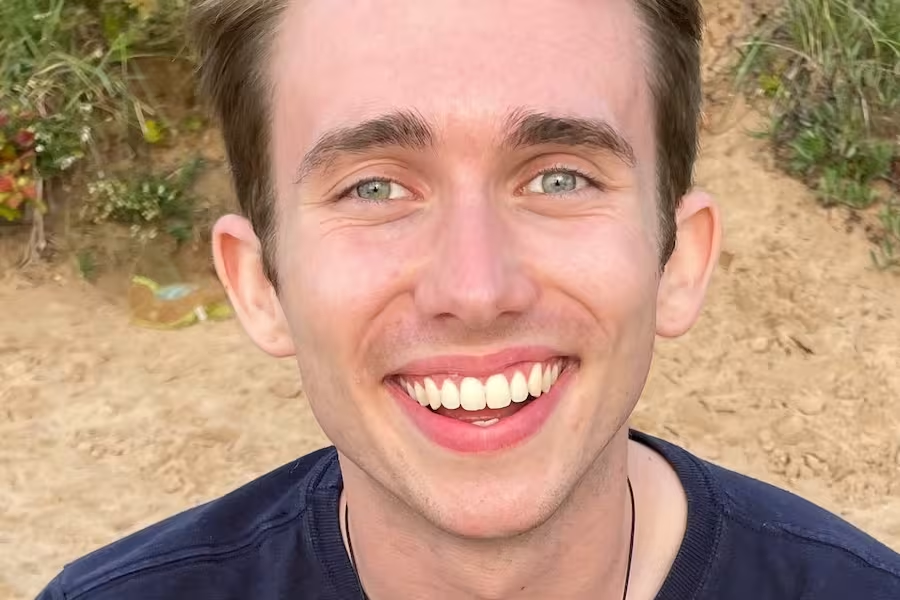
Interlochen Affiliation: IAC 14, 17, 19; IAC St 24
Interview Date: July 7, 2024
Justin Ekstrom attended Interlochen Arts Camp for three summers, studying Theatre, and returned to Camp in 2024 to work as an Alumni & Parent Relations Intern.
This oral history is provided free by the Archives of the Interlochen Center for the Arts (ARTICA). It has been accepted for inclusion in Interlochen’s audio archive by an authorized administrator of Interlochen Center for the Arts. For more information, please contact archives@interlochen.org.
00:00:00 BRAD BAILEY
Today is July 7th, 2024. This is an oral history interview with:
00:00:05 JUSTIN EKSTROM
Justin Ekstrom.
00:00:05 BRAD BAILEY
Conducted by Brad Bailey on the campus of the Interlochen Center for the Arts. So, can you tell me your name again and spell it for me?
00:00:13 JUSTIN EKSTROM
Yeah, my name is Justin Ekstrom. The first name is J u s t i n, and the last name is E k s t r o m. As in magic.
00:00:23 BRAD BAILEY
So, where were you born, and where did you spend your childhood?
00:00:26 JUSTIN EKSTROM
I was born in Williamsburg, Virginia, and I spent my whole childhood there, went to high school there. It's on the east coast of Virginia. It's where Colonial Williamsburg is. And Busch Gardens. Very beautiful place to grow up.
00:00:40 BRAD BAILEY
And so tell me about your parents and your siblings, if you had any.
00:00:43 JUSTIN EKSTROM
Yeah. So my parents are both educators. My mom is a professor at the College of William and Mary. She teaches philosophy and focuses in free will and autonomy and philosophy of religion. And then my dad has been a teacher my whole life. He started out as a Latin teacher, and now he's a high school math teacher. So I think that really did, since I was a kid, instill a love and a value for education in me.
00:01:11 BRAD BAILEY
Wonderful. And do you have brothers and sisters?
00:01:13 JUSTIN EKSTROM
Yes. So my older sister is 28. She's five and a half years older than me, and she went to camp before me. My mom is a camp alum and went in the 70s and 80s. And then my sister came here as a camper and as a counselor. And then I have a younger brother named Matthew who is, I think he's 21. He's 18 months younger. I was really close and am close to both of my siblings. My sister was just the right age to be kind of a role model for me, and kind of everything that she did, I wanted to do too as a kid. So she started in dance classes, and I wanted to take dance classes. She started in musical theater. I wanted to do musical theater. She did creative writing, so I wanted to do creative writing. And then my brother and I are so close in age that we would do everything together growing up, too. We would play together, and we're in a lot of the same dance classes. And yeah, those are my siblings.
00:02:12 BRAD BAILEY
Wow. And so you mentioned that there was a connection to Interlochen. Tell me about your parents and older siblings connection to Interlochen.
00:02:19 JUSTIN EKSTROM
Yeah. So my mom grew up in Michigan, and she played the clarinet, and she was the first in my family to attend Interlochen. She went to the All-State program in '79.
00:02:33 BRAD BAILEY
How old is your mother?
00:02:34 JUSTIN EKSTROM
She's 57 now, and she's told me about how the All-State kids back then would wear the yellow belts instead of the blue or the red, and they would wear skirts instead of knickers if they were girls. And it was eight weeks long. So she did that program first, and then she came back as a camper in, I believe it was in '80 and then '83. I know she did clarinet and I think she also did, at one point she did the fine arts or the some arts program, general.
00:03:06 BRAD BAILEY
Okay. And your sister?
00:03:08 JUSTIN EKSTROM
Yeah. So then my sister came here as a general arts camper and then as a theater camper, and then she came back after graduating high school as a counselor. And so the first year I was here as an intermediate, when I was 12 years old, my sister was here as a counselor. And that was really nice, because it was the first time I'd ever been away from home, and living in a cabin with 14 boys was kind of a lot for me. And so to have a family member on campus to when- whenever she had an hour off or a day off, we would get to spend time together. And we had a habit of, I was a creative writing major when I was 12 years old and 2014 as an intermediate, so my first class in the morning was at the Writing House in Creative Writing, and that's right across the street from the intermediate camp where she was a counselor. And so she would have all her counselor responsibilities in the morning, being with her girls in the cabin. And I would take my writing class, and then it kind of matched up perfectly that she had some free time right after my writing class. And so we had this habit that she would go to the coffee tent, which they still have. She would get us hot chocolate and cookies. And after my writing class, we would share hot chocolate and cookies and talk about the morning before I went to my next classes. So those are really nice memories for me as an intermediate. Yeah, and I think that first time coming to camp was really the time more so than the others. You know, it's hard, it's great. It's exciting to be at Interlochen and exciting to be at camp and around peers. And it's also, can be homesick at that age. So having her there was great.
00:04:47 BRAD BAILEY
So let's back up a little bit though. What were your concentrations here again?
00:04:50 JUSTIN EKSTROM
So I did creative writing as an intermediate. And then I did musical theater as a high school camper for two other summers.
00:04:57 BRAD BAILEY
For two summers. So you did three summers in total here?
00:05:00 JUSTIN EKSTROM
Yes, as a camper.
00:05:01 BRAD BAILEY
As a camper. And so back up then to how did this interact with your education back home? Back in Virginia? Like, whether it be high school, and then of course, talk about college.
00:05:10 JUSTIN EKSTROM
Definitely. Yeah. Well, my elementary, middle school was a very small private school that really didn't have- it was good education, but it didn't have like a special creative writing program. And it didn't have a theater program at all. There were no plays. It was just too small. So coming to Interlochen, I had been a writer before that, but it was really something I would do kind of in my free time for fun. It was never something that was taken- I guess, actually, now that I'm saying this, I- that's not quite right, because I think at my elementary middle school, I was in this special reading group at school. There were just 3 or 4 of us, and I did have a teacher now I'm remembering who cared about our writing. So I think I would write a little bit at school, but Interlochen was really the first place where, like, creative writing was taken really seriously and a place where you're with so many peers who take it seriously too and care about it as much as you do. So that really supplemented my education and then going into high school. Williamsburg is not a big city, and for its size, I think the arts programs that were available to me were great opportunities. I did this summer program at home, and I loved my theater teacher from my high school, but the stuff in Williamsburg was nothing like the.. just the rigor and level of training that you get in Interlochen, especially in musical theater. It's really at a professional level, and you're treated that way and so much is expected from you. So that really, I think, advanced my training as an actor so much and has really helped me going into the theater program at Brown, where I go to school now, and also going to, I did a study abroad program in London at the British American Drama Academy, and definitely the acting training at Interlochen has been really at the core of what I've done in college and at that study abroad program, and was the first time I really had serious acting training outside of more casual theater activities. I had this really great acting teacher in 2019, when I was in the musical theater production program named Jane Brody. Jane Drake Brody. She was really into acting, being gutsy. She would talk about guts a lot, and when you first meet her, you're not sure what to think. She seems intense or unexpected, but she grew to be just my favorite teacher I had here at Interlochen, really encouraging us to be brave, to act on our impulses and to kind of shake off artifice, nervousness, or getting in our own way as actors trying to be good or trying to be a way that we think we should. She was about kind of grit and rawness and intensity, and she was just so encouraging and a really great teacher. Yeah. So the education I got here was has been really foundational for things I've done beyond Interlochen.
00:08:13 BRAD BAILEY
And so, how do you manifest that then on the day-to-day level back at Brown, how do you take some of these principles that you've learned here in your work there now?
00:08:23 JUSTIN EKSTROM
Yeah, I think at Brown, and this might actually be true, I think Interlochen was the first place where you are really expected to rise to the occasion of acting in a really professional way, being really prepared, using all your free time to practice, being really on top of things. And I think the teachers at Interlochen put a lot of effort into explaining why that's important, and making sure you know that that's what's expected. And I think in the environment at Brown. And then what I expect to be true, just in the professional world outside of college, is that that's what's expected, but it's not necessarily spoken or prompted out of you, or nobody's going to tell you these are the things you need to be doing. You just need to be doing them, or you're not going to get hired or hired again. And a lot of it is on you. There's a lot, I think, as an actor, of being responsible for yourself.
00:09:27 BRAD BAILEY
Motivation?
00:09:28 JUSTIN EKSTROM
Yes. Knowing how to and knowing how to warm yourself up. Be prepared. Know your lines, do your work, do your scene work, or your work on monologues, etc,. on your own time, and to hold yourself to a certain level of discipline that nobody's going to be there to tell you you need to do this or you need to do that. You just need to know how to do it on your own. And so I think, to answer your question about the day-to-day, Interlochen trains you to do that and to be able to do it yourself. And that's what you're going to need to be able to do out in the world.
00:10:03 BRAD BAILEY
Great. So talk to me about that first year. What year was that your first year you came here?
00:10:07 JUSTIN EKSTROM
That was the summer of 2014.
00:10:09 BRAD BAILEY
2014. So tell me about- you've heard about Interlochen your whole life. Had you visited before that summer?
00:10:14 JUSTIN EKSTROM
I'm not sure, actually, that I had visited. So I think it was the first time I showed up was as a camper.
00:10:19 BRAD BAILEY
So even when your sister was here earlier, you all never made the trip out from Williamsburg to Interlochen.
00:10:25 JUSTIN EKSTROM
I could be wrong, but I'm pretty sure I had only seen pictures. Yeah.
00:10:31 BRAD BAILEY
So 2014. You're 12 years old. So what was your first experience when you first physically came to the campus? What were your first impressions of the physical space?
00:10:39 JUSTIN EKSTROM
I think it's hard to remember now because there's so many. I have so many memories at this point from all the summers, and-
00:10:46 BRAD BAILEY
Well, here's a better question. What is your favorite place on campus?
00:10:50 JUSTIN EKSTROM
When I think about your last question, too, I think the Writing House was so special for me as a camper. Just so exciting and cozy. And I guess when I try to think of early memories too, I think about just the smells of the cabin, the smells of wood mist in the air, rainy days in the cabin, seeing rain fall out the window, and the Writing House being a really special haven as a young writer, very cozy and sort of romantic. The stone building and so many nooks to kind of go off and do your writing. I remember as a young camper too, it was special to have days to be able to go.. I think we got one day off a week or we had two days off, but there was some time as an intermediate when you got to have a little bit more freedom than you usually get to have. Usually, you're with your cabin or you're in class and you're a lot more monitored as an intermediate. But there was some space of time when we got to go have more freedom. And I would use those times to sit on the main campus, the mall, and I got to have a laptop as a Creative Writing camper. And I remember sitting on the mall in one of those green chairs, writing on my laptop, and just the beauty of the trees and feeling so inspired, looking around at the environment, hearing music rehearsing in Kresge. And I think those feelings, combined with being so encouraged by my instructors and my peers at the Writing House, that those memories of being in that environment also are memories of feeling really empowered and excited as a writer that I was writing things like I'd never had before, and people cared and were going to listen. But I think, yeah, the natural environment for any artist, but I think especially as a writer, is really inspiring to be around here.
00:12:55 BRAD BAILEY
Great. Thank you. And so, who is your most memorable person that you've met here at Interlochen, and why?
00:13:01 JUSTIN EKSTROM
Yeah, well, I talked about Jane Brody. She was a really great teacher. I mean, think about I had really great directors in my 2017 the Musical Theatre Showcase program, Jeremy and Rob. I don't know if I have one figure who's just looms in my head.
00:13:21 BRAD BAILEY
Several people is fine. Don't worry about it.
00:13:23 JUSTIN EKSTROM
Okay. Let me think about some of my counselors. I know that two summers in a row, I had kind of this pair of counselors that had kind of the same dynamic one would be the more rigid or sort of telling us what to do. I remember I think I was an intermediate camper. I had one counselor, I think his name was Mitchell, and he was a musician, and he was very.. he was nice, but he was very honest about the rules. And then our other counselor was this super chill dude named, I think his name was. I don't remember his name, but I remember him being sort of like the softer guy. And I remember him coming to me once and having a conversation with me. Like, aside from other campers about, I don't know what I did, what I was interested in, that really meant a lot to me and made me feel just that he would care to take the time to see me and pay attention to me and ask about my experience. I think I was sort of shyer back then as a kid, and to have a more like quiet conversation with him was really nice. I had this counselor named Talon in 2017, which is funny in my memory. He's a lot older than me, but at this point he was probably 19 then. But cabins had themes and he made the theme of our cabin, the Pride Cave. And I think back at home I had just come out as queer. So that was really exciting, that like, there was a rainbow rock in front of our cabin and he was just like, really out and proud.
00:14:53 BRAD BAILEY
How old were you again at this time?
00:14:54 JUSTIN EKSTROM
I was 15. Yeah, I think he was in theater, too. And he and the other counselor that summer came to see my showcase. He was just really supportive, so many different people. The director of my 2019 musical theater program, Greg Hellems, I think, was a great mix of making sure we were on top of things, really setting the expectations and the high bars, but also had this sense of humor and warmth to him. Yeah, so many great people and then people I've stayed in touch with, like this girl who was in my musical theater program in 2017 named Sydney, just I remember thinking for theater programs on the first day, they would have us all audition, so we would sing our song and then do our monologue. And I remember when she did her monologue, I just thought it was so amazing, and she seemed so cool. And I thought, like, everyone would want to be friends with her. And then we ended up like, striking up good conversations and a good friendship. And then I remember telling her that a few days later that after her monologue, I just thought she was so amazing and cool.
00:15:58 BRAD BAILEY
So it seems like not only professionally but also personally, this place has impacted you. So, can you describe, sort o,f in general, after you've sort of listed all these experiences? How has it impacted you personally today? Some of the moments, like the Pride Cave moment and just some of those moments where the other counselor came up and just really asked about you, allowing you to be seen, you know. And so how does that impact you today when you look back and think about all these experiences?
00:16:25 JUSTIN EKSTROM
Definitely, yeah. I was thinking on my way here, and I've been thinking all summer that I think Interlochen is just a place where I feel so much myself, and I feel like being here is getting to connect with a part of myself that just feels so at my core and so pure and so true. And I think Interlochen is so special because of like, things I've been saying before. It's one of the first places, as a kid where you are really seen and your art gets taken seriously. And art is unique in the educational world too, because it's this thing that you do that comes so much from who you are as an individual and something that is really vulnerable. It takes vulnerability to write or to put yourself on a stage and to have somebody recognize that as important, I think is really empowering as a kid. And then to be able to connect with those memories as an adult is just as empowering. I remember this time when I was a Creative Writing student, done creative writing for fun, but we really focused on, okay, we're going to write fiction this week, or we're going to write poetry this week, and it's really one of the first places I wrote poetry. And I had this teacher there named Coach Assad. She would have us call her Coach, and I had written a lot of poems at Interlochen, and I hadn't really written poems before that, and there was going to be this poetry reading that was optional. We didn't have to sign up for it, but we could, and I wasn't sure if I was going to do it. And I remember her thing was sticky notes. So, to mark up her own piece of writing, or when she had an idea, she would make a sticky note and put it in her notebook, or she would use that to edit our work. And so she wrote on this sticky note that she left on my notebook. She said, you're a poet. You should sign up. And so I did sign up for the reading, and I read a poem. And that has always stuck with me. And going forward as a writer, even today, as a writer. Over this past semester at Brown, I took an advanced poetry class, which I had to apply to and be admitted to. And I remember sometimes feeling like the other people in the room were so experienced in poetry. They had read a lot and written a lot. But I would think back to that experience of Coach Assad saying, you're a poet. And it really is so validating and empowering those experiences.
00:18:53 BRAD BAILEY
And so what keeps you connected to Interlochen?
00:18:56 JUSTIN EKSTROM
Well, a lot of it goes back to those memories of feeling validated as an artist and empowered, and the training, and also to the family connection. I think this place is.. I'm really close with my mom in so many ways, but this place is something we really share a love for and something that connects us both, that we both recognize how magical and great it is. And like I said, I think it's sort of always is with me wherever I go. Feels like I really was allowed to be and become the person I really am, and to flourish as that person in this place, maybe for the first time that fully. And so when I get to feel that way again, wherever I am in the world, it's like I have Interlochen with me. And I think if I ever feel like I'm lacking that feeling, I can always come back to this place and feel it again.
00:19:56 BRAD BAILEY
All right. Great. A couple last questions. How would you describe Interlochen to someone who hasn't experienced it?
00:20:01 JUSTIN EKSTROM
I think it's hard. I was in a conversation with someone yesterday, and we were saying it. I think it was an alumni who came in and said, for someone who doesn't know it, it is hard to sort of capture fully. But I guess I would say it's this wonderful place where people come together to get to do what they're really great at and what they really love. They get to express who they are and express that. Like as we say in the slogan, through this universal language that is so connecting and sort of transcends barriers in communication. Art just really cuts to the core of what it is to be human and to get to celebrate that with people who love the thing that you do just as much. It's just really magical. And to get to do it in one of the most naturally beautiful places in the world. It's just one of the greatest, most inspiring and free places.
00:21:01 BRAD BAILEY
Wonderful. And the last question why does art matter in our world today?
00:21:04 JUSTIN EKSTROM
Yeah, it's scary thinking about artificial intelligence and what makes a person. I guess I don't understand fully what an artificial intelligence really is, but it's scary to think that what it is to be a person could be manufactured. I guess I don't have answers to that question, but when I think about a kind of future that scares me, that is taking for granted or not taking into consideration our human worth. It's a world with less art. And so it must be that art is so important because there's something really human about it. And like I said before, it's this kind of way of communicating that transcends barriers of language or culture. It also comes from those things, those special things about being human that our culture, and it so often comes from the heart and feeling, and its aim is to strengthen and foster empathy and to create a world that's expanded and bigger than what we know, and to allow us to see more than we know, and a world without it feels cold. And I worry that we could be headed in that direction
00:22:30 BRAD BAILEY
Very well. Well, thank you so much, Justin. You know, thank you so much for interviewing with me today.
00:22:35 JUSTIN EKSTROM
Yeah. Thank you.
00:22:36 BRAD BAILEY
Anything else you'd like to add or say before we sign off?
00:22:38 JUSTIN EKSTROM
I think that's everything.
00:22:40 BRAD BAILEY
Wonderful. We'll hopefully continue, maybe another interview in the future, for sure. Yeah. So today is July 7th, 2024. This concludes an oral history interview with-
00:22:49 JUSTIN EKSTROM
Justin Ekstrom.
00:22:50 BRAD BAILEY
Conducted by Brad Bailey on the campus of the Interlochen Center for the Arts.
Copyright
Copyright to the audio resource and its transcript is held by the Archives of Interlochen Center for the Arts (ARTICA) and is provided here for educational purposes only. It may not be reproduced or distributed in any other format without written permission