
Oral History Interview with Jody Burns
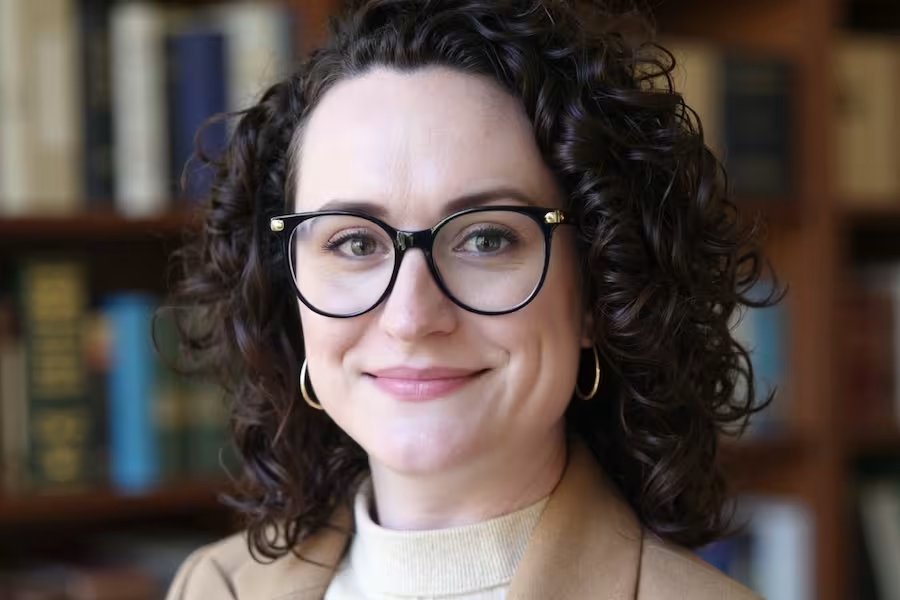
Interlochen Affiliation: IAC 01-03, 05 | IAA 06-08 | ICA St 16-17, IAC St 09-10, 10-11, 11-12, IAC Fac 12-17
Interview Date: July 19, 2025
Jody Burns studied Theatre Arts at Interlochen Arts Camp in the Junior, Intermediate, and High School divisions and graduated from Interlochen Arts Academy. She returned to work and teach at Interlochen for multiple summers.
This oral history is provided free by the Archives of the Interlochen Center for the Arts (ARTICA). It has been accepted for inclusion in Interlochen’s audio archive by an authorized administrator of Interlochen Center for the Arts. For more information, please contact archives@interlochen.org.
00:00:00 ELIZABETH FLOOD
Today is July 19, 2025, and this is an oral history interview with Jody Burns conducted by Elizabeth Flood on the campus of Interlochen Center for the Arts on Zoom. Thank you for sharing your time and story with us today.
00:00:15 JODY BURNS
Thank you for having me.
00:00:17 ELIZABETH FLOOD
So to begin, please tell us your name, your connection to Interlochen, and the years that you attended.
00:00:25 JODY BURNS
My name is Jody Burns. I was first a camper in 2001. At the age of eleven I was a Junior camper. 2002 and 2003, I was an Intermediate camper, took a summer off, came back in 2005 for a year of High School, and then that fall I started the Academy. I spent my junior and senior year at the Academy. I graduated 2008, and then the summer after my freshman year of college I came back and started teaching as the choreographer for the Intermediate musical theatre kids. And I did that for nine years, until 2017, but in the Fall of 2016 I came on as like additional help in the Admissions Department for their fall, like, application time. And then I ended up actually staying until June filling in for someone who's on maternity leave, so I was also on the admissions staff. Four years as a camper, two years as an Academy student, nine years as specialty. And then in 2017 I moved out to California, and I've been here since.
00:01:34 ELIZABETH FLOOD
So what brought you to Interlochen in the first place?
00:01:45 JODY BURNS
I mean, the very first place my mom actually worked there, and then met my now stepdad, and has been for a really long time, who still works there. So it was very much a family situation. There was a long time physics teacher, Mr. Naji and his wife ran a daycare for like decades, and I was the first daycare student when I was three years old. And I had him as a teacher at the Academy, and it was really cool to see him and like, I grew up with his kids, and we were baby children together. So yes, my mom worked there in the early, early 90s, when I was really young. Like my whole life, I've been around Interlochen, and I grew up in Traverse City.
00:02:22 ELIZABETH FLOOD
Okay, so there's many directions of things we could go in, but I'm curious what some of the main differences for you, just starting as your experience as a young person between Camp and Academy were?
00:02:36 JODY BURNS
That's a really good question. Oh, man. I mean, Camp is so magical. The just exposure to other people, I know that sounds silly, but when you grew up in a really small like northern Michigan town, it gets a little bit monotonous sometimes even though it's beautiful there. And I just remember meeting all these people for the first time at such a young age, and just being like, "Oh my gosh." I vividly remember the people that were in cabin seven of Junior girls. Back then Camp was eight weeks long, so I was in these cabins with these girls were there for eight weeks. There was one girl who was a dance major from Venezuela. I remember a girl from California, which was a foreign land to me back then. They were spending eight weeks. They were so young, and they were spending eight weeks up here, one playing the violin, and it was so magical. And then the Academy is like Camp amped up times a hundered, I mean, you just hone in on such, for our age, serious work. I was a theatre major. I then went to school for musical theatre, and my first few years of college, I was like, "Done all of this," it's such a next level experience. And the Camp, it has that, but it has such this warm like adventurous feel to it as well. Not that the Academy wasn't adventurous, but it seemed more serious, but it was exciting too. It was exciting. And building deeper relationships. I just saw one of my best friends in high school, like two weekends ago, because she just had babies, and so it's it's crazy.
00:04:18 ELIZABETH FLOOD
Well, I definitely want to ask more about the friendships, but first I want to ask what made you interested and decide to go to the academy?
00:04:28 JODY BURNS
Yeah, I think this probably happens to a lot of artists as they get older and navigate different careers, they think about early choices. It never seemed like it wasn't going to happen for me. My family's really tied to Interlochen, so it just sort of made sense. And my last year as a camper, so the summer after, I guess my sophomore year of high school, just being there, talking about the Academy with instructors and all those things, it just really was seemed normal. And I wasn't really that scared to leave my public school. It just it made a lot of sense to do that. And looking back, I mean, I feel like everyone is always like I wish I would have taken advantage more, but it was wild. It was wild. I mean people were from all over the world, and we were there to like run around and like play pretend, but like really seriously and take it really seriously.
00:05:28 ELIZABETH FLOOD
Was there anything notable, like you already had the Camp experience, and you grew up steeped in Interlochen in certain ways, and I'm just wondering what that transition was like to be now a full time high school student at a new school, but that you were already familiar with?
00:05:44 JODY BURNS
Yeah. I mean the vibe of Camp versus Academy, it is shockingly different. I mean, just the numbers. Camp sees between twenty-five hundred and three thousand students and the Academy is around five hundred. So just right there, the number of people is so much less, and you feel so much more seen, at least I did, by the faculty, by your instructors, because you're with them for so long. And there are definitely a lot of people who came to the Academy who didn't grow up in places with winter and so just the weather changes, the fall comes, it's a very kind of insulating experience. Everyone is insulated in their art. It feels very... it's hard to put into words. At least for me, it felt very safe. It felt very warm and exciting, but scary a little bit. It's a little scary. A very tangible memory for me is, so the music building was not there while I was a student, and so actually going from physics class, which was in Dow at the end of the hall, I think these are all renamed now, but the JVS Hall is what it's known as, I guess by the library. There was no building there like there is now, and so as theatre students, we would leave that door and run to the theatre across the snow, and we never wore jackets. I mean, I don't know. It was just absurd. We were always freezing and running and cold. That was such a daily memory for me. In the mid afternoon when we kind of switch over to our theatre classes, it was just this race to the other side to feel warm again. [laughs]
00:07:32 ELIZABETH FLOOD
What were your favorite spots here as a camper and Academy student? I'm curious to know at some point in this interview what it's like to parse apart knowing a place through different stages because I'm intentionally trying not to ask about being an employee or like working here for a minute, but I wonder what that's like because I also feel like the place grew with you.
00:07:55 JODY BURNS
As an Academy student you really get to know the grounds much better. You spend so much more time there. Campers are very well pushed around to certain areas. There's not a lot of alone time, especially as a young camper. I mean, at eleven years old I wasn't like going where others weren't. And where the cabins are, that's not used for the Academy. So all of that area is really blocked off. It's not really gated, I mean, it wasn't back then. Nothing was gated when I was a student, actually. The whole thing is gated now. But yeah, the cabins were just like abandoned. So it was very special to sort of walk down by The Bowl, which is a really important piece of Camp life as Les Preludes happens at the end of the season, and but all along there where all the practice huts are, isn't used during the Academy as much, but there's this really nice trail down along The Bowl, and then that goes down by the beach, and that's where kind of Intermediate girls is, and oh, I know that's not called that anymore, but I love that area down there. There's like gazebo down there. I love the gazebo. And that's also a space that I would run along there when I was working there later. That's like a little special place. I spent a lot of time in Harvey Theatre. It was new, very new when I was a student. So yeah, I spent a lot of time there. I did a lot of shows there. That was also special. A lot of places before they were redone. I was sort of right at the beginning. The Creative Writing building was built a few years before I started at the Academy, the original Visual Art Building, the Film building was built right before my senior year. It was finished before my senior year. So that was like a magical place where only you know, very special people got to be, to live, and was so fancy and so like coveted. Wow. Yeah, but I think in terms of sentimental spaces, down by The Bowl, that path down there, kind of behind Kresge, that little area, or on the side of Kresge and down by the lake is really special.
00:10.21 ELIZABETH FLOOD
This is my first time here, and I've been hearing about from everyone all summer the different changes that have happened, but I think there is something different about being an Academy student and being here while the changes are happening. And so I'm curious what that was like?
00:10:38 JODY BURNS
Yeah, every discipline seemed to have -and I know this also from knowing the faculty later on- a very special relationships with their buildings and their spaces. The Dance Building, for example, and it's absolutely gorgeous now, absolutely stunning. But the old one had the same effect except it was falling apart, but it had this very beautiful rustic energy, and I can still remember the smell of the Dance Building. I was always in dance as a camper. You don't really cross disciplines as an Academy student, but as a camper, you do take different classes, so I took like dance electives, and I remember running down to the Dance Building. We weren't allowed to wear our dance clothes under our uniform, so we would hike our tights way up under our shorts, and it was a zillion degrees outside and running around, there's sand everywhere. It's all very dirty, and. So I remember running down there as a little eleven, twelve, thirteen year old during Camp, and just it was so fun to be in the big studio that looked over the lake. I think somewhere there's a photo of like an early ballet class that I had. There was like an Interlochen photo of this class I was in, and it's just so funny to see. But the new dance building, you know, it's moved with the times. It wasn't going to probably stand much longer than it did. I mean, as you know, people spent many years there, and they develop relationships with their spaces, and a lot of people had feelings about it, but it's still just as beautiful. I think they did a great job keeping the feeling of it while giving it a space that is sustainable. The visual art building- I remember when they knocked down Hut C I think it was called, it was this I think like the painting hut, and it used to sit behind one of the dorms, like behind Hemingway or by the library, which when I was a child, was a gym. A very hot, sweaty gym. I had Camp classes there. The tuba hut. I don't know if that's still there, but it's the practice hut. I think it's not there because the music building's there. They knocked out like all these little practice rooms, but the tuba hut was well known for different activities, as well as tuba playing.
00:13:07 ELIZABETH FLOOD
Could we go back to some of your friendships? And I'm interested in the memorable people that you've met along the way, and then hearing a little bit about some of your lasting friendships.
00:13:21 JODY BURNS
Yeah, wow. So I had a really close knit group of girlfriends at the Academy. There were five of us. We did have a name for ourselves which I will not share here. We were all theatre majors, all from different areas of the world. We did everything together. We were young and weird, [laughs] but we've stayed friends. Almost all of them came to my wedding in 2021, which was really exciting. And are now all married also, and some have started familie, some are just starting families. Our journeys together were so, it's so emotional in the moment, like everything is just at one hundred percent at all times, if not one hundred and fifty percent. It is life or death at all times. And that is sort of how it was. Now to get into a little bit of the trouble without giving too much away, but I was actually a day student at the Academy, so I went home every night. And it also meant that I had a car, so we used to sneak off campus in my car. We had a system where I would pull up to this one spot and they would all pile in and hide on the floorboards while I drove off campus. Again, we didn't used to have gates, so it was a lot easier. And we would go do all sorts of things, and then I would just bring them back before I went home. I think I did that a lot more times than my parents knew about. That was pretty fun. I sometimes got my car taken away because I got caught, but then I would always get it back. [laughs]
00:15:06 ELIZABETH FLOOD
What are the memories of Interlochen that y'all return to and kind of reminisce about?
00:15:13 JODY BURNS
Oh man. I mean as theatre majors the shows really last. They stick with you. A lot of the rule breaking sticks with you. When students are about to go home like for a break or something, it's called a travel weekend, at least it used to be. And so on travel weekends no one can do anything, like you have to just like be in your room, and like people come and check on you, and they make sure that you're not being weird. But I used to spend the night in my friend's dorm kind of often because I had so much studying to do... because two of them lived together. And one time it was a travel weekend, and one of the counselors came to the door to check to see that we were all following the rules, and I hid in the shower. And the counselor came in and opened a shower, and I was just like, "Hi," and she was like, "Why are you here?" I was like, "Oh, I'm gonna miss my friends," and blablabla and she's like, "You need to go home." I'm like [fake crying] "Okay fine." That was pretty funny. I mean I remember graduation. It was so wild. I remember thinking at the time, you know, I bet this is the best live orchestra commencement moment ever. Technically it was the juniors because the seniors were all walking, but it was the most beautiful way to walk down Kresge and graduate, Senior year is, for everyone, just so... everything revolves around auditioning for college. And it's kind of nuts, I mean, in the theatre world we would have lunch meetings with our professors to go over our audition monologs. Everyone's sort of not competing, but talking about all of the places they're auditioning and where they're thinking about going and then the musicians, they're always practicing, like, you know, five thousand hours a day, and that's all that was talked about. Like all you talked about was college. I work in college admissions now and have a lot of space for folks who take time after high school and really think about their journeys, actually. That's all there was senior year, was what's happening next. And, you know, you start getting your acceptance letters or your denials, and it became very competitiony which was interesting. And at the same time, we're in shows, we're always auditioning for shows, and it's just busy. I mean, basically my schedule was, this is also before we had block scheduling. They now have block scheduling. But like I went to school from eight thirty to five thirty, and then I had a dinner break, and then rehearsal started at seven. And that was like all the time. It was all day, five days a week. It was really intense the amount of work you put in. So it's not like we didn't have fun, it was just so much work. It was so much work.
00:18:13 ELIZABETH FLOOD
Wow, those are long days.
00:18:17 JODY BURNS
Very long days, and so in that time we had like seven classes a day. Six or seven classes, and it would be academics in the morning, and then your major classes at night, and then, yeah, if you were in a show, you went to rehearsal. It was crazy.
00:18:36 ELIZABETH FLOOD
So maybe this is a moment to transition into- what was it like teaching here? I have many questions about what it was like for you to then be teaching, but then also, what was your relationship to Interlochen like being now on faculty?
00:18:53 JODY BURNS
Yeah, so this section will bring the tears for sure, just as a warning. [laughs] So two weeks before Camp was to start the summer 2009 I got a call from one of the instructors, and he was the director of the Intermediate six week musical theatre program. So these are eleven to fifteen year olds. Middle School. Everyone usually hates that age. I have such a special place for them even though they're insane, and he said, "Our choreographer dropped out," and the choreographer that was supposed to be was actually someone I went to the Academy with, and she was a year younger than me. "What are you doing this summer?" And I'm a horrible college student with nothing going on. I was like, "Yeah sure." It changed my life. I mean truly, truly changed my life. So I was choreographing for the six week musical theatre students and two three week workshops. So there's the six week students that put on a full musical in six weeks, and then there are two three week workshops. And the workshops rehearsed in this shack which was separate from the Dance Buildingbut sort of right by it. I don't even what it's called. Covered in sand, disgusting. They're on the floor, they're doing exercises, they're stretching, I'm disgusting. It's all disgusting, just horribly dirty. And then the six weekers rehearsed and performed in Phoenix Theatre. So I jumped in. I had no idea what I was doing. I remember the director said to me, he said, "You know, the person who has done this before, she was a great dancer, but she was a bitch to the students." [laughs] And I was like, okay I think I can figure that out. And I fell in love very, very quickly. I actually just yesterday, and this made me feel very old, saw that one of the students I had in the very first year just got engaged. And I was like oh my gosh, I can't believe it. I had her and her sister through the program. And the first year we did Little Shop of Horrors. It was a ragamuffin situation. We built the sets. They have, even through when I was there, many more resources and funding for costumes and scenery and people to help with that and lighting. We were doing our own lighting. I mean, it was, it was wild. And I remember with the stage manager, who I went to the Academy with, painting the black and white checkered floor and painting the backdrop with the Little Shop of Horrors planned and everything. And it was wild, but I fell in love. I fell hard. [laughs] And I started this, not tradition, but my kind of signature thing was this really intense physical warm up in the beginning of every class. And I had kind of a series of songs that I changed them a little bit over the years, but that was like my signature was that you come in and we do this aerobic workout that has stretching and all these amazing things. And by the end of the kids were leading it themselves, and they loved it, and it was so fun. And I was into my sort of theatre hippie phase. I would make leg tassels for all the students, and we would all wear leg tassels. I mean, it was just insane, but Little Shop of Horrors. That was the first one with Bill Church. And then I also was in the Shakespeare Festival, performing. Oh, it was insane. Shakespeare Festival started in 2008 with Twelfth Night, and then in 2009 they did Taming of the Shrew- because this person who was the choreographer was also supposed to be in the show. So I was also in the show. I was a clown because we did Taming of the Shrew in like a 1920's circus theme, and I played a clown. And a few years ago, the costume designer, Candy, she retired, and she sent me the original rendering of my clown costume with my name on it and a little note. Just lost it. It's the cutest thing ever. And I my pants had like a hula hoop, and it was adorable. And so a week before Camp starts, we're in all day rehearsal for the show. And I mean, that's just it, like that's basically all the rehearsal we had. So then I'm doing this job during the day and then still rehearsing at night, and then the show opens. So then your doing the job during the day, and you're performing at night. And Bill was the director of the Shakespeare show as well. We were together all the time, and I was nineteen and didn't know what I was doing with my life. [laughs] Yeah, so that was my first year, and then the second year when I came back, 2010, that was the year of Midsummer, and I played Helena. And that was a dream, amazing role and time, and meanwhile I grew really close with another acting teacher who was also in the show, and him and I are still very close. I'm the godmother of his daughter, and we were best friends, inseparable, and he played Puck. So that was a fun, fun summer. I did Little Shop of Horrors, and then Cinderella with Bill, and then this crazy lady came in to take the director role, and she ended up marrying Puck and producing the child that is my goddaughter. And they fell in love at Camp, which was very sweet, but she was the director of the Intermediate students, er the Intermediate musical, and we did cats. With no cats. It was the cutest thing ever. That was so fun. And then we did Spelling Bee. And then the current director, who is still there, Peggy Treckerwhite, came in, and we did A Little Princess, Orphie & the Book of Heros, Godspell, and we ended, my journey as a faculty ended with Sunday in the Park with George which is one of my all time favorites, but all along there the woman who I am just an absolute awe of, Anne Lewis, has been the music director for that program for thirty plus years, and she was always there. We were always together. She's probably there right now. I don't know what musical they're doing this year, [laughs] but we still talk the three of us, Peggy, Ann and I. We were an incredible team the three of us, it was incredibly difficult for me to leave. I still think about it all the time. Every summer, I think, oh my gosh, like, you know, I miss it so much, and I always want to know who's the choreographer? What are they doing? But it is the relationships you build with the other faculty there that are just very magical. And we all live in the little cabins. [laughs] I lived in the same cabin for six years. One of the duplex cabins when you're going down water tower lane on the right, I think like twenty side B or something like that. I lived there for six years in the summer, and it was just my little like no air conditioning, so small, but it was my little place. Those memories are, I think, the strongest for me, was my time teaching the kids. And I love the students, and some of them I had for like four years. Some were eleven and then grew up and then through the program and went on to High School and went on to the academy. I sent a ton of kids to the Academy, a ton of kids the academy. I remember Bill saying to me, he's like, "Why are all your students coming to Academy?" Because I'm like, "I'm telling them to audition. You're welcome."
00:26:30 ELIZABETH FLOOD
Do you have any teacher moments that really stick with you?
00:26:31 JODY BURNS
Oh, I forgot Oliver. We did Oliver because that made me think of a teacher moment. I don't know if you're familiar with the musical Oliver. "Please sir may I have some more?" Ever heard that? That's from Oliver the musical. Every year- have you been to Collage? Did you go to Collage this year?
00:26:48 ELIZABETH FLOOD
I did, yes.
JODY BURNS 26:50
Magical place. So Collage is a big deal in the Camp season. It's always in the second week of Camp. All of the disciplines come together, and the Intermediate musical six weekers, we had to put together a whole thing. And I was like, oh the Intermediates are going to be better than the High Schoolers. There is no option. These kids are incredible, and they're going to show everyone. So in the Food, Glorious Food song, which is like, [singing] "Food, glorious food. That extra bit more." I kind of remember the coreography still, but I basically decided that it was going to be a bucket dance and that everyone needed a five gallon bucket. So I had the students in Kresge. They were all sitting on the outside rows with their buckets the whole show until they were ready to come up. They ran up to the stage. They danced. They were out of breath. They were singing and belting and banging buckets around. And it was the cutest thing. It was so good, and I have a copy of it somewhere. But it was such a beautiful, proud moment, and so fun to see them see themselves in this exciting way. They're like, "Wow, I'm good at this. I can do things. I'm cool. I'm having fun." And that show, even though Oliver is about a boy, an orphaned boy, but the rest of the cast are very serious adult characters. So doing it with eleven to fifteen year olds, that's always the sort of challenge is, yes, we had this one perfect boy and he played Oliver -and also had him for like, four years, but his first year he played Oliver- and he was perfect for it. It's a pretty easy like role to find, but then you have to cast Nancy who's like the waitress at the pub with the sordid past and the abusive boyfriend and blah, blah, blah, blah, blah, and then the boyfriend who's all the things, and the policeman who sings this very like baritone song about selling Oliver on the streets. And so that was such a strange journey. [laughs] And I remember talking to the girl who played Nancy, and she was like, "You know, I'm having a hard time," because it's literally about this abusive relationship that she has with this horrible guy who's like the hornswaggler of the town, and stealer and burglar or whatever. And I remember sort of talking to her about it of how it feels, from like a dancing perspective, how this sort of feels in her body, and going through those kind of rehearsal moment with her of her owning that character. And it was so incredible. And I remember her talking about it later. She went to the Academy. A ton of those kids went to the Academy that year, actually. Oliver, the policeman, Nancy. So that was a really amazing memory. Cats is something I will never forget. If you've ever seen Cats it's about three hours. I love Cats. Oh, I love it. So three hours long. We cut it down to 45 minutes. The kid weren't cats they were sort of in like social groups. So we had the service cats that were like the little butlers, and they were the kind of chorus behind one of the cats. And then in the Macavity song, which is very punchy and [sings] "Macavity, Macavity" I said to the director, I think we should do a chair dance. And she's like, you're telling me you're going to choreograph her chair dance with thirteen year old girls. And I was like, yes. I am. And so sure enough, we got a bunch of Cabaret chairs from like the basement of who knows what forgotten corner of the theatre, and we put red lights on the stage, and they did this chair dance. And it was, you know, a little bit wild for the Intermediate girls to do, but it was incredible and amazing. And I don't regret anything. Ending my reign with Sunday was so magical. It was beautiful. It was just incredible. Their collage performance they did "Sunday." It was beyond magical. I've seen adults be worse, much worse than those kids.
00:31:16 ELIZABETH FLOOD
Those are beautiful. Thank you so much for sharing them with me. What advice do you give students who are on their way to the Academy? What have you given? But what would you give now?
00:31:31 JODY BURNS
In the moment, I remember just telling students, just sort of giving them the confidence of you can do this. You have this. You can do this. Working on monologs with them, that's something that all three of us did. We would help them with songs and their auditions and everything. So giving them that confidence. I think that was my overall goal, was showing students that they are good at what they do. They have talent. They work hard and like helping them see that in themselves. I remember as a young person just sort of not having the self awareness, I mean I was eleven, you know, to be able to look at myself and see like, oh my gosh wow. That's good. Good job, Jody. So I wanted to give that to them, because it can be really hard, and they're all coming from different backgrounds. They're all coming from different theatre communities in their hometowns; some that are really vibrant, and they're involved, and their families are involved and some that's like this is a dream that they sort of have by themselves in a vacuum of sorts in their small town somewhere. So Interlochen is a big deal for those students, and I wanted them to feel inspired and proud of themselves. And my favorite projects were always the students who didn't think they were dancers or students that didn't think that they were movers, and often this fell the boys, the twelve year old boys. It's a hard age. It's a really hard age, and there's a thousand left feet. It applies to everyone, but by the end they were always much better at the dancing and flexibility and all those things than they were at the beginning. And I do remember this time when, it was during Cats, and this is one of the students I had for many years because she was eleven in Cats, and her grandparents came to the show, and I think they were her main guardians, and they asked me like, "You know, we should discourage this, right? She's not good enough to like, make it." And I was like, "Oh no, she's incredible, and she is very good at this. You absolutely should encourage her." And they were sort of taken aback, "Oh, we thought this would just be something that she did once and be fine." And I was like, "Absolutely not. She is incredibly talented." And you know, who did I see on an episode of Chicago Fire like six years ago or something? I was like this is crazy, and she went on to also the Academy. [laughs] I just remember that so vividly. It really stopped me in my tracks like, no this, there's so much talent. There's so much, she has so much to give, and she loves this so much. She works so hard. I think empowering the students that way help them empower themselves at home and, you know, really express to their parents or guardians what they wanted, what their passions were, or also deciding maybe this wasn't their passion. They really loved it in this moment, and maybe it's not what they want to put a hundered percent of their energy in, which is also fine. Always my goal was to just instill in them the confidence that they are absolutely enough, exactly the way they are, and they have so many options on where they want to go from here, and this is just the beginning, but always wanted them to know that they were enough. More than enough. And that was really magical.
00:35:15 ELIZABETH FLOOD
You made me cry. [laughs] That was so beautiful. Maybe the second week here, I went to the Intermediate band performance, and there was parents sprinkled throughout, and all of the kids with all their friends cheering each other on in this most gorgeous way, and I was sitting there, and I had a friend with me, and at a certain point in time, I was just like, "I hope all these kids after this, someone tells them how proud they are of them." Sorry, I'm gonna cry- it's just so amazing what happens and like how amazing heart goes into it. So they were really lucky to have you.
00:35:50 JODY BURNS
And the intermediate age is really magical at Interlochen. It's my favorite time as a camper, my memories of wearing red socks were really amazing. And it's such an important time in their lives, especially now, when there's so much media and different things that influence. But I think I just, I really fell in love with that age, and I can see how it's easy to just brush them aside and not see them for the talent and the passion that they have. A lot of energy went into- this is no bashing, I swear -But back then, a ton of energy went into the High School musical. When you go to the High School musical at the end you will see why. It's an incredible thing. And the Intermediates were just sort of these ragtag whatevers that were given as much as we could. If the tech folks that are doing the High School production have time, they'll come over and help you do this. But then we got our own costume designer, and then we got our own set student. Once they started a tech theatre program at the Camp, and those students would help do the Intermediates as well as the High School. And then it just kind of grew and grew and grew. But they are so worth it. It's an incredibly important time. My goal always was to give them the best version of myself. I wasn't giving myself the best version of myself, but I hope I was able to give them the best version of myself in that moment. Interlochen for those nine years, it definitely saved me, and it created this home and this consistency in my summers that led me to be able to do other things and become the person I am today, all those years later.
00:37:45 ELIZABETH FLOOD
My last question is, so this project is for the Centennial that is coming up in the next few years. And so the question is, what do you hope for Interlochen in the next hundred years, both in what are the traditions that you hope are carried into the future? And what are some of those things that aren't quite here yet that you are hoping are part of the next hundred years?
00:38:12 JODY BURNS
I'll start with a silly one, and I know it's already changed, but I love the uniform. I wore the uniform from like age eleven to age twenty-seven, so it was very special to me. I think the uniform carries this space for students to be seen outside of the clothes that they're wearing, or the clothes that their parents can afford, or, like, all those things get kind of stripped away when you put the uniform on. I know probably in the moment campers hate it or whatever. I love the uniform. For many and still to this day, most of my clothes only match light blue and navy. My sweaters, like I don't have things that don't go with that combination. And often, when I'm doing nervous things in my life or presentations or new things, I will put on navy pants and a light blue shirt [laughs]. I almost wore it. I almost wore a light blue collar shirt to this, and I was like, "Okay, no, let's not do that." So it, I don't know, it has a really special place in my heart. I know it's changed, and I heard that they got rid of the uniform during the Academy, but I don't know. That's one piece. I do hope that Interlochen continues to grow. I guess I could kind of be considered an old timer now which is a little bit terrifying, but I hope that it does stick to its roots, which is in teaching young people. I mean, in 1928 we are bussing in people from all over the country to play instruments by the lake and that connection with nature and connection with each other is what Interlochen is all about. The world today is changing, but art truly is everlasting, and young people's experience with art is so important. It's incredibly important. And I hope that Interlochen continues to grow in a way that it is able to provide more scholarships. I know it does now, I know a little probably more than most, but my dad is actually the VP of Finance. He's been there for about thirty-five years. His name is Pat Kessel, if you ever run into him. You might know him. He's really built a financial future for Interlochen. Education is expensive. Art education is expensive, but the more people we can provide it for is just the better and just the community it builds. It's worldwide, and Interlochen is an incredibly special place. Oh, there I go. It changed my life. I always joked, but I hope to go back someday and be the first female president in my old age. Once I'm done with school. I work in higher ed admin, so I hope to go back to the art world someday, but Interlochen is incredible, and I hope that it continues to remember that the point is to inspire young people to be creative, to grow and to believe in themselves, as corny as that sounds, but yes, believe in themselves and push themselves to better futures. I think it can do it. I think it can do it.
00:41:58 ELIZABETH FLOOD
Thank you so much for your time today, Jody. It's been such a pleasure to speak with you.
00:42:03 JODY BURNS
Thank you so much. Elizabeth. I really do appreciate you taking the time and hanging out with me and letting me reminisce some about this incredible place.
Copyright
Copyright to the audio resource and its transcript is held by the Archives of Interlochen Center for the Arts (ARTICA) and is provided here for educational purposes only. It may not be reproduced or distributed in any other format without written permission