
Oral History Interview with Jeff Paulson
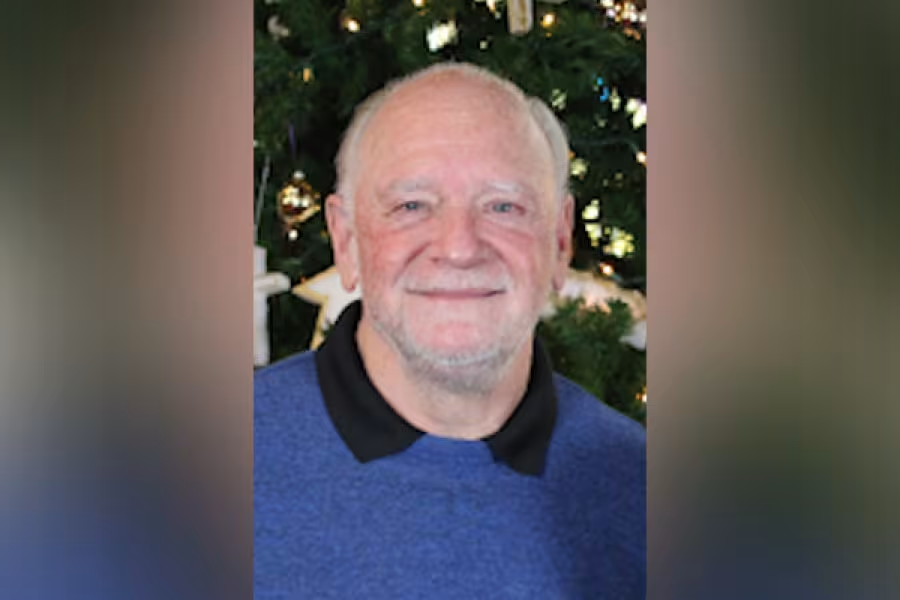
Interlochen Affiliation: IAC/NMC 70 | IAA 70-74 | IAC St 74-75
Interview Date: October 18, 2024
Jeff Paulson studied trombone at National Music Camp and went on to study trombone, choir, and jazz at Interlochen Arts Academy. He returned to campus after graduation to work on Camp staff.
This oral history is provided free by the Archives of the Interlochen Center for the Arts (ARTICA). It has been accepted for inclusion in Interlochen’s audio archive by an authorized administrator of Interlochen Center for the Arts. For more information, please contact archives@interlochen.org.
00:00:00 IAN JONES
So today is October 18, 2024 this is an oral history interview with Jeff Paulson. You prefer Jeff or Jeffrey, Jeff, Jeff Paulson, conducted by Ian Jones on the campus of Interlochen Center for the Arts. Thank you for sharing your story with us today, Jeff.
00:00:16 JEFF PAULSON
My pleasure. I was a camper first in 1970, the summer, I was in the intermediate camp, had a wonderful time. Then I came to Interlochen Arts Academy that immediate fall - started my wonderful, joyful time at Interlochen. Graduated in 74, worked as a CIT that summer at the Music Camp back those days called and then the following summer was a counselor, full time counselor, and I just had a great time. I mean, it's where it just started. Interlochen started for me with that summer camp experience in 70, but the truth is that it was hearing the music at the state park across the street when we were camping with my parents, and they loved music. My dad loved to play violin, and my mom was a singer, and they heard this music, and they were like, what is that? And of course, you're camping, so you explore. You come across the street. My parents fell in love with it. I was pretty young at the time. I was probably seven years old, maybe I hadn't started my music really yet, and my parents, a number of years later, said, Hey, remember that place we went camping, and they had all that music and, you know, we could hear them playing "Reveille" in the morning, you know, I'm not sure if they still do that at the camp. They do, ah, this is great. You know how would you like to go there? And I said, why, it's a camp, and it's music and okay. So I came to Camp. My parents came up every weekend. They drove about two and a half hours from Saginaw, Michigan, and in one of their trips, they had a opportunity to hear about the Interlochen Arts Academy, this new thing that had been going for a few years. And they said to me at the end of the summer, "Would you like to go back there to school?" Now, like anybody going into ninth grade, the way they sold me on it initially, the truth is, they said, you know, it's a boarding school, and there are girls there and guys there, and, you know, you get to live there. I said, Okay, so what's the best part? Well, classes don't start till mid September, so you get a couple extra weeks off. And I was like, hot dog! I'm all in for it. I was all in and I was ready to be in the marching band back in Saginaw and all that type of stuff, because I love music, and I played, not great, but I play very well. So I sent in an audition tape. Next thing you know, got a letter and a call said, "We'd like you to come to Interlochen." That started the journey. You know, that's kind of the forerunning seeds. I have to admit, you know, really it was at two weeks extra time, or three weeks of not having to go to classes. But it was cool, very cool.
00:02:47 IAN JONES
So the music literally drew you here from across the street.
00:03:15 JEFF PAULSON
It did. It did. It was, you know, pulling us in to this really cool place, and just loved it. It was it was fun. I didn't have any problem being away from home or anything with the summer camp ,and so it was the perfect fit. It just was the perfect just, just drawing in. You can't be anything better.
00:03:38 IAN JONES
What do you remember about coming to campus for that first time in what the summer of 70, right, for camp, you had been to campus previously because you'd come across the street. Okay, now you're showing up as a student and you're intermediate. You're saying goodbye to your family. What sticks with you from that time?
00:03:55 JEFF PAULSON
You know, it probably was, "Well, folks, you can leave now. I want to have fun." I mean, it was, you know, we had, I don't know, maybe 15 guys in our cabin, cabin three, I can still remember, and the party was on. I mean, in a party, in a sense, was like, you know, again, play music, gonna go out and be able to be swimming and canoeing and sailing and going on hikes and going to the nature center for a science program. I was ready. I was ready to go in and have fun. There wasn't any homesickness or anything. There was something special about Interlochen and being here in the midst of this, this wonderful music, I never thought, and I wasn't a great player at the time, but it's where I really started to grow as an artist, as a person.
00:04:54 IAN JONES
How do you think that has stuck with you? So those kind of first lessons, I mean, that was first summer. You, obviously you had some level of interest. Your parents apparently had a lot of interest in the academy, because they talked to you about it initially. But what was that transition like coming from camp? I did a summer at camp. Now I'm here year round. I got those extra couple of weeks of summer. But what's that like when you arrive on campus and now you're here with this group of well, how many students were roughly? Do you think were here?
00:05:24 JEFF PAULSON
Oh, attendance was light, lighter than is today. We we probably had 350, 400 students. Maybe it was, it was interesting times for Interlochen. It was time to grow. The world was different out there, but it felt like I was at home. The transition from camp to the academy was like, yeah, man, I'm here this, this is a lot of fun. The transition was, in those days classes were Tuesday, Wednesday and then Friday, Saturday. Thursday was lab and your performance days and your arts. Monday was performance, Sunday was off in concerts. So it was different, kind of figuring that schedule out. But I really liked it. That was that was really cool. You know, I just blended right in. You know, the counseling staff, the Dave Sporny, the director lower brass at that time, was, he was pretty tough on me. And, you know, ahhh okay, I was horrible student for studying, you know, my music. I really, I could have practiced a whole lot more, but I was playing a lot. I was playing a lot. So, you know, he just kind of rolled right into it. And then the academics were really pretty outstanding. I would have never gotten that back home. I just would not. The caliber of the professors here. And I say professors, not teachers, because the standards that Interlochen set were so much higher. Jack Hood, there's a name from the past. Dick Parks I had, I had lunch with Dick Parks today. What a cool gentleman. And remembered this is, this is 50 plus years ago, and Dick and I as we talked about lunch, or talked at lunch about what it meant to be here at Interlochen, because it's such a special place. We grew. And as a professor, one of the neat things that he did was it didn't stop when the school year ended. It continued on because he, like many of the other folks up here, would invite us to go on trips and that type of stuff. So we did canoe camping up in in Canada, at the Quetico Provincial Park. You know, there are all kinds of things that we did beyond, I mean, the professors at Interlochen made this be home. And back in the days, I'm not sure if we still do it at Interlochen today, but each each student was assigned one of the professors, and they became like your adopted family away from home. You know, you were treated as family. So Interlochen grows you, makes you think outside the box in ways that you never would think of, you know, back in the local schools, and that's not to to beat on the local schools, but it's what separates and elevates Interlochen into this new plane of education and experience.
00:08:31 IAN JONES
How did you first connect with Dick Parks when you got here?
00:08:35 JEFF PAULSON
Dick Parks was my biology instructor. Yes, he made me cut open the fetal pig, you know, which we all just really love doing. But he got, he engaged me to go out camping with other students. One of the things that they would do would have us go out, and if you want to go camping, you know, and they take us out into this beautiful area that we have, and we'd have these overnighters, aka, my name rocky comes from being assigned to choose where we're going to camp. One of the first times out, and I went, Oh, I think this is a great area. And it was the worst area that you could ever imagine, because it was filled with aka rocks. But there was some special knack that they had and they went, well, we like you. We like what you're doing. And so I got drafted, and they would offer me to go out and be kind of the senior camping guide or something like that. But we had, you know, we just did that a lot. Special time, special time.
00:09:40 IAN JONES
You mentioned that Interlochen grows you, so as a student here, how did, how did Interlochen grow you, and what did it grow you into? What did it grow you for? What came next? What I give some ask. What was that impact? How did that manifest itself in your life after Interlochen?
00:09:57 JEFF PAULSON
Interlochen painted a picture of how one should live, and by that, I mean there was a moral, ethical code about your art. It wasn't about performing for yourself. It was about putting on the best performance you could for the audience, for the people out there, from from the music side. But it also made me be the person about doing that same type of thing for the rest of my life, about being the best for those I was working with, those I was dealing life with, my family, my wife, my children, with other people, into my very nature of what my business and what I did over the years. I pushed hard to be the best for other people, and I got that here at Interlochen. That was the underlying theme, you know, be the best. Be the best. When I left Interlochen, I was a good bass trombone player. I wasn't a great bass trombone player, but what happened was the seats that I had here pushed me into college at, I went to Michigan Tech. And there I played in the pep band, in the jazz band, in the Keweenaw symphony, in the trombone choir, you know, I played all this other music and the wind ensemble, And I started to grow even deeper, just because of the love. I didn't realize the love I had of music until I left Interlochen. Interlochen lit the fire, ignited the flame, if you want, and just pushed me into things I didn't realize I was capable of doing. I told my wife today as we were coming in, I said, if I had not gone to Interlochen, I would have never had the opportunity to meet some of the greatest jazz players this world has ever seen, Maynard Ferguson, Stan Kenton, Woody Herman, Thad Jones, Mel Lewis, you know, just to name a few. And those are big guys. In 1977 our jazz band at Michigan Tech was playing and doing a clinic, and the Woody Herman band was coming in their players, and they we would play, and then they would critique in front of all these kids from the Upper Peninsula, Michigan. And after the we were done, they, Ben Manger, and the lead at the trombone section came up said, "Hey, we're gonna go out after the gig. You got some place we can go?" Yeah, so I took him to the local establishment. Yes, I was of drinking age, okay, let's make that clear. The ambassador bar is where it was. We're sitting there, and they said, you know, we hired a bass trombone player, but you blew us away today. We want to hire you. And I was like, Oh, my and, and immediately I thought about Interlochen, and I would have never had this opportunity. I mean, I It's the analogy today would be a sports player wanting to play professionally. And how many kids are that want to play football or or baseball or basketball, hockey, but you it's less than you know, point zero, 1% I got to be that point zero, 1% in music. Now your question is going to be, so did you say yes? And the answer is, for a week, I mulled it, and I I really wanted to go, I wanted to say yes, but I turned him down. It's the hardest thing in my life to ever do, and I'm kicking myself, you know, because I would have liked to have done it. They wanted me bad. They said that "You call us anytime, you call us anytime." I did play with them, we crossed paths. Our band has been with them, and so I sat in. It was tough. Truth of that story is I thought for sure my father would have killed me if I'd left school to go play in a band. The end of that story, though, is three weeks before my father died, he said to me, "Jeff, how come you never went and played with Woody Herman?" Well, Dad, I thought you would have killed me, you know, if I'd left school, he said, "You could have gone back to school at any time." And I was like, Oh, yeah. Well, so much for that. Okay, Dad, thanks. Really appreciate it. Yeah, so, you know, I would not have had that opportunity, the experience, that's what Interlochen, that's just a piece of what Interlochen made, you know, for me in my life. That's why I'm sitting here today. You know. If I could say one thing to future students and current students, is that Interlochen is the start of your life, and don't look back. Take the opportunity that you have, this gift, and know that you're going to be able to grow from it. You may not have accomplished everything that you wanted right now, and think you're maybe not good enough, but I'll tell you what, from the kid at the National Music Camp, back in those days, who sat, I dunno, near the bottom of the section lower half, maybe in the middle, I dunno, but to be able to be then offered a job to play professionally. This is the gateway, right here. Take it, grow it, use it, and know that the world's unlimited. You know, as an alumni of Interlochen, it's so cool to look back and to to see what my colleagues and the students that have graduated and with, and the current students, what they're doing now. It's, it's, it's amazing. I mean, it really is amazing, the opportunities, the things that they're doing. Wow.
00:10:07 IAN JONES
You were talking just about kind of how Interlochen gave you that opportunity. And music has been a big part of your life from early on, from what drew you across the road, to what kind of kept you here, to you found a community, you found an opportunity to perform, and in college and in the community - it's a it's a lot of focus on art. Why? Why do you think that art matters in the world today? Why do we think we need it? Why do you think it's important? What do you think it does for us?
00:16:52 JEFF PAULSON
It's been a while since I've been on campus. Shame on me. Boy. That's another thing for the for the youngsters, fellow students, come back often, come back often. I think it's in Kresge. Art is the universal language.
00:17:12 IAN JONES
It's, what I don't know why I can't come up with it a second. I'm embarrassed.
00:17:18 JEFF PAULSON
No.
00:17:19 IAN JONES
Dedicated to the promotion of world friendship through the universal language of the arts.
00:17:24 JEFF PAULSON
There it is. There it is. Why's art, you know, why is art important? There it is. That's the statement. The people I've gotten to know meet all through my life, the common thing that we can talk about is art, and it takes all the politics out of it. It takes out nationalism, patriotism. It breaks all the barriers down. You know, if, if we could get modern politicians today talk about art, you know, we this place would be, the world would be a better place, you know, to have the opportunity to step, step foot in Interlochen, or you can, you could just change your life. For, so, for me, Liang-Ping was my roommate my sophomore year. He's from Taiwan. I got a call before the school started and the semester, and they said, "Would you mind if you had a student from another country?" And I was like, well that's the coolest thing in the world? You know, Holy shmoly. And they said, "Well, now you have to understand, Jeff that he doesn't speak English." I said, "Well, I don't speak Taiwanese or Chinese. Is that going to be a problem for him?" And they said, "No, we don't think so." You know, it was, it was the greatest thing in the world. We were able to grow and exist together. And art, arts was the language that we spoke together. It was so inspiring to have somebody that had a different culture and experience in life, and to be able to share in basic, simple ways. And fortunately, he learned English, because I never got the Taiwanese or the Mandarin Chinese the dialect, but it didn't matter. We communicate, we we live life together. If we could do that, you know, it's two high school kids, the world can do this through, through the media of the arts. And with how the arts is growing at Interlochen, just, you know, from my days back in the 70s, you know, it was kind of the basic music, you know, drama, dance, a little creative arts there. But to what's happening now here at Interlochen with all of the forms of media going on, it's, it's amazing. Interesting to see and to read about what our students are doing. It's, it's, I'm, it's, it's, it's changed. It's, it's life changing, world changing.
00:17:41 IAN JONES
It makes me think of, you know Interlochen is we're doing this as a part of the celebration of Interlochen centennial. What do you hope for for Interlochen in the next 100 years? Where do you hope it goes? What do you hope it does? What would you like to see?
00:20:24 JEFF PAULSON
It's not about legacy. It's not about buildings. In 100 years, in the next 100 years, when Joseph Maddy first came out here and had a vision, and none of us probably really know what he did, but I can imagine that he he probably whistled a tune of something to hear what it sounded like in this. In 100 years, that whistling of a tune will be so different we can't even imagine it, but I hope that we keep bringing people back home to Interlochen that will keep dreaming of that of that vision of what's that next tune going to be, the sound, the call that we use, what is that going to be? Is it going to be in the next version of AI? Is it going to be a simple person just sitting here on a park bench using a tablet or something, or maybe, you know, some AI mechanism, but writing the next composition of music or a play, or envisioning a ceramic art. You know, they're going to see what is, you know, that that form and change, but that Interlochen has got to be here. It's, it's the place. You know, sometimes talk about living in a bubble, and people always make that as a bad thing. They go, you know, while you live in a bubble. And that applies to any places of education, learning, I think it's a good thing. It's a place where the mind grows exponentially, and I just hope it continues to grow. It just doesn't stop. You know, somebody, hopefully 100 years from now, will listen to this recording, and all the others said that, that, that we're making, we're doing what they want. They've got the vision. Still it hasn't stopped. It just, it just continues to grow. And they should ask themselves, how about the next 100 years? And it doesn't stop. And, you know, it's I never dreamed of sitting here 50 years from when I graduated with somebody asking me a question like that about the future, but, but I care - every time I drive down I-75 I scan the radio in, trying to catch, you know, the Interlochen station. What are they playing? My question is, would be to the trustees, what are they doing to ask that same question about what they are planning, what their vision is to be able to ensure that students have that opportunity 100 years from now to be doing this. You know, that's a forward thinking.
00:23:40 IAN JONES
To think about like, what visions are we going to have, what holes are we going to dig, what new things are we going to bring forth for students? And what do we want them to do with those things in the world to make it a better place?
00:23:52 JEFF PAULSON
Oh, yeah, if I go back to my time as a teenager, the whole science department at Interlochen made the big difference for me, you know, they opened my eyes. Byron Hanson. I can remember a winter night that he was out outside of our dorm chopping ice, so then in the morning, we would have a way clear to go. You know, here, here's a guy who's amazing, you know, doing his conducting in leadership for us, in the band and in the orchestra, and he's out there at nine o'clock at night, chopping ice. You know, how many people know that that man gave like that? Nobody. Nobody knows that, till now. You know, that's what he did. My my buddy Loren Kayfetz, he and I graduated together. When he came to Interlochen, Jack Hood pulled me in and said, I need you to take this guy under your wing, because he's coming in the middle of the year. And Lauren and I, we always kid about that, because he said, "Oh, man, you've always had to watch over me." Wow. 50 years later, you know, we've done vacations together, you know we're going to stay together at the reunion here, we've kept in contact. I mean, you know, lifelong friends were their times thart we lose contact with each other, sure, because life is busy. You know, stuff goes on. This is the toughest question about you know, who really impacted you more than anybody else? The list is long. It's it. It's not just one person. I think that's what makes Interlochen so special. There's not just one person that impacts you. It's it's the whole community. It's the campus. You don't like, you may not like a particular instructor on given day, but that instructor the next day is got your back and doesn't treat you because you, you know you wrote a bad essay or something like that. They care. They really make a big difference. It's the whole community. The days President Jacobi, he and his wife, special people on this campus, because they're in my day, what they what they did and cared, and just being out and greeting people. When they retired, I don't know if they were living permanently in Florida, but my, my parents ran into him, and they remembered him, really, yeah, how does that? How does that happen? I mean, you know, there wasn't a big sign said, you know, we're JEFF PAULSON's parents, you know. No, they just knew. So I could, you know, I could say, you know, the Jacobi's, but over the years, I mean, just so many people. When we drove in, when my wife and I drove in person, who's, you know, obviously, one of the professors waved to us, smiled. I was like, wow, this is, all they know is it's alumni weekend, but really it's the first day. It's early on, even, even even the security people were so welcoming.
00:26:06 IAN JONES
I will ask you, if you have a favorite spot on campus, and what is it, and why?
00:27:10 JEFF PAULSON
Oh, my favorite place on campus is over across the way in the pines, over by way, past the junior boys camp in the woods. And I probably can't describe it visually to you, other than it's by the lake, full of trees, where we used to camp a lot, near the river and up at the lake. You know, we camp there a lot with other students. Take them out, introduce them to camping, 101, but I could walk out there, you know, on a Sunday afternoon, and it didn't matter what the weather was, and just the peace was amazing. The solitude and the glory of nature. Awesome. That's the place. I said to the security guard, I said, you know, "Can we go any place? Can we," "Absolutely the place is yours. Just wear your tag." I said, "Do I have to wear my blue corduroys too?" And no, no, no, no. He says he says you probably won't fit him anymore, and but you know, going out to that place is where it's where I want to take my wife, she's never experienced that. She heard the music this past summer when we were camping across the street, you know, I said, that's what we hear and watching the campers, you know, crossing the street. It's, it's just an experience. We didn't have crossing guards in our day, by the way. We just ran for our dear life. No cars were hurt in this episode. But that was, there's one other place that's off campus, that's in we used to call it the high meadows, and there's homes that are are built up there now, Ian, if you go down to it's Karlin Inn it's on the left hand side and up, I, been too long, but you could go up there and the view going and looking out to the West, you know, it's like you could almost, I, I know you couldn't, but it was like looking to Lake Michigan, but the clarity of the stars and the beauty, oh my gosh, just, I think there are homes that they've built up there now, but that'd be a place that we would take people some, sometimes to camp. God, that's, those are,those are good memories.
00:29:38 IAN JONES
One of the things I do want to go back and and ask you about is, how in beyond music, how did, how do you think Interlochen influenced your personal your professional life after Interlochen? How did it set you up for where you went? How did it give you a perspective on what you would do in your life?
00:29:59 JEFF PAULSON
A few years ago, I had the opportunity to talk with Dick Parks and Carl Scheffler, both professors I had here. And it was funny, because Carl Scheffler said to me, says, "Well, Jeff, we knew that when you grew up, you're going to be a pastor." And I looked at him, I said, "Now Carl, yes, I'm a pastor. I told you, I'm a pastor. That's that's just an easy one." He said, "No, really, we knew. We just saw that in you." And I was like, really? I had breakfast the next morning with Dick Parks. And I said, "So what do you think I was going to be?" He said, "Oh, we all knew you're going to be a pastor." I was like, doggone it. What Interlochen did to set me up. It allowed me to take the experiences I had here, a kid away from home, and learn to be self sufficient and respect and honor other people, no matter who or where they were, where they came from, what their lifestyles were, and it made me respect people, honor people for who they are. And everything I've done in my life has been about respecting others and the arts. I didn't realize this until I was in seminary, and an Arts professor asked all of us to draw a circle, and there were probably 20 of us in the class. And so she had a plethora of items out on the desk. And so there were people that got protractors out, you know, and others trying to draw a circle and make it perfect and everything. And then she had to show them, and she said, so here's the problem. What you all tried to do is make what somebody else think is the perfect circle. I asked you to draw a circle in your own vision, and when I drew my circle, you know, I did freehand. It's pretty awful, but she honored it, because it was what came out of my vision, without it having to be somebody else's vision. She honored it. And so I reflected back to Interlochen because of this creative connection and I went, nobody told me what to think or how to to do something. They gave me guidance. They gave me some parameters, wide parameters of learning. You know, this is way to interpret music or what's on the score, but what you put into it is your own thing. And Dr. Kopikian, that's the professor seminary, that's what she was telling us. That you take your own creativity and make that in your life. And so I took that creativity. I took respecting other people, meeting them where they were and where they are. And to this day, I do that. I don't judge people. I accept them, and that that came from Interlochen. If I'd been back in in Saginaw, you know, good school system, back in those days, proabaly still is, but Interlochen gave me the opportunity to respect everybody and their work in them as a person, and I've never stopped doing that. It doesn't matter, yeah, in today's world, we get so caught up in lots of different things, I don't care for person who they are. They are a gift by the Creator, and I respect them. If I can respect them, then life is good. It just doesn't matter. I'm gonna respect who a person is, what they do, what they bring to the table, whether life is all about I don't care if they're they're straight or gay. I don't care if they're, you know, trans, white, Black, it doesn't matter. I respect who they are, because that's what Interlochen taught me, to respect people, respect what they bring to the table. My parents were great and inclusive people, but they were still molded by their past, past life experiences. Interlochen broke that mold and gave me this freedom to be who I am. So it changed. It changed, changed who I was, you know. I can't imagine, what I'd be like if I hadn't come to Interlochen. I just, I just can't imagine. I think I would have been somebody in an old shoe, you know, just there doing the same thing day after day. Lack of creativity, lack of compassion, yeah, it's just, that's what Interlochen did. It grew me. It grew me.
00:35:20 IAN JONES
I think that's great.
00:35:22 JEFF PAULSON
I wish I could synthesize that down.
00:35:25 IAN JONES
No, I thought you just did a beautiful job of that. You did a beautiful job of that.
00:35:31 JEFF PAULSON
You know, it's, you know, we sometimes get caught up in the politics of everyday life. And, you know, as I've watched Interlochen grow, it's had its bumps, you know, like everything else, but where it is now, you know, I being a little casual here, but I've never met Trey, you know, but, but I think what he's doing is leadership is really incredible, because things are are happening.
00:36:04 IAN JONES
Is there anything else you want to share? Anything you feel like, Oh, I really wanted to talk about this, and we didn't.
00:36:10 JEFF PAULSON
I just love Interlochen. It was so important at that, that key time in my life, and it's never stopped being important. I've wanted to come back frequently, but life gets in the way. It's sad. Boy, for our students today, I just, I guess I couldn't impress anymore that, come back. Don't be afraid. Yeah, it changes. Yeah. You had a bad experience where two times, you know, guess what? That's life. It happens. But don't let that color you in your life. And what you do, you know, give back. Giving back is probably the most important thing. You know, when I graduated from the Arts Academy and I spent two summers here, it was about giving back. And that's what we have to do. We have to give back. Because one of the things that would entice us to come back is to give back and to be able to, you know - when you have a bad day, who can you go to? And ultimately, I'd love to be one of those people that you know, a student, a professor, one of the staff people, can know I'm gonna go talk to Jeff. He experienced it, he gets it, and he's here, and he's gonna listen without judgment. You know, I hope that happens. I really, I really do hope they can figure that out, because that's, that's the next part of the that 100 year plan is to make that work so we can give back in real time with face to face stuff. It's like,
00:38:10 IAN JONES
It's about being an active member of that community.
00:38:13 JEFF PAULSON
It is,
00:38:13 IAN JONES
Yeah,
00:38:14 JEFF PAULSON
It is. One last piece,
00:38:16 IAN JONES
Sure.
00:38:18 JEFF PAULSON
And this, I think, is probably the most important thing of all, and this is for the students. You are the recruiters for the future of arts, of all the disciplines, the sciences, the academics. You're going to be out in the world, and you're going to see people in various stages of their life, seek those out who you think would benefit from Interlochen. Find those rough stones that can become the gems of this world. Connect them to Interlochen. That's the greatest gift you could give to this wonderful place, to find the next the next student, the next professor. Go out into the world with your eyes wide open. That's gonna make the world change.
Copyright
Copyright to the audio resource and its transcript is held by the Archives of Interlochen Center for the Arts (ARTICA) and is provided here for educational purposes only. It may not be reproduced or distributed in any other format without written permission