
Oral History Interview with Gretchen Carr
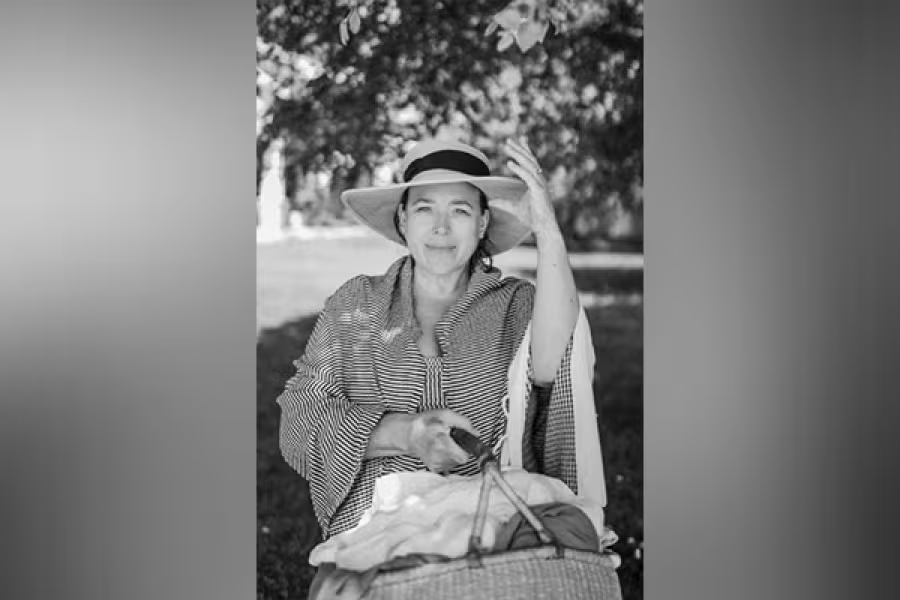
Interlochen Affiliation: AS 87 | ICA St 17-21
Interview Date: August 27, 2024
Gretchen Carr studied piano in the All-State program and National Music Camp and later returned to Interlochen as an employee.
This oral history is provided free by the Archives of the Interlochen Center for the Arts (ARTICA). It has been accepted for inclusion in Interlochen’s audio archive by an authorized administrator of Interlochen Center for the Arts. For more information, please contact archives@interlochen.org.
00:00:00 BRADFORD BAILEY
Today is August 27, 2024. This is an oral history interview with Gretchen Carr conducted by Brad Bailey on the campus of the Interlochen Center for the Arts. For disclosure, this interview is virtual. Miss Carr is on Zoom. So where are you based right now?
00:00:03 GRETCHEN CARR
I'm based in Traverse City.
00:00:19 BRADFORD BAILEY
We were going to have a discussion today about your experiences here at Interlochen, if you want to sort of give me a brief history of your personal history here, and then then you can just sort of go into general discussion of what you would want to discuss today.
00:00:35 GRETCHEN CARR
So I was a camper at the All-State program in I believe, was 1986, it could have been 87. Interlochen would have to review their records. I'm pretty sure it was 86. I was an All-State camper in the Intermediate, advanced piano section. It was an incredible, very short two-week experience. And it really did change my life. My daughter was a camper there from 2015 to 2019. I was also an employee at Interlochen from 2017 to 2021. What I really wanted to share was that growing up here in the Grand Traverse region, I had friends whose parents were on the faculty at Interlochen, and they, there was this very eclectic, fabulous, artistic group of friends that I had the privilege of watch and observe when I was at a very impressionable age, as early, as young as nine years old, until my early adult years. All of these people are gone now. One included John Church, who was instructor of metals, I believe his son is on the faculty at Interlochen right now in the theater department, Bill Church. But John Church was really, really close friends with Al and Susie Vigland, who were very influential artists in northern Michigan, and they are no longer living, but they would have these incredible dinner parties and gatherings and everything. For example, there was one, one dining room where we had a beautiful summer dinner, and the plates were by Al Vigland, and there were these metal candlestick holders by John Church and paintings by Susie Vigland and Larry Lean, who I believe was also on the faculty at Interlochen. There was work there also by Jean Noble Parsons. So we were in this dining room surrounded by work created by local artists and artists that were affiliated with Interlochen, and it was an incredible time, and I'm really glad that that was part of my childhood and part of my upbringing. The influence that Interlochen had on the regional culture here was very significant.
00:02:52 BRADFORD BAILEY
Well, talk to me about that. You said that the the culture outside of Interlochen, because, you know, that is a conversation that we haven't really had a lot this summer- about people who, you know, the impact of Interlochen in the city,
00:03:06 GRETCHEN CARR
Or in the region as a whole.
00:03:07 BRADFORD BAILEY
Yeah, in the region. And so what do you think the relationship is currently like?
00:03:14 GRETCHEN CARR
I think Interlochen still influences our regional culture, very much. We have the Traverse City Symphony Orchestra seems to have reached a different a
new level with their new facility in the former Cherry Land Mall. I know that an Interlochen faculty member, I think it's Riccobono, conducts the small Benzie Symphony. I mean, to have a symphony in rural county like Benzie County, I think is it says a lot. So there's two examples right right there, the Traverse City Symphony Orchestra. Now it's called the Traverse Philharmonic. And then this Benzie Symphony, which is a civic orchestra, and I know that a lot of current faculty do interact with several community organizations, fine arts and musical theater organizations outside of the – so I think it's still very, very strong. And I think it's, it's great.
00:04:10 BRADFORD BAILEY
So um, what do you think the future of it will be? What do you, how do you see the future of that relationship developing?
00:04:20 GRETCHEN CARR
I hope Interlochen Center for the Arts can give their faculty room to breathe and grow outside of the organization. I think that's very important. Because the faculty as individual, each one of the faculty members as independent art artists, I think that they're huge assets to our community, and they should be, they should be celebrated and respected and compensated well.
00:04:48 BRADFORD BAILEY
Okay, understood, understood, and do you think that's happening?
00:04:51 GRETCHEN CARR
I don't know. I think it's important. I think it's important for everyone to know that the in the Interlochen faculty members as individuals, are very important members of the community at large.
00:05:05 BRADFORD BAILEY
What does Interlochen mean to you, personally and professionally?
00:05:09 GRETCHEN CARR
Personally, it's an incredible place, its, to just grow and to observe and to learn. And then professionally, the work ethic that I was exposed to as a, as a young piano student, the desire to want to, you know, everything that you put out it, it's it should be as great as it possibly can be. I think those are the two things that I have, I have taken from that environment.
00:05:42 BRADFORD BAILEY
And how would you describe Interlochen to someone who hasn't experienced it?
00:05:50 GRETCHEN CARR
Today in its present form?
00:05:52 BRADFORD BAILEY
Yes or in the past, but today in its present -both, both actually, it's up to you.
00:05:58 GRETCHEN CARR
Today in its present it is an incredible example of what is, you know, what is possible when the original intention of Joseph Maddy was to create this place where young musicians could come and grow and accelerate together. And I think that spirit is definitely still there. Obviously it has expanded into all art forms, which is great.
00:06:27 BRADFORD BAILEY
What is your hope for Interlochen’s future?
00:06:31 GRETCHEN CARR
Oh, I have confidence that it will continue and continue to- the thing about Interlochen, compared to all other types of arts opportunities for young artists, is that it has this history, and I think that Interlochen should really, really should use that to its fullest advantage, the history and tradition.
00:06:54 BRADFORD BAILEY
And so why does art matter in our world today?
00:06:59 GRETCHEN CARR
Well, art represents original thinking. It represents creativity, and we need that all the time, every day, constantly. Original thinking and creativity.
00:07:17 BRADFORD BAILEY
All right, great.
00:07:18 GRETCHEN CARR
And passion.
00:07:21 BRADFORD BAILEY
Passion, absolutely, absolutely. Do you have any takeaways from your time here that stand out? Any other moments you'd like to share?
00:07:32 GRETCHEN CARR
Again, I think the history and tradition is so, is so, it's, it's what sets Interlochen apart. I grew up watching Ed Catton in my community, just as a community member, and he was the original voice of Interlochen Public Radio. And I grew up watching Gwen Frostic interact with her work in her office, and I know that she had- there was a period of time where her illustrations were on Interlochen programs. I'm sure you can access Gwen Frostic and Edward Catton in your Interlochen archives. They both resided in Benzie County, and Ed Catton was the descendant of Bruce Catton, who was a civil war novelist, a Pulitzer Prize winning Civil War novelist, author. And then Gwen Frostic was an illustrator and writer, and she had a studio in Benzonia that was world renowned. She was world renowned for her for her wood block prints, which depicted her observations in nature. And so both of those people I watched grow old, and I remembered when they passed away, and they were pillars in my community, but they were pillars in the Interlochen community as well. So I guess, I guess the biggest thing that stands out for me is that I, I grew up with living history all around me, and it really made an impact on what I do currently, I have a podcast called The Traversecityist, which is about the people that create the culture in and around Traverse City.
00:09:16 BRADFORD BAILEY
And so in sort of your discussions, how does the general community look at Interlochen?
00:09:27 GRETCHEN CARR
Well, I'm really glad that the people that have lived here most of their lives, they just see Interlochen as this, you know, great place to see, this beautiful place to see a concert in the summer. I think, I think for a lot of people, that's how they think of Interlochen right now. But I can't really speak, I can't speak for the whole community. I know that people that have lived here all their lives see Interlochen as this, you know, world class institution in our backyard. That has been a common phrase that you hear.
00:10:00 BRADFORD BAILEY
Well, very well, any other potential, meaningful collaborations that you have potentially experienced over the over the years here that you would like to discuss before we sign off.
00:10:14 GRETCHEN CARR
Well, there have been collaborations with former Interlochen alumni, campers and Academy students that I've had throughout my life that have been particularly meaningful and part of my own personal artistic growth, and I feel fortunate that I feel like I can tap in if I if I ever want meaningful collaboration. There are so many amazing people that have been affected by the Interlochen, by Interlochen Camp or Academy that I can I can reach out to. So I feel lucky that I have such a network at my fingertips.
00:10:55 BRADFORD BAILEY
Great. Well. Thank you very much. Miss Carr, it was wonderful speaking with you, even for a short time, even for a short time.
00:11:04 GRETCHEN CARR
Brad, it was a pleasure to meet you. Good luck with this, with this endeavor that you started.
00:11:08 BRADFORD BAILEY
Well. Thank you very much. And have a wonderful day. Today is August 27, 2024, this concludes my interview with Gretchen Carr for the Interlochen oral history project here on the campus of the Interlochen Center for the Arts.
Copyright
Copyright to the audio resource and its transcript is held by the Archives of Interlochen Center for the Arts (ARTICA) and is provided here for educational purposes only. It may not be reproduced or distributed in any other format without written permission