
Oral History Interview with Elizabeth Paxson
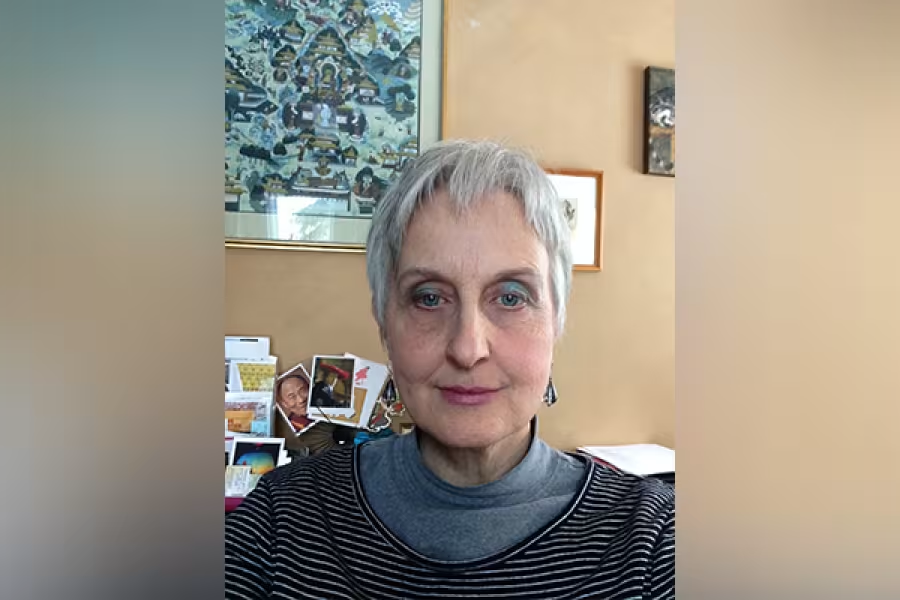
Interlochen Affiliation: IAA 66-69
Interview Date: July 16, 2025
Elizabeth Paxson studied Visual Arts at Interlochen Arts Academy.
This oral history is provided free by the Archives of the Interlochen Center for the Arts (ARTICA). It has been accepted for inclusion in Interlochen’s audio archive by an authorized administrator of Interlochen Center for the Arts. For more information, please contact archives@interlochen.org.
00:00:00 ELIZABETH FLOOD
Could I have a tour of your studio please?
00:00:01 BETSY PAXSON
Of course. Well, this is just the basement. Walk out basement. Have a beautiful woods behind me, but I have turned this into my workspace and sort of showroom for pottery, which is what my current focus is. And I have work in four different galleries around locally. Higher Art Gallery in town, and then Ruth Conklin in Glen Arbor, Oliver Art Center in Frankfurt, and Painted Bird in Sutton's Bay. And then I usually do the Dennos markets if I can, if I get in. I don't do outdoor art shows because I'm not hauling tables and tents around and then having a big rain storm. [laughs] I'm too old, and you know it's too much work, so. You know, I'm realizing the limitations now of being older, and so I'm not doing large work now because it's just too hard. So I'm just doing what I love to do, and hopefully other people love it.
00:01:03 ELIZABETH FLOOD
Should we sit down now?
00:01:04 BETSY PAXSON
Yeah, we can sit down.
00:01:06 ELIZABETH FLOOD
So today is July 16, 2025, and this is an oral history interview with Elizabeth Paxson conducted by Elizabeth Flood in Elizabeth Paxson's home studio. Thank you so much for your time. Have you lived in the area since going to school at Interlochen?
00:01:30 BETSY PAXSON
I bounced all over the country for a while after Interlochen. I came back to Michigan in 1982, and then I moved to Chicago in 1985 and was there for about five years, and I came back to Michigan. And I've lived here pretty much since that but not up here. My husband and I had a business in Saugatuck for about twenty-two years. I was with him from 1994 until we moved up here in 2014, so we were in that area till about 2014. It was a music and book store that I helped him run. CD's, and so lots of music, books. We had jewelry, we had all kinds of stuff. But, you know, I had loads of different jobs in my life because a lot of times if you're an artist you got to do other stuff to make a living. I'm not really a big city person. I lived in Chicago for five years. That was enough. I also lived in Baltimore previously. I lived in rural Maine, but I have found being sort of a neurodiverse person, I have a lot of trouble with noise and things like that, and cities- If I had gone to New York or somewhere, maybe I would have made a mark, but I just didn't want to do it. I really felt like I couldn't live in the city, so. I'm a country girl, I guess. [laughs] And we moved up here, we were looking at different places to retire when we closed our business, and I'd always loved Interlochen, and I loved it up here. We would come up here for little getaways. So I, we just kind of went, huh? No brainer. Why don't we just move up to the Traverse City area. So we did!
00:03:29 ELIZABETH FLOOD
What are your Interlochen memories that come up throughout your life? Or if someone mentions Interlochen what do you think of?
00:03:35 BETSY PAXSON
Wow, that's a really hard one. There's so many memorable people and friends. It's odd. It's just things like different little events that would happen. It wasn't so much like the concerts or the big stuff. It would be things like walking in the woods with classmates goofing around. [laughs] Just sort of the camaraderie and that wonderful sense of this community that was so rare and really truly unusual. People when they're there, I don't think they understand how very special it is. Some may, but really when I left it felt like a heartbreak. And I didn't feel comfortable initially in college because I felt like I had this community, and then it was gone. I felt like I got such good training there. One teacher for four students, and you go to college- I went to a big university, and it was like two hundred people in a class, and I hated it. I just hated it. I probably should have chosen differently, but I didn't feel like I got good direction that way, so. That was something I felt like they could have done a little better was, you know, counseling for where you're going to go next because being an artist of any kind, it's not easy unless you're one of the top people. Unless you're a Peter Sparling, who is a dear friend, or so many of the other people, Chris Brubeck. Unless you're one of those people, you're not necessarily going to have an easy path doing your craft or your music or whatever. So yeah, it's important to try to figure out what it is that you want not just in terms of your training but your community. Because that was so much a huge part of what Interlochen was for me. It was that sense of community.
00:05:49 ELIZABETH FLOOD
Someone that I interviewed brought up Interlochen as like a place for young people to pupate like a chrysalis kind of, and I thought that was a beautiful way of holding what happens there. I think as an adult coming here and bearing witness, I understand the specialness of being like, wow, this doesn't exist lots of other places. So yeah, could you tell me a little bit more about what that was like to come to Interlochen, knowing, searching for that community, finding it and then having to re-emerge in the world?
00:06:24 BETSY PAXSON
Oh, it was kind of devastating. [laughs] I know it was that way for some other people. I don't know about everybody. I mean, I didn't stay in contact with very many people until I came back from my 25th reunion. So it was like a lot of years went by, and then all of a sudden, it was like these people, it's like you were never gone. It just felt like you were still all together. You still had that connection with people. So yeah, it was very difficult forging new friendships and mainly just the sense of being in a place that felt safe. For me that was the first place I ever lived that I felt really safe because I'd had a lot of trauma and things in my childhood, so Interlochen felt safe to me because I was surrounded by all these other people who are kind of like me and teachers who understood that you're different and they're not judging you or just being critical. They see that your brain works differently, that you have these gifts that you need help figuring out how to use. So yeah, it was very difficult making that transition. It's really like a breakup. It's like breaking up -well, literally too. A lot of people were breaking up with their boyfriend. I mean, we made these intense relationships there, and then all of a sudden you're all going off, and some of those people stayed together, some didn't. But you know, really, you are breaking up in a lot of ways, and you're losing these intense relationships that you had with the teachers too, just great teachers. Special.
00:08:16 ELIZABETH FLOOD
Could you tell me about some of these memorable people that you met along your Interlochen journey?
00:08:22 BETSY PAXSON
Well, there were so many. I mean, I had a lot of dear friends in both in dance and art. And Peter was one, Chris Brubeck and Peter and I were in English class together. Howard Hintz's is class. We loved him, but we teased him. [laughs] And yeah, we were kind of cut-ups a little bit. You know good students, but we had fun in that class. The painting teachers I had were great. Peter Ramsey, he was my first painting teacher, and I don't know he just, he really sort of opened things up for me because I came from a family of artists, and so he helped me sort of get a different perspective than what I necessarily had had. Jim Alley was another painting teacher. I really enjoyed his class. Jean Parsons was my pottery teacher, and she was head of the department, the Ceramics department, or head of the Art department, I guess then. She was not an easy teacher. Kids would leave her class in tears sometimes because she was really very- How can I say it? Direct and [laughs] very blunt about how you were doing, but because I came from a family of artists and was used to being criticized, I didn't care. I thought, I'm here to learn. You know, she can say whatever, and I'm just going to take it in and try to use it to my best ability. So, yeah, that was an important class. And just the great camaraderie; I remember being in that class with Kurt Weiser, who is in California, who became a great potter. I mean, he's just an amazing artist, and he was quite a character, and there were just so many people in the class. The jokes, the kind of as you're sitting there working you know you're having this wonderful back and forth. There are people I'm still friends with who live all over the country, and I keep in touch with them.
00:10:31 ELIZABETH FLOOD
Could you tell me a little bit about your interest in ecology, like you were talking about the birds and things. And I'm wondering- sorry this is a leading question- is that from time at Interlochen, or how is that carried with you throughout life?
00:10:48 BETSY PAXSON
Well, some of it did, but I've always been very attuned to nature. My mother was really- She loved botany. She studied botany. She had to go back to school to get a teaching degree when my dad died, and she loved botany, so she was always taking us for walks in the woods and teaching us to identify flowers and trees, and she made a book with all these specimens, and I used to love to look at that. And she was a total bird lover. I was always attuned that way anyway. And my dad, I think, had loved the lake and nature. And boy, this lake. It really gets into you if you grow up, you know, we used to spend a lot of time on the beach when I was a kid, and it just gets into you, it's hard to leave it, and being here, it's kind of still there. I could never live somewhere where there wasn't significant water. So I have a cousin in Santa Fe, and she's like, "Oh, you should move to Santa Fe." And I'm like, nope, sorry, there's no water. Not like this. You know just going to the beach and being able to listen to the waves and look at the water, it's so healing. And so I've always been interested and just done studies on my own on different things, you know, insects and trees and birds, and I love nature, and that's always sort of informed my work in different ways.
00:12:26 ELIZABETH FLOOD
Did you have any favorite places around Interlochen's campus that you enjoyed hiding at or-
00:12:36 BETSY PAXSON
[Laughs] Hiding at. It was different. We had girls side and boys side, and there was a spot by the lake, and there was this little sort of balcony thing, and we'd go topless sunbathe by the lake, and then the boys would paddle by in the canoes, [laughs] and try to look, and we'd wave, "Hi." There were fun places, but just you know walking around in the woods. But we didn't have the kind of leeway they have now. We had, we called them S Men, security men, and at night, they would be touring around with their flashlights shaking the bushes for kids. And you know if you got caught, you could get kicked out pretty easily, but kids would get kicked out for smoking. I'm sure that's probably not true anymore, but it was very strict, and a lot of kids really didn't like that, but I figured you know yeah it's strict. I didn't exactly like it, but I felt safe in the sense of feeling like they were paying attention to what was going on. Maybe they weren't, I don't know. I mean, it's a beautiful place. There's lots of lovely spots that I remember. I used to climb this really tall pine tree in front of the art building. I would get up about twenty, thirty feet and just hang out up there and listen to people's conversations when they were walking by. That was when I was dancing, so. I don't think I could climb even ten feet now, but that was fun.
00:14:29 ELIZABETH FLOOD
What was the academy curriculum like? Were you picking?
00:14:33 BETSY PAXSON
Yeah, you chose your major and a minor usually, or somebody chose for you, like if you're the child of some famous musicians and you're already playing an instrument then that's what you're going to do because they're not going to give you a choice, probably. But there were people like Peter, he was a violinist, and then all of a sudden, I think he saw some dance performance or something, and he just went, "That's what I want to do!" So yeah, sometimes you get inspired. For me, I've always been a crazy person who does everything. I've been a singer, I've been a- folk music mostly. I've been a concert producer. I've worked for nonprofits. I've done so many different jobs. I'm a writer. I've had things published, but I've always done all those things. I've always done them, and it just felt totally natural, and the hardest thing was trying to stay focused on one thing long enough to feel like I was approaching some kind of mastery over it. So I always say I'm a jack of all trades and a master of none. [laughs] It's really the journey. It's about the journey. And I think I'm probably ADD or something because I bounce from one thing to another. It's like I just, I start getting bored with something, and then I have to do something else. So I don't know, it's just part of who I am. I enjoy the sort of novelty or the difference of doing something, but they're all interrelated really. My poetry is very visual, so it kind of ties in with my visual art. Some people may find it difficult to do that, to go back and forth, but for me it's like I have to do it.
00:16:40 ELIZABETH FLOOD
Do you have any advice for current or future students? It's exciting to have this conversation with you in your studio, to hear about the many lives you've lived.
00:16:52 BETSY PAXSON
Yeah, it kind of feels like about a thousand years. I feel like I'm a thousand years old. [laughs] Especially after going to our 50th reunion, it was kind of eye opening.
00:17:04 ELIZABETH FLOOD
What was that like?
00:17:06 BETSY PAXSON
Oh I mean, it was amazing because there were people that I didn't even know very well then that I sat down and had great talks with, but it still felt like I knew them even though we weren't close when I was there. It's just like, when you're part of that, it's like you're symbiotically somehow all connected even if you didn't know each other that well. I don't know how to describe it. And there's just this deep love for the experience, and you know feeling like you were part of that. I think our classes were sort of unique because it was early days, and it was very experimental, and we were all trying to figure things out, including the staff. [laughs] So it was kind of different, and it's wonderful reconnecting with people, but it's also very sad when you get to be our age, people are passing away. We just lost James Carter Cathcart, who was in our class, who was a wonderful musician. And you realize how fragile everything is. And you know, I would just say, while you're there just treasure it and really make the best use of your time and your teachers and appreciate what you have there and the relationships that you form there because they will last your whole life. They really will.
00:18:35 ELIZABETH FLOOD
Why does art matter in the world today?
00:18:39 BETSY PAXSON
First of all, it's beauty. And to me beauty is, that's my guiding principle, and I don't mean beauty in the sense of beauty pageants. I mean the beauty of nature, the beauty of this earth, the beauty of being. If we all just paid attention to that and made that our guiding principle, like do no harm if something is beautiful in nature or whatever, leave it alone. Wouldn't we be a lot better off if that was always the guiding principle to be in harmony with that? And I think that's a lot of what art tries to do. I think that it's visionary. It's also subversive. [Laughs] Art is very subversive. It's just really important. It represents like a freedom of the mind and spirit because it taps into something that's beyond the day to day ordinary stuff. It's like seeing with that other eye, that third eye or- And I think that it has a way, music, art, dance, whatever the medium is, it has a way of getting into people not through their kind of left brain cognitive thinking, but it goes right into your core. It has a way of getting inside you without you even knowing it. That's why I say it's subversive because you can hear a piece of music or look at a piece of art and not even realize what it's doing inside you because it may just flip some switch in there that suddenly triggers some change or a way of seeing things. So yeah, it's subversive, but it's beautiful and it's futuristic. It's like, whatever we can imagine, then it comes, and that's kind of terrifying because we're seeing it now with all these things like AI. I mean, that terrifies me more than anything because it has no soul. And that's what the arts have. They have soul. They embody our souls, and the stuff that's happening, it can be as brilliant as you like, but if it doesn't have a soul, and if our governments don't have a soul, then we're in a lot of trouble, and I think we are in a lot of trouble. So that's why art is so important because it's the soul of humanity, really. That's just how I feel about it.
00:21:33 ELIZABETH FLOOD
And what do you hope for Interlochen in the next hundred years? What kinds of traditions or things from the past hundred years would you like to be carried into the next hundred, and what would you like to see manifest that hasn't been a part of Interlochen's history yet?
00:22:00 BETSY PAXSON
I don't know, I've seen a lot of development like they've built all these wonderful new buildings, which are fabulous. They really expanded the infrastructure, but I feel like when we were there, we didn't have all that. It was very sort of basic, but the important stuff was there. I hope they don't get lost in the idea of grander and grander and more great buildings and all that. That's all great, but if you lose sight of the real focus, which is the love of the arts and inspiring young people to want to pursue this soulful endeavor. You know, I really hope that focus remains primary.
00:22:50 ELIZABETH FLOOD
I think that's really important, the soulful endeavor of what you're saying, and you said, maintain what's important, and then you did specify, but I'm wondering if you could highlight again, like, what is important to you to maintain, like, what is the important of that? And then, how do you, how do you make sure to keep that in a classroom and in an institution?
00:23:19 BETSY PAXSON
Well, I think there's a lot of focus on, and it's natural that people want to become famous. They want to succeed in their craft or their art or whatever. And there's a lot of focus, I notice, on highlighting all these people who've gone through Interlochen and become famous, but most of us didn't. And yet, art is probably still the driving force in our lives, and I think that that should still be the focus. It's like, no matter whether you think a student is going to become somebody important or famous, they still have a contribution to make, and you don't know what they may contribute, even if it's in another field. You know what, if they decide to go become a doctor or a scientist or researcher or something, you don't know what they're going to create as a result of having that background. And that teaches them how to see differently. So yeah, I think keeping the focus on the importance of the students and not on the importance of cranking out celebrities. [Laughs]
00:24:47 ELIZABETH FLOOD
How did your time at Interlochen influence your personal and professional journey? But how did your time at Interlochen nurture you through life? Or what kind of were the seeds that you carried with you?
00:25:00 BETSY PAXSON
Well, I think for me personally because I had had a lot of struggle and difficulty growing up, I think that experience was, like I said, I felt safe there. I felt seen. And just having these wonderful people, these teachers and people who were all really good at their professions and everything, see me and pay attention and kind of give me that nurturing. I think that's what really stayed with me. I mean, I was totally shocked when I won the Young Artist Award. I didn't think I deserved it. [Laughs] I thought, oh here there's so many other people here who deserve this so much more than I do. I really thought that, and I kind of still do, but at the same time, I felt like, hey, I did this. And you know, that really gave me a good foundation when I went out and experienced all these other things to say, I did something good. I did something right. I may never do anything make my mark in any way, but I feel like that was really good for me.
00:26:16 ELIZABETH FLOOD
So it gave you a kind of confidence.
00:26:19 BETSY PAXSON
Confidence. I didn't have any confidence when I went there, really, not really. I kind of felt inadequate. And I was a scholarship student, and that was another- you always feel, if you're a scholarship student, you're kind of like, oh well, I'm a scholarship student. Maybe some don't, but I did because there were a lot of kids who had resources, and that's not something I had. And so yeah, that was really important. It just gave me a very good, solid foundation for feeling like I was worthy. Worthy enough to get on with life, get out there and keep doing the art.
00:27:02 ELIZABETH FLOOD
And what an important gift for, like, a youth to have a sense of self, like that's the point of-
00:27:10 BETSY PAXSON
Well, in coming to learn things much later in life, only really in recent years, that my whole family is neurodiverse. I have a brother who's a genius. He was a boy genius, but he struggled horribly. We all did. We all struggled horribly because we were just so different, and we had different ways of seeing things, different ways of perceiving things, and people didn't understand. It was like you try to say, "No, but it's this way," and they'd look at you like you were cuckoo, and say, "Nuh-uh." And yet, I think learning that later in life, I went, oh, okay, I think I get it now. My brain doesn't work like other people's brains, and I think there were probably a lot of other Interlochen students that I knew, and also after that feel the same way or have the same way of being different. And that made it a challenge, but to be in that kind of environment where I was surrounded by all these other people who had differences, was so valuable for me because I was able to, you know, say, "Hey, I don't have to do it that way. I can figure out my own way to do it."
00:28:29 ELIZABETH FLOOD
I'm trying to gather, just ask people more about the social elements of being there, as opposed to just the academic or the arts parts. You lived there for-
00:28:44 BETSY PAXSON
Three years,
00:28:46 ELIZABETH FLOOD
So what was it like to be a student there, a person, a teenager in that place?
00:28:54 BETSY PAXSON
It had challenges, and like I said, it was really strict when I was there. Much more so than it is now. I mean, dorm life I had never experienced. I basically grew up on my own. I had a sister who was quite a bit older, but I was alone a lot, and I wasn't used to sharing with anybody, and all of a sudden you're in this little box with another person, and it was challenging. I don't know it was funny, I remember the first week or day, I don't remember who it was, but this girl, she said, "We have to make our beds?" She said, "I've never had to make our beds. We have a maid who does that." [Laughs] I remember just kind of cracking up and saying, "Are you kidding me? Well, here's how you do it." So there were these funny little things, you know, it's like you're with these people who are from all different kinds of backgrounds, and you're learning all of a sudden about how to handle like being in close proximity to somebody if you've never shared a room. Just interesting things. And then meal times. When we were there they had Navy surplus stainless steel trays with little troughs in them. And you'd go into the dining hall and put your tray, and they'd slop the food in the tray. We had to put our uniform on on Sunday. We had dress dinner and required concert. We would have to go in, and then they would serve us, students, that was their work was being servers. Then we could sit down because that's when parents would come to visit. So you'd have like a dress dinner on Sundays. And then the art students, we had to wear the knickers, the corduroy knickers. And of course, as art students ours would always be covered in paint or clay or something, and then they'd yell at us and say, "You can't come in the dining room with those on you got to go change." [Laughs] So yeah, there were a lot of funny things like that that colored the atmosphere.
00:31:16 ELIZABETH FLOOD
Thank you so much for speaking with me today.
00:31:20 BETSY PAXSON
Oh, thank you. Appreciate it.
00:31:22 ELIZABETH FLOOD
It's been such a pleasure.
00:31:23 BETSY PAXSON
It's enjoyable to look back and appreciate what a great time that was. And we're living in some really challenging times, I don't envy these young people. I mean, some of us are doing what we can, you know, to try to make change, but this is scary. It really is. So we have to keep making the art because those are, those are some of the first people that get targeted in an authoritarian regime. So I worry, but keep doing it. It's important because that's the soul of who we are.
Copyright
Copyright to the audio resource and its transcript is held by the Archives of Interlochen Center for the Arts (ARTICA) and is provided here for educational purposes only. It may not be reproduced or distributed in any other format without written permission