
Oral History Interview with Dawn Dreisbach
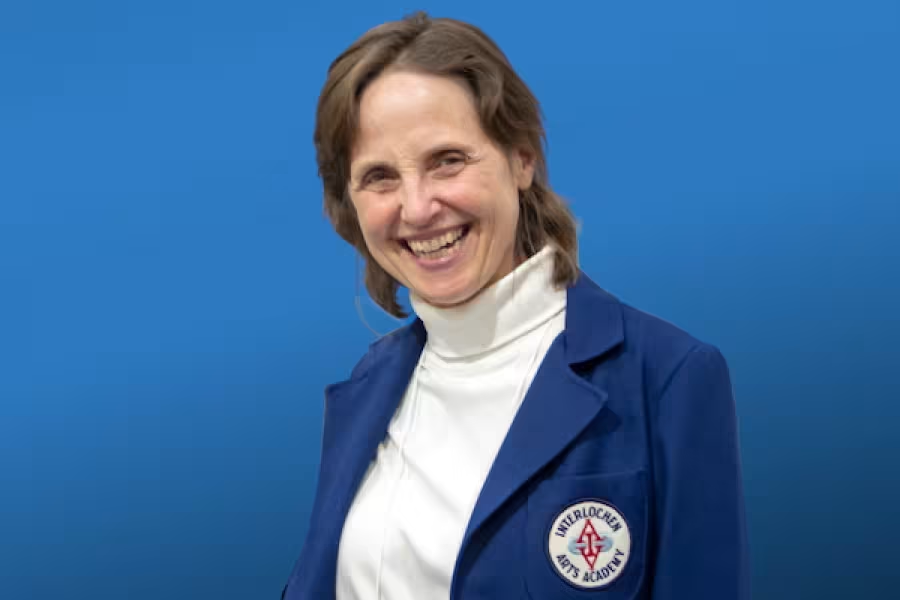
Interlochen Affiliation: IAA 81-85
Interview Date: October 18, 2024
Dawn Dreisbach studied violin for four years at Interlochen Arts Academy.
This oral history is provided free by the Archives of the Interlochen Center for the Arts (ARTICA). It has been accepted for inclusion in Interlochen’s audio archive by an authorized administrator of Interlochen Center for the Arts. For more information, please contact archives@interlochen.org.
00:00:00 MERYL KRIEGER
So today is October 18th, 2024. This is an oral history interview with Dawn Dreisbach conducted by me, Meryl Krieger, on the campus of Interlochen Center for the Arts. Thank you so much, Dawn, for sharing your story with us.
00:00:13 DAWN DREISBACH
It's really amazing and a little exciting and nerve-wracking to be thinking of my experience as anything oral history-like.
00:00:25 MERYL KRIEGER
So please tell us your name, your connection to Interlochen, and the years you attended.
00:00:30 DAWN DREISBACH
My name is Dawn Dreisbach, and I was here for four years, from 1981 to 1985, as a violin major.
00:00:40 MERYL KRIEGER
How did you learn about Interlochen and what drew you here?
00:00:43 DAWN DREISBACH
My parents showed me a flyer about the Arts Camp, about National Music Camp, and this was when I was in eighth grade, and my parents were looking for high schools for me to go to, to get out of the public school system in Ohio. But the only thing that was really on the agenda was a local prep school that was very New England, do all sports in the afternoon, the kind of place where I knew a lot of people had gone, and that was probably where I was going to go. But then separately, they showed me this flyer about NMC, and at the bottom I was like, okay.. At the bottom there was a thing about the Academy and okay, so the arts attracted me, but also there was a thing about how many years of math you needed to have in order to graduate, and it was only three instead of four. It's like, that's the place for me. The cosmic joke, of course, was that Mr. Trepti here made me love math so much in geometry that I ended up taking four years of math and being a math tutor while I was here, but I told my parents like, oh well, that sounds pretty cool. And they said, we've never heard of that. And so within a month, we were coming up in January of 1981, and I had my audition with Paul Statsky. And I remember getting out of the car late at night, and it was dark and the lake was frozen, and seeing three students cross-country ski past that clock in the middle of campus and thinking, what is this place? So and then I got the acceptance letter after auditioning.
00:02:50 MERYL KRIEGER
So let's start with what is your favorite memory of your time at Interlochen?
00:02:56 DAWN DREISBACH
Getting ready for dress dinners was one of my favorite things. It was the end of the week, Saturdays after we had had our five days of classes. You come back to the dorm, take off your uniform and you'd turn on the radio station, play your pop music while you're getting ready, you know, and listen to Cyndi Lauper. Madonna was not out yet, you know, and get gussied up and then wait for your friends, or go to your friends rooms and see if they were ready. And just this bustle of getting ready for dinner. And then you'd see everybody coming out of their rooms and going through the lobby and like, oh, wow, she must have gotten that in TC last week. And there was such an event element of it. And finally, you could relax for an hour or so before your concert or before going to concerts because of course it was going to be a busy night. But that ushering into the weekend and doing something special with friends was so nice.
00:04:10 MERYL KRIEGER
Was there a particular person who was really memorable that you encountered here at Interlochen? And what about it or them?
00:04:18 DAWN DREISBACH
I just stumbled on two discussions that I had at the end of ninth grade about my schedule for the next year, and I'm going to turn to this, so you might- So my violin teacher was my sponsor, and he had to sign off on my schedule for the next year. And this was Mr. Statsky. And what I wrote later, the- later that day was "Now for the trauma of the day.." This is May 14th of 1982, "which is something that has really frazzled me. I took my prospective sophomore schedule for Mr. Statsky to sign, not expecting any problems. The schedule consists of English two, French two, geometry, biology, dance two, lessons, and orchestra for academics. Mr. Statsky, before I even gave it to him, said jokingly, ‘I've been turning these down by the dozens.’ I wasn't quite sure how to take that, but soon found out when he saw the four academics, he said ‘Instrumental majors are only supposed to have three academics, and I know how serious you are about all your work, but I'm just afraid that you wouldn't have time to eat relaxing meals with your friends, get plenty of sleep, socialize, get good grades, and practice. You have a great deal of talent and have progressed more than any of my other students, and a student such as yourself shouldn't be put in that kind of position. Why do you want all those academics?’ I told them that I wasn't sure if I could get into a good college if I didn't. Also saying that if my grades started to slide, I would definitely drop something. How could I tell him that I'm not sure that if violin is what I want to do. He continued about how much I had grown this year and what I needed more than anything was chamber music. He said ‘You could take lessons until you were 80 and still not be as good a player as a person with chamber music. Between that and practicing, you would grow enormously.’ This brought up the question that I had to come out sometime. ‘How much should I practice?’ Well, I asked for it. ‘Two and a half to three hours a day on lesson music, plus another half hour or an hour on chamber music.’ He said if I wanted to do music as a hobby, I'd be all right, but otherwise something had to go. In short, the time had come. Violin or academics? I'm supposed to go to counseling and talk to them, also to my parents. I'm going to see if I can muster up the courage and talk to Mr. Driscoll and see what he has to say. I swear, I don't know what I'm going to do. Wish me luck. Bye! -Dawn."
00:07:24 MERYL KRIEGER
And this is something you wrote?
00:07:26 DAWN DREISBACH
This was from my journal. So then we have two days later, "Tonight, Emily and I went to tutorial and I poured out my scheduling problem to Mr. Driscoll. The first thing he said was that it was a very common problem at IAA, and I'd be making decisions for the rest of my life. I really can't lose either way, even though there will always be. What if I had taken the other class- The other choice? He also didn't see the need for four academics, but didn't dwell on that. It was fairly short, direct advice and probably the best I'll get. Emily and I talked to him for an hour and 15 minutes. It was great. He said that had this been 1984, we were reading 1984 in class at the time, and we're now in 1982, because I was so outspoken and sometimes obnoxious in class, he said I wouldn't have lasted 30 seconds in class before they took me away to be vaporized. Sad but true.” So these two journal entries, I don't remember this. I really don't remember Mr. Statsky saying anything that complimentary to me, because I didn't feel very good about my playing. I'm at the back of the seconds, the second violins in an orchestra and and I just want to give this shout out to the Oral History Project, because I would not ever have sat on an airplane forcing myself to read all of the other overly dramatic parts of this, of this journal, and finding these gems of- this is what it's like. This is Interlochen at its best. I'm 15 years old, and I'm trying to decide whether my passion lies with this wooden box or with these other ideas, and to have teachers like what Mr. Statsky said about, "But you need to sleep and you need to have dinner with your friends." And so, of all people, the violin teacher who's sort of like the pinnacle of expertise, our instrumental teachers were gods to us. And for him to be saying, you've made so much progress, I want you to take care of yourself. Somehow that got lost in my 15 year old brain and I, I did. So what I ended up doing, I took French over the summer. A full year's worth of French, which freed my schedule so that I could take chamber music. So it sort of solved the problem. But looking back, it was like, that was such an Interlochen solution. And they would tell us at the time the unofficial motto of Interlochen was "Do More in Less Time", which I knew at the time, we probably shouldn't have been told because you tell a teenager that and they'll do it. They'll feel like that's what they have to do. And that kind of leads me to the notion that Interlochen is really good as a place to come back to. It's really wonderful to sit around the table with alums from any year, whether they graduated five years ago or in 1964. The common experience that you share, and that you realize that these kind of private struggles were happening everywhere. If you were God, you would be hearing this all over the place and be like, why don't you talk to each other? Why don't you support each other through this? And you get that coming back to reunion. But, at the time, it's so hard to find that kind of peace. Thank goodness this place is so beautiful, because the beauty does go into your soul and feeds your soul, and the passion of the teachers feeds your soul. The longer I was here, the more I was talking about my teachers. And one interesting thing was, for many years I worked in the development office at another art school, and one year some teachers from a conservatory came to the school and I said, "Well, yeah, and I went to Interlochen." And they said, "Oh, it's so interesting because we see students come from Interlochen and from this other art school and from the other art school, the students are like, ‘I'm very good at what I do.’ And there was a school where, like the head of school would say, “You are welcome as you are.” And, and so when these students got to conservatory, they were welcoming themselves as they were. But these professors said that the Interlochen students would hold professors in such high regard that it's not about me, it's about place and the expertise that I'm surrounded by. And there is that about Interlochen. From the moment that we arrived and put on our uniforms, you're no longer you. Now you're one of us. And deal with that. Now create - you're one of us, now be an individual. And that's hard. It's not going to come out in how you dress. It does now more without the uniform. But even so, I think Interlochen is still Interlochen. And there is an, you know, an Interlochen-ness that is hard to live up to when you're a kid. And I think those of us who are lucky come back and we realize it turned into something beautiful in us. And it takes a while. It took me 15 years, but when it happened, I wouldn't trade it for anything. And last night, I sent a picture to my mom that a friend had taken just last night, just sitting in the dining hall, and she wrote back, you look so happy. You're in your other home. So it takes a while. And I ran into someone who had been a trumpet major. I was doing theater after I left here, and I was doing summer stock. And the master electrician happened to say to me, "I was a trumpeter at Interlochen Arts Academy." "Interlochen", I said, and suddenly we're at this pizza place with all the other people in the play, and suddenly we're talking. And he was telling me things about how his lip had blown out right before his Juilliard audition. And so it was over. And now he does theater lighting, and he didn't feel like he could ever go back, because our feelings are so, so intense about this place. But for those of us who come back, we realize that angst was important and it is a part of who we are. But it can grow into something that just means that today I'm going to be the strongest special education teacher that I can be. But, you know, Interlochen people aren't necessarily doing anything for the money.
00:15:48 MERYL KRIEGER
That's a fact. You started getting into this a little bit, and I want to tease it out for you and let you kind of lay this out clearly. Was there a particular project or performance or activity here at Interlochen that stands out for you?
00:16:46 DAWN DREISBACH
I have a poem that I got at my last Interlochen reunion. There was an inauguration of a- it's a path that's covered with wood now, and it goes to a pond area. I didn't know that this existed before that reunion. And some of the science teachers came back two years ago. So 2022. Mr. Tavener, who I had had for biology and for driver's ed, was there. He said, oh, driver's ed, I hated driver's ed. I said, that was the best thing ever. We'd go on to the frozen roads, and he would just pull the emergency brake to put us into a skid on the ice, and you'd have to deal with being in a skid before you knew any, it's like, well, of course I'm going to turn into it. Why would I turn away from it? Because, you know, he was teaching us that way. And I feel so fortunate to have learned how to drive up in the winter in Northern Michigan from my biology teacher. But at this inauguration of this path over there, there was a student, a current student, who had adapted a poem, and he read it, and I asked him for it, if he could send it to me. And he actually handed me the rain stained, crumbled paper that he had been reading. And I have this next to my desk. I teach in an urban area at a school, mostly children of immigrants, and I love the work. But Interlochen is my way into my teaching. You know. So this is the poem that I have right next to my desk. It's called A Camper's Prayer, broadly modified from Aldo Leopold -"Gods of the hills, grant us your strength to go back to the cities without faltering. Strength to do our daily task, without tiring and with enthusiasm. Strength to help our neighbors who have no hills to remember. Goddess of the lake, grant us your peace and your restfulness. Peace to bring into a world of hurry and confusion. Restfulness to carry to the tired whom we shall meet every day, and to be content to do small things with a freedom from littleness, self-control for the unexpected emergency, and patience for the wearisome task with deep depths within our souls to bear us through the crowded spaces. Grant us the hush of nighttime, when the pine trees are dark against the skyline. Grant us the humbleness of the hills, who in their mightiness know it not. And the laughter of sunny waves to brighten their cheerless spots of a long winter. Spirits of the stars, may we take back the gifts of friendship and love for all. Fill us with great tenderness for the needy person at every turning. Grant that in all our perplexities and everyday decisions we may keep an open mind. Beings of the wilderness with your pure winds and from the Northland blow away our pettiness with the harsher winds of winter, and drive away our selfishness and our hypocrisy. Fill us with the breadth and the depth and the height of your wildness."
00:20:06 MERYL KRIEGER
That poem leads me to another question about do you have a favorite spot on campus and why is it a favorite?
00:20:17 DAWN DREISBACH
The lake is the essence of Interlochen for me, where my soul resides. It's deep and broad and always there. And even if I went to on a walk through a woods when I was a student, it was in the context of that lake and the terrain was formed by that lake. And I think that in all the intensity and stress and exaltation that happens here, the lake calms it all. And whether it's the humor of the ice fishing huts and the walking on water feeling when we're skiing on the lake and getting to actually see what's on the other side of that peninsula. It's so big on the other side that it's always changing and it's always there. Which pretty much sums up adolescence right there, you know?
00:21:33 MERYL KRIEGER
That's what it is. Yeah. There's a couple of places we could take this, but I'm thinking of a place that feels kind of natural. How did your time at Interlochen influence your personal and your professional journey? Take this, whichever piece feels right.
00:21:52 DAWN DREISBACH
I have shot for the best in everything that I've done, whether it was getting A's at Vassar College, although I did call myself the B+ queen, not always attaining what I wanted to or whether it was auditioning, and I moved into acting after Interlochen and, you know, going to auditions and thinking, well, of course I can do this, or getting the training I needed. The pushing, the pushing and the expectation and also the confidence of, well, I'm passionate about it, so I need to learn how to do it. I need to learn the technique of it and nothing comes without work. I think something that made a big impression on me was when I first arrived and we had to write in English one, single character, single setting, and I wrote about somebody coming to a school by herself and being lonely and seeing the trees. And I got it back, and Mr. Driscoll had given me a C+, and I was absolutely horrified, absolutely horrified. But he said, you can revise it and I will take the average of those grades. And that's another piece that sums up Interlochen. Wherever you were, you could always be invited to get better. And it's not that they were going to erase any grades, but the average was going to go up. And so there was always room to grow, always room to grow, always encouragement to grow. But also you were being held accountable for what you had done. And if something that you had done was not up to the expectations that you have for yourself, that it's not going away. But that's all right. And I live my life that way of taking responsibility for where I am and aiming as absolute high as I can. If you're going to do it, aim for the sun. Always. And yeah, we have to deal with the disappointment of not reaching it. And I think that is the flip side. You also have to eventually develop the strength of character to deal with who we are when we leave Interlochen. We turn into people with very, very high standards, very, very systematic ways of reaching goals. And we need to learn how to be kind to ourselves and to understand that that means that most of the time, we are not going to be reaching the goals that we set for ourselves, but that we believe that aiming, that reaching is more important. There's a quote from Martha Graham to her dancers about "There's a drumbeat within us that is stronger than other people, and we have to listen to it, and we have to, we have to dance with that." And I think that we share that at Interlochen, and it is beauty and it is a burden, and we can burn out. And part of what we learn as our legacy is how not to burn out.
00:25:48 MERYL KRIEGER
You're getting into actually, my next question, which is how your time at Interlochen influenced your personal and professional journey. So I'd invite you to follow that piece of where you were already going.
00:26:00 DAWN DREISBACH
I mean, it did. That's- I will say that we didn't have a lot of time to develop our emotional and social selves here. And so this being an oral history, and as somebody who was here for four years, I hit adolescence around the age of 25, in terms of some of the emotional pieces that other people go through earlier on. So some of the legacy was that I was a little out of kilter. But who isn't? Everybody's adolescence is whatever it is. And then you need to fill in the pieces. I think at Interlochen we're a little bit more clear on what we, what our strengths are and what we didn't really get, and that college and relationships and life teach us later on. And that might be why I was about 35 when I came back to a reunion and saying, oh, you know, by now those pieces have rounded out and now those very strong technical skills are not just running the show anymore. Now we've blossomed into these full individuals and what individuals we get to be because of this place. But it takes a while. Your time with Interlochen almost extends another 10 or 15 years because you need to find that personality, that love, the emotional knowledge, I don't know what it is, that kind of took a back seat when we were practicing scales and arpeggios. Oh, I have a crush on somebody. Well, that doesn't really matter, because it's time to practice and that person isn't available too, because what- that person is practicing too. So there are a lot of things that, as normal high school kids, we put off for a while.
00:28:09 MERYL KRIEGER
So I'm going gonna follow this up with what advice, given all of this, would you give to current and future students at Interlochen?
00:28:17 DAWN DREISBACH
Come back, come back, come back, come back. And now, having looked at my journals, I would say also, don't get rid of your journals and come back to them because chances are you were a cooler person than you remember. You were more balanced than you remember. Our memories tend to remember just the couple of things that rose to the top that we perseverated on. But there are so many details. So come back. That's one way to fill in the pieces. Look back at things that you did that you may have forgotten. Don't fossilize this place. Don't let this place be the memory that you had the day that you left when you graduated. Because that's the, that's the absolute worst day to have for your last look because you have no idea. You're mourning Interlochen and your family is around and you're going into a new great unknown. There's no way that you have any perspective on this place, and that's okay. The last thing you need to do is have this place all figured out when you're still packing your stuff. Give it time. The first time I came back was ten years, and that was still too soon for me. I mean, it was fine, but it didn't feel like any kind of figuring things out. We were just like, running around campus and doing the things that we wished that we had done while we were here. We were still like, sort of like students, but then coming back about five years after that, then it was like, oh, oh, somebody was sitting around our table at reunion that year. And she said, I just want to apologize to all of you that I was an adolescent with you. You're like, yeah. So my advice to people, don't let it stop the day that you graduate, it's like kimchi. It's going to get better. Interlochen needs to age with occasional doses of, with other Interlochen alums, and with keeping your things so that you can touch base and understand that the person you were here is still the person you are. It's not that that person is a part of you, it's that you're a part of this student. And somehow that matters. So Interlochen is us every day and if for some reason it's not clicking, then you just need to futz with the recipe. Don't give up on this beautiful wine that is evolving within you. That is this place and it starts off a little harsh, like young wine it and it'll be like, ooh, that's a little acerbic. I was really acerbic as a student here, but man, it doesn't stop.
00:31:37 MERYL KRIEGER
Gonna poke at two little pieces and then open it up to you. What kind of lasting friendships did you form at Interlochen?
00:31:47 DAWN DREISBACH
Well, I'm here because of a, because of a lasting friendship. You never know who it is who's going to still be around, because part of that depends on their journey. There are people who I thought for sure I'd stay in touch with, but who haven't stayed in touch with Interlochen, and there are other people who I didn't necessarily think I'd be in touch with. But I see at reunion and oh wow, this is wonderful. So I think that's a more delicate, complicated dance because now there are more people, there are more backgrounds, more relationships to Interlochen. But it doesn't matter if I meet someone who went to the Academy, it's all there. That's more important than whether I was on the hall with them, or whether I can remember exactly who they are. It's the Interlochen-ness and whether people are in a place where they are open to it, because I could spend four years with someone, but if they're not in a place to be open to Interlochen right now, what we have is some memories. And those memories probably are fun, but it's not living so much.
00:33:12 MERYL KRIEGER
The last question, formal question I'm going to ask you is kind of the biggest one. So take whatever piece of it you want. Why are the arts.. Why do they matter in the world today?
00:33:24 DAWN DREISBACH
I'm getting back to violin now. In 2018, I played in a good community orchestra outside Boston for 15 years. But then what happened was my arm developed a lot of tension, and I couldn't hold the instrument anymore. If I picked it up, the violin went off to the side because I couldn't twist my, my left arm enough. And I'm now working with a massage person and someone who teaches violin, but also does the Alexander Technique. And I'm getting it back but, the night before I flew here, I had a lesson and we were walking around the studio with polar bear feet. Imagine your feet are wide and have pads on them like polar bears. And what does that feel like and what does it feel like if we're tossing a ball between us with polar bear feet? Oh, I can catch the ball better. What if you stop having polar bear feet? Oh, that throw was really hard. Oh, well. So what would happen with your instrument? If you have polar bear feet and you're grounded versus holding yourself up and not having polar bear feet? And so we're exploring the nature of creating music, creating art. So I'm spending a fair amount of money on lessons at the age of 57. And why am I doing that? Why? If I'm lucky, I'll be playing some scales in a couple of months. Why does art matter in my house that I'm doing this? And I decided that it's me and I don't know why. What is the value of the arts? I don't know. But I'd rather have a life with art that is only scales and arpeggios than to have a life that's silent without it. And I'd rather my violin know that I'm picking it up and putting in the sponge so it doesn't dry out, and getting it to feel that at least it's moving, even if I'm not drawing the bow on it. Because I can't do that yet. Because it's alive and giving me the vibrations back too. So art is vibrations. Art is what we're bringing to life, and then the art amplifies it, I guess, because I don't know, it's pretty ridiculous that I sit in my dining room looking at this big maple tree outside my house, and I'm sitting, just holding the instrument and noticing any tension that comes into me because I'm holding it, because of all the tension and all the years. But noticing that, oh, that's feeling a little bit different. That's feeling... And who would I be if I weren't doing that? I don't know, but there's something about holding, having that violin silent as it is right now, and aiming for it is like what I was saying before that at Interlochen we shoot for the sun. The sun might just be getting the violin under my neck and I'm not there yet. What does art matter? What could this, what does this matter? I don't know, but I kind of wish that I had brought my instrument and I could just sit at the lake this week.
00:37:32 MERYL KRIEGER
Thank you for that. Is there anything else that's coming up in your mind that you'd like to share before we stop?
00:37:39 DAWN DREISBACH
Let me see if there were any other things that I wanted because I didn't notice before. I have a Mr. Trepte story.
00:37:48 MERYL KRIEGER
Okay, go for it.
00:37:50 DAWN DREISBACH
So Mr. Trepte was, I had him for geometry, and two years later, I went on the math science trip to Beaver Island with him, and I was working with him a little bit that year because I was a math tutor, and this is so him. The Beaver Island is the second largest island in the Great Lakes, I think, and we were each of the different math science teachers had a small group, and there was a pond in the middle of the lake, and some of the students in our group were going fishing there, and it was morel mushroom season. And I was with Mr. Trepte. And he said, "Yeah, we'll go, we'll go pick some mushrooms." And we were standing there in the woods. He and I were maybe 3 or 4ft apart, looking down at a bunch of leaves in the middle of the woods on this island. And he said, "Now I am looking at two mushrooms." And I went, I don't see any mushrooms.. There's a mushroom, he said. Oh, look at that. And I picked the mushrooms. And so we did that for maybe half an hour. And that night for supper, our group ate freshly caught fish and morel mushrooms for our dinner. But the way he showed me how to find those mushrooms was how he taught. Now you know it's right here. And I think it sums up the best of the teaching here. It's here. There's this silence as we, yeah. If you look, if you're too tense right now, you might not see it. Relax. Notice. Give yourself time. Oh, there it is. You found it.
00:39:57 MERYL KRIEGER
That's lovely. Thank you.
00:40:01 DAWN DREISBACH
Thank you.
Copyright
Copyright to the audio resource and its transcript is held by the Archives of Interlochen Center for the Arts (ARTICA) and is provided here for educational purposes only. It may not be reproduced or distributed in any other format without written permission