
Oral History Interview with David Lake
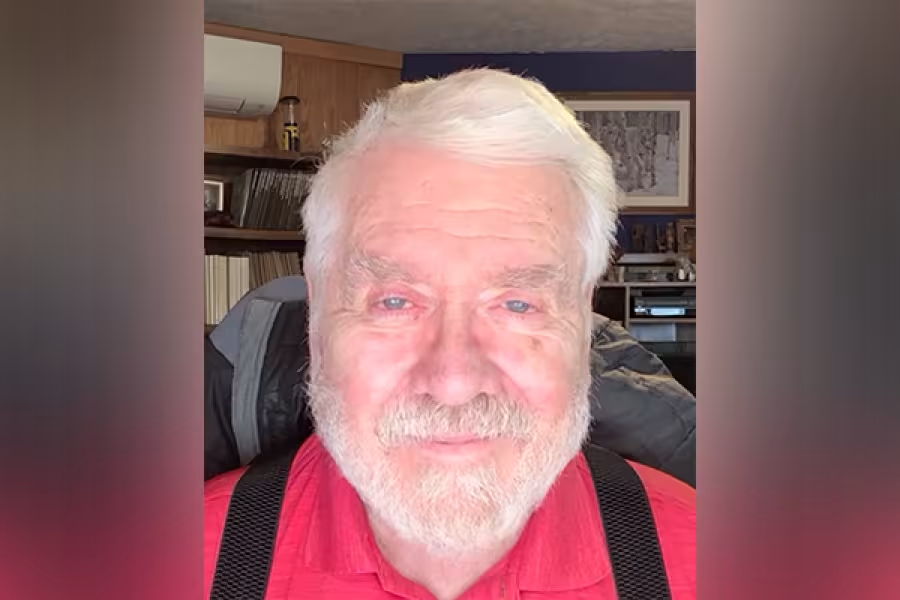
Interlochen Affiliation: IAC St 64-68, 70-82 | IAA Fac 74-81 | IAA St 73-83 | ICA St 83-09
Interview Date: July 31, 2025
Over the course of 45 years working at Camp and the Academy, David Lake served as a math instructor, accompanist, and staff in the music library.
This oral history is provided free by the Archives of the Interlochen Center for the Arts (ARTICA). It has been accepted for inclusion in Interlochen’s audio archive by an authorized administrator of Interlochen Center for the Arts. For more information, please contact archives@interlochen.org.
00:00:00 ELIZABETH FLOOD
Today is July 31st, 2025. This is an oral history interview with Dave Lake conducted by Elizabeth Flood on the campus of Interlochen Center for the Arts. Thank you very much for coming in and speaking with me today.
00:00:12 DAVE LAKE
Thank you for speaking with me.
00:00:14 ELIZABETH FLOOD
Could you please tell us your name, your connection to Interlochen, and the years that your relationship has spanned?
00:00:21 DAVE LAKE
Dave Lake, and I was first here as a college student in 1964. In summers, I've always been connected in some way with the music library. But after teaching at Central, I started here full time Academy and Camp in, I believe it was '73. I had my foot in the door because the library, of course, knew that I knew their job, and there was an opening as a full time person, but that branched out into everything, and most all of them as a musician and or leading some of the musical groups. So I did that through the year 2010, that was my official retirement, and took a hiatus. Was a couch potato for the first year, which is I should advise is a very poor thing to do. If you've been really busy in your career, don't just go cold turkey and say okay I'm not doing anything. I hated it. I've done since that many things like volunteer for the film festival, and that was a big issue in our area. Also, a long time affiliation with the Old Town Playhouse, where they would do musicals, and I love that as an avocation. Have done several here, and after that short break of about two years, came back, I liked who was in the library, and they liked me, and it's right down my alley the type of work they do. So that's a perfect collaboration, and it gives me an opportunity to get out as a retiree. Well, try to keep up with the high school students of the Academy and in the summer campers. That's a job for anyone.
00:01:59 ELIZABETH FLOOD
How did you first learn about Interlochen as a college student and what brought you here originally?
00:02:06 DAVE LAKE
Well, I grew up only about six, seven miles from here. In the summers, I would go to Long Lake, and my grandfather had property there, and oh, we'd visit two or three times a summer for maybe a total of a week, but have been familiar forever. And we'd come over once in a while to a concert. My historical dating is a little off balance since it's been about sixty years now [laughs] since that first exposure. I do remember though a concert. There was the violin soloist, I believe he was a faculty member here, with the orchestra in Kresge. And I also believe they did not have the full roof in by then, I'd have to check my date book, but that was my recollection. And I'd never heard a violinist live and playing a very technical piece. I can't even remember the name of the piece where violinists are playing two melodies at once with some pizzicatos in between, you know, a very technical, complicated kind of thing. I was astounded. I had had recordings of classical music, but, you know, I never watched them or heard anything of that nature. And we walked around, I think we took a tour. I believe the cafeteria was still in the same area, different building. And so I worked the first couple years. My college roommate said that, "Well, that's sort of a rut, isn't it?" And a lesson I learned is that not all ruts are bad. So it was basically ten full summers, and then when I came full time was because I had resigned from my current job, which was faculty in the math department at Central Michigan University. And when I got back, I checked every junior college in the state for a position. I thought that was a natural connection, and no offers from any of them. So I had my foot in the door in the library, and they had an opening, and so that's sort of how it started. Also on an hourly basis, accompanied dance, and at the same time I taught two or three math classes at a time, so a partial load. And that was, again I'm estimating, probably seven or eight years I did that combination of things, and quickly got my foot in the door playing choral activities. So I played for both the chorale and the chorus. I'll mention one of the gentlemen I worked with right now is Kenneth Jewell, and we had a very long history, and he is even longer than mine probably at Interlochen. In fact in the library part of my job, worked with his daughter, Alice Freudigman. People will recognize her name. She passed away several years ago.
00:04:42 ELIZABETH FLOOD
I'm just marveling at the different hats you've worn here, and how you fit in so many places. Can I ask you a little bit about what your musical background or relationship is?
00:04:54 DAVE LAKE
Sure, I was a math major in college, accounting minor, but I describe my college career as math and accounting and music full time because I was accompanist as well as a clarinetist, and my social connections are all through the music department. I once received a recital book for the year that music majors are- one day a week they put together a daytime recital- and I was on nearly every program either as a clarinetist or as a pianist. And I also discovered musical theatre in college. Walking through the practice rooms, I heard somebody playing. I didn't know what the piece was. It was excellent. I liked it, so I knocked on the door, and it was a music major, and she was the accompanist, the pianist for the pit orchestra. And I said, "Well, what is that that you're playing?" And it happened to be "Kiss Me, Kate." I said, "Well, how do you get to do that?" My high school was too small. We didn't do musicals, didn't have that. So she said, "Well, go to Dr so-and-so and ask him. He'll probably be able to use you for rehearsals or something." So the professor had a British accent, which I thought was cool. He says, "Well, here's the full score. You take that and come back and play the overture for me." I said, "I'll do that now," because I have a bit of a gift for reading. And he said, "Well okay." And he said, "We can use you." So got my foot in the door in that, and I was always second choice of which performances because the piano major, you know, was there first. She didn't happen to like the dances. I thought they were great because it was just orchestra. You didn't have to worry about balance particularly, and they had more meat to them because they were just orchestra. The next year, I was asked, "Would you like to do it again?" And I said, if we could change the formula just a little because I'd like to be the main person, and I'll play all of them. So I did it. In fact, got to be as a student, a music director for Fantasticks was one of the favorite shows I ever had. So I had that background going and got hooked up with the theatre in town, the Old Town Playhouse. There were definite connections between the two institutions, and so the musical theatre thing was important to me. Got to do a Godspell, played piano and directed musically here. Did a Pippin at the Academy. Let's see, summer, I wasn't the director of music, but I played for Oklahoma!. I played for West Side Story in the summer productions. Altogether, I counted between Central and then all the way through my career here almost fifty different shows [laughs]. Not here, but, you know, including in town, including, oh nearby towns that had playhouses and things like that. I love that. When I heard Fantasticks in New York as a collegiate, if there had been a notice on the door saying audition here, I would have forgotten that the subways don't smell too well, and that I liked rural life, and I would have signed up. Who's to say if I had gotten it or not, but it excited me that much. So it's always been a second love besides Interlochen in general.
00:08:16 ELIZABETH FLOOD
So then the whole time were you also teaching math?
00:08:20 DAVE LAKE
No, I just did that six to eight years or so. And then it happened that they had a full time position, and they offered me that. I declined because by then I was doing so many musical things that I thought, I'm happy with that. I also had the oh, around forty years old or in that area, where people think, "Am I doing what I should be doing?" I think a lot of people think that, Well, I got a master's in math. I didn't feel like I was pumping gasoline, figuratively. I really loved having that. When I did have both, that was great, but the music was better, and there's a huge variety in that. My favorite part of forever here, I think it was twenty-three years, most of which with Jeff Norris, was the head of the opera program and opera workshop. Was officially the music director for, the faculty member though was the vocal teacher, and I wasn't a technician with voice, but I knew enough to teach the musicianship angle of it. And that's why I get excited when a few students, you see their names in the headlines and they go important places. That's probably about all. Oh, I did a rock musical, Tommy. That was within the last few years. I like all types of music as long as it's done well. I understand if you're six years old and you can't play Tchaikovsky yet, that's fine, but I'm saying that things like rock weren't necessarily my favorite. One summer, one of my best friends, we made a deal. I would go to America and Three Dog Night, which is one of the summer performances at Interlochen, and he would go the Detroit Symphony. I was just pleasantly surprised. They were wonderful musicians, and I can't say that I would choose that as my listening music necessarily, but being here and exposed to all of that, the overall thing is, it's done well, and I can tell. I mean, it doesn't matter what their style is. They sell it and they know their art. And that's another great thing about this place because you get exposed to most all that stuff.
00:10:26 ELIZABETH FLOOD
In some of the conversations I've been having with people who've worked at the Academy, it's come up that Interlochen Arts Academy is a place valuing arts education, both the arts and the academics, in kind of a balanced way. And so I'm really interested-
00:10:42 DAVE LAKE
And the academics are tough. They are.
00:10:45 ELIZABETH FLOOD
-in your relationship being in both spheres. Most of the people that I've talked to have only kind of lived in one of the corners.
00:10:53 DAVE LAKE
I have a tiny story linking that. The head of the department of Math & Science at that time wrote an evaluation for your work that year. It was a point he made, he said it was very nice to have someone that was in in both mediums. He was very complimentary, except he wrote a word that would be pronounced accompany-ist. And I said, "I just have to tell you because it's my nature and I am a word person, that the word is accompanist." And he said, "Are you sure?" And I said, "Well, I am one, so." I mean, I guess that's bold to tell your boss. So he learned that it was a piano accompanist. I respected the fact that he liked the connection because in a department meeting we could talk about that. They're not really at odds, but they compete for their own - but my students have to have a certain number of hours, and we have to have them practice, and we have to have them, you know, etc. So it's not really a battle, but it's protecting their territory. One other student thing. I had a student from the Philippines, was a very fine violinist, and it was in a math class. I knew that, he'd get B's, and I knew that he could get A's. And my philosophy at the time was, I don't care if you get a C minus, if you put in the effort, and maybe that's what you can do in the subject. But I felt like he was underachieving a little. Well, I learned a lesson because I found out that he practiced about three hours a day on his violin. He was intending to be a professional violinist, and so that took precedence for him, and I could certainly live with that. I mean, I changed my attitude that many students, especially by time they're juniors and seniors, have decided that's what I'm going to be, and when they follow through there's miraculous results sometimes. So I learned don't make him do every homework problem. He's fine. He could do it. He's getting what he needs to out of this class, but he's also going to be a fine musician, so.
00:13:00 ELIZABETH FLOOD
I'm wondering, what advice would you give to current and future students at Interlochen?
00:13:07 DAVE LAKE
One is to appreciate where you are, and I think most all do. So many people are really dedicated already at a high school age to where they want to go. And it's not all bitter competition, but competition is part of it. We used to have auditions every week in orchestra in the summer, and they were nicknamed. Everybody knew, they were called bloody friday's because between WYSO and the, at that time was called Concert Orchestra, the second group. The ones in the second group knew that they weren't quite good enough to be in the tops, so they actually changed the name, and it just made me smile because the kids still know the same thing. [Laughs] To me, it just confused it. So now instead of Intermediate orchestra, I'm not even going to chance what it's called now because I couldn't keep up. I'd gone thirty years calling them something original, and then we upped the status of the name. There's still an A group and a B group, and you don't even think it was worse, you think it as they're not developed yet. Or maybe it's somebody who music is not super serious. Maybe they're an artist, you know, maybe they're a drawer. There have to be places for those too. And I know so many students, they were outstanding in classes of mine, musical classes, that didn't do that as their profession. They might be a CEO. They might be any number of things; university teachers, but most of them still have a musical connection. They'll at least, if they live in a big city, they'll sing in a great church choir, or have still the training that was necessary and the liking for the art. So it's very important that it develops that in people who aren't going to be able to make it their profession or just end up saying "No, I don't want to do that that fervently," you know, "I just want to do it for my enjoyment and my edification." I experienced a few students through the years that had extraordinary talents. They happen to be vocally inclined. The type that, oh, if you auditioned for a solo in the choir, they typically get it. And they were the best of their home area too. Everybody that comes here is about the best at home, and so there's a little development there that they have to learn. If I'm not the best, can I go with that? And if you adapt the fact that I'll strive to be as good as that person, that's very healthy. But if you just say, well I give up. I can't be the best. I felt really sorry for two or three people I can think of through the years, that's all, that were very, very talented, but didn't expand on it here. Just thought, "Well, I usually get the solo, so." Well life doesn't usually work that way, and no matter how good you are here, out in the professional world you probably won't be instantly good. That's pretty rare. So when I see a student that was here a couple years even, and takes off and is very often in opera, if that's what they're aiming for, they'll get a good job in Europe, perhaps. But I've got at least three, four, five that I've worked with that have jobs in opera companies full time, and it's so exciting! And they certainly didn't stop working ever. Even though they were very good.
00:16:29 ELIZABETH FLOOD
You mentioned Kenneth Jewell and a few other names that I've heard throughout the summer, and so I'm wondering- The question is who is the most memorable person have you encountered, and why? I would like to broaden that and say who are some of the memorable people that you've encountered?
00:16:42 DAVE LAKE
I'll answer the one memorable persons with personal connections to me first. Definitely, Ken Jewell was one. Jeff Norris was vocal teacher here and ran the opera program for years. And the third was Henry Charles Smith; served in several capacities. He retired as principal trombone with the Philadelphia Orchestra. So, you know, he was a top musician, and I can't answer to when he started conducting, I'm not sure, but that's what he wanted to do after that playing career, and I g0t to work with him. University Band, at that time, we had a program with the University of Michigan, which is wonderful because you could get college credits through them in the summer, and they'd have some theory classes. Not a lot of other classes other than applied music, but they could get credit for University Orchestra and University Band. This is how I first liked him. He had auditions. This is a little braggadocio, so you can point that out. Had auditions, and part of them were sight reading. Well, I find piano simple to sight read, so clarinet is like, there's only one line. [Laughs] And so I did pretty well, and he announced in the first rehearsal, I'd made first chair, and I'm feeling pretty proud because I'm from a little school and University of Michigan and Eastman are a little down there a ways. Just had a good audition. Anyway, he announced that he had most probably heard the best sight reading that he'd heard. The man has had a whole professional career, and I thought, I want to be your friend, I mean, thank you. Thank you! He also did wonderful jobs with WYSO, conducted faculty staff orchestras. We'd usually have at least one or two concerts a year. Also, I got to play Jessye Norman's lesson one summer. Most people around here identify with her even though I think she just was here for one summer, and her teacher was Willis Patterson from U of M, who was also here in the summer, and she just needed to fill in for rehearsal, so I did, and of course she won concertos hands down. She'd sing something Wagner, and it was great. Aaron Copland, I have met and shaken his hand. He conducted. WYSO one week. They'd brought him up to Kresge in a limo, the back streets where you normally can't drive, and let him out, and he had to rehearsal, but there was nobody to show him where to go. He'd never been here before, and so I was the librarian, and I'd taken his scores or whatever, and he said, "Could you possibly tell me where the men's room is?" And I said, "I'll do better. I'll lead you to it." There's one between Kresge and The Bowl. And he said, "Thank you very much." I've treasured that forever. [Laughs] Not many people get to show Aaron Copland where the bathroom is. It was an honor. And also, Fred Fennell, we would have a library picnic in the past, this hasn't happened, oh for probably ten years now, but on the Monday afternoon off, which used to be the staff off day in general, no concerts, no rehearsals, we would take a canoe trip, a paddle trip down the Platte River. And Fred would always want to go with us, so he had his own paddle. I was connected because after he left Camp and everything was over, I'd get a phone call typically, "Would you mail me back that paddle?" And I discovered how difficult it is to mail a canoe paddle. I think UPS can maybe handle it now, but it was a real- I was responsible for that. And gentlemen by the name of A. Clyde Roller was a very popular conductor here. I worked with him a lot. A very funny and very professional gentleman. I believe he was regularly conducted with Houston, one of his jobs, Houston Symphony. Anyway, there's several traditions involved. When A. Clyde would be there, the first rehearsal he'd give a down beat, and the strings would play a "Hoedown" from Rodeo. [Sings] They'd have it planned, you know. He probably expected it, but gave up. And then they present him with a box of animal crackers. I don't know if you remember them, they come in a little hexagonal box, and they would attach a string so we could hang it around his neck. Now, if he needed energy, he might eat an animal cracker. More likely, if there was a mistake, let's say the clarinetist blobbed something up, he'd say, "Clarinet. Can you work out that entrance?" And he tossed them an animal cracker. His other habit was to, cello's were right to his right hand and, "Celly, you know, fish fuzz." That was the favorite comment of his, fish fuzz. I think it's southern? I'm not sure. You can ask Jan Roller, he's on campus, [laughs] his son. And he said, "I want you to make a big sound on those chells, all right? Like whoa! Can you do it?" And kids just loved him, and he was excellent too as a conductor. So those two at once were in my office once, and I was a sort of manager of upstairs librarians, and they would take their coffee break in my office. There was a new gal, first year staff member, operating the Xerox machine which was part of the same room, so she just observed. And they both came in at once, and they're both hilarious, just full of personality. Especially Fred can be pretty stern in a rehearsal, I mean he's a master of what he does. And they just have a little chat session, and the young lady came up and she said, "Do you know them?" She was especially interested in Fred, she was a band player. I said, "Yeah." She said, "Would he say hello to me if I said?" I said, "I'll introduce you next time, it'll be fine. [Laughs] He's quite human, I mean," or he might pop in to say, "I need some staff paper," because he'd rewrite the piccolo part or something on a whim. It didn't sound good that day, so he'd make it different. Those are some of the people. Oh, one other Interlochen person I can't leave out is Howard Hanson. He composed his Sea Symphony, that's S-E-A not in key of, which I believe was at least his last major work. And he was seventy-five at the time, and the first performance was here. And as usual, it's a big chorus number with orchestra, so it was with WYSO. And they always need men, male singers are always a valuable commodity, and I had sung with the University group a few times, so got to sing it, and you have to consider a composer however they choose to write their music, whether you're Beethoven or not, you haven't really heard it until that first time the orchestra plays it. You can do it on your piano or whatever. So he got through, and he wiped his brow, and he said, "Well, there may be snow on the roof, but there's still fire in the furnace," which is such a darling thing to say, I mean it was sort of self complementary, but it worked. And I can only imagine what that feels like to a composer. Especially with a huge group, you know. And they did it pretty nicely. It was a good year or so, and that's just special that you get to do things like that. My best performance ever, or most fun, was a Carmina Burana. Hugh Floyd conducted it, and he conducted here maybe six, eight years. He conducted it, and we were good friends because I played all his choral stuff, and then he started just coming in the summers to do the, what we called festival choir. Oversized choir in the big numbers. And so I sang with a couple friends of mine in the Music Library. We had a hundred and twenty-five men in the chorus. And do you know Carmina? At least one very famous all male number, and it's called "In Taberna." Of course it's all in Latin, but the lyrics are risque if you translate them. They were copied from stones in Pompeii or something, anyhow, it's really fun oratorio. And there's one short soprano solo, super high. And of course, there's typically no applause between movements and in that sort of work, and she sang it, and it was beautiful. In the little gap between that the next movement, you hear out the back window of Kresge, [Ducks quacking]. The conductor who has red hair, and he was trying so hard not to laugh that his face was red, a different red. He was up there clashing, sort of bobbing, getting ready to start the next movement. But it's my favorite part of the whole show. But also, you don't always get that many men that were all singing it together. It's a tough thing to sing fast words in Latin. [Laughs]
00:25:42 ELIZABETH FLOOD
Could you tell me a little bit about a favorite spot here on campus, a place?
00:25:47 DAVE LAKE
I probably would have to say in the new Music Library. That was such a breath of fresh air. It took forever fundraising, planning. My previous boss, Del Weliver, worked about forty years here and had the audacity to retire before I did, which I didn't like that. Anyhow, he and his wife, Evelyn, she planned the academic library, and it was course years in planning, and we'd count things, and we estimate, and how many of these do you expand by each year? And just a myriad of problems with a brand new building, and you want to take advantage of how high are the desks and just everything like that. So in about 2008, we'd been moving all year, taking things in our cars that you didn't want to pack in a semi because we filled a semi and just drove down the few blocks down to here. And you imagine how heavy the music is. Our library has, these are just the parts for orchestra, between eight and nine thousand, and they're this big, and they could weigh up to twenty pounds in one container. We have another eight thousand or so in band. We have about five thousand roughly in choral, and that doesn't count huge amounts of solo, ensemble, study scores are separate. Every sort of listening media you can think of. So huge, huge move. And they did it during our vacation. We had a two week spring vacation. We moved it. The thing is, in the new library that the elevator between the two levels was broken. I mean, it's brand new, but it wasn't working. So to get it down steep steps, and quite a few of them, and a lot of heavy stuff. So they would put it on little carts that held, I'm going to say, about three, four hundred pounds worth. And these daredevil movers, they weren't people from here, they were a company and much younger and braver than I, would follow them down. They were on wheels, and I think they could have died if the cart went up, went offline or something, but they moved it all. And now, of course, they're not much for putting things in order, so imagine sorting it all out at the bottom. And still the front area has a lot of CDs. They've grown out of use now because you can get it on your laptop, but I was gone when they put those on the shelves, and it turns out they'd originally planned long shelves all the way to the end, but as all construction things, found out they needed another fuse panel. So in between that long section, they chopped it up, put a gap with a fuse panel. Well, they'd put them in so that they went 1 to 100 say, skip the panel, and then on the other side, put 101 through 200. Now you imagine several thousand of those. That is much harder than if you go in that one section, there are two sections, and you just go fill that from left to right, and then go to the next section. Just because of ease, finding and putting stuff back and Alice, and I just said, why did that happen? So my sister in law, who had one summer, volunteered to do one of the positions at Music Library. We'd had an absentee, one that didn't pan out. She came over with me, and one Sunday we spent three or four hours, and we just changed them so they fit the practical way of using them. Kids would take three or four a day, and a lot of kids would use them at the time. This is a story on Del. He came in and he noticed. He said, "Why did you do that?" I said, "Del, have you filed very many or gotten them off the shelf?" Because that's, you know, not part of his job. "Well no, but," you know, we didn't ask. Well he didn't ask us when he put him in the wrong place. [Laughs] And you know, we've worked together for years, so it's not confrontational necessarily, “but I'm the boss.” Well, yeah, you are, and I'm not criticizing it. I just took care of it, and I just sort of said, "Oh, got things to do." And he sort of stood there to say, "Well, I guess that can work." Who can say, I might have acted the same way if I was in charge of the whole place, and you did that without checking with me? [Laughs] I guess it's a good example of trust your employees, if you've got good ones.
00:30:23 ELIZABETH FLOOD
Could you speak more about the Music Library? I don't know that much about it, and I'd love to hear more.
00:30:29 DAVE LAKE
Historically, it was always the bottom floor of the Cafeteria, Stone Center. We shared it through some years actually, string faculty had studios down there. There were maybe two small ensemble type rooms, you know, good size rooms that you could put an octet in or something like that, or a sectional. But then the most of the floor was two huge rooms of stacks for the band, orchestra and choir things. We actually added one, we took over a string studio for scores because it got to be so cramped. We would be putting recordings in the orchestra files because we had no more room in the regular files. It was just very, very difficult to deal with. And then we had a main circulation room. There are little halls connecting these. And then Del had a separate office. And then one office was mine, shared it with the person in charge of distributing music to librarians all summer and the copier. And the difficulty was the ceiling leaked, and I never wanted to know what it was, but sort of a black sludge came down. We had one whole aisle that was just flute music because we'd had a huge donation once, and otherwise it sort of interspersed everything, but all flute. It seeped down, ruined. I mean, there's no way it's even saved them, the things that you can't replace, some of them. And at first, we told the flute teacher, we thought that would be effective. We're not so effective when we say, "Well, the ceiling leaks." They say, "Oh yeah. Well, sometimes we mop with too much water." Well, this was kind of big, and we told the administration. I know they have priorities, and we weren't one. One day we came in and our two big desks, Alice's and mine were in the circulation room at that time, and right next to the first row of the ensemble music was right beside us, and it had leaked through the ceiling onto our desks. It wasn't the black sludge this time, it was just sort of mop water, but still is disgusting. I remember Alice climbing up on a stool, and she wrote, it was a curse word, and wrote the date. Started keeping track of, oh yeah, this happened then. We had one of the septic things. That was separate. I believe I called that in and maintenance as well. It was awful, and they used an awful lot of bleach. So inaccessible working area. And when we got new computers, it happened to be under one of the pop dispensers, and you know what sticky pop could be like on a keyboard. It was in the works, but it was a big financial adventure also. So the big move, and I bet you, I probably moved a ton just myself hauling things that we would get rid of, that we would recycle, or things you didn't want to pack in a semi and then the huge, big move. So when that started, of course, we had AC finally. I mean, that's a huge plus in the summer for music as well as people. Both benefit from that. Had my own very nice office. I was basically cataloger. It sort of goes along with my math mind. I love to do it, and that's a sickness most people said. I would stay up to one am, there wasn't such a thing as overtime pay, but just for my own edification, I'd write down how much, and I'd always round down so nobody could say, oh, it was ten minutes and you called it fifteen or so. No, I always went down, and I accumulated about five hundred hours, but I figure I got it done maybe a year or two sooner because once you start cataloging, you're in two different systems until you get that done. And I didn't mind, I'd turn on the baseball game while I was doing it, and just sit there copying contents. One record could take you a couple hours if it was in Hungarian, unless you spoke Hungarian, and putting in the diacritical marks, you know. [Laughs] So I got that done before the turn of the century. It was about ten years to do. I cataloged just over 106,000 items. They'll never get that many more because there's not room. But that was a really nice feeling, knowing that that's a physical contribution I sort of made to the place. And I liked doing it, I mean, that's the plus. And of course, that's ongoing forever. We're on the fourth new cataloger since me. The new one is great, and I have a sort of a vested interest, so after a couple years away from here, I was basically in charge of donations, which can be huge. We can get a truckload of donations sometimes. I'm in charge of deciding, since I cataloged it, worked in it thirty, forty years, I can make as good a decision as anyone is this the type of thing we need? Well, we used to take fines, for example, and that was part of my job, which is endless, and you get to deal with "My dog ate it." "No, you don't have a dog." "Oh, that's right, I can't have a dog." [Laughs] Or you know, I played the quartet and I checked it out, but my friend went home with it. Well, I said, "As we explain the first time you check something out, the person that checks it out needs to be in charge of that. Now, if you want to call them up, write them a letter or something." We would all post ourselves after the last note of “Les Préludes” and the dancers were posed and Cecil B. DeMille had just finished the production, and sort of a sign of what it means to the kids: I was aiming for the conductor's stand to get the scores before they disappeared, [laughs] and one young lady comes out. I remember she was an oboist and had her hand such as thus, something was in her clothing, I mean it was evident. And I said, "Do you have any music of ours?" "Yes, but can I keep it?" I mean that sort of just shows you the emotion, and it is that way, I'm sure, at most camps. But you have your friends, you have your cabinmates, you have the groups you played in,, and you have the people you've met, the leaders, the conductors, the teachers. Well, I got it from her, I felt almost guilty.
00:36:44 ELIZABETH FLOOD
So this project that we're doing, the oral histories, is for the centennial. And I'm interested in what you hope for Interlochen in the next hundred years, both what are some of the values and traditions that are part of Interlochen's history that you hope are carried into the future, and what are some of the things that maybe you didn't see while you were here that you would like to see?
00:37:06 DAVE LAKE
In no particular order: I like the tradition of the theme at the end of summer concerts. It doesn't apply at all to Academy, and it's disinvolved in some ways. Used to be, there'd be a little statement at the end of the program that says, "Please remain silent after the theme." And of course, it's only a minute and a half or so anyway. But especially in Kresge with big crowds, there'd be people that didn't read it or something. And the tradition was not a happy one, the Intermediates would always go, “Shhhhh!” Which is way worse than the little clapping that might have gone on, but it was a funny tradition,. And we made a deal of asking the counselors: "Teach your kids, even the Juniors, in between movements you don't do that," and say, this is a spot, even if some people don't abide by it, I think that could be a teaching experience. Now, they don't say anything about it. And so there are a few thousand people that have been here, and that might seem like a silly tradition, but it's they play the last piece, and then they usually the concert master, or whoever's first chair will conduct it, not the conductor even, and it's just sort of a gentle period on the concert, and you get up and leave. I sort of would like that reinstated. There's another thing that I haven't trotted down and had a meeting with Trey about, but the archives are quite an important thing at this school. Particularly because of historical things and their alumni, and those alumni who give money and things of that order, and they might call up and just, "Oh, I need a cabin picture of 1945 or something." And trouble is that Eileen's department hasn't always been done as well as she does it. So she has some gaps, and every day she has a stack of pictures that I tried to identify for her. It takes up space in the library, and we're at the stage now, even though we were new seventeen years ago or so, space is at a premium, and she's right in the middle of it, which doesn't allow her a lot of good space. My favorite room in the whole library was the storage room because I could put special things there. That now belongs to archives. They need a place, and I'm afraid the higher up people don't think it's important, and I don't know how to express that. I can't think of a place that pictorial, in some cases audio, even history would be better used and appreciated than here. So a little building like, well like yours, like Apollo. I mean, of that nature. I even thought of one time Fine Arts. Alumni would adore it. Absolutely adore it. My brain says, "Don't you want to please the alumni because they're a big help to your institution?" You get them excited, and you can get anything you want. I'm doing a project right now, all the orchestral holdings I'm making ready for PDF files. That is not a one person job. It will not be completed in my lifetime. I barely brushed the surface, but it is coming at some point. That will save you tons of space. So I'm going through the eight or nine thousand orchestra pieces. Probably the most important thing that we've gotten done is I devised what will remain in the set. Part of it is getting rid of- pieces are molting. There's no use for those anyhow they're taking up space. But I make what we call a skeleton set, which means fully erased, looking mint. Sometimes, if you've ever tried erasing a whole set of markings, we have an electric eraser, but still, it's really time consuming. An ugly task. So I clean a set of playable parts, and I have a skeleton that's separated so if you need to make a copy of any part in there, you can. A fraction of the space on the shelf, and then we have a playable part, meaning if somebody says, "I'd like to sight read this tomorrow," you have a moderate size number of parts. If you needed to supplement with one or two, you could make them, but it requires a lot of other research. Is it complete? Especially the older things that have been here since the '30s, you can't even find reference to them in any of the major sources. So if you have a score, that's great. You can tell if you got all the parts. Don't always have it, and you try to find out if all the instruments are there, if even the triangle is missing, if you don't have a score, ehhh. So that takes research. Just the cleaning of the skeletal set. I repair anything that we save as a playable set, which takes a lot of taping sometimes. I don't erase it. It still has bowings in for the string players and things like that. So you could use it right off the shelf most things, but it's very time consuming. Some just single pieces can take me a day, you know, eight hours total of work. Some I can do in twenty minutes, half an hour, that's about the least. That's what I keep busy with when they don't have something else to fill in with. I'm a bit of a fixture in the summer because I help them prepare a lot, but then we get our seven ensemble librarians and four people that work in front as counter people. They're busy with all their tasks, and they need the space. Whereas in the winter, I can spread out to sort a set. I can use a whole table or two tables to make it more efficient. Can't do it in my little work area. So I like to hang out. I love meeting the collegiates. For the most part our summer people are collegiates. Find some fantastic personalities, varying successes of work, but most very good. They have a saying on the wall, says, "Librarians must stop crying before they attend rehearsal." [Laughs] It means that some days are strenuous and a conductor will say, "Oh, I've changed my mind. We want to do..." Well, that's not always a simple process. In fact, much of it we do during the winter, making sure we've got enough parts, cleaning up parts. Sometimes somebody else has it, another group has it. So teaching them not to panic. We have a very old poem that goes for librarians: "Remain like a duck. Calm and unruffled on the surface, but paddle like hell underneath." And it's very appropriate because even when bad stuff does happen, you may be the only calming force and maybe the only solution at the same time, so it's really good for collegiate age folks to run into those adult problems. It's a hard job.
00:44:01 ELIZABETH FLOOD
Thank you very much for speaking with me today. This has been such a pleasure.
00:44:08 DAVE LAKE
Thank you. Well, I was nervous knowing those questions, at eighty-three I can't remember them all, and I had special things I wanted to say, so I wrote them down, and I thought that's what happens when you have a Virgo personality. [Laughs]
00:44:23 ELIZABETH FLOOD
Thank you for your notes. [Laughs]
00:44:25 DAVE LAKE
You are welcome.
Copyright
Copyright to the audio resource and its transcript is held by the Archives of Interlochen Center for the Arts (ARTICA) and is provided here for educational purposes only. It may not be reproduced or distributed in any other format without written permission