
Oral History Interview with Coggin Heeringa
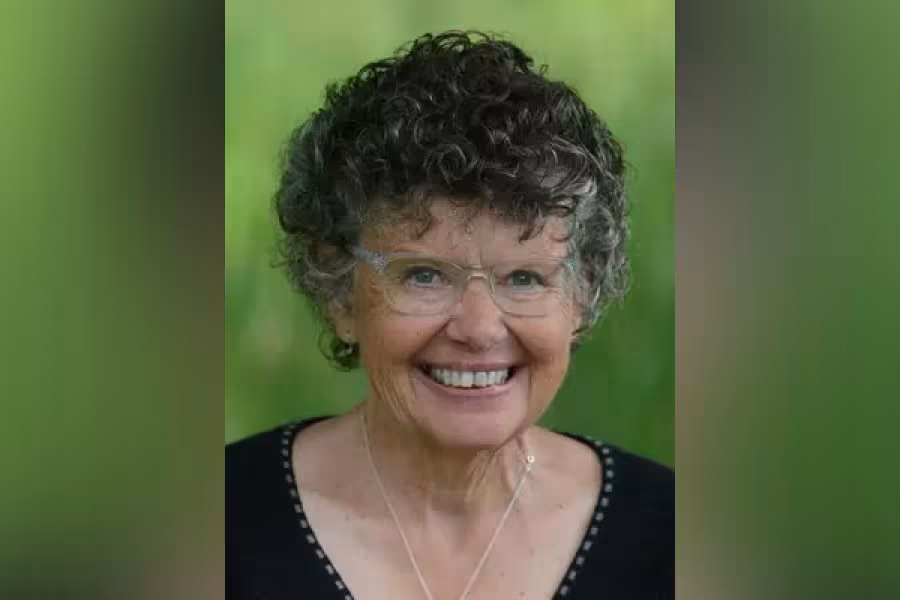
Interlochen Affiliation: IAC St 67-69, 71-72 | IAC Fac 73-19, 21-26
Interview Date: July 17, 2025
Coggin Heeringa has spent 57 summers under the stately pines and has been an instructor of environmental studies at the Walter E. Hastings Nature Museum at Interlochen Arts Camp since 1971.
This oral history is provided free by the Archives of the Interlochen Center for the Arts (ARTICA). It has been accepted for inclusion in Interlochen’s audio archive by an authorized administrator of Interlochen Center for the Arts. For more information, please contact archives@interlochen.org.
00:00:00 ELIZABETH FLOOD
Today is July 17, 2025, and this is an oral history interview with Coggin Heeringa conducted by Elizabeth Flood on the campus of Interlochen Center for the Arts. Thank you very much for coming in and speaking with me today.
00:00:13 COGGIN HEERINGA
Happy to be here.
00:00:15 ELIZABETH FLOOD
So please tell us your name, your connection to Interlochen, and the years that you have been here.
00:00:21 COGGIN HEERINGA
My name is Coggin Heeringa, and I am now part of the Interdisciplinary Arts faculty, but I teach environmental studies both to musicians and to the Interdisciplinary students. I came here in 1967 as a Counselor in Training, and I have missed two years since then. One of them because of Covid. And I've been working at the Walter E. Hastings Nature Museum as an instructor since 1971.
00:00:56 ELIZABETH FLOOD
I want to ask first about your favorite place on campus - if you have a favorite place on campus, or places, where you have memories. But then I'm also interested in how campus has changed. You have seen campus change in your time here.
00:01:09 COGGIN HEERINGA
I have seen campus change, and sometimes for the better, and sometimes I miss things. My favorite place on campus is actually a place in the woods beside the Little Betsie River, and there's a misshapen tree that for years children have called Coggin's throne, and that is my favorite place in the woods. But on campus, I just love the campus. I do.
00:01:37 ELIZABETH FLOOD
Earlier, when we were on the walk, we were walking into this building, you were telling me about some of the changes in The Mall.
00:01:43 COGGIN HEERINGA
Oh my goodness. By the time I got there, the deer weren't here anymore. But there was a very big building called the ABA building, that when I came it had an information booth, it had the ticket booth, and it had instrument repair and it was right in front of Kresge. And so when people came onto campus, they would come up to buy their tickets or ask for information. And sometimes when I was early faculty, I did volunteer over lunch hour to answer questions about the campus. There wasn't that much campus then, so it was much different. We used to have lights in the campus that pointed upward. Now with the dark sky and everything it would be light pollution, but at that time it would just shine in the sky. It was so beautiful. And in the wintertime, when it came, or even when it rained, in the light you could see the drops or the flakes coming down, and it was just magnificent. So I remember that as something very beautiful when I was here. And then at the time I came, the wishing well actually was a wishing well. And in the middle of the wishing well was a little silver dish. And when you put a coin in, your wish would only come true if you hit the dish. They made a lot of money that way, but they finally discontinued that because the last day of Camp, the Intermediate girls threw their red socks in because they had graduated on to High School and it was so expensive to clean the plumbing every year they made it a planter.
00:03:17 ELIZABETH FLOOD
This is not a campus change, but I was instructed to ask you about the sleep time, sleepy music? Dream music?
00:03:25 COGGIN HEERINGA
Slumber music.
00:03:26 ELIZABETH FLOOD
Slumber music!
00:03:27 COGGIN HEERINGA
Slumber music, yes. Girls or boys, it happened on both sides, would go to bed. There'd be "taps," that was time for bed. After they were lying down and it was quiet, one cabin at a time would go around and behind the cabins in the woods, they would sing some quiet folk music and stuff, and it was called slumber music. And so in the cabin, you would have rehearsals because next week we were going to have to do slumber music, and we'd choose our folk song that we were going to sing, and like Kumbaya and stuff like that, and then we'd practice it. And the night we got to go out, and it was dark and the stars were blooming, and we'd sing these songs, and just go from cabin to cabin and sing slumber music all around the division.
00:04:12 ELIZABETH FLOOD
Where I live, in Picasso right now, there's a harpist who practices in the basement of the building. And so at night when I'm going to bed there's usually someone practicing playing harp. And so when I found out about slumber music, I was like-
00:04:25 COGGIN HEERINGA
I know what you mean because where, let's see what would be there now? Where the Dance Building is used to be faculty housing, but there would be four of us in one of these cabins. We called them hovels, and that was a good name for them. And there was one bathroom for the four of us, and then the walls didn't go all the way up to the ceiling. They just went part way. And the people on the other side of me for years were classical guitar players, and they would be strumming at night. So even when I left the division and became faculty, I still had slumber music.
00:05:00 ELIZABETH FLOOD
How did you first learn about Interlochen? What brought you here?
00:05:04 COGGIN HEERINGA
Well, in my high school all the good kids came to Interlochen. And it was always a dream, but I wasn't that good. But my family was on vacation on the Door Peninsula, where I now live, ironically, and it was a terrible time because it rained every day. And we did all this touristing, and I then told my dad, I said, "This is terrible. If we took the ferry across the lake, we could go to Interlochen, and we could Camp there, and it's not raining there." And we did. And it was the year of the International Music Educators Conference, and we were in the State Park when the place was just bubbling with all sorts of famous composers and all these educators and guest conductors. And I would, at dawn, walk over from the State Park, and I'd stay here till call the quarters for the kids, and then I'd go back. And for a week, I just took in Interlochen. And the day before I left, I had a lavalier around my neck, and I buried it in The Bowl. And I said, "I'm coming back." I didn't put a time limit on it. That was fifty-eight years ago. [laughs] It was weird. There used to be a little amphitheater that is now where Corson is called The Shell, and it was like The Bowl only it was littler. And one day I was sitting on park benches, and the choir was rehearsing, and I was sitting next to this man, and we were chatting, nice guy. And the conductor turned around said, "Mr. Nelhýbel, is that the tempo you had in mind?" And I go, "Oh my god, you're famous." And he says, "Yes, I am."
00:06:44 ELIZABETH FLOOD
You've met a lot of memorable people here.
00:06:46 COGGIN HEERINGA
Oh I have, yeah! Kodaly was here then. I mean it was just amazing! And all these people, people from all over the world, and I thought this was the most wonderful place on the earth. And it was.
00:06:58 ELIZABETH FLOOD
Could you tell me some more about some of the other memorable people you've met along the way and in your time here at Interlochen?
00:07:05 COGGIN HEERINGA
When I was a counselor, we were allowed to one day a week take a night out. And I took the nights out that festival choir rehearsed. And so in festival choir, I sat next to a University student whose name was Jessye Norman. And that's when I decided to major in science because I realized if that was a voice, I didn't have one. And so actually Jessye changed my life. She never knew, but that's a famous person, and my goodness, she could sing. Even as a college student she was amazing.
00:07:41 ELIZABETH FLOOD
What are some of the projects or performances or activities that you've seen or partaken in that are memorable to you or stick out in your memory?
00:07:52 COGGIN HEERINGA
Well festival choir was always important to me, and we used to have guest conductors come in, like Robert Shaw and people like that would come in, and sometimes that went well, and sometimes it didn't go well. There were like three hundred people singing, and they were huge. And so Margaret Hills was a conductor. We had wonderful, wonderful conductors, and some of them were kind to the students, and some of them were a little demanding, and some of them it was just a very poor match. But every year we got to sing under a famous, famous conductor, and that was exciting. And then it's been kind of fun when people who were campers have come back, like when Josh Groban came back, and I remember that concert because at the end he was going to sing a song, and he wanted the choir to be in it. And he wanted them to wear uniforms, so he was singing "You [Raise] Me Up," and he was just singing along, and then they had a ladder, and the choir came up the ladder, and they came down in their uniforms, and the kids were embarrassed but. And the audience just broke into applause and crying, and it was just, it was the concert. And I remember when Howard Hanson was here for the last time, and he was doing "A Sea Symphony". He conducted it, but then at the end of the concert instead of letting the concertmaster do the theme, they handed the baton to Howard Hanson, and he started the theme, and he kept going to the end of the piece. Oh my goodness, that was memorable. That was special. It was a night. Yeah, that's a memory that I remember with famous people here.
00:09:30 ELIZABETH FLOOD
Famous or not famous, but the people who make this place happen. You've met many people who-
00:09:36 COGGIN HEERINGA
I have. And there used to be traditions. Like every year there was a huge operetta. I mean, cast of a hundred and fifty, and you didn't have to be a voice major. You could be a ceramics major or a dancer. Anybody could be in the operetta. And Dude Stevenson did the choreography for it and made sure that every person in the show was in the frontline at some time. So there were these swirling and they were in costume, and everybody went to the operetta, and everybody was in the operetta. They were huge. And so I got to see many, many Gilbert and Sullivans there. But another thing, back before there was a festival -so we just entertained ourselves in those years -there was always a faculty dance concert. And Joe Kaminski and Sheila Reilly would do a duet. Sometimes they were funny, you know, a Charleston thing. Sometimes they were very sad. They did "Pavane for the Dead Princess," which I still remember to this day. Beautiful dance. But then there was another dance teacher named Mr. Hug that was humorous, and he would fly in from the rafters or come in from the back door. Faculty dance concert, people could hardly wait for it. It was one of the highlights of the year. It was just so wonderful.
00:10:58 ELIZABETH FLOOD
And around when were they doing this? When did they stop doing it?
00:11:01 COGGIN HEERINGA
Oh, it's all faded out. A lot changed when we went from eight weeks to six weeks. It was eight weeks. Even the Juniors came for eight weeks, and then they made the Juniors shorter, and then they made everybody shorter, and then they made that shorter. So now there's all sorts of combinations. So they have an intensive week before Camp starts. They have three sessions of two week Juniors, two sessions of four week Juniors and six week Juniors. They have three week Intermediates and six week Intermediates. And then they have a full thing of High Schools and a half thing of High School. So there are many combinations, plus the intensive at the beginning, and then some kids, many kids, come to Camp, and then they come back for band camp the next week when that's over. So it's a season.
00:11:47 ELIZABETH FLOOD
Could you speak to how the change from six weeks to eight weeks changed your teaching at all?
00:11:52 COGGIN HEERINGA
It absolutely changed my teaching because in the early years every student had two electives. So they would have a major, but then they could choose two classes that weren't in their major, and they could opt to take environmental studies. Or in the very beginning when I started it was called Nature Lore and Conservation, which the kids called Nature Bore and Constipation. So we changed the name to Environmental Exploration, and that's what we still call it today. So they could take anything. A flute player could be in the operetta. If you were in operetta, you could maybe take one class in ceramics or metalsmithing or whatever. So every kid got sort of a Whitman's Sampler of the arts. Which I thought was very important because by the time they get to college, they have to focus seriously on what they're doing, and high school is the last time you can experiment and have kind of the freedom to fail. And I did that here. I took two summers of organ lessons and discovered I do not have the coordination to play the organ, but I appreciate it because I struggled. I found out how hard it is. I understand what it is. And so now when I go to an organ concert -Oh, Chapel Oregon! I haven't mentioned that. And I've heard amazing people at Chapel Oregon because they bring in famous people. Every Sunday, some famous organist would come and play, and I can't do it, but I can certainly appreciate it because I took lessons here, and it was hard.
00:13:30 ELIZABETH FLOOD
You had three logos on. Three different Interlochen, two different Interlochen logos.
00:13:36 COGGIN HEERINGA
I'm wearing three today [laughs].
00:13:37 ELIZABETH FLOOD
Could you talk about the different logo changes over time?
00:13:39 COGGIN HEERINGA
Because I knew I was coming, I got out one of my heritage sweaters. Well, first of all, my original sweater which I will wear next week for Emily Boyd's Memorial, so I'm keeping it clean. It was blue. It said National Music Camp, and it had a lyre on it. And so when we were National Music Camp, we had a lyre. And then we had a extremely ugly one where they had four different icons for the different arts, but they weren't really matching very well. It was MADDY. It was Music, Art, Drama and Dance and Youth; MADDY. And that was very cute. And that went away. And then we had what we now call the pregnant 'I', which is just like a laurel wreath around an 'I'. And then we had the flowing banner logo, and now we have the interlocking logo. So we've gone through five, and I think I am wearing four of the five today just because I don't throw away my clothes.
00:14:38 ELIZABETH FLOOD
Did you know Joe Maddy?
00:14:40 COGGIN HEERINGA
No. He died two years before I came, as did Walter Hastings. But I do remember in my orientation from Emily Boyd: every noon the Intermediate girls had to sing a grace before eating, but it was non-denominational, and then they had to wait till the counselor picked up her fork before they could begin eating. It was a very, very etiquette school sort of thing. So, every day we sang these different kind of grace songs, except we were not allowed to sing Johnny Appleseed because Joe Maddy didn't like that song. Okay, he's been dead for two years, but we don't sing that song. Joe Maddy didn't like it. Okay. And that sort of thing went on for a very long time. Joe Maddy wouldn't like this. We can't do this, Joe Maddy wouldn't like it. For example, they'd play call To [The] Colors before a rehearsal, and if you heard that anywhere on campus, you had to stop and stand at attention till it was over. During the World War Two, they were very, very into being American and nationalism, and they were very into playing American music during all that time. And every concert had to have some American music on it. That was really a big thing. And even back in the '40s, they were playing Florence Price and stuff like that. They did American music intentionally to try to spread American music because most of the symphony orchestras were still always playing European music. So we always had American music on almost every concert. Oh, of course WYSO every week, World Youth Symphony Orchestra, would play, and the entire campus would go. It was like a big family reunion. And they'd play the theme, and then after the theme, there was silence. And that is one tradition that has gone away that really hurts. And then that morning, there would be an all Camp service, and it was non-sectarian, and it would start out with the brass choir playing for fifteen minutes doing pretty much Baroque music with brass choir. And in Kresge it was amazing because it would reverberate throughout the building. You'd go early so you could hear the brass choir, and then each week one of the choirs would sing, and one of the faculty would give a so called inspirational message. In my early years, once a year, Mr. Stone would come and give the sermon. W. Clement Stone was responsible for us surviving, actually. Gave us money to build the Academy. He was greatly respected. He had a big thing about positive attitude. And he would give these speeches about, "I'm happy and I'm healthy and I love it," and the kids had to repeat it. And we'd, "Girls, don't laugh, don't laugh. He's our benefactor. We need him. Don't laugh." Okay, so we were all healthy and happy, and we loved it!
00:17:34 ELIZABETH FLOOD
I spoke to Chuck Kelly, who gave one of these sermons.
00:17:38 COGGIN HEERINGA
I gave a sermon every year.
00:17:39 ELIZABETH FLOOD
Did you? What was yours about?
00:17:41 COGGIN HEERINGA
Well, every year it was different.
00:17:42 ELIZABETH FLOOD
Yes. What were some of them? Do you remember?
00:17:45 COGGIN HEERINGA
No, but I do remember why he did it. Because Howard Hintz, he worked at the Academy, but he was in the program office in the summertime, and he would invite the people to talk, and if you did, he'd write a thank you note. And Howard Hintz wrote the most beautiful thank you notes in the whole world. And I wanted thank you notes, so I would do it [laugh] in order to get the thank you note. So he organized that. I remember I usually got the one right around the Fourth of July. And so he'd say, "What are we going to do for hymns?" And I said, "It's close to Fourth of July, you know. We could probably do something maybe patriotic. And one time he arranged for the brass choir, when they left to just come around behind the piano, and they did [sings Ta-ta-ta], the whatever it was. So it sounded patriotic, and that was memorable. Oh my goodness, it's so cool! And it was. But yes, all the kids went, and that was just a tradition. But slowly we did away with any of the kind of religious stuff. There are still religious services that take place on campus, but they're organized by staff members, not by the institution.
00:19:00 ELIZABETH FLOOD
Could you talk about some of your colleagues and the people that you worked with, like Lyman?
00:19:05 COGGIN HEERINGA
Yeah, I worked with Lyman for, we figured out, thirty-seven years. When I became the new environmentalist, my training was biology, and so they needed somebody in geology, and Bill and Emily Boyd knew this guy from somewhere else, and thought he might be a good fit. And so Lyman and I worked together through many life changes, and we worked together for thirty-seven years. It was wonderful. And it was an eight week camp then, so I would teach biology every other week, he'd teach geology, and then we'd switch, so each kid would have four weeks of each of the areas. A lot of the people who are here now have been my students in the past which is a little creepy, but it's fun. J Berry's granddaughter was my class last week, and she said, "Coggin was my teacher too." It's just weird. Quite often I have second generation. More and more often I have third generation.
00:20:07 ELIZABETH FLOOD
Where did you grow up?
00:20:08 COGGIN HEERINGA
I grew up in Dixon, Illinois.
00:20:10 ELIZABETH FLOOD
I'm curious about what it was like to learn about this land? To be an ecologist here.
00:20:17 COGGIN HEERINGA
I learned by doing. I mean I was here, so I had to learn the plants and the animals, but working with Lyman I got a pretty good background in geology and an interest in it. And I can spot a Petoskey stone at twenty feet. I mean, this is a thing here in Michigan. In fact, yesterday my students went looking for Petoskey's because that's what you do at Interlochen. And if you find one you're gonna have good luck. But you can't just buy one with an ice cream token. That doesn't count. Ice cream tokens are a form of currency. The kids trade things. They buy things with it. They gamble with it. Ice cream tokens are currency with the current students.
00:20:59 ELIZABETH FLOOD
Were ice cream tokens here when you got here?
00:21:02 COGGIN HEERINGA
No, no.
00:21:02 ELIZABETH FLOOD
Is this a recent phenomenon?
00:21:04 COGGIN HEERINGA
Maybe yeah, it's a recent phenomenon. Back in the division, if you won something wonderful, you did something just extraordinary, you got a bathtub pass because the Junior Intermediate infirmary had a tub! You know, six weeks in the sand, a bathtub pass was something.
00:21:29 ELIZABETH FLOOD
Things have changed at camp. [laughs]
00:21:33 COGGIN HEERINGA
I guess I would say Emily Boyd was my first director. So Emily and Bill, until the day she died, we were in communication. And actually I got a call from her son last night. I'm going to speak at her memorial, so. It is family. And here at Camp, I, for some reason, am kind of included in the voice faculty family in the evening. I have lunch with the radio people, and I have breakfast with theatre people. So I have been very lucky to really become friends with a lot of different people and learned from all of their experiences.
00:22:14 ELIZABETH FLOOD
And that feels like the gift of this place.
00:22:17 COGGIN HEERINGA
Exactly, yeah. It is all of the arts. And I kind of like the tagline: "Where nature meets the arts," because we are. And I think it's really important for our kids to be exposed to the arts, but also to be exposed to nature at the same time. Because I hate to say it, but scientists are really bad communicators. Artists can communicate through their arts. And how many singer songwriters have written influential songs about saving the Earth? How many classical composers were inspired? Visual artists, that's their muse, I mean, that's where they go. So if our students become familiar with the environment and become stewards of the environment and proselytizers -if they preach the environmental thing, we might actually turn this thing around. So that's a good thing. I take secret, secret joy when I find out some of my students have gone into environmental fields, and many of them have. This is a funny story. We had a new session come in, and there were some return campers and some newbies. And the return campers were kind of telling kids the ropes: "Coggin, we think she likes kids. She's kind of weird, but she asked a lot of questions, and if you don't know the answer, just say it's probably because of the glaciers, and you're going to be right." And so I was all ready to refute that. It's true. It is. I mean, the reason we're in the lakes is because the glaciers. The reason there's sand here. Everything. It's all because it's glaciers. Why are there sand dunes? Because of the glaciers. And then one kid had to challenge me, "Why are we so smart?" And I said, Well, you know, there are anthropologists who believe that during the early ice age period, people who learned to communicate and remember things survived, and just the hunter gatherers didn't. So we could almost attribute some of the human intelligence to only the people who develop intelligence because of the glaciers survived, and you are the descendants of those people. So it's all because of the glaciers. I couldn't not say that, and that's just speculation, but it's true. I often tell the kids they're the descendants of very lucky people when you think of all the bad things, the pandemics, the earthquakes, the starvation, all these things, and still somehow the human race has survived. And every one of them made it because every one of their ancestors was either lucky enough or smart enough to do that.
00:25:09 ELIZABETH FLOOD
Do you have any advice for students today or in the future?
00:25:14 COGGIN HEERINGA
For the kids who are really, really focused on their art: look beyond and take advantage of other things because you can burn out, but if you also enjoy the rest of the world -Experiment with something else. Learn about other things. There is more to your art than your art, and anything you learn is not wasted.
00:25:36 ELIZABETH FLOOD
Okay, we've been talking a lot about changes in different ways and forms. What do you hope for Interlochen in the next hundred years is a question I've been asking people, and I'm interested specifically in what are the traditions that you hope are carried into the next hundred years? And what are some of the things that Interlochen hasn't been doing that you would like to see in the next hundred years?
00:26:03 COGGIN HEERINGA
I just spent the afternoon with somebody who is, Academy grad who is, really into environmentalism. I would really like us to protect the land that we're on. I would really like to see a very sincere restoration plan to protect the land, and restoration isn't going back to where it was. It means just make a viable and sustainable environment where plants and animals can thrive, and in that environment, young people can thrive also. On the other hand, when they came this was cut over beer and wasteland. There was a lumber camp where Pines Division is with a lumber mill. There were a schoolhouse that's now the little Red School House. It's been moved several times. There was a narrow gage railroad that ran through the campus. And in fact, Interlochen is not between the lakes. It means it's a place where the narrow gage railroads would interlock. And in the early years of the Camp there were still piles of sawdust, and the kids played king of the mountain on it, and they had to plan getting across the road before their train came through because if they were late in the early years- Well, being on time has always been very important here. We are on time, and it used to be imperative. And this is sand. We're a sandbar. We really are. And when the narrow gage railroad loaded with logs would come through, they could feel the sand vibrating. And I've had people, who I knew in the beginning, remember when the railroad went through. Early on there was like horseback riding and there was roller skate classes, there were accordion choirs. It was different. I don't think we need to go back to the roller skate classes, or maybe even the accordion choir is just as well it's gone, but some things that have gone away like early music program has gone away, and that's a big loss, in my opinion.
00:28:03 ELIZABETH FLOOD
What was the early music program?
00:28:05 COGGIN HEERINGA
They did Baroque music, and they had all these madrigal singers and things like that. It was so lovely, but not too many kids were interested, so that went away. We used to have huge concerto competitions. And I mean, huge, huge, really competitive. People were going all over to listen to auditions, and the winners would play with WYSO on Sunday night, and that is not as big as it used to be. They still have sort of a competition, but it's not the whole Camp turns upside down for three days for the auditions, which was pretty much what happened.
00:28:42 ELIZABETH FLOOD
I'd been trying to understand what challenges were.
00:28:44 COGGIN HEERINGA
I was never involved in challenges, but I was the counselor that had to take care of the children on bloody friday when they came back from the challenges. And it was traumatic. And in some ways, I'm sure it's good because it made them practice, and it really let the good student progress, which was Maddy's idea that you could progress as far as you could, you could be as good as you could. But it was traumatic for the kids to compete, and they did call it bloody fridays, and it was- I probably still have tears on my shoulder from the years I would, "Well, maybe, maybe was just bad day. I know you missed that note," and they were blind challenges. The kids would vote, but they didn't know who they were voting for, so. But they did. I mean, everybody knows their own. They kind of knew. It was political too. There were good things and bad things about when it was a huge thing.
00:29:44 ELIZABETH FLOOD
When I'm talking to people who went to Camp or the Academy, I've been trying to really poke at more of the social scene. And I'm really interested in what the social scene-
00:29:55 COGGIN HEERINGA
Did you say polka?
00:29:56 ELIZABETH FLOOD
Oh-
00:29:56 COGGIN HEERINGA
Did you say polka? Yes, polka! Social scene, yes indeed. There was a polka band, and that was made up of people, mostly High School boys counselors but some musicians, and they made arrangements of famous pieces of music like the Les Preludes polka, or the Ride of the Valkyries polka, or even the Interlochen theme polka. Yes, it is very bouncy, and they would play at the Fireplace Inn, and then as soon as we got the kids to bed, the staff would go out and polka. Except I'm from Wisconsin where people really polka. These were people who did not know how to polka, so it was more like bumper cars, and it's almost dangerous, and it became more dangerous as the time going on. But they also, every once in a while, would just set up in main Camp and polka. And they'd play the polka music, and people would just be out on the Mall polkaing. And apparently when they were clean out of Emily's thing, they found the scores for the polka band. And so they may exist. Who knows? This a rumor. There are many rumors, but the rumor is there is now an available set of scores with all parts of the polka music arrangements, but it was fun. It was fun. And then there was 'Cabin K,' which was The Karlin Inn. And Karlin Inn was a dive, but it stayed up late, so after the kids were in bed or the stage was struck from a program, or whatever, people go there. Especially at the end of a production. Then the entire staff would go there, and that was 'Cabin K.' And also the Hofbrau used to be an old house, and it just became a bar. And there was a lady named Marge there. And Marge owned it, and she really liked Interlochen, and that was a place people went a lot. And then after she sold the place, and they started fixing it up, she became a very loyal volunteer, and she would bake cinnamon rolls for the Junior boys counselors every week, and she was the world's worst cook. And so she'd come in, and they said, "Oh Marge! You brought us cinnamon rolls. Oh, we're gonna wait for our meeting, and then we'll have them during the meeting," and then they'd play frisbee with them or whatever. Everybody loved Marge. You do know about dune goons? When they go to the dunes, there's this very steep hill, a dune climb. And if you go up and down the hill ten times, you get to be a dune goon. So how do they keep track? Well, a counselor with markers on the bottom of the hill, and a counselor is at the top. And every time you go go up, you got one, you know, you come down, you get a cross. And so there would be dune goons, and sometimes double dune goons, and maybe even if it's a cool day, triple dune goons. And the ballet teachers hated it because there're these little girls that they're fitting for their tutus for their concert, and they have x's up and down their arms. That was a tradition, and they made them go in their knickers. The kids would go up to tourists at the dunes and say, "We're from orphan-lockin and they make us wear these clothes, and they don't give us any food. Can we have some candy?" And people would give them food. But they actually did take them. They took them to The Cherry Hut, and then they got to have cherry pie a-la-mode at The Cherry Hut. That was a big deal. And sometimes we took a bus to Gwen Frostic's and got to meet Gwen Frostic. That was a person that was influential in my life. We'd take the little girls, and one day I got over my fan girlness. I said, "Miss Frostic, I'm trying to be a freelance writer. And do you ever have writer's block?" And she looked at me and said, "My dear, if you know about a subject enough, words will pour forth from you." In other words, do your homework. And even before I do my little radio segments, I probably put three or four hours into researching the thing because if you know enough about a subject, you don't have writer's block. Words just flow. They come. They're there if you know enough. So she was influential, and she was very involved in the Camp up to a point. There actually was a garden in her honor behind the Chapel in the early days, but it's sort of gone away.
00:34:47 ELIZABETH FLOOD
I went to her house a few weeks ago.
00:34:50 COGGIN HEERINGA
Isn't it amazing?
00:34:51 ELIZABETH FLOOD
It is. The number of presses is incredible!
00:34:55 COGGIN HEERINGA
And they were from Germany. I mean, they were the real meal. They were running all the time, and she was printing books and cards, and of course the little girls would buy the cards to send to their parents and stationery and books and poetry and- Oh and then, did you see the footprints in- No? She never told people how she got the animal footprints into the concrete of her house. And she'd take the girls up to her private apartment and give them lemonade and a cookie, and it looked over the pond, and we all got to be there with Gwen Frostic.
00:35:30 ELIZABETH FLOOD
What a magical experience.
00:35:32 COGGIN HEERINGA
Yeah, that was every year. We every year, we took the girls and it was Camp.
00:35:38 ELIZABETH FLOOD
And it's so formative to see an artist in their own space out in the world, being an artist as an adult. I think that that's really important for children to know that you can like live and be.
00:35:51 COGGIN HEERINGA
Live and be. They say, "Oh, you know, I can do this."
00:35:55 ELIZABETH FLOOD
Yeah, I can live as I am.
00:35:57 COGGIN HEERINGA
I am who I am. And in her case, she was this wizened, old, crippled lady, but she was somehow radiant anyway. Oh, and she sometimes did Sunday service and came and talked to the kids.
00:36:12 ELIZABETH FLOOD
Really!
00:36:13 COGGIN HEERINGA
Yeah.
00:36:14 ELIZABETH FLOOD
A broad question that we've been asking, but I think is really important. Why does art matter today?
00:36:21 COGGIN HEERINGA
It's what makes humans human. It's how we communicate without words. It's what makes us different from any other animal, is that we can show our feelings through a different medium. And it doesn't matter which one, they all communicate in some way. I lean toward music. Well, I like the visual arts, and creative writing is sort of what I do, and I'll never be a dancer, but I wanted to be. Oh, this was funny. When I was a child, I lived near Chicago, so every year for my birthday we'd go on a train to Chicago, and we'd see Marshall Field's window, and then we go to the Nutcracker in the afternoon. So I'd watch The Nutcracker, and I wanted to grow up to be an Indian princess like Maria Tallchief. I come to Camp. I make friends with Joe Kaminski, and discover that Joe played Drosselmeier and Mother Ginger in the productions in Chicago, and he had for years danced with Maria Tallchief. And when I said, "Oh, was that wonderful? He was a little harsh in his description of her. On stage she was magical. So Joe was a faculty member here in the summer. He also was one of my very best friends of ever. I told you about faculty dance, and he and Sheila would do those dances. But then he was in my breakfast club- There are breakfast clubs, and so he, A. Clyde Roller, Freddy Fennell, we all had breakfast together every morning for year after year after year. The breakfast club has just continued, different people years, but three of us are still alive, and we still all have breakfast together. He was kind of the father of our group. Oh and Wayne and Mary Brill, who were the Camp photographers, were in that group, so. You've seen the Brill collection of photographs, right? He had studied with Ansel Adams, so he was a very good photographer. In the basement of Brahms they had a film center, and they would go down there and do the magic. And he was fresh out of this workshop with Ansel Adams for a while, and so everything was artsy fartsy. It was great. And they were at the table.
00:38:41 ELIZABETH FLOOD
Every day you ate breakfast together in the breakfast blub? What is the rules?
00:38:45 COGGIN HEERINGA
7 o'clock. Culver dining room. Except then it wasn't. And for years that dining room was a gallery in the and they put up students art in there. And in the early years, until very recently, until thirty years ago, maybe there was a flower shop in the basement of the hotel, and they would make arrangements, and there would be a flower arrangement on every table. And then they'd also make little woodsy things out of mushrooms and dried flowers and stuff, and sell them as souvenirs. And so we had fresh flowers for everything. There were fresh flowers on the dining room tables in the dining hall and special ones in the faculty dining room because we were special. And then they also sold like individual roses and things like bouquets. And so after a show, kids could buy roses and take them to kids. Yeah, the flower shop. That's a forgotten thing. We don't have a flower shop anymore. Mrs. Wilson was in charge of it. George Wilson's wife.
00:39:46 ELIZABETH FLOOD
Were the flowers grown here? From the flower arrangements?
00:39:49 COGGIN HEERINGA
They'd go out and nip them from the gardens, and there have always been gardens here. I'm thinking of a lot of things. Did they tell you about Capers? Every cabin has to clean. I would not have named housekeeping Capers. You clean, and you'd have a job every day, and they took cabin inspections and white gloves, and you might get the golden dustpan if you did really well. And so that was a tradition. Twenty minute swim, you've heard about the twenty- Oh, you haven't heard about the twenty minute swim! Before you could go out in the boats you had to swim twenty minutes, back and forth. And if you didn't, you couldn't go in a boat. You couldn't go in a canoe. The idea is if you were drowning we could reach you anywhere in the lake, if your boat turned over or something. So you had to swim twenty minutes. You had to turn over a canoe, and you turn it right back up again and get into it. And passing your twenty minutes was huge. You wanted to pass your twenty minutes. Oh, and everybody had a badge. You know about badges? And when you went swimming, you put the badge on the badge board. And then when you got out, hopefully the badge board was empty. And if the badge board wasn't, we'd have a lost swimmer drill, and they'd blow an air horn, and all the counselors would go and we'd go searching. And sometimes they'd have drills, and they'd hide a child somewhere, and we couldn't find the child on land or sea, and I was a lifeguard then. We had these sweatshirts that said, "If we don't do our job, someone dies." No pressure.
00:41:29 ELIZABETH FLOOD
What a terrifying uniform of your sweatshirt.
00:41:33 COGGIN HEERINGA
Well, I got my WSI here when I was a Counselor in Training, and we had to take three hours of swimming class. It was cold back then. It was much colder then. It was very, very cold in the early days. I mean, kids would wear mittens to practice. We'd let them take pillows and blankets to concerts. It was cold. Don't let anybody tell you it's a myth. It was cold in the '60s and '70s. Really cold.
00:41:56 ELIZABETH FLOOD
I've seen, looking through the old photos, people wearing jackets. Yeah, and I was wondering if it was a different season, but now I'm hearing-
00:42:03 COGGIN HEERINGA
It was cold.
00:42:03 ELIZABETH FLOOD
-it was cold all the time, okay.
00:42:05 COGGIN HEERINGA
And everybody had sweaters all the time.
00:42:07 ELIZABETH FLOOD
That's changed.
00:42:08 COGGIN HEERINGA
Yeah. Well sometimes it's cold! When I was taking my WSI, we'd have a thing on the beach, a fire so we could warm up. But then when I was a lifeguard, I was in Intermediate girls, and the kids would know when I get done teaching. And so kids in my cabin would- they were so sweet- they would turn on the shower so it'd be hot and steamy, but they'd also take my hair dryer and put the tube in my bed so I could take a shower and get in my bed and thaw out before we go to supper. Isn't that sweet?
00:42:38 ELIZABETH FLOOD
Taking care of each other.
00:42:40 COGGIN HEERINGA
Yes, exactly. And I have always thought Emily and Bill Boyd, they were in education, that we were a case study, and they were studying how cabin unity happened and how collegiality developed. I don't have any proof. She'd do questionnaires sometimes. I was very suspicious that we were case studies. And she always said my cabin was collegial, so that made me proud.
00:43:05 ELIZABETH FLOOD
Now I'm intrigued by these questionnaires.
00:43:08 COGGIN HEERINGA
If you have a chance, do you sit with members of your cabin? Do we ever have fights in the cabin? Do you ever have any-? They didn't have the term mean girls then, but they had mean girls then. And I lucked out, very rarely had any mean girls in my cabin. So that was a good thing because mean girls are real, and it's a hormonal thing. It happens to Intermediates. It's gonna happen. What else do I remember that was weird in the divisions? Well, first of all, they didn't bring their clothes, they sent them in railroad trunks. So they all came with trunks, and when they came we had an inventory, and we crossed off what they had, and then we put the trunks in the, and when we left, we had to go through and make sure everything was put in. And every week, we'd send the clothes to the laundry and make sure they got everything. Now they do it here on campus, but we had to send things away to a commercial laundry in those days. Intermediates have twenty-two thousand pounds, I think, of laundry a week, something like that. It's huge. Think of all the socks. Think of the shirts. Think of the uniforms.
00:44:12 ELIZABETH FLOOD
That all look the same.
00:44:14 COGGIN HEERINGA
That all look the same. This is a little town. We have, you know, we have a sewage treatment plant. We have maintenance plants. We are a city.
00:44:22 ELIZABETH FLOOD
Thank you so much for speaking with me today and for having me in your classroom last week.
00:44:28 COGGIN HEERINGA
Okay, well someday I'd like to take a walk with you and show you where buildings used to be.
00:44:32 ELIZABETH FLOOD
Yes please.
00:44:33 COGGIN HEERINGA
Because it's different. So I'll take a walk with you. And you didn't know about the radio shack or any of those things. Before they built the station, we had a recording studio behind The Bowl, but that was right by the Intermediate waterfront, which is now moved because the Dow building went in. It's different.
00:44:52 ELIZABETH FLOOD
I'm curious about how you feel about history being preserved. I know this project is a lot about trying to gather some of these traditions and how things have changed. And things change for many reasons, and are sometimes good, the change, but I'm curious how you feel.
00:45:11 COGGIN HEERINGA
Well, I am very into restoration at my other place, and I do a lot of oral histories there. I'm not trained, but I do them because there has been so much human impact on the land. And you can't do restoration without finding out how people have impacted the land through the years all the way back to the indigenous people. Here, you can't plan the future without understanding how we got here. And that is one really important part of the archives. The other thing is, I cannot understand why they don't pour more money into the archives because if somebody becomes famous, they're going to want their cabin picture from 1960. They want to know what Josh Groban looked like when he had a smaller mouth. They're going to want to know if somebody was in cabin three, and what she looked like when she had braces. And it exists, but it's all moldering. It's just they haven't put enough money into it. But you can't plan the future without knowing the human impact of the past. That's why it's important, and that is a personal question, but that comes out of my environmental work. If we don't know how people despoiled the land, we don't know how to fix it, and humans have had an immense impact on the physical plant of this land.
00:46:33 ELIZABETH FLOOD
I hadn't so explicitly thought about the relationship, and thank you so much for making that statement about the relationship to time and history and land and archive.
00:46:43 COGGIN HEERINGA
How can we restore the natural environment without knowing that it was clear cut. And when we planted we planted plantations of monocultures, and we happened to plant trees that aren't very helpful to wildlife. And we are letting invasives go into our riparian wetlands, but that used to be where log drives went down that river, and we need to know that there was a logging village here. We need to know that indigenous people were here two thousand years ago. We need to know that, and it should plan our future. Okay, sermon over.
00:47:23 ELIZABETH FLOOD
Thank you so much Coggin for speaking with me today.
00:47:26 COGGIN HEERINGA
I didn't want to do this, but it has been kind of fun.
00:47:28 ELIZABETH FLOOD
I'm so glad!
00:47:29 COGGIN HEERINGA
I didn't want to do any personal things, but that is my experience. That arts and nature connection, that's my personality, that's who I am.
Copyright
Copyright to the audio resource and its transcript is held by the Archives of Interlochen Center for the Arts (ARTICA) and is provided here for educational purposes only. It may not be reproduced or distributed in any other format without written permission