
Oral History Interview with Chuck Kelly
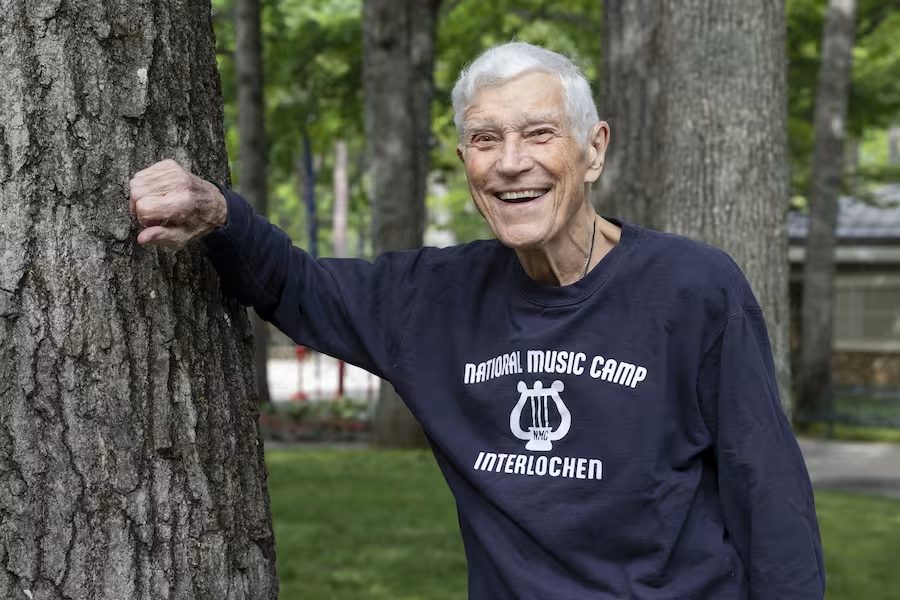
Interlochen Affiliation: AS 43-46
Interview Date: June 28, 2025
Chuck Kelly attended National Music Camp's All-State division for four summers, studying clarinet. He is also a proud Camp parent. He has stayed involved over the years as a member of the Alumni Board and as an Interlochen Trustee.
This oral history is provided free by the Archives of the Interlochen Center for the Arts (ARTICA). It has been accepted for inclusion in Interlochen’s audio archive by an authorized administrator of Interlochen Center for the Arts. For more information, please contact archives@interlochen.org.
[This is an Oral History interview with Chuck Kelly, conducted by Eileen Ganter on the campus of Interlochen Center for the Arts on June 28th, 2025.]
00:00:00 DR. CHARLES KELLY
This is Dr. Charles Kelly. I'm a retired dentist, and I haven't ever retired from playing the clarinet from Interlochen. [Dr. Charles Kelly begins rifling through the bags he brought in the studio. He pulls something out.] I'm sure you've got this picture.
00:00:19 EILEEN GANTER
I don't know that I have that picture.
00:00:20 DR. CHARLES KELLY
Okay, this is students, faculty and trustees. There's my wife-
00:00:28 EILEEN GANTER
Dee!
00:00:30 DR. CHARLES KELLY
and here's Jeff.
00:00:31 EILEEN GANTER
Kimpton, yes.
00:00:33 DR. CHARLES KELLY
I can't tell you the year, but Jeff was here. Well, do you want it?
00:00:37 EILEEN GANTER
Oh yes, yes, yes! Oh good! Thank you.
00:00:39 DR. CHARLES KELLY
I've got to get rid of this stuff.
00:00:41 EILEEN GANTER
Wow. This is a presentation piece.
00:00:46 DR. CHARLES KELLY
[He begins unwrapping paper from the bags. Suddenly, he drops a large metal object onto the table. He continues unwrapping, searching for something.] I don't know where I had these.
00:00:57 EILEEN GANTER
Oh, look at that.
00:00:58 DR. CHARLES KELLY
Yeah, here's a whole bunch of old ones that I just found a closet, and I don't know if you want these?
00:01:05 EILEEN GANTER
I want everything that has anything to do with Interlochen.
00:01:07 DR. CHARLES KELLY
Okay, 'cause I'll just give it to you now. Oh this was 2017, [clinks the medallion on the table] and this was the fifty year thing [lays the medallion on the table]. And here's another one, the same [clink].
00:01:25 EILEEN GANTER
Oh, those medallions. Yeah!
00:01:28 DR. CHARLES KELLY
[Continues looking through his bag, through the paper] This is the Applause Award, [places the award on the table] but I would like to keep that. We don't do that anymore. The Alumni Board, which was very, very much active back then. We had alumni clubs in Chicago, San Francisco, New York, Detroit, a couple other places, and they all had a president and a vice president and the secretary, and they met usually about every three months, and they raised money. All of their officers were on the Alumni Board of Interlochen. There was no Academy yet, and we met for a week in the summer, and it was the big alumni reunion, and it encompassed every class, not just recent ones, which is what we kind of do now. Which I am very much against because when you get the whole gamut of ages, that's when you get the tradition passed on. I really hope we will revive the alumni group. That's why I was hoping you could find that outline of the whole week that I put together for Mrs. Parsons because that showed all the stuff we did. We really did a big working session at the reunions. So anyway, this was given to the alum that did the most work for the year. There was one given out each year, and I luckily got one of them, so that's on my shelf at home. [Reading from the award] Interlochen Alumni Organization Applause Award. The usual thing for the alumni reunion was just a whole lot of meetings, because we were quite involved in the fundraising and other stuff that the alums could do. Always ended up with a bonfire on the beach with s'mores the last night. We ate in the dining room, but never with the students, like now. We waited till they were all done because we had a lot of speeches done during that time from all the people on the Alumni Association, and the president always summarized the year that went on and so on. It almost became a tradition; if you were secretary for two years and did all that work, you got to be a president for two years afterwards. So I was. One of the things that was an honor for the president was to give the address at the Sunday service in Kresge, and I've got a copy of mine. They were about forty-five minutes long. We always had a Sunday church service at ten, and the second year of your presidency you were the principal speaker. Otherwise it was somebody else that was there and stuff. That was probably one of the most honorable things I ever did. It was just really nice.
00:04:45 EILEEN GANTER
What was the subject of your speech that you gave?
00:04:48 DR. CHARLES KELLY
How the arts effects wellness. It's all about- my philosophy at that time was a wellness dental practice, not a fix it one. Keeping people healthy. It took about five years of study to develop it, but it worked well. We had a hundred kids a week in our pedo program, and eighty-five percent of them never had a cavity. And nobody had gum disease. We had to have five new patients a week to have something to do because all of our regular patients were well. It was just wonderful. Anyway, that's another topic, but that's what this is about [tapping his Sunday service speech], the stress of life, and how by managing our stresses, we become a well person. It's not that straw in the camel's back that makes you sick. It's the load underneath it, and we always blame the straw, and it's the load underneath which you got to make right, so the straw doesn't mean anything. And that was the philosophy of this. I could go on and on about that. I got an awful nice story of a trombone player from Les Brown's Band of Renown who came to our office, and he'd given up playing the trombone. He was from Charlevoix. He was a minister, and he had a partial denture, and he had just always cavities. Yeah, I think he had sixteen cavities and terrible teeth loss, and he had to give up the trombone, and went into the ministry. Anyway, we got him on the right track, and we saw him for about five years, and he never had another cavity. And we built in some new structures, and he was disease free. And after about a year and a half, he had a trombone quartet going. He was teaching trombone in Charlevoix, and he had a whole assortment of trombones that he was working with, and that was just kind of neat because he couldn't play his instrument before. That's what this was all about. [Pats the speech] The stress of life is, I'm afraid, kind of not handled right in our culture. We think of stress as one of the seven stresses, psychosocial stress. That's what we call stress. That's just one, and I really do not need to get into that now because that's a whole lecture, so I'm sorry to get dissertated, but it's what trains my life really, I guess. That's why I talked about that in the thing [Pats the speech].
00:07:28 EILEEN GANTER
[Pointing to a photograph] Well, was this guy under stress?
00:07:30 DR. CHARLES KELLY
Oh yeah! There's Johnny Allman. He became a symphony player, and I don't know from where he was. There's John Dudd. He became Director of Advancement here at Interlochen, married the soprano teacher. Dick Fiegel was in our clarinet class, and [pointing at another person in the photograph] I cannot remember his name. Yeah, that was Glynn Barnett. He was an attorney. He played in the Michigan band with me.
00:07:57 EILEEN GANTER
So this guy, [pointing at a photograph] what was he feeling at right that time?
00:08:00 DR. CHARLES KELLY
That was me. I was second chair. [Pointing at another person] This guy was unbelievable. Improvising anything, and just improvising any music, fabulous. I had a better tone, though. [Laughs] And she was, that was Sue Fenton, and she was from Fenton, Michigan. She used to send me reeds. That's a pretty big clarinet section.
00:08:32 EILEEN GANTER
Sure is. You care to talk about how you got into that? How you got to Interlochen in the very beginning?
00:08:40 DR. CHARLES KELLY
In 1942, the Traverse City women's Musicale put on a piano concert for scholarship money for kids to go to Interlochen, and I sold an awful lot of tickets, and it wasn't because of my ability. I got one of the scholarships, and another good friend of mine, a flutist, got the other one. And the concert pianist was Percy Grainger, so Percy Grainger got me to Interlochen the first year. And that first year I was really lucky because that was the last year that the professional musicians would come. Petrillo sued him, Dr. Maddy. And so I played the Grand Canyon Suite with Ferde Grofe on his stool conducting. I played the theme with Howard Hanson conducting. We had lots of concerts with Percy Grainger conducting. We didn't have Kresge. We just had The Bowl. He would come in the back of The Bowl, and he would sneak down behind the trees. He'd run around one and they'd peek around, - he was really eccentric - and then he would run down to the next one, you know, and he's funny. He'd run up on stage and start conducting. So I had those experiences which we didn't have, but it was good that we didn't have them because I had Gustave Langenus as an instructor. He was the top clarinet in the world for writing music for studying clarinets. I still got a bunch of his music at home. When he couldn't come back the next year, Keith Stein came from Michigan State, and he changed everything I was doing, and he made me into a clarinetist. I had him two summers. He was wonderful. Back then, all of our bands in high school went to the state for a meet in the spring, just like the track team goes to the meet, you know. Now the athletes get all the credit. Anyway, he just was wonderful, and then he turned out to be one of the judges at the festival, and he gave me a first. [Laughs] I played in a woodwind quintet, clarinet quartet, solo, and then the whole band. The music festival was really something back then. Every band in the state that could afford it, that was in '46, '47. Interlochen has gotten me to do all this kind of stuff. I never would have done it by just being in Traverse City Band, and of course got into University of Michigan. And William D Revelli didn't even scare me because I'd had him at Interlochen already, and he remembered me from Interlochen. He always said hello to my wife and I when we were down for the games, walking down the street, and he and his wife would be walking, he never forgot me. He never forgot anybody. He was an amazing conductor. And of course, his, "You play that. You play those measures. You play them. You play those measures. You take their seat." That was a concert with him, and he got me to play, but he never moved me. Didn't move me up either. Some of these claims, like Glynn Barnett, we went to the Rose Bowl in '48 and won forty-nine nothing, and the band we had was shown up on the last day of the regular season by Ohio State. We had a military band. They had a show band, and we looked not good. We were just like army. So William D Revelli couldn't take that, and he hired the Michigan State marching band coach, and we started practicing for the Rose Bowl and becoming a show band. And we got on school busses at four in the afternoon for two weeks before the Christmas break, went to Willow Run, where they put a hanger up for us, and we drilled for two hours, had a box lunch, drilled for two hours more, came back at ten, and then I almost flunked out of college, you know? But we, when we got out there, the headlines were, oh boy, we're in the entertainment center of America. We're going to show those guys up. And the next day, the headlines were all Go Blue. They couldn't believe how much better we were. We just had all kinds of stuff going on, you know? And so anyway, that's another story, not Interlochen, but Interlochen made it possible.
00:13:36 EILEEN GANTER
So a couple things that you're reminding me of, but first I want to ask before I forget, what was it like to work with Howard Hanson? Of course he did our Interlochen theme, and he's so central to Interlochen.
00:13:47 DR. CHARLES KELLY
He was very quiet. He was a quiet conductor. He just got up there and did it. He's just the opposite of Revelli. He was just sort of a majestic person, and he acted that way. Not haughty, not at all. Just a normal guy. I wanted to talk about scholarships. We set up a scholarship. My wife and I inherited from my deaf aunt, who was an artist, some money, and we put that all in her name in the Lungershausen Scholarship. The scholarship was awarded to a hard of hearing or deaf art student. Back then, we really got to know the people that we had. It was a scholarship for two people every summer. There was no Academy. We had some of the nicest kids, and we had such good communication with the students, and then they stopped that, and now you're not allowed to see your students. And they used to give us a piece of artwork. and you can't do that anymore. It's against the rules for you to have any of their artwork at home. Anyway, this is an example of what they would give us. [Holds up a framed artwork.] This is a pencil sketch of his roommate. Ivanko from Macedonia. He became one of our scholarship students when he was a freshman, and he came in the summer, and he was so good that they gave him a place in the Academy. And he went four years in the Academy and an extra year as a student. And his last year, he was commissioned by the Pope to do a mural in the Vatican. [Turns the frame over to show a newspaper clipping.] And here he is with the Pope getting- this is his mural. And that came from our scholar. And I just, I can't tell you, and every time he'd come back, we would see him, and he ended up eventually being an art instructor at one of the Indiana schools. And I used to correspond with his mother by email in Macedonia. And when they came for his graduation, [He pulls an envelope out that has been stuck in the back of the picture frame. He begins to unfold the envelope and pulls something out.] she took this little gold cross off and gave it to my wife. And I corresponded it with him for about three more years. We would transfer about every two months, and we visited and talked. Then all of a sudden, I couldn't get through to her anymore. And I've been trying to get him to give this, and I thought maybe you might be able to track him down. I just wanted him to have his mother's cross. That's another Interlochen story. You couldn't ever have that anywhere else. Ivanko Alexander Talevski. Anyway, I would advocate that the scholarship people when they want to should be available with their students to see each other and maybe take something home too. So I got one more item. My wife and I always sat in Corson in the back row at the end because we could see all the people we know in the orchestra and all that stuff, and watch them play instead of looking at the back of the people in front of it. And we could also get out if the music wasn't good. So I was sitting there without my wife, she was gone in May, and down the row, we were the only ones up there because everybody was down in the front at the jazz concert. A Chinese boy was down, and he was six foot two, but he was a boy, down on that row, and I could see him getting up every once in a while and jazzing around you know and everything. So after we were finished and everybody was standing up and starting to leave, I went over and I said, "Gosh you were really into this music." He said, "Oh yeah, I really like this." I said, "Well, what do you play?" He said, "Oh, I'm an art major." And so I thought, oh! Well that's unusual. And then a friend of mine who plays clarinet, saw me and came up, and I introduced her to him, and she said, "Oh, well do you have anything on display down below?" He said, "Yes, I've got a painting down there and some artwork." Well she said, "Well, let's go down and look." So we went down, and his display was the first one in the door on the left, and then his picture was down a little further. The picture was one he did when he was a freshman. He was a four year student, we found out, and he was finishing his junior year. He said, "I don't like the picture very well, but it's fine." I said, "Well, what else do you have?" He said, "Well, it's right down here." So it was right next to the exit. At the exit door was another good friend of mine that's been a volunteer. She was, for fourteen years, the person who had the Chinese students come to her house Easter and Christmas on the breaks. So I said, "You got to meet her!" So she came over, and she just started talking with him about all this stuff. And they said, "Well, let's see it." And we looked at this sculpture. It was this wide. Unbelievable beams of ceramic. I don't know how he ever fired them. A whole big column in the middle, and all kinds of stuff around the outside, and it was on a stand. And I said, "Well, guys, tell us about this. I don't know how you ever did this!" I said, "What's this box here with the hinges?" He said, "Oh, that's a trap door. Open it." So we opened it up. He pulled out a cord, and he plugged it into the socket, and the whole thing started: colors! The center of the core was going around and around, and all this stuff was going on. And everybody stopped leaving. They all started watching it. So everybody was taking pictures of it, and he was getting his picture taken all over the place, and it was so neat. And what was even neater, he's the one that got the art award. So I'm looking forward to next year, if I'm still around, coming and finding him again. I don't know his name, but I know we can find it. So anyway, that's another Interlochen story. So anyway, if you're an active alum, and I guess I was because I was on the Alumni Board and and I met her [gesturing towards Eileen] on the radio station board, and I took lessons with three clarinet instructors here after I got out of the Navy and got back in town, and it got my kids grown enough. I was missing from Interlochen from the time I got out of high school until I finished the seven years of college, and then two years overseas in the Navy, and then I came back with seven kids, no came back with just three, but I soon had seven, and I didn't have much time for Interlochen. But then when I started back, it was just like I'd never left. And the Alumni Board was the bridge, and the radio station Board was part of it. And then when Rick Dupree, who was the very, very, very good development person, when we had somebody above him, very, very bad. Rick Dupree came to me and said, "We need a Planned Giving Committee." "Fine. What's that?" Well, that's a brand new thing. That's how you use charitable trusts and all kinds of stuff. He said, "I don't understand it, and none of the attorneys even know yet, but I'd like you to get a committee." I said, "Okay," so I picked up about twelve estate planners from around the country, and we had a Planned Giving Committee which was completely almost anonymous. It was not a committee of the trustees, it was committee of the President, Roger Jacobi. And we really had quite a thing. We had our own stationery. We had our own office in the radio station. We eventually, after three years, got a person running that department. We raised a lot of money. We probably were very active for almost seven or eight years, till everybody else got attuned. One of our most effective things was to have a breakfast at Norpines on the deck, and we would have a round table of eight or nine people, one person from the committee and one person who had given a gift, who would testimony to everybody. And boy, we really did have success there on those kind of things. And that plan Giving Committee involved us getting on the radio with spots, [looking at Eileen] and you got a lot of my stuff. You looked it up for me. I'd forgotten all the stuff we did, you know. We gave instructions to all the trustees, and it was a very active, very, very active committee. From that same committee, we formed the Northwestern Michigan Academy of Planned Giving from all the quarter of the state, from Grand Rapids north, and we met every three months with all the attorneys. We kind of ran the show for all the attorneys in the area. It was really very, very good.
00:23:45 EILEEN GANTER
Did you have any idea when you were there in the '40s, the trajectory your life would have with Interlochen?
00:23:52 DR. CHARLES KELLY
Oh. No, never thought about it. It all just sort of evolved.
00:24:01 EILEEN GANTER
Could you tell me a little bit about those early days? Was the challenge system going then? Nobody knows what the challenge system is. Did you guys have to challenge each other for chairs?
00:24:10 DR. CHARLES KELLY
Oh yeah!
00:24:11 EILEEN GANTER
Tell me about that.
00:24:12 DR. CHARLES KELLY
Oh sure. Well, the first thing we did was to sit down as a whole group with the clarinet instructor, and then we'd all play. Usually it was the chromatic scale from the very bottom to the very top and back down. And then he would fine tune more. And he would pick us up pretty much by tone, as well as the ability of not squeaking and all that stuff. And the challenges occurred, except for William D. Revelli when it could happen anytime, they were done in the clarinet sectional rehearsals. Yeah, yeah, we had a sectional rehearsal every day besides the one with the band, and I don't ever remember any challenges happening in the full band repertoire except for Dr. Revelli.
00:25:11 EILEEN GANTER
Could you talk about how that worked? Did students challenge each other? Did Revelli challenge you? How did that work in the All-State for the chair positions?
00:25:19 DR. CHARLES KELLY
Well, Dr. Revelli would be playing the music, and all of a sudden he would hear something he didn't like, and he could tell. He said, "You two in the trumpets, would you play that? And then you play that?" He said, "Stay where you are," if it was good. If it wasn't, you changed chairs. That was it. Nobody voted. And I don't ever remember that we voted in the sectionals either. I think it was up to the instructor. I was so bad the first two years that I didn't ever have to worry about advancing, and then in the last two years, I was good enough to not worry too. A conductor, he was from Flint, when I was getting up and top, he stopped the rehearsal. He said, "You know, I saw that young man in the front row, second chair, and I thought, boy, we must have a pretty bad section, but I was wrong! He's really been working!" [Laughs] It's funny how much you remember, and you know, dentists talk so much because they can't let the patient talk or they won't be able to do anything, so we just talk all the time. Often not realizing that we're boring people. What else? Planned Giving became very, very big. I should talk about the upper class people in those days. Back in those days, the person who was above Dupree was very threatened by Planned Giving. They were so afraid that they would take away from the annual giving because he wasn't making his goals. They didn't want to help us at all, and they didn't even allow the Interlochen radio station to be a part of the fundraising. That was completely separate. If you gave to the radio station, it didn't count for giving Interlochen, and if you gave at Interlochen, it didn't account for being the radio station. The radio station didn't decide that, no, and it was really a mess. So they were very threatened by Planned Giving when actually Hillsdale College did a study that showed that once people did a planned gift, they increased or started an annual fund gift. It was just the opposite of what our development people were threatened by or thought they were threatened by, so yeah. So I kept hollering about that study Hillsdale did in the '50s.
00:25:19 DR. CHARLES KELLY
Could you talk about what it is about Interlochen that makes you so committed to making sure that it goes on? Talk about what Interlochen means to you and how you share that.
00:26:12 DR. CHARLES KELLY
Well, they've always had a Board of Trustees that were very capable. We value their philosophy. That's me, and I'm sure that everybody who sets up a planned gift values that. That's why they give.
00:28:33 EILEEN GANTER
Could you talk about what that philosophy is?
00:28:38 DR. CHARLES KELLY
That everybody has something of value to produce, and everybody has a chance to be excellent. And Interlochen, I think, tries to nurture that. One of the examples with TP Giddings, he used to give us breathing lessons so we would know how to abdominal breathe and all. And we don't have anybody that calls a bunch of kids over and wants to talk to them about breathing anymore. It just was that way, you know. And he would ask questions and he wanted an answer right now. He wanted to get your mind really keen. And that philosophy of becoming perfect as you can become was very definitely just a part of the campus. You were really asked to be more than you ever thought you could be. The first person to answer his question always got an ice cream cone, and boy, we were shouting out more wrong answers than you can imagine, [laughs] but I got one once. I was pretty happy. I think Trey is very, very open and visible and available for people. That's the way Dr. Maddy was and TP Giddings. They were just as available as anybody. They just stood for what they believed in. One of the things that I first found out about Interlochen was in the Cherry Festival parade, they were always the marching band with the girls with their knickers and the boys with their corduroys in the parade, and the very last and everybody in the parade was waiting for Interlochen. And I know my mother used to say, "Oh here comes Interlochen!" And they playing often better than any other band. Everything was just fine even though they'd only been together for a week. That was just a part of what came out of here, that outstanding performance ability. I know when a bunch of the women back then went to Dr. Maddy and asked if they couldn't get something else besides the britches. And he said, "Well, a lot of you girls have some really pretty knees, but there's a bunch of girls out there that don't have such pretty knees, and I think we ought to be careful for them." [Laughs] That was it. The knickers stayed.
00:31:12 EILEEN GANTER
Could you tell me about Joe Maddy and TP Giddings? What they were like as people?
00:31:18 DR. CHARLES KELLY
He didn't talk to you as a student as much as TP Giddings did. He didn't have a very private contact with us, but he conducted. He was one of our conductors, and that was where we dialogue. We didn't have meetings with Dr. Maddy. And I have at home a program for Traverse City High School band concert, and the guest conductor was Dr. Maddy. He was definitely outreaching. He was working so hard to get money he didn't have time to do anything else, and he was definitely not a person who would compromise his values. Never. Joseph C Petrillo was awfully strong, but Dr. Maddy was stronger.
00:32:08 EILEEN GANTER
You talk about Interlochen and bringing out the excellence in someone. What did Interlochen bring out in you? Talk about how it changed you.
00:32:20 DR. CHARLES KELLY
It made me realize what I could do. They realized what my potential was, and it gave me the ability to work towards that perfection. Not that I ever made it all, but. It's just hard to explain, it's just it becomes part of your whole value system to be like Interlochen says you can become. Great place, makes me cry.
00:33:00 EILEEN GANTER
Do you have a message for the students who are here now? Talk about what you'd tell them.
00:33:06 DR. CHARLES KELLY
Be very accepting of deferred reward, and do not be lured by instant gratification.
00:33:22 EILEEN GANTER
And why is that?
00:33:22 DR. CHARLES KELLY
Because what you imagine is going to happen and you're worried about never does.
00:33:29 EILEEN GANTER
And what would you like Interlochen to remember about you, Chuck Kelly?
00:33:36 DR. CHARLES KELLY
I think the ability to let an alum do as much stuff as I was allowed to do has been a real blessing because I've learned every time, a lot of stuff. I'd like to see that Sunday service come back. I really would. That was really attended by a lot of people. Oh, I've got another story. When the state park had an entrance right across from ours, it was terrible in the summer to try to get in with all the campers coming out into the road. That year, the head of the state parks of the state came up to do his visit on a Sunday, and he was walking around the campground, and he went to the people and said, "This campground is 100% full. Where are all the people?" And they said, "Well, they're all across the street." And he said, "Well, what's across the street?" "Well, a concert." "What? A Concert?" "Yeah, just go look." So he went over. The next week, they were surveying the entrance, and they moved it all the way down the road. Made a great big entrance so they could all get off the road and away from our entrance. And the next year, it was all what's now. Isn't that something? Just because all the people were at the concert. [Laughs]
00:35:06 ELIZABETH FLOOD
Thank you. That was beautiful.
Copyright
Copyright to the audio resource and its transcript is held by the Archives of Interlochen Center for the Arts (ARTICA) and is provided here for educational purposes only. It may not be reproduced or distributed in any other format without written permission