
Oral History Interview with Carolyn Purcell
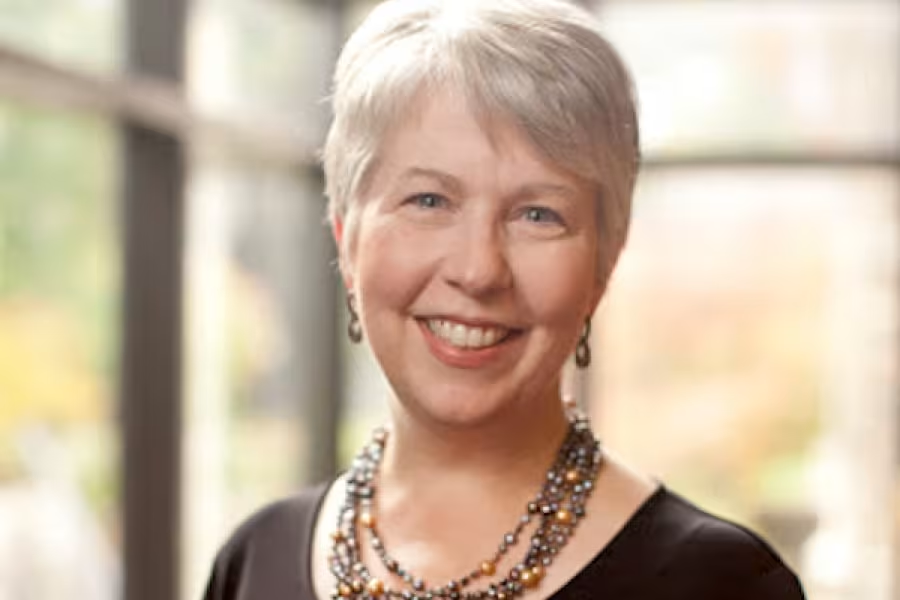
Interlochen Affiliation: IAA 84-86 | IAC St 87 | IAA St 90-91 | ICA St 04-06, 05-05, 18-25
Interview Date: July 12, 2024
Carolyn Purcell studied Creative Writing at Interlochen Arts Academy and has worked at Interlochen for more than 10 years in several different roles.
This oral history is provided free by the Archives of the Interlochen Center for the Arts (ARTICA). It has been accepted for inclusion in Interlochen’s audio archive by an authorized administrator of Interlochen Center for the Arts. For more information, please contact archives@interlochen.org.
00:00:00 BRAD BAILEY
Today is July 12th, 2024. This is Brad Bailey. This is an oral history interview with Carolyn Purcell conducted by Brad Bailey on the campus of the Interlochen Center for the Arts. Nice to meet you, Carolyn.
00:00:14 CAROLYN PURCELL
Thanks, Brad.
00:00:15 BRAD BAILEY
Can you tell me your name and spell it for me?
00:00:18 CAROLYN PURCELL
It's Carolyn Purcell. C a r o l y n, P u r c e l l.
00:00:25 BRAD BAILEY
So can you give me a little bit more information about where you were born and what your childhood was like?
00:00:29 CAROLYN PURCELL
Sure. So my maiden name is Felix. Carolyn Felix, F e l i x. And that would have been my name when I first came to Interlochen. I was born on Travis Air Force Base, California. My dad was in the Air Force, and so we were a military family. We moved around a lot. The first time we moved was not too long after I was born. My father was sent to Vietnam and we moved to Florida and moved, you know, usually every 3 or 4 years. The longest place that I spent growing up was in the Hampton Roads, Virginia area at Langley Air Force Base, and I was there from the time I was eight through 14. And then my family moved to Oslo, Norway, where I lived for the first couple of years of high school.
00:01:21 BRAD BAILEY
And then for the rest of your high school, where did you go?
00:01:23 CAROLYN PURCELL
Then I was here at Interlochen. So I was living in Oslo, Norway. I attended an American school there, a Department of Defense American school, Oslo American School, but that school only went through 10th grade. So when we moved there, we knew that we were going to be living there for three years, and that I would have to find another education situation for 11th grade. Now, the military would have sent me to an American school on an American Air Force base near London. But I had heard of Interlochen at that time. I had heard of National Music Camp because my father used to spend his summers up here, not too far away. So I knew that there was this place called National Music Camp, where kids went and they did music. I had done a lot of music growing up- violin, piano, singing, things like that, but I wasn't sort of super passionate about it. I didn't see myself as wanting to come to Interlochen for camp. But while I was living in Norway, I found a copy of the book, "Joe Maddy of Interlochen" in a used book sale, believe it or not, in Oslo, Norway.
00:02:33 BRAD BAILEY
Was it in Norwegian or English?
00:02:34 CAROLYN PURCELL
It was in English. And that book was written around 1964. Not too long after the Academy opened. And it mentioned the Academy. It has, you know, stories about Joe Maddy and the founding of National Music Camp.
00:02:48 BRAD BAILEY
And what year was this when you found the book?
00:02:50 CAROLYN PURCELL
1983, probably? 1983 or so. We moved to Norway in 1982, so it was sometime shortly after. And so through that book, I found out that there was an arts academy, a boarding high school, and I thought, well, that's really cool. And I tucked that in the back of my mind. Well, shortly after that, I was reading Seventeen magazine, as teenage girls did in the 1980s, and there was an ad for Interlochen Arts Academy in the back of Seventeen magazine.
00:03:21 BRAD BAILEY
So that's two serendipitous moments that happened around the same time.
00:03:25 CAROLYN PURCELL
Yes. And the thing that what really struck me now was that the ad specifically mentioned creative writing. And up until that point, I didn't know that Interlochen had anything to do with creative writing. So at that point, I had become interested in writing. I had been writing in journals regularly for several years. I had kind of started to see myself as a writer, was writing things at school. So that was what really caught my attention was, wow, I could go to this place as a writer. And so, as one did in the 80s, I wrote off on a postcard for information and requested it. Now my parents response was, sure, you can do that. You can get information. And then I get the information and I page through this, you know, guidebook, you know, repeatedly over the the weeks after that.
00:04:20 BRAD BAILEY
And all this is from Norway?
00:04:21 CAROLYN PURCELL
And this is all in Norway. So and this would have been when I was about 15. And this just became what I really wanted to do. And my parents said, well, you, you can apply, but we probably couldn't afford this if you get even if you get accepted. My dad was enlisted, career military enlisted. So, you know, very just middle class military kid. So I do my application, I send out some writing samples and lo and behold, I get accepted and I get some financial aid. But my parents are like, it's just not enough. We just don't think we can do it. Especially because we also had to pay for plane tickets from Norway. And they contacted the financial aid office here and they explained the situation. They did an appeal and they gave us another $1,000 or so, and my parents said, okay, we'll do it, we'll make this happen. So I came over from Norway, had never been here-
00:05:26 BRAD BAILEY
To Michigan?
00:05:27 CAROLYN PURCELL
I had been to Michigan one time, but had never been to Interlochen.
00:05:32 BRAD BAILEY
Got it.
00:05:32 CAROLYN PURCELL
And my parents did come with me and get me settled. But that was how I ended up here. And, you know, my parents made a big sacrifice for me to come. I was here for my junior year. Went back to Norway for the summer. My dad was then reassigned to southern Illinois near Saint Louis. And at that time, you know, I came back.
00:05:55 BRAD BAILEY
That's serendipitous as well. Because it's closer, right?
00:05:59 CAROLYN PURCELL
It's obviously much closer. Now, I was able to come back for my senior year. That time, you know, I knew my parents were sacrificing for me financially to come. And they they said, you know, if we pay for Interlochen, we don't know that we'd have money to pay for college. They took out personal parent loans. And so one interesting story about that that really has stuck with me is that one time my senior year, I was feeling kind of down about something. Who knows what, you're a teenager, who knows? And I called my mom and I said, you know, if you could just send me some homemade chocolate chip cookies, I think I would feel.. that would help. And my mom said, well, I don't really have the money to go out and buy the ingredients to make chocolate chip cookies. So, you know the extra money that it would take to buy chocolate chips and and things like that. And that really struck me and stayed with me. When I think about what parents sacrifice for their kids, when they think that, that that's what's best for them.
00:07:00 BRAD BAILEY
Wow. You were here at Interlochen and you said the 11th and 12th grade.
00:07:04 CAROLYN PURCELL
Correct.
00:07:05 BRAD BAILEY
So let's step back a little bit because you went from from Travis Air Force Base to at what city is that near again?
00:07:10 CAROLYN PURCELL
It's near Fairfield. It's in Fairfield, California. So it's-
00:07:13 BRAD BAILEY
Yeah. Northern, northern California.
00:07:15 CAROLYN PURCELL
Yeah.
00:07:15 BRAD BAILEY
So from Travis to Florida to Hampton Roads, Norfolk to Oslo, back to-
00:07:21 CAROLYN PURCELL
You're missing a couple places in there. Florida to Utah.
00:07:24 BRAD BAILEY
To Utah, okay.
00:07:25 CAROLYN PURCELL
To Ohio.
00:07:26 BRAD BAILEY
So you bounced around quite a lot. Okay.
00:07:28 CAROLYN PURCELL
To Ohio, to Virginia.
00:07:30 BRAD BAILEY
Okay.
00:07:30 CAROLYN PURCELL
And then to Norway, then to Interlochen.
00:07:33 BRAD BAILEY
Then to Interlochen. And how many brothers and sisters do you have?
00:07:35 CAROLYN PURCELL
I have an older brother and an older sister. They're both they're six and seven years older than me. So they were already in college by the time or off on their own by the time we moved to overseas.
00:07:46 BRAD BAILEY
Okay, great. But the first time you did move overseas with the family was in Norway. That first time?
00:07:51 CAROLYN PURCELL
Yes, yes.
00:07:51 BRAD BAILEY
Got it. Talk to me about your relationship with music and sort of what that was like growing up. Because you said that Interlochen, because you had known it had been a music camp, that was something you weren't not interested in. So I was curious about what your relationship with music was growing up.
00:08:06 CAROLYN PURCELL
Well, I mean, my older brother and sister were playing violin in elementary school, and I did start violin lessons.
00:08:11 BRAD BAILEY
Where was that?
00:08:12 CAROLYN PURCELL
In Utah. And I started violin lessons when I was 4 or 5, and I just played for a period of time, some months, you know, going to a Saturday morning music program. But I didn't stick with it. It wasn't like I became a prodigy or anything, but my brother and sister did continue playing. My mother is not really musical. I mean, they sang in the church choir, and my dad had played trumpet in high school or something, so they had a little bit of music, but it wasn't like a family with deep connection to music. I don't-
00:08:42 BRAD BAILEY
Which- church choir where?
00:08:44 CAROLYN PURCELL
I mostly remember, I grew up in the Assemblies of God church, so we moved around and usually my mom sang in the church choir. My dad conducted the children's choir for a couple of years, things like that. So there was that kind of music around. There wasn't much classical music around, but my brother and sister did play in the school orchestra and the marching band and did different things. So there was that sort of, it was always part of our life, but not intensely. I then started playing violin again when I was in fourth grade. I played in school orchestras, fourth, fifth, sixth and seventh grades, and took piano lessons during that time as well. I was fine, I did school music. I played in the school orchestra. I didn't have private lessons. I didn't practice a ton. I wasn't the best violinist in the school. I wasn't the worst violinist in the school. But I learned music and I learned how to read music. I learned- I loved music, I actually loved music, but I don't think I understood the process of practicing and what was really required to develop as a musician.
00:09:52 BRAD BAILEY
Why is that?
00:09:53 CAROLYN PURCELL
Oh, maybe it was just never presented to me as an opportunity or, I don't know, maybe I was- I'm more of an extrovert and I'm not as focused as some musicians can be. And then about that time, I also really started, you know, in middle school, I really started being more interested in writing and words, you know, literature. And so that sort of became more of my thing is my sort of interest in while I loved music, my interest in being a musician was shrinking and my interest in writing was growing. So I think I knew that I wasn't like a serious musician. I think it's good. I think it's a good thing to to be exposed to music and have that foundation.
00:10:39 BRAD BAILEY
You seem almost like it's still a natural talent, though in lots of ways to be able to still be able to engage in these with, as you said, not as much practice as some other people, but your, your ability to still be in the sphere of that work was still impressive, I would think. So what type of stuff did you creatively write in high school before you came here?
00:10:57 CAROLYN PURCELL
Well, you know, it wasn't what I would consider very sophisticated. And when I think back even to the writing that I sent in with my application.
00:11:05 BRAD BAILEY
What did you send in?
00:11:06 CAROLYN PURCELL
I remember a very sort of fairy tale, kind of short story that I sent in. I might have sent in, I remember in high school I wrote a little play, like a ten minute play that we did at school. And remember, this was a small American school overseas. So my school was about 15 kids in my 10th grade class and about 25 kids in my ninth grade class. The entire school kindergarten through 10th grade was about 180 kids. So this wasn't sort of like an intense environment. You could write, you could play around. And I wrote on our little school newspaper and I wrote some poems that I don't even remember. So it was what I would call fairly young, unsophisticated writing. But I knew I liked it, and I also was interested in journalism and all these things that had to do with communication. When I came here, I was thrown into the deep end. I mean, there was this was like serious writing at Interlochen and kids who were not naive. I was from a very conservative religious family, military family, and I'd been exposed to a lot of things in terms of travel and things, but in terms of my social environment had been quite sheltered. And when I came here and I was exposed to great writers, kids who'd had a lot more worldly experiences than I had. It was some culture shock. It wasn't negative, but it was adjustment. And when I look back and I think about the kind of writers that I was exposed to. For example, Mary Oliver and Gary Snyder came as guest writers when I was here, maybe even Robert Bly. I mean, I had no clue who these people were or why I should be impressed by them, other than my teachers seemed to be impressed by them. So it is very interesting. And sometimes I think about how all of those experiences were a bit wasted on my youth. I didn't even know what I should be taking away from them.
00:13:15 BRAD BAILEY
Wouldn't that be the point though? Especially as an introduction to these things. The point is the introduction to these things.
00:13:20 BRAD BAILEY
Right, but I think that even as I sat and listened to these writers that I was, you know, I could tell that everybody was very impressed by. I didn't understand the historical context. Right. So I didn't understand like historically, why is Gary Snyder important? Why is Mary Oliver important? And I didn't necessarily connect with them sort of on an emotional, social, emotional level. Right. I was a 16 year old kind of sheltered girl. So it's interesting to look back on that and wish I could sit in those rooms again with those writers, because I would get so much more out of it now.
00:13:56 BRAD BAILEY
So at what point then did you realize that that experience was a definitive experience in a way? When did you come to that realization that these were pivotal sort of moments that you should pay attention to and sort of try to understand?
00:14:09 CAROLYN PURCELL
Well, so interestingly, as a writer here at Interlochen, I was very mediocre. And I tell people that too, sort of like I was a mediocre violinist. I was a mediocre writer at Interlochen. My grades were fine, but I wasn't- sort of, one of the superstar writers. They took a certain number of writers on a writing tour every year. I was never on the writing tour, but I learned how to write. And I guess that's the thing, is that all of that didn't matter. I mean, it might, you feel a certain way as a kid because of what you're experiencing. But what I took away was I learned how to write in a way that I would never have learned. So what I tell people is that I learned how to write sentences and words and paragraphs so clearly and confidently that it's like part of who I am now. I can't write something or read somebody else's writing without having the lens of the way I learned to see writing while I was here as a 16 and 17 year old.
00:15:08 BRAD BAILEY
That's a great point. Could you expound on that a little bit more for me and give me examples as to how that is?
00:15:14 CAROLYN PURCELL
So here's the class that I really remember. This was the writing teacher, Michael Delp. He started teaching here the same year I came, 1984. He was the head of the writing program for many years, and I took a class from him called Literary Essay. And what we had to do, We would get these random topics every week. We had to write an essay a week. I think 500 words. And he would give us a random topic. And sometimes it was, you know, one time it was like he had cut out headlines from tabloids like the National Enquirer or News of the World. So they're kind of crazy headlines. And he like, gave, passed them out and was like, this is the subject of your essay this week. So it's this very random thing, but you have to somehow figure out how to write an essay about that. So we did that every week, some strange topic, and we had to show rewrites. We had to show all of these different versions of the same essay. So we would have our initial draft, and then we had to show like three other drafts. We had to have revised at least one thing in every paragraph for every draft. So we had to show that we were going through the revision process. And so I remember looking at things like a paragraph. Well, how could I if I change the sentence to the first part of the paragraph, or if I change the order of the sentence, or if I change the clauses or whatever, how would I revise this paragraph to make it a stronger paragraph? So it really taught me to be analytical about words and not, not look at them sort of romantically, if that makes sense. And we also did writing workshops. So, you know, at 16, you're sitting around a table with ten other writers and you're critiquing each other's work and you're learning that process. And I really learned that somebody could tell me what they thought of my writing, but it was up to me to make a decision about what I was going to do with that information. I didn't have to follow somebody else's suggestions. So I became very confident in my ownership of my words. I don't know if that might not be the exact right words, but an example would be when I was in my early 30s, I went to a writing workshop in Santa Fe, and so I was with adults. It was a memoir writing workshop, and we were critiquing each other's work and all of that. And the woman who was leading the workshop sat down with me, and she said, I have never met anybody who seems so fearless about other people critiquing their work. Like, you don't seem to have any sense of fear of that process. And I was like, well, I've been doing that since I was 16. I was putting my work out there listening to people critique it, and I just said, I can take it. Somebody can say what they want about my work. It's totally up to me to determine what to do with that. So I think that's what I really came away from as a writer, from Interlochen, was just a sense of confidence in my words and my writing, and I've used that in every job. Like I haven't gone on to write the Great American novel, but I've still used that sense of writing and confidence in my words in almost every job I've had.
00:18:25 BRAD BAILEY
That's great. And so on top of that, what other aspects of Interlochen during your time here as a student those two critical years do you take and use in your work to, and life today?
00:18:38 CAROLYN PURCELL
Well, I think from a more emotional standpoint, as a military kid who had moved around, this really became my emotional home when I was in my 20s and started, you know, coming back to visit. I started saying, well, my heart lives here. And so I think that's the big thing is I became part of this community. And for somebody who didn't have a hometown, Interlochen became my hometown. There are people here who have known me since I was, you know, 16 years old. Eileen Ganter has known me since I was 17 years old. So that has obviously had this huge influence on me because I keep coming back. But yeah, that's one of the other big parts is it gave me a community. I think another thing is it gave me a language in the arts that, you know, because I became friends with people from all of the different arts areas. I sort of developed a, an ability to converse with people in different arts areas. You know, I have a, this much knowledge about a lot of the arts areas. So when I was in journalism school, I had a journalism professor.
00:19:45 BRAD BAILEY
Where'd you go to journalism school?
00:19:46 CAROLYN PURCELL
Regent University in Virginia Beach, Virginia. And I had this professor who said that a journalist's interests are a mile wide and an inch deep. And I think that also, you know, something that I developed at Interlochen because I became exposed to classical music in a much deeper way. I became exposed to theater and visual arts. And and so I-
00:20:07 BRAD BAILEY
Almost a master generalist in a way.
00:20:09 CAROLYN PURCELL
Yes, I became I did. I became a master generalist through my, my Interlochen community. So yeah, I think that that's another thing I've taken away from it is I have an ability to connect with people from all the arts areas. I might not know a lot about it, but I hopefully know enough that I can fake it for ten minutes to have some conversations about it.
00:20:31 BRAD BAILEY
So what about this place would allow it to be sort of a center of your emotional home and sort of a place, an anchor, so to speak? What about it? Whether it be like the physicality or the environment, give us aspects that that allowed it to be that for you versus any other place you could have been?
00:20:48 CAROLYN PURCELL
Right. I think that there is the physical connection to place. Right. I, I think as a military kid, as opposed to people who grow up in a hometown who have an emotional connection to place. I didn't have that because I moved around. So I didn't have like, oh, I go to, you know, this place that I've been going to since I was six years old or whatever. I didn't have that. But when I came here, I developed an emotional connection to the physical place. I think a lot of it has to do with the time in your life. You're an adolescent, you're exploring creativity, so you're heightened. I think you're in a very heightened place emotionally when you're here. I also think that there was a side of me that was uncovered here that hadn't, you know, other people didn't necessarily get me. So I was the kind of kid that I often felt like I was slightly out of step with a lot of other people my age. And I think that that had to do with sort of that creative spark. So when I came here, I felt a sense of belonging that you could feel. So that leads to that sort of emotional attachment and a sense of home.
00:22:02 BRAD BAILEY
And so how would you describe Interlochen as someone who's never been here?
00:22:07 CAROLYN PURCELL
Well, the first word I always use is community. Interlochen is a community of artists and people who are connected to the arts, invested in the arts in some way, so they may be invested in the arts as artists themselves. They may be invested because they value the arts in some way or because they support the arts. So to me, it's always been a community. But in terms of expounding on that, I talk about, you know, it's out in the woods. It is its own little bubble. You know, it's a beautiful place, all of those sort of descriptive words.
00:22:45 BRAD BAILEY
And so talk to me then about some of the people you met here, whether it be friends or peers that you keep in contact with, that sort of, you know, have made an impact in your life that you can talk about today.
00:22:56 CAROLYN PURCELL
So the interesting thing is that the people that I was closest to when I was here as a student are not necessarily the alumni that I'm closest to now. However, I had a group of friends when I was here. You know, I've mentioned that I was from a conservative religious environment, and it was really important to me to be with other Christians who were passionate about their faith. So we did have a student Christian group that we were very close. There were probably 15 or 20 of us, and we had four of the Residence Life staff who were sort of our group leaders, you know, kind of like a a youth group at a church, but here. And so we had some leaders that we really came became close to. They were very supportive and we did great stuff. We met twice a week. We sang a lot of songs. We did campfires, we did social things. So they were really my family when I was here. They were the people that I sat with in the cafeteria and turned to all the time. I am good friends with a few of those people still, particularly a friend named Ken Bresser. He was the first person I met when I got to Interlochen. The first student I met, I should say we were here quite early, I guess during the check in process. And it just so happened, we discovered early on that our birthdays are one week apart in August. And I have a brother named Ken, and he has a sister named Carolyn. And so we had these kind of funny connections, and he was also a creative writing student. So he and I have maintained friendship over the years. You know, we have seen each other many times over the years. You know, text each other and keep in touch. He's one of the closest friends that I, I still have here. But through the years, because of my involvement with alumni and on staff, I have all of these layers of friendships. So people that I maybe wasn't friends with while I was a student, I've now become deeper friends with because our lives continue to intersect. So whether it's they've come here for a reunion and we've spent time together, or I lived in New York for a while, and I hung out with some of them in New York or whatever. And so in that way, it's kind of neat because I'll, you know, sit with somebody and I'm like, yeah, I really didn't know you when we were 16. But we have this shared history and we, you know, care about each other and love that our lives intersect now.
00:25:28 BRAD BAILEY
So go back a little bit to the timeline so I can understand the years and the structure before I go to some of the more general Interlochen points that I want to cover. So what year did you graduate from here?
00:25:39 CAROLYN PURCELL
I graduated in 1986.
00:25:41 BRAD BAILEY
Okay. And then you did what?
00:25:42 CAROLYN PURCELL
So I went to my undergrad, was at Oral Roberts University in Tulsa, Oklahoma, and by the time I graduated, I was kind of burned out on writing. So that's something that I think can also happen at Interlochen, is you study something really intense- intensely as an adolescent, you kind of find out, you know, how intense is this and how much passion do I have for this? And I was a little burned out on the actual writing issue. So I really wanted to go into broadcasting and journalism. So I ended up actually majoring in radio production because I had become enamored with radio at this point. So I studied radio at Oral Roberts and government because I kind of thought I would do something maybe with the Foreign Service or something. But I came back the summer between my freshman and sophomore year of high school- of college, sorry, to work an internship at Interlochen Public Radio. So I was here that summer.
00:26:37 BRAD BAILEY
How was that summer?
00:26:38 CAROLYN PURCELL
It was a fun summer. You know, being here in the summer is just, it's fun. You're working with all kinds of young people. And I just remember doing a lot of, you know, fun, social bonding kind of things. But it's funny because I don't have a lot of specific memories from the summer, but.
00:26:56 BRAD BAILEY
And that was summer of, what.
00:26:57 CAROLYN PURCELL
'87.
00:26:57 BRAD BAILEY
'87? Got it.
00:26:58 CAROLYN PURCELL
Then I graduated from college in 1990 and decided to come back as a Residence Life person to live in the dorms with the Academy kids, and that was an interesting experience. You know, again, I think it's because I wanted to come home after being away at college and this was home. So I came here for a year, worked in the dorms. It was fine in terms of I just decided I don't really want to work with teenagers. That's not my thing. But it was an interesting experience to be here in that role for for a year.
00:27:32 BRAD BAILEY
And that was summer of '80..?
00:27:34 CAROLYN PURCELL
That would have been. that would have been the school year, actually.
00:27:36 BRAD BAILEY
So '90, '91?
00:27:37 CAROLYN PURCELL
'90, '91. Yep. So '90, '91. I was here for that school year. Fun fact I was Jewel's hall counselor for about a week, and then they moved her to a different dorm. So but it was that same year. So then I moved to Virginia. I went to graduate school at Regent for journalism, you know, got married, got on with life, and then moved to New York in 199-, no. In 2000, moved into Manhattan, was working in publishing, working for a publishing company, doing editorial work. So I really was using my communications and my words, I was using my words. All of this time when I lived in Virginia, I worked for a newspaper for a while. I worked at Busch Gardens, the theme park, and I wrote
00:28:26 BRAD BAILEY
in Williamsburg?
00:28:27 CAROLYN PURCELL
Yes, I wrote training manuals. I wrote the employee newsletter, I wrote training programs. So I was doing a lot of writing then publishing in New York, doing editing.
00:28:39 BRAD BAILEY
How was that in New York?
00:28:40 CAROLYN PURCELL
Yeah, that was 2000 to 2004.
00:28:42 BRAD BAILEY
How was it?
00:28:43 CAROLYN PURCELL
Oh, it was good, I mean, it well, it was- I lived there during September 11th, so that was traumatic.
00:28:48 BRAD BAILEY
Well, we'll talk about that. Were you still connected to Interlochen while you were in New York City?
00:28:52 SPEAKER_S3
I was a bit, I was still connected. We would come and visit. I still had friends on staff when I moved to New York is when I actually started getting connected with other alumni in New York. I volunteered to help, like at college fairs and things like that. So I would go to a table, you know, give out Interlochen information. And actually, on September 11th, we were supposed to have one of those college, high school camp college fairs at the World Trade Center Marriott.
00:29:19 BRAD BAILEY
Which is located essentially right next to..
00:29:21 CAROLYN PURCELL
Was yeah, it was basically in the plaza of the World Trade Center. And so I had-
00:29:28 BRAD BAILEY
On that day?
00:29:28 CAROLYN PURCELL
On that day, we were supposed to be there at like 6:00 that night. So I had taken my things to work. I worked two blocks away from Times Square.
00:29:35 BRAD BAILEY
It was an evening event?
00:29:36 CAROLYN PURCELL
It was an evening event. So I had taken my things to work, expecting that after work I would just, you know, take the subway down.
00:29:43 BRAD BAILEY
Where was your publishing office?
00:29:44 CAROLYN PURCELL
41st and Broadway. So it was, yeah, just south of of Times Square. So I, you know, would have taken the subway down to World Trade Center for that event. So of course, as the events unfolded on the, on September 11th, you know, I remember at one point in the middle of the morning, you know, after both planes had been hit, but or both towers had been hit, but I guess potentially before they had collapsed.. But I remember thinking, oh, I wonder if we're still going to have that tonight. And of course, by that night, the Marriott didn't exist anymore. It was one of the buildings that collapsed that day. And so it was this, you know, it was a very confusing day. But interestingly, the next week or so, Janet Morris, who worked in Admission, reached out to me. She said, you know, I- we haven't heard from you since September 11th, and we just want to make sure you're okay. So that was sort of my Interlochen September 11th connection that that we were actually supposed to to be having a volunteer event that night. So New York was, I mean, it was a good time. It was. I loved New York. And it's similar the way that I felt at home in Interlochen. I felt very much at home in New York, I think, because it had a lot of creative energy. But we left in 2004 to come here. At the time, we thought it would be perfect if we had a house in Michigan and an apartment in New York and enough money to go between the two. But when the job came up to move to Interlochen in 2004, that's when I first came back to work with alumni. So at that point, I was the coordinator of alumni communication and events and, you know, moved back to Interlochen. My late husband at the time, late husband, moved back-
00:31:25 BRAD BAILEY
What was his name?
00:31:25 CAROLYN PURCELL
His name is Patrick Purcell, and he moved back to Interlochen. He had grown to love Interlochen. He had worked at Interlochen.
00:31:33 BRAD BAILEY
Where is he from?
00:31:34 CAROLYN PURCELL
He was born in Kansas City, Kansas or Missouri. I forget which Kansas City. And then he grew up in Atlanta, in the Atlanta area. You know, I introduced him to Interlochen after we got married, and we got married in 1993, and I introduced him to Interlochen through visits. And he thought this was a pretty cool place. He wished he had come to Interlochen as a kid. But in 2003, when we were living in New York, he was teaching at that time doing some contract work and teaching, and he didn't have any big full time things in the summer of 2003. And so he decided to come and get a job, a summer job at Interlochen. I stayed in New York because I had the full time job, but he came and decided to get a summer job, and he worked in the concert office, ushering and helping with concerts. And so he started to build his own Interlochen relationship and connection and made his own friends. So when I got the opportunity to to move here, work full time.
00:32:33 BRAD BAILEY
The next year?
00:32:33 CAROLYN PURCELL
The next year, that was something he was supportive of. So we both moved in 2004 while he was here. He, he did teach for a year at the Academy. He taught math, did some other work. He taught part time and did some other things as well. And that was when I started working with alumni and started building all these alumni connections. So, you know, suddenly I'm starting to become friends with people, alumni who are much older than me or younger than me, and developing these, what I call my layers of Interlochen relationships. And then we left here. He was offered a full time science job. He had a science background in Denver, so we decided that that was the way to go. We, we relocated, moved to Denver. I still stayed connected to Interlochen. I still did some volunteer work, even some freelance writing.
00:33:21 BRAD BAILEY
What year was that?
00:33:22 CAROLYN PURCELL
It was 2006.
00:33:24 BRAD BAILEY
Basically two years here in that-
00:33:26 CAROLYN PURCELL
Yes, I was here for about two years at that time. So once we were in Denver, I was doing some freelance work for Interlochen, writing for Crescendo, and we had purchased property here. We visited regularly, so I stayed connected. It still was very much part of my community during that time. And then my child was born in 2006 after we moved to Denver and we stayed in Denver until about 2012, 2013, I guess, and we moved to, from there to Washington DC or to the DC area. Silver Spring, Maryland. And we were there for five years while I was there is when Patrick passed away. And after about two years, I decided it was time to come back to Interlochen. This is where this is where we-
00:34:16 BRAD BAILEY
You wanted to come home.
00:34:16 CAROLYN PURCELL
Exactly. I wanted to come back home. I think that's a good way of putting it, that once I lost my husband and was a single parent, this is where I wanted to be. I wanted to come back to this community where people knew me, where I had relationships, and where I knew we would have a place to be.
00:34:33 BRAD BAILEY
And what year was that?
00:34:35 CAROLYN PURCELL
2018?
00:34:36 BRAD BAILEY
2018. And how many years have you been married to Patrick?
00:34:39 CAROLYN PURCELL
Patrick? 22 years.
00:34:40 BRAD BAILEY
22 years. Wow.
00:34:41 CAROLYN PURCELL
Yeah.
00:34:41 BRAD BAILEY
When you came back, how was that coming back here? And then how did you get integrated into the community again? Because you seemed like you had a sort of tethered connection to Interlochen the whole time, no matter where you you went. So what was it like coming back after Patrick's passing? How was that coming back here to this community?
00:35:01 CAROLYN PURCELL
Well, I had a deep sense that it was the right thing to do for me and for Violet, my daughter. So it felt like coming home. You know, there's always transitions when you come, when you're sort of in and out of a community, even though you have been connected all the time. So there were adjustments in terms of just now, I'm here as a parent and I still have connections. But, you know, organizations change, people change, people come and go. So there is still a sense of coming back and having to build the connections again, build the relationships again. Organizations change. You have to adjust to new organizational culture. But it always has felt like the right thing and the right place to be. Violet has thrived here.
00:35:51 BRAD BAILEY
Talk to me about how differently the relationships are now as staff, affiliates, employees of Interlochen and working with alumni, your relationships with alumni, what those relationships are like, and how different or similar they are to some of those relationships you had as a student with other peers and colleagues?
00:36:11 CAROLYN PURCELL
Well, I mean, there's a couple of things that are interesting. One is that working with alumni and connecting with alumni who have known you for decades now, at this point, it's interesting how you see each other differently than you did when you were 16, right? So you see yourself differently. So I think that's one of the things that's interesting is that people that I wasn't friends with then, that now I look forward to and that have included me in their groups and, and that I feel connected to. So I think one thing that's changed is that you don't have the sort of baggage that you had when you were 16, and you're not categorizing people or things like that. You're much more open. I think that one of the things is that there's a sense that all of us are bonded because of our Interlochen experience. So there isn't one Interlochen experience. Obviously, we all had different Interlochen experiences. You meet people, you were different majors. Somebody follows the rules. Somebody tends to be more rebellious and skirts around the rules. Somebody gets kicked out because they've broken rules. Somebody leaves here and they hate music because whatever. So you tend to have.. there's not one singular Interlochen experience because you all have different experiences based on what you're bringing to Interlochen and how you respond. But I think looking back as adults, we look back on the Interlochen experience as something that no matter what was different about it, there was still something that shaped us that was sort of the same force. Right? So we are connected through that experience.
00:38:02 BRAD BAILEY
And so who made the greatest impression on you here at Interlochen, if you were looking back on the entirety of your experience?
00:38:11 CAROLYN PURCELL
So not just my-
00:38:12 BRAD BAILEY
Well, that's why I wanted to do the timeline of the school. But then your whole time was critical. Your whole timeline. So. So now I want to understand who made the greatest impression. You could do one or the other if you want to. But I was trying to get an overall sort of impression of who who made the biggest impact on you person.
00:38:29 CAROLYN PURCELL
That's a lot of years to take in. I mean, I can look at Michael Delp, the writing teacher, and say, like, he had the biggest impact on my development as a writer, particularly from that one class Literary Essay, where I really learned how to take apart words. So I would say in terms of my development as a writer, Michael Delp. My personal sort of connections. You know, I've worked with a couple of teams of people. I worked with a team when I first came back in 2004 with two other women who we had real synergy working together as a team, Carly McCall and Anne Shaw in the what was then called the Office of Alumni Relations. And so they've had sort of a lasting impact on me, sort of professionally and personally. Yeah, I mean, I think that I tend to form relationships in so many different ways. You know, even now working with Ian and Alyssa, that is something.
00:39:28 BRAD BAILEY
Their names, their full names?
00:39:30 CAROLYN PURCELL
Ian Jones and Alyssa Blaker. I mean, that will stay with me, you know, our team.
00:39:36 BRAD BAILEY
Why? In what way?
00:39:37 CAROLYN PURCELL
Well, it's interesting, I started in 2018 and they both started in 2019. I had all of this Interlochen experience. They did not have Interlochen experience before they came. And then a few months after we came together as a team is when Covid happened and we all went home. So I saw this group come together of people who, with different experiences, we had to work together as a team, and it's been interesting and wonderful and lovely to see how we've grown as a team, how we've developed synergy, how we work together, how we laugh. We have so much fun. And that really is something that I think happens because of the environment that we're in and because of, I mean, the people that are involved. So I will definitely, as I look back on my career, which I'm 55 now, so we're, you know, maybe ten years more, I will look at this time with this team of people and feel particularly fortunate.
00:40:37 BRAD BAILEY
And so what's your favorite place on the Interlochen campus and why?
00:40:41 CAROLYN PURCELL
Gosh, I mean, I really do love sitting on the patio on Dottie's Deck by the lake eating lunch. I feel so happy to have that opportunity in the summer, especially to try to eat there as much as possible. Last summer I think I ate out there pretty much every day. This year has been a little harder with the weather, so Dottie's Deck overlooking Green Lake and being able to sit there and eat my lunch in the middle of the day and just be like, I am so lucky I get to, this is where I get to eat lunch every day. So I think that is one of my favorite places. Standing in Corson at the very top, looking down over all of the seats into the stage, of course. And it's another feeling that I feel very connected to. I guess I remember it being in the choir and standing on stage and looking up and seeing that sort of the reverse view. That's another one.
00:41:38 BRAD BAILEY
So tell me about a humorous story during your time here, either a student or or any other time, a humorous story that, like, sort of typifies what you would think an Interlochen experience would be for someone listening to this.
00:41:51 CAROLYN PURCELL
So there's an alumna named Kate Angus. She graduated in around 1993 or 4, I think 1994. She was a creative writer here, and she was here when I was a Residence Life person. She was in the dorm, so she was a student. And she's somebody that I've maintained some friends, friendship with and contact with over the years saw her. And, you know, we lived in New York at the same time. So I remember seeing her in New York. So this would have been around, you know, 2000, 2002, something like that. So she would have been in her late 20s and I was in my mid 30s. And Kate told me this story, which I think is such a great Interlochen story. She said that when she graduated, she wanted to go to film school and her dad was sort of like, well, like, what is, what are your career options? And, you know, what's your plan B or whatever? And Kate, in true Interlochen fashion, said, well, I always have my poetry to fall back on. And I just love that for an Interlochen student, that poetry was her plan B. I think that typifies how we come out of Interlochen, you know, with this idealistic view of, of where the arts fit into the scheme of the world. So that's that's one that I love. Another funny Interlochen story. This is a good story. I remember when Josh Groban came, the very first time that he came to perform, and he was only I mean, I don't even know if he was 21 at that point. So he had only been out of camp for like 3 or 4 years when he hit it really big. And he was here and it was a sold out crowd in Kresge And he came on stage wearing his, like, camp belt and camp badge, and he had a backup choir of campers backing him up. And it was just this, like magical moment when you see this sort of young star who's coming back to this place and. And I remember being very excited at that moment, just really proud and excited about that Interlochen story.
00:44:02 BRAD BAILEY
And so you said you were Jewel's hall monitor for a week? Any interesting stories from that?
00:44:07 CAROLYN PURCELL
No, it was too soon. She left. I was in the dorm with the younger students and she was not. I was in the dorm that I was in was a lot of the ninth and 10th graders, and I think she was an 11th grader. When she got to campus, they kind of quickly realized that she fit in better with the older girls, so they moved her to the older dorm. I don't even remember having much conversation with her, so.
00:44:32 BRAD BAILEY
And so what is your hope for Interlochen's future?
00:44:35 CAROLYN PURCELL
Well, I really hope that we will, really this whole idea of making it possible for everybody to be here without there being the barrier of the finances, you know, it was a sacrifice for my family to come here. And I think I'm really grateful that they made that sacrifice for me. But I know that a lot of families can't. So I think that that's my hope is that people will value what Interlochen is about enough that they will want to make it possible for everybody to be here. Just, you know, no matter their financial circumstances. I think that we have to be flexible and changeable. I mean, the arts are changing, the world is changing. And as easy as it is as an alumna to feel nostalgic about the past, I always have to balance that with the present and the future and making sure that we are adjusting, that we are being responsive and flexible and resilient and all of those words toward the future, because we don't want to just be something stuck in the past. So that's I guess one of my big hopes is that we continue. I mean, I think we've done that. I think we've done that in a lot of ways. But I hope alumni will walk that path too. I think that's part of why I love working with alumni, is that I want to help them walk that path of adaptability and and change.
00:46:03 BRAD BAILEY
And so now, having looked back at your experience for almost like 40 years of interacting with Interlochen, what do you think about that phone call with your mother's sacrifice. Now that that sacrifice allowed you to be here? And then now looking back at the impact this place has had on your life, what do you think about that?
00:46:22 CAROLYN PURCELL
I don't know that my parents even truly understood the impact that Interlochen would have on me when they made that sacrifice. I think that they knew that it would be good for me in the moment. But I think that many people don't fully understand the impact that Interlochen will have in the years, in the decades to come. And I think that the impact Interlochen has is different than other educational institutions. I do think that many people, when they choose a college or a boarding school or a private school or whatever, it's a transactional relationship. I think they're like, if I go here, then I will walk away with this thing that will then allow me to do this other thing. And I think that the people who talk about Interlochen and the impact of Interlochen, it's not transactional. It is. I don't know if relational is the right word, but it's not transactional, because the impact that it has had on me is not a transactional relationship. It's not that I came here, I gained this and I walked away and it got me this other thing. It's much more about- it's transformative. It's not transactional, it's transformative. And I don't think people understand that until they experience it.
00:47:39 BRAD BAILEY
Do you always wonder where your life would be if you had never knew about Interlochen, that fateful time in Norway?
00:47:46 CAROLYN PURCELL
I mean, I think that I would have stayed inside boxes a lot more. I think that my world would not have been as opened up as it was as much as it was here. And I think I might have stayed within some of the boxes of my family environment, my history, versus kind of blowing up the boxes, which I kind of feel like I do most of my life.
00:48:12 BRAD BAILEY
And so two questions left. What advice would you give to future Interlochen students and alum?
00:48:17 CAROLYN PURCELL
Don't compare yourself to other people. Don't compare your experience to somebody else's experience and be present. Like be present with your Interlochen experience, because what you're going to get from Interlochen isn't the same thing that somebody else gets from Interlochen. Again, it's not transactional. It's not, we exchange this and you get that. So because it's more transformational than transactional, then I think it's something you have to sit with, walk with, journey with and give it time.
00:48:50 BRAD BAILEY
And so the last question why does art matter in the world today?
00:48:53 CAROLYN PURCELL
I've thought about this a lot, and especially because I have friends who work in fundraising for, you know, social justice or health or things like that. And why, why does art matter? I think art is the fertilizer that improves the soil that everything else good grows in. So I think that art in our world fertilizes this thing, the soil in our lives, and that allows people to do all kinds of things that allows them to become scientists. It allows them to become caring people. I think without the arts, people in general are just going to be less caring because the arts are the fertilizer that allow caring people to grow, that allow curious people to grow. So I think the arts are important because it's the fertilizer in which all of the other good things in our society that allows all of those other good things to grow.
00:49:51 BRAD BAILEY
And so that's it, you know. Is there anything you wanted to add that you think we haven't discussed? Anything about alumni or anything personal that you think would be critical to add to this conversation we've had here today?
00:50:04 CAROLYN PURCELL
Well, I could maybe talk for a minute about my experience as a parent, right? Because now my own child has come here and she was interested in music from age seven on. And so I kind of knew that this would probably be a good place for her. And when we moved back here, she was in seventh grade, so she was in a local school for seventh and eighth grade and then started here in 9th grade and has been here 9th, 10th, 11th, 12th. And we'll be here for one more year as a postgrad student. So it's also interesting to see your own child then experiencing Interlochen on that level. I think one of the things that I'm most grateful for is that she feels so much herself. She can be herself here in a way that she wouldn't be able to anywhere else. And so that to me as a parent, that's worth it.
00:50:57 BRAD BAILEY
Great, great. Well, thank you so much, Carolyn. It was a pleasure chatting with you today. I just want to say thank you for coming. I appreciate your time and effort that you spent with us today.
00:51:06 CAROLYN PURCELL
Thanks. That's good.
00:51:08 BRAD BAILEY
Great. So today is July 12th, 2024. This concludes an oral history interview with Carolyn Purcell conducted by Brad Bailey on the campus of the Interlochen Center for the Arts.
Copyright
Copyright to the audio resource and its transcript is held by the Archives of Interlochen Center for the Arts (ARTICA) and is provided here for educational purposes only. It may not be reproduced or distributed in any other format without written permission