
Oral History Interview with Beth Stoner Wiegand
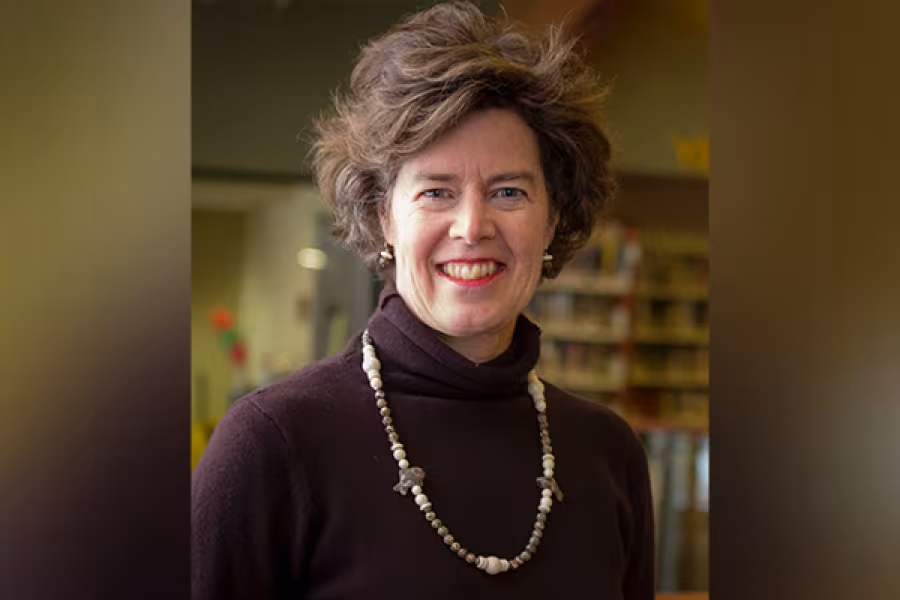
Interlochen Affiliation: AS 75-76 | IAC/NMC 77-78 | ICA St 92-14
Interview Date: July 22, 2025
Beth Stoner Wiegand attended National Music Camp for four summers, studying clarinet in both the All-State and High School divisions. She later joined the staff of Interlochen Center for the Arts, working for 22 years in progressively responsible roles with the Philanthropy team.
This oral history is provided free by the Archives of the Interlochen Center for the Arts (ARTICA). It has been accepted for inclusion in Interlochen’s audio archive by an authorized administrator of Interlochen Center for the Arts. For more information, please contact archives@interlochen.org.
00:00:00 ELIZABETH FLOOD
Today is July 22, 2025 and this is an oral history interview with Beth Stoner Wiegand conducted by Elizabeth Flood on the campus of Interlochen Center for the Arts. Thank you very much for coming in and speaking with me today.
00:00:13 BETH STONER WIEGAND
Delighted to do so.
00:00:14 ELIZABETH FLOOD
So please tell us your name, your connection to Interlochen, and the years in which you were in relation.
00:00:21 BETH STONER WIEGAND
My name is Beth Stoner Wiegand. My first introduction to Interlochen was a camper. I was an All-State Camper, which was a program that was supported and run by the University of Michigan, but held on Interlochen Center for the Arts' campus. And I was here 1975, in the Intermediate Band program. And I was here in 1976, also for All-State, for the High School Band program. Those were two week sessions each of them. And the differential at that time was the All-Staters wore navy blue skirts versus knickers. And I often thought, "Gosh, it would be so wonderful to be able to wear the knickers one day." And the following summer, sure enough, the summer of 1977 I came as a eight week camper. At the time it was the National Music Camp, that was prior to when it became Interlochen Arts Camp. I was in High School girls, and in fact, I was in division one cabin one. And then I returned the following summer, 1978, again a High School girl camper. I was in division one cabin six, which was right across from the lake and the Sundecker and my major all four of those years was as a clarinetist. And when I came as a eight week National Music Camp participant, I also minored in ballet. Then I returned to campus to Interlochen Center for the Arts in April of 1992 as I joined the year round staff and the Advancement Department, as it was called at that time. And I finished my tenure in December of 2014 when I happily was getting married the next month, January of 2015. And all of my twenty-two years here was involved with the Advancement Department.
00:02:35 ELIZABETH FLOOD
How did you first learn about Interlochen? What brought you here?
00:02:41 BETH STONER WIEGAND
So when I was a young girl growing up in Ann Arbor, Michigan, there was a really wonderful connection long standing between the University of Michigan and Interlochen Center for the Arts. In fact, I think Dr Maddy even had the typewriters that were used here in the early days donated for the summer from the University of Michigan, so there's lots of connections. But the Ann Arbor Public Schools being right there in the same town as University of Michigan, they had a very robust music program, and I started in fifth grade as typically one did. Picked an instrument. I picked clarinet because my father had played clarinet and we had one in the home. So that was a pretty easy decision. And as the next couple of years unfolded, the clarinet and I seemed to agree with one another, and rather than transferring over to the oboe, which was the original plan, because there weren't as many oboists as there were clarinetists, I stayed with the clarinet. And had the opportunity to apply to come to camp, and it was really through not only my private music teacher, but the schools that really promoted: If you want to excel, if you want to be around your peers who are engaged with being the best at their various instruments or crafts; Interlochen is the place you want to go.
00:04:03 ELIZABETH FLOOD
Could you tell me about some of these peers? Who were some of the memorable people that you interacted with in your time as a camper here at Interlochen?
00:04:12 BETH STONER WIEGAND
So there were so many people that were wonderful. Sidney Forrest was one of the clarinet faculty members here that ran the sectionals, and he was just a wonderful mentor as well as musician for us as we were trying to become better clarinetists. The sectionals that we would have were just really memorable on how we'd just broke down the different passages, particularly the troublesome ones, and learned how to play them and play them together and play them in unison and play them in tune, and all that good stuff. There was also the instrument repair gentleman, Bob [Scott], and I'm blanking on his last name, but he was from Lansing. And one summer, I think it was the summer of '77, I was sort of talking with my hands. We were standing in line. We had our instruments. Somehow, my mouthpiece landed on the ground and cracked. I immediately went to the instrument repair man who had another mouthpiece to replace, and you know, on goes the story. It was a Bay mouthpiece, if I'm not mistaken, which was much better than the one that I had and just memories of, "Don't worry, dear, we have everything you need to take care of this. This casualty with your instrument."
00:05:37 ELIZABETH FLOOD
So you grew up hearing about Interlochen. What was your first time here as a camper ike? What were some of the ideas that you had about the place prior to coming? And how was your first year here?
00:05:53 BETH STONER WIEGAND
So it was the summer of '75, and I remembered we were driving in, and we went by the Interlochen golf course with the CCC pine trees and just sort of taking in the environment. Living in a cabin with other girls, at this point from the state of Michigan, but whom I did not know. I was scared to death. I mean, I was scared to death about what the competition would be like, you know, would I measure up? Would I be good enough? I was terribly homesick, and it was only two weeks, but it was really my first time away, and I had a lot to overcome. And did so. And that actually was very instrumental, I think, in my growth both as a person and as a musician, on being in unknown territory and coming away feeling like I had improved as a clarinetist even after two weeks.
00:06:42 ELIZABETH FLOOD
It's really beautiful the number of people that I've spoken with who feel as though coming to Interlochen as a child gave them agency and confidence in that agency to then carry out into their time after. I'm wondering next about what brought you back to Interlochen to be part of the staff?
00:07:03 BETH STONER WIEGAND
Right, interesting story. So, my camp friend Gayle Shaw was here as the Alumni Director. And this would be, I want to say it was maybe like 1989, 1990 something like that. And not only did we meet here, but we also were together at Indiana University, which is an interesting element of Interlochen; it seems like it's followed me, or I've followed it my entire life, where no matter where I am, there's crossover of people that I encountered while at Interlochen. So Gayle noticed an opening for a couple different positions and would send them to me. At the time, I was working at the National Endowment for the Arts in Washington, DC. And on the third occasion it was a opening in the Development Department, and I had never really raised a dime in my life, although I had done some sales work, and I applied. There was a situation when I was at the National Endowment for the Arts where it seemed that my boss, I worked for the chairman John Frohnmayer. I worked directly with him, and it looked like he was going to be a casualty of the politics that were going on at the time, having to do with the Mapplethorpe issue, which was a pretty significant arts funding debate on Capitol Hill for months and months and months. I sort of determined it'd be better for me to take care of myself than to rely on where I might be placed should my boss be fired. And so there was someone from Interlochen coming through DC to be part of the American Symphony Orchestra League youth program, and she and I went to lunch. I ended up paying for lunch, which should have been a cue for the future working for a nonprofit, and did receive an offer, and after about three sleepless nights, decided that I would come and work in the Development Department for Interlochen Center for the Arts. I thought I would be here for two years. There's this sort of assumption when you're working in Washington, DC, particularly if you're in the government, that you spend X amount of time, and then you go outside of the Beltway to get more experience to come back in and, you know, sort of have a higher level opportunities from a work standpoint. I thought I'd be here maybe two years and go back to Washington, DC. I loved being there in my 20s. Lots of friends, the Smithsonians were right there, available to take in at any point, professional sports were there. It was just a wonderful time in that period of my life. And the first morning when I reported here was April 6, 1992. I remember it rather vividly, and my alarm went off, and rather than hearing the traffic report, I was hearing the fishing report. And I thought, "Something is dramatically different here! We'll have to see how this plays out!" Move from the big city. And even though I had been familiar with Northern Michigan during the summer, I had not ever lived here year round. So, that was part of the adventure.
00:10:19 ELIZABETH FLOOD
Could you tell me a little bit more about what your job was like here on staff?
00:10:25 BETH STONER WIEGAND
So never having raised a dime before, I was hired to do corporate and government relations. So my role was to attract, secure as much funding from the private sector as possible. And really what prompted me to accept the position was I had been looking to go from the public sector and the National Endowment for the Arts to a company like Sara Lee or Ameritech, or companies that gave out support to the arts sector. And those jobs were very difficult to come by because generally they were not big staffs, and they were hired from within. And I had applied for a couple positions, Sara Lee specifically, and was not given the role. And so I thought this would maybe be my pathway to eventually ending up doing corporate relations within a company. And so the corporate relation connection here at Interlochen was attractive. And so I started to learn from what had been established heretofore and how to expand that, and that was really my responsibility. The government element was starting to fade away as arts funding was decreasing, and so there wasn't as much emphasis put on that, even though I came from Washington, DC, and had a fairly good understanding of the political terrain. Interlochen really wanted to remain benign regardless of who the elected officials were, in other words, you know, get along with everybody and not really rock the boat.
00:12:15 ELIZABETH FLOOD
How did your time as a camper influence the work that you did here on staff?
00:12:21 BETH STONER WIEGAND
So that's a great question. I remember very vividly the first meeting of the Corporate Council, which had already been formed, and that was part of a facilitating role that I had. It was comprised of C level individuals at various companies, mostly the Midwest, but it was also some people across the country. This is people like Bob Giles, who was the publisher and editor of The Detroit News. This is Chuck Knight, who was CEO of Emerson Electric. This is David Lawrence, who was the publisher of the Miami Herald. This was Bob Blanz, who had an executive title with one of the telecommunication companies. It was a whole host of really interesting people that had some sort of connection to Interlochen or Northern Michigan, and they were there to offer expertise as well as provide corporate philanthropy. And they would gather on campus once a summer, it was called Corporate Weekend, and I remember in this first meeting, most of them I had met individually prior to the Corporate Weekend, but we were sitting around talking about camp life. Someone said, "Well, what's it like to live in a cabin here for eight weeks?" And I spoke up and described what it was like to become familiar with fifteen girls over the period of eight weeks- that you really formed a sisterhood, and not having a sister myself, just an older brother, it was very inspiring and influential as I moved forward in getting along with others. What cabin life was like, how you accepted everyone for who they were, and it was always the artistic component that was the common denominator of mutual respect. And so when I described it, there was just sort of this quiet in the room, and then there was a hearty acknowledgement about that experience informing them in an authentic way.
00:14:36 ELIZABETH FLOOD
You were here. You know what it was like to be a student here, and so much of the work that's done here centers the students and is asking for support for the students. And so to have been a student yourself, I think, is really meaningful to the work that you did.
00:14:51 BETH STONER WIEGAND
I think it made a significant difference in that role. I had many meetings around the country with corporate folks, and could easily articulate what the student life was like, what it was like to have a scholarship, which I did. I had lived it, and that brought more credibility to why I was asking them to support the institution, and I think in more than one occasion that was actually a tipping point in making a difference to secure a gift.
00:15:21 ELIZABETH FLOOD
Between your time as a camper and working on staff, what are some of your favorite places on campus?
00:15:31 BETH STONER WIEGAND
Gosh, that's really hard to answer. As a camper, the Sundecker was just a mecca point. It was right across from cabin six in 1978. I would come back from a rehearsal and I would go for a swim. I'd take a sailboat out. Wonderful, wonderful memories of how to take advantage of everything available to us in the summer, both artistically and non artistically.
00:16:00 ELIZABETH FLOOD
What Interlochen project, performances or activities that you either bore witness to or were a part of yourself have stood out to you in time? What are the reference points that you either bring up in conversation with other people, or you think of when you think of Interlochen?
00:16:20 BETH STONER WIEGAND
It's hard to sort of select one from four summers or twenty-two years, but I do remember very vividly the summer of 1978 I was in the High School Symphonic Band. There were different conductors that came through every week. We went through an amazing amount of literature and repertoire. It was just stunning. And the last week that summer was William D. Revelli, who was revered as a band conductor. He was the marching band Maestro at the University of Michigan for years and years and years. And one of the pieces that we played was Music for Prague by Karel Husa. A very difficult piece set in 1968 when the Czechs were invaded by the Soviets, so there was a lot of interesting artistic elements to the composition. It was not all melodic, there was some tension in the music, there was quite a range of the melody that he had written. And the clarinet part was extremely difficult, and the entire clarinet section was really grappling with it, and we were clearly not satisfying the conductor. And even though there were challenges going on at that point at Interlochen once a week, and certainly we'd had challenges on, I think it was Friday, the concert was on Saturday evening, and he was calling extra rehearsals because this piece was not coming together to his satisfaction. And he even did on one of the extra rehearsals a down the row with the entire clarinet section. He was so frustrated with it. It was, it was, it was frightening, it was scary, it was all of those things. And we had a rehearsal, I think it was Saturday afternoon. This was in Corson Auditorium before the concert that night. And when the baton went down that evening for that piece, and when we finished the last note, there was this awe amongst the entire High School Symphonic Band. We had absolutely nailed that piece to the wall, and the expression on his face said the entire story. The pride that he had in the accomplishment. We had risen to the challenge with a very, very difficult piece, even though it was the eighth week of camp, you'd think we, you know, sort of had our chops all together. Very difficult, very memorable. And the opportunity to please this individual who was very revered was just, I remember it today like it was yesterday. It was simply the most amazing accomplishment of a group coming together and producing a flawless performance. I would say, in terms of working here, the 50th anniversary of the Arts Academy was a seminal period during my tweny-two tenure here. Every discipline traveled somewhere to present their art form. There was an all Arts Academy reunion on campus. The graduation Commencement ceremony that year was accentuated by a Collage performance by returning alumni and in some cases mixed with students. So, David Holland conducted a String Orchestra of all the returning alumni that he had taught during his tenure, and that was his final concert of his career here at Interlochen. It was incredible to have all these forces come together. Not having been an Arts Academy student, I had grown in appreciation during my work life here as to the caliber and to the importance and the accomplishments that the Arts Academy has, very separate from the Camp. But the 50th anniversary of the Arts Academy is extremely memorable to me as a definite highlight during those twenty-two years.
00:20:32 ELIZABETH FLOOD
I didn't go to Interlochen. This is my first time here. And in the past five weeks even, I find myself so moved at the performances that the campers are putting on. And I'm just curious what's happening in your body- What is the embodied emotion or feeling when you see performances like this? With the Detroit Symphony and WYSO this weekend, I was just thinking about what it must be like to be both an adult playing with the children, the campers, and then the campers playing with these adults, and how fulfilling that is for everyone there, and then to be an audience member and just get to receive that gift. I'm just a little curious about how you reflect on experiencing some of those performances.
00: 21:23 BETH STONER WIEGAND
Well, they're experiences that you really never forget if you're performing, for sure. As an audience member, you appreciate what you have the privilege of attending. And as a employee, if you ever find yourself frustrated, discouraged, questioning why you're here or what you're doing or why you're doing it, the very easy solution is to step outside of your office and go walk in a classroom or attend a rehearsal or a concert, because then you are immediately brought back to why you are here and why you're putting in the blood, sweat and tears to make something happen for the overall good of the institution. So, it's a wonderful way to remind yourself about the purity of why Interlochen exists and why it's worthy of your 100% focus on whatever your job, your task, your responsibility is. I think it's a little different for someone who has not attended versus someone who has, but yet there's a takeaway for both. And I think that the Theme for Camp is iconic. It doesn't matter if you're driving your car somewhere, anywhere and you hear, you hear Howard Hanson's Symphony No. 2, and the theme comes through, your eyes just tear up. There's just no ifs ands or buts about it. That is a drawing card that ties everyone together who attended camp, for sure. The Academy has its own draws like that, but in a different way. You know, it's unified by faculty that they shared, by tours that they had, by the roommates, by it's a nine month drill versus an eight week drill or six week drill now.
00:23:24 ELIZABETH FLOOD
Could you tell me a little bit more about your experience with challenges? I've been asking people who were here when challenges were going on their different experiences. So I'm interested in A) what the structure was like for you, but then also what you've taken away from that practice throughout your life.
00:23:42 BETH STONER WIEGAND
So I had very positive experiences with challenges, and I had some deep learning experiences with challenges. When I was in the All-State program, this was the summer of 1976 I was with High School Band. I don't remember the piece, but I remember the segments that were selected for the challenge process, which is basically your section gets together. You face the front. There are two chairs in the back. The section leader chooses the phrase or the segment of the piece, one of the pieces that's on the program for the coming week, and both player one and player two perform, play those, they call them licks, I guess you could say, and then the section votes on who played it better, player one or player two. So it was a very peer oriented process, and depending how your peers voted, you either moved up or you moved down. And the section leader was not involved with that decision. It was truly a peer oriented process. So in 1976, I found myself performing this particular segment that was selected quite well, and I moved up. I moved up several chairs, and I was very proud of that. It was a process that required you to learn to grapple with your nerves. It was a process that you had to be familiar with the music. You couldn't fake it. Your fingers had to know it on your instrument. You couldn't rely on others. You couldn't coast. You had to know it yourself and be a part of the action. When I came as an eight week camper, the process was the same as it was during the All-State programming. And I started off as fourth chair in High School Symphonic Band, and a segment was selected, and I didn't play it well. I fumbled on it badly, and I moved down, and I continued to fumble on it obviously flustered, didn't have a way of sort of resetting myself very well. And I moved down 20 chairs that particular week, which was pretty awful. Tears followed, for sure, and a call to home. A collect call to home was made and determined I was not a quitter. Determined that yes, I could play it, yes, I could be a valued participant no matter where I sat in the clarinet section. And I had to move past that to grow in character, that not everything always goes the way you want it to. And even if you thought you were better than most the people in front of you, you were not in that particular moment, and you had to learn from it. I think it was a wonderful way to grow both as an artist and as an individual. And as time has moved on, there are reasons that it doesn't exist in the same way, but it prepared me tremendously for pursuing the clarinet as a clarinet major at Indiana University.
00:23:43 ELIZABETH FLOOD
Do you have advice for current and future students of Interlochen?
00:27:15 BETH STONER WIEGAND
My advice would simply be to take advantage of every opportunity that is in front of you and pursue things that maybe you didn't think possible while you're here. I know of several examples where either campers or students came in with a particular major and explored a different craft. You know, one example is there was a vocalist that came in as a sophomore at the Arts Academy and loved dance, had been introduced to dance minimally and became a professional dancer. So the ability to really determine where your passion is and what you're best at, Interlochen opens those doors in ways that most organizations don't even know how to begin. And I think that's a tremendous asset that the organization offers young people who come here.
00:28:14 ELIZABETH FLOOD
I've been asking this rather broad question, but it's interesting to see what everyone brings to it. Why does art matter in the world today?
00:28:26 BETH STONER WIEGAND
Having started as a young dancer when I was four years old, enrolled partly because I was an active child, and partly because my mother's family couldn't afford to give her dance lessons as she had hoped to pursue. I think every young child needs to have the opportunity to express themselves. Art is a craft. It's a discipline. It can be a career. It's a community. There's room for everyone, whether recreational or if someone seriously is pursuing it based on their talent. There's room for everybody in the world of art. And I think art is often beauty, but it's also the expression of what's going on inside somebody that they then express themselves. It also gives purpose to those who maybe don't have a purpose. There's so much emphasis today on sports, and not every child is meant to be on a sports field. And I think there's so much emphasis on that, and there's not as much balance with what the artistic pathway does not only for the individual, but for society. So art does matter in many ways that are unrealized to the general public. And I remember when I was working at the National Endowment for the Arts, and we were having extensive meetings on Capitol Hill about the reauthorization of the agency and the comparison of art was, well, why don't you do more Sound of Music? And this was in 1991, '92, and yes Sound of Music was a phenomenal, iconic film. But here we were, years later, and there were different things for artists to talk about and to express through their art form. And there needed to be a recognition that art evolves. It doesn't stay the same. It's sort of like black and white to color. You know, things change, things progress, things evolve. And there has to be an acceptance of that that is never harmful, but always supportive. And I think that there's a lot of healing that can happen through the arts as well if people give it the opportunity, we talk about arts therapy and some different aspects of wellness related to the arts, and I think those are very valid.
00:31:10 ELIZABETH FLOOD
So this oral history project is part of the centennial project. One of the main questions that I'm interested in is, what do you hope for Interlochen for the next 100 years, both in what are the traditions and parts of the history that you want to be carried into the next 100 years, and what are some of the things that we can work on building in the next 100 years that aren't presently part of Interlochen?
00:31:37 BETH STONER WIEGAND
That's sort of tricky. I haven't really looked in my crystal ball as to what the future might hold. What I would hope, though, is that certain elements of the institution that were there at the beginning are continued. I think that the uniform has always been something that's a standard at Interlochen. It helps determine who belongs here and who's a visitor here on campus during the summertime, so it's a protection, it's a safety. It's a source of pride that the tradition of Interlochen, you're a part of it. I think that some of the disciplines that have been instilled in Interlochen, that our founder, Dr Maddy established, are important to not lose sight of. It's hard to predict what the future holds, certainly technology has changed so much about how we interact with one another, how the arts are delivered, certainly. But I think electronic devices are not the power. It's developing your craft that's the power that's going to carry purpose with you as you move forward, as well as the institution. And I think that there also is a temptation to look at more progressive contemporary music and not necessarily retain the classics. I think there's an important balance to make sure is instilled in all the art forms, whether it's film, visual arts, music, dance. I think knowing the classics, knowing how that art form has evolved from the fundamentals. I remember one of the Grammy sessions that happened here. Wynton Marsalis was coming to perform, and he was a Grammy winner, and so the Grammy sessions was having basically conversations with the campers by Grammy winners, and Wynton Marsalis was one of those. So he talked about the importance of scales. He was asked the question, "Well, Mr. Marsalis do you do scales every morning?" And he said, "Absolutely," as I'm remembering, I think he said, "I spent about an hour on scales," and the faces of the campers was, wow! Why would you do that? You know, how boring is that? What good is that going to do you? He described how all the compositions that he's ever played had their fundamental basis from scales, from what key you're in, etc, etc. So that's just sort of one element where you have a master talking about the importance of scales, and the time that he was putting in on that. I think Interlochen's future is certainly bright. I think it has an alumni base unlike any other arts institution in the country, if not the world. I think that they just need to continue to work to find that balance between what's gone before and what lies ahead.
00:34:36 ELIZABETH FLOOD
When I was preparing for this interview, I learned of your work on some of the endowments here. And you bringing up time, I'm interested in your thoughts on what an endowment does for the future of an institution? To have an endowment ensures a kind of futurity, and so I'm interested in your thoughts around that.
00:35:01 BETH STONER WIEGAND
So endowment, from a fundraising standpoint, from an institutional stability standpoint, the larger the endowment, the more stable you are, the more you are insured of your future. It used to be that your endowment should be four times whatever your operating budget is. There was a bit of formula established with that. But as we were seeing, a few organizations across the country that are fully endowed, and what that means to attract the best talent possible, since they don't have to necessarily come up with the high dollar tuitions that are being charged these days. So endowment is a critical aspect to the future stability of any organization. And the tricky thing about endowment is that when you think about the future, the future is now. And Interlochen was late formally to enter into the planned giving arena of philanthropy. Considering that the Interlochen Center for the Arts started in 1928 and not to formally organize a planned giving program until 1992 is sort of stunning. It's not that bequest gifts and different planned gifts weren't coming into the institution, but it was not a formal part of the Development program here to actively pursue those. So what that means is that you pursue it, and it used to be, you know, it might take about five years from the beginning of a conversation to someone making a commitment. It's one of those kinds of conversations that is not an easy check to write or an easy commitment to make. It's a very thoughtful decision by an individual or a family or a couple or whoever, to make that kind of investment in an organization where they leave their ultimate gift. So there's a lot of activity that happened during my tenure here that is now being realized. Just now being realized, from the seeds that were planted. And so the endowment element, people have to realize that starting now is critical. It's not something you think about down the road, that building endowment happens with every relationship you have, every contact that you have, every parent that you meet, etc. Those are the starting points in which your endowment can grow exponentially, if the representation of the mission is appropriately conveyed. So I don't know if that really answers your question, but it's one of those things that you should never put off, that it's never too soon to work on endowment, that it's never too soon to start planting the seeds with people who might be interested in leaving a portion of their estate plans to the institution. There were many surprises that happened while I was working here, that people we did not know who had made some sort of provision in their will to come to Interlochen. And so those will happen, but that's not enough. You have to aggressively pursue it as a strategy point for the institution. It's not going to happen on its own, and you can't rely just on the investment finance team to double, triple, quadruple your portfolio. It's something that everybody actually has a hand in doing.
00:38:11 ELIZABETH FLOOD
Thank you. As my last question, I'm just wondering if you could speak to some of the changes that you saw over your twenty-two years on staff here. Just around campus a lot has changed, and I'm curious about some of your observations.
00:38:30 BETH STONER WIEGAND
Well, you know, when you're here and you're living it that's one thing, and when you step away you can't look over your shoulder and you can't critique or judge how things have evolved. The notion of gender has been a significant change since I left, and how the institution is adapting to that cultural component within young people today. That is something that was really just beginning as I was exiting my tenure here, and so I have observed some of the changes that have happened in that regard, and have to trust that the institution is making decisions that are in the best interest of its clientele and of the organization. And I really trust that that's happening, and I'm not going to second guess it. But it's a different environment today. I think technology, I think dietary, I think of so many elements of students' lives are different, and I think we cater to them. In some cases, are helpful. In some cases, maybe not so helpful. When I was here as a camper, I was not a great eater. I didn't like most of the food that was put on my tray in the cafeteria, but I had to learn to eat it. And there's nothing wrong with that. That was not a hardship. That was you're going to Camp, it's not going to taste like home, but you learn to adapt. And I think for young people to have to learn to adapt to a situation they might not be familiar with is part of their growth. And I think we stunt that by not allowing that to happen. I think that, as I mentioned earlier, the fundamentals of the classics throughout all the disciplines are important to keep in balance with contemporary music and contemporary dance and all of the ways that the different art forms are evolving through innovation. And I think innovation is important. I think there's always a trial and error. Came to the world premiere of the opera two years ago. She was an African American sculptor [Edmonia Lewis], and there was an opera written, and it was performed here. It was brilliant. I'm sorry the name escapes me, but it was brilliant, and it was new and fresh and a commission, if I'm not mistaken. And so delighted to be a part of it here in the audience, so thrilled and proud that the institution had the opportunity to present it for the first time to the world. So wonderful, right? Certainly as the 100th anniversary of the Camp is upon us, you certainly want another 100 years to be in store for the institution, for the young people who have a talent, that need a place to go, where they can be around others that share that same passion.
00:41:36 ELIZABETH FLOOD
Thank you so much for speaking with me today. I want to check if there's anything else that you'd like to say before we close out.
00:41:46 BETH STONER WIEGAND
I think a couple of the questions that you pose that I might touch on who is the most memorable person you encountered at Interlochen and why? There are two names that came to me. Well, certainly Dr. William Revelli when I was a Camper, but when I was on staff, when I first arrived in 1992 I mentioned the Corporate Council and Dave Lawrence, who was the publisher and editor of the Miami Herald was chair of the Corporate Council, and I went down to Miami to visit with him prior to the Corporate Weekend happening in July, and Hurricane Andrew went through Miami, I think a day or two before we were scheduled to meet. I thought, surely this is going to be postponed, canceled something. And I called him, and he said, No. He said, I'm going to honor this meeting. This is important, and I'm looking forward to having you come. So, happily I got on the plane and went down to Miami, and as I walked into his office, he and his son were on the front page of the paper delivering newspapers I think it was to Homeland, Florida, which was right outside of Miami, that had been particularly damaged, and people were living in cots. And it showed he and his son delivering papers that morning. And he held me in his office talking about Corporate Weekend for four hours. I couldn't believe it, and yes, there was an interruption here and there of a phone call, but he never once ushered me out of his door and said that our time was done. He knew I had come down specifically to meet with him, and he was honoring that. Given all the other things that were in front of him as the publisher of the paper, and the calamity that had happened in essentially the backyard of Metropolitan Miami. And I came away from that thinking there's something about this that I think I'm in my right place, even though the fishing report was the first thing that I would hear after my alarm went off. The fact that this individual would spend that amount of time with someone who was new on the job, who he didn't have to take his precious time to make me feel valued and important was simply amazing. I have carried that with me my entire life, and would hope that I can reciprocate that same kind of respectful response as I mature in my life and hopefully help young people with whatever might cross my path in that way. It was extraordinary, and we're not in touch very much anymore, but I will never forget that moment. That was key. The other individual is a fellow alum of the Camp and Academy, Stephen Hayden, who was instrumental at a critical time in the history of the organization with his philanthropy. His philanthropy and his talent. His peak years were aligned with a critical chunk of my tenure here. And he had the corporate side. He had the creative side. He was a vice president at Ogilvy and Mather, which is a top advertising agency based in New York City. He traveled the world, but he always found time for a phone call for me, a visit when I was in New York, or whatever the request might be. He developed, for a year or two, a poster program for Interlochen, and I remember walking in his office and seeing one of the posters framed behind his office. And every time someone would come in from a business perspective to meet with him that had an Interlochen connection, would comment on the poster, and as soon as that meeting was done and that person had left, he would call me and say, "Here's someone you need to reach out to." We got some tremendous new contributors as a result of simply that poster behind his desk.
00:46:09 ELIZABETH FLOOD
That is such care.
00:46:11 BETH STONER WIEGAND
So those two individuals, there were many, but those two, particularly, I will never forget. The only other thing that I might add would be, I pretty much was here during the development and execution of the Sasaki campus master plan and had a hand one way or another in just about every facility that was constructed on this campus as we know it today. I think all of them have unique stories, unique ways the funds were raised, but the one that strikes me the most is probably Visual Arts, and that happened in a fairly short order. The Giving Tree, as we call it in fundraising, was pretty narrow, which means not a lot of contributors. And it was building off of a dream that Barbara Dow had based on her relationship with Jean Parsons here, who was one of the founding Visual Arts faculty members hired by Dr. Maddy at the outset of the Academy. And she and her husband had given a seven figure gift for a new facility, considering all that Jean was doing in an environment that was less than constructive, if you would say, for her art form. And the passing of Barbara gave the idea that maybe we might go to one of the Dow Foundations and have the building named in her honor, if they were willing to accept our proposal of the amount of money that it would take to do so. And they accepted it, and the Executive Director at the time, Ranny Riecker, told me that it was the easiest acceptance of any gifts that had been presented to them or proposal that had presented to them heretofore. It was $3 million that they added on to the million that Barbara and Herb had contributed many years ago, and it had been in a restricted fund because it was for specifically Visual Arts. And really an amazing fast track to get others to join, to name studios, to complete that facility. And there had been a handful of folks when we were talking about music and some other disciplines, [they would say] that when you get to visual arts, come see us, and we did follow through on that, they made good on their intentions, and that building came together in pretty short order. And I loved the fact that the amount of admissions representatives from higher institutions, whether it's Pratt or RISD or wherever, across the country, started finding their way to Interlochen's campus in the middle of winter to recruit students. Where maybe it had been two or three, now it was twenty-five, thirty that would hold forth and look at portfolios here on Interlochen's campus. I find that that particular facility moved the needle more dramatically, perhaps, in the growth of the discipline here on campus than some of the others.
00:49:51 ELIZABETH FLOOD
As an artist myself, I spoke to Pat Kessel earlier this week, and when we were talking about the thirty year plan and the buildings, one of my first exclamations here was noting how gorgeous the design of the buildings is here, but how the design meets the utility and the needs of each discipline. And I think as, yeah, an artist who has worked in various spaces, sometimes they're beautiful facilities, but they're not actually what you need to do your work. And I think it's just so amazing here to have been toured through many of the buildings here, and to see that so much of the intention in the buildings was for the artists inside them. So I just wanted to say thank you.
00:50:42 BETH STONER WIEGAND
Well, I think that's a really terrific observation. I think it's very true, and I think that a lot of the credit goes to the division chairs and the faculty members who knew exactly what they wanted, and they expressed that to the architects. Cornerstone certainly did, not all the buildings, but a lot of them, and they certainly grasped exactly what the desire was by the faculty and what they needed. And they knew the the environment here, as Sasaki did, which is known for its tree canopy and its outdoor expertise, they had an understanding of how to make something out of this environment, not create a cityscape, but make the facilities fit within the existing landscape and the topography of the 1200 acres that Interlochen Center for the Arts owns. So I give considerable credit to the division chairs, and I think all of them, as I said, have unique stories. I think Del and Evelyn Weliver for the library that was transformed from a gymnasium, is spectacular, and they spent much of their career touring other libraries in the event that something might happen where they could design something here for Interlochen. So amazing amount of artistic expression and understanding functionality versus esthetics.
00:52:01 ELIZABETH FLOOD
Thank you so much for your time today. It's been such a pleasure to speak with you, and I've learned so much.
00:52:08 BETH STONER WIEGAND
Well it's been a joy, Elizabeth, to do this with you. Thank you for the opportunity, and it's hard to take many years and synthesize it down into a handful of memories, but it's been great fun to walk down memory lane with you today.
ELIZABETH FLOOD 52:27
Thank you.
Copyright
Copyright to the audio resource and its transcript is held by the Archives of Interlochen Center for the Arts (ARTICA) and is provided here for educational purposes only. It may not be reproduced or distributed in any other format without written permission