
Oral History Interview with Allie Kessel
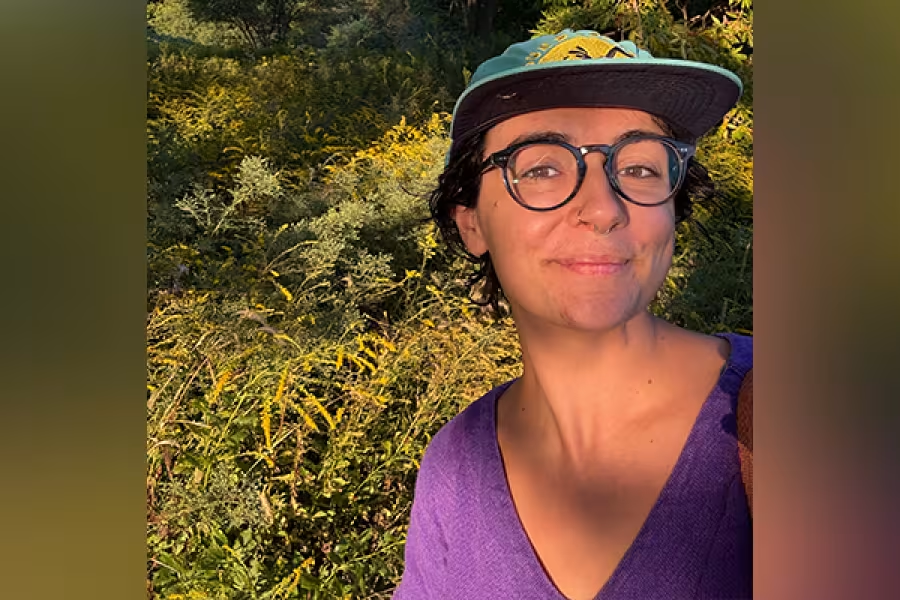
Interlochen Affiliation: IAC 06-07, 09-10 | IAA 12-15 | ICA St 14-14 | IAC Fac 19
Interview Date: July 25, 2025
Allie Kessale attended Interlochen Arts Camp for four summers, studying General Arts, Chorus, and Theatre. She went on to Interlochen Arts Academy, graduating as a singer-songwriter. She returned to Interlochen to work at Camp as both staff and faculty.
This oral history is provided free by the Archives of the Interlochen Center for the Arts (ARTICA). It has been accepted for inclusion in Interlochen’s audio archive by an authorized administrator of Interlochen Center for the Arts. For more information, please contact archives@interlochen.org.
00:00:01 ELIZABETH FLOOD
Today is July 25, 2025, and this is an oral history interview with Allie Kessel conducted by Elizabeth Flood on the campus of Interlochen Center for the Arts. Thank you so much for coming in today.
00:00:14 ALLIE KESSEL
Mhm. Of course.
00:00:15 ELIZABETH FLOOD
Could you please tell us your name, your connection to Interlochen, and the years that this relationship has spanned.
00:00:23 ALLIE KESSEL
My name is Allie Kessel. Interlochen has been a second home for me pretty much for my whole life. I was able to attend Camp for four summers, mid 2000s, for four summers, and then I was at the Academy from 2012 to 2015 and I was a staff member in that time, in 2014, and then a faculty member in 2019.
00:00:51 ELIZABETH FLOOD
Could you talk a little bit about how you first learned about Interlochen/ what your introduction to Interlochen was like?
00:00:59 ALLIE KESSEL
I find it to be fairly special. My parents actually met here, so I was kind of, not like conceived here, but the idea of me came to life at Interlochen. So my dad has been working here for over 30 years, and so that is how I got introduced. And my sister also attended Interlochen, and she was seven years older than me, so I always looked up to her. Thought she was the coolest, and so her coming to Camp and Academy, I was like, I've got to get in there. And it was just a lovely, lovely second space to my growing up and being able to express myself here in a lot of ways.
00:01:42 ELIZABETH FLOOD
What are some of the memories that you have from your first summer here as a camper?
00:01:49 ALLIE KESSEL
My first summer I was nine years old in Junior cabin One. I was actually, like, extremely homesick, even though I like lived in Traverse City. But having my dad work here was always funny, and so I would see him during the day, and it was the best, and we'd like, catch up over lunch. It was wonderful. And then I would go back to my cabin at night, and I would be so homesick, and I would write my parents letters, which like I would send to my dad through Interlochen mail. And I'd be like, "Please come save me." But it was just me like having anxiety about leaving the house as a nine year old. And then during the day, it was great. I had just like art explorations, I did like a ceramics class. I was in Junior choir with John Bragle. He ended up being my choir teacher in my Academy years. I think probably some dance was involved, some theatre, just a fun mix of all the different art disciplines. And it was so fun. And I actually met one of my friends, Charlotte Gruman, in that first cabin. We ended up going to the Academy together, and now we both live in Chicago. So kind of crazy. I was just at her birthday party, and they were like, "How do you know each other?" I'm like, "We actually met when we were nine at arts camp."
00:03:09 ELIZABETH FLOOD
That's so special. You've had so many different relationships to Interlochen, and I kind of try to keep them linear at first, but it so quickly becomes intertwined. Where I was going to ask about some of the memorable people and these friendships that have blossomed and lasted over time. And so I'm imagining in that question that that spans a lot, but...
00:03:32 ALLIE KESSEL
It does, yeah, I think I have a lot of friendship memories, because I was a camper my first summer, and then I did two summers as a day student because of the whole homesick thing. Tried to, like, alleviate that a little bit, but then I was like, I'm missing out on these core friendships. So I did the Intermediate Musical Theatre program, the six week summer camp, and I stayed on campus when I was, like, 12 or 13, and that was awesome. I met some good people there, and a lot of people- let's see Thaddeus Kaszuba, Will O'lean for sure I met that summer, and then they ended up being at the Academy with me a few years later. And Thaddeus lives in Chicago now. Will was in Chicago, but yeah, that last summer that I was at camp I feel like started to form those long lasting Interlochen connections. And then coming to the Academy, it's a whole nother level of connection, I feel like, because you're just here year round, also in the dead of winter, you kind of are forced to really socialize because there's nothing else to do! Which is, I think, good. So I came here my sophomore year of high school for the first year of the Songwriting program at the Academy, and created some great relationships. My first boyfriend, Evan Fulcher, we are still like best friends to this day. I talked to him like at least once a week. So it's really special just to, like, have those people still in your life.
00:05:06 ELIZABETH FLOOD
What was it like to be here at the start of a new program? I've talked to some people who were here when they started the Jazz program, or even at the beginning of Academy itself. And so I'm just curious if you could feel the newness and like what that meant as a student.
00:05:24 ALLIE KESSEL
Very much so. It was interesting. I almost came my freshman year of high school and I was going to try and do, like, Comparative Arts and like combine Composition with Creative Writing to do this Singer Songwriter thing that I wanted to do. But I think it was Jeff Norris, at the time he was a vocal instructor, his daughter is a songwriter, and that kind of blossomed the Singer Songwriter program. Just, like, him seeing a lack of that discipline. And so, yeah, the first year was with Courtney Kaiser-Sandler, and it was originally kind of tailored to be a two year program like junior and senior year. There were three sophomores that were admitted, which was me, and then two others, Hailey Ward and Maddy Silberman. It was kind of crazy. We were in the basement of Stone in, you know, these little practice room type classrooms, And Courtney- there was so much going on. She was starting a new program. She had a new baby. Her husband was like, on tour, doing tour manager stuff. And so there was a lot going on. And it was really interesting, because some people came in as seniors- they made an exception to this two year rule that they were kind of trying to do the first couple years. And so some people, like, were feeling, "Oh, maybe these are things I would like to get out of this program, rather than maybe what you had in mind." And so that kind of created some tension at times. Especially with like, one person leading the program, and there was like 25 of us. But once I got to like my third year I could really see the expansion of the program. Bringing in at the time, Kyle Novi, to like bring in a production side of things. Being able to see the program evolve just in those three years that I was a part of it was really cool, and now to like come back and visit and see how the contemporary music program has completely blown up is really cool. But yeah, it was hard and wonderful because we got to create this thing together. But also, as a student you don't really understand all of the logistic sides of things, so it's like, "Oh, I want to do this and this and this," but like a lot of that isn't possible, especially in the first year of a program.
00:07:43 ELIZABETH FLOOD
I'm thinking about time scales. And it's fun to talk to you, having been here recently. And I'm interested in what are some of the things that you already have noticed have changed around campus, generally and then specifically in that program?
00:07:59 ALLIE KESSEL
Yeah I mean, like I said, we started out in the basement of Stone cafeteria, and now there's a whole contemporary music wing in the new Music building. To be able to see that is so awesome. And then also to have the relationship with my dad to be able to, like, see that too, and like, kind of know things are happening has been really cool. Yeah I mean, we had one classroom, Courtney's office, and, like, a couple practice rooms, and I think now they have a full recording studio for the production program, a lot of more like dedicated space that's not just like, "Oh, hey, there's this annex room that you get to have." So just, it's exciting to know the students now have so much more things to have access to. And I actually know a couple of the students in the program right now, which is fun to like have that relationship and see how different it is and how similar it is at the same time.
00:09:00 ELIZABETH FLOOD
Yeah, what was it like having your sister here and your dad and your parents? Could you talk a little bit about the family ties to the place and how, to Interlochen, and how that impacted you wanting to come here as a high school student?
00:09:15 ALLIE KESSEL
Yeah, I mean... I remember being like young, young maybe like four or five and like walking along- there's a stone wall that's behind The Bowl theatre, and I would be holding my dad's hand. We'd always come out and see concerts and get ice cream at the Melody Freeze. And so like just from a very young age it felt like a very safe place for me, and I think looking back on it all, I didn't realize that like not everyone had access to this and like to have access to a space that is so safe to create in. I don't know if I would have taken the path of being a musician and being a creative person, or like, felt like I could do it as a career and all of that stuff, if that wouldn't have been introduced to me at such a young age. I'm so thankful that I was able to just grow up like, "Oh yeah, this is life." I mean, I knew it was special and like different, but just to be able to have access to it from the get go, was like, "Yeah, of course, I'm gonna be there," and then like going to public school for one year of high school, was like, "Yeah, I definitely need to be at Interlochen." Because it wasn't really, you know- there's some magic in these woods here. I think just in nature and also with the people that are here. Being able to foster an inclusive and safe place for young people to create art is so important, and I'm like so glad that I was able to be a part of that.
00:10:57 ELIZABETH FLOOD
Do you have favorite places on campus, and also, how did your relationship to campus itself change once you became a high school student here?
00:11:09 ALLIE KESSEL
I love Kresge. It's like been a dream since I was very, very little to like be singing on stage there, which like I got to do as an Academy student. But maybe someday I'll be able to have a tour and come through, and that'll be like a really nice, big, full circle moment. But there's something about Kresge, especially when the curtains are open and you can see the lake through the glass doors in the back. I think it's such a cool spot. Also Junior girls. There's a swing set that is like kind of behind Cabin One ish, I want to say that, I go back to, and would go back to, like, when I was an Academy student, just to have, like, my little quiet space to hang out. I'm a big nature person, so just the natural areas around campus are really special. And then coming as an Academy student and even Camp, I guess- I had my first kiss by the bear outside of Corson the summer I was in Intermediate Musical Theatre. Just socially and romantically, and just like becoming a person, there are so many little landmarks around this campus that have really shaped my life. Yeah, yeah, like Kresge, I think my boyfriend, Evan, at the time, he did the scavenger hunt to ask me to MORP, which is our prom. And like the last clue led me there, and he was in the audience, and I was, like, on stage, and it was just this, like, really cute, romantic thing. Endless amounts of ice cream at the Mo Fro talking with my best friends about all the things.
00:12:52 ELIZABETH FLOOD
Wow, that's so special.
00:12:53 ALLIE KESSEL
Yeah!
00:12:55 ELIZABETH FLOOD
I was gonna ask a little bit about, or just generally, about the social aspect of being here. I know it's really intertwined with one's like artistic journey or being, but outside of some of the academic things, what was it like A) to be a camper, socially, and then B) at school?
00:13:16 ALLIE KESSEL
Yeah. Camper, I feel like you make quick connections because we're in a cabin together in the middle of the woods and you're just kind of like here, and you got to make the best of it. And I don't stay in touch with as many Camp people- like on social media. It's nice to be able to stay in touch that way, but Academy was definitely where I, like, really fostered some good, long, lasting friendships. And then I was a day student for the first year and a half that I was in Academy, and then I moved into TJ my second semester of my junior year, and that kind of really shifted things for me as well. I mean, I was already staying on campus, like, super late in general, but then being able to, like, live here kind of opened up a whole new thing. And senior year, I was in McWhorter dorm with Madison Douglas, and she is now doing some amazing things as Rett Madison. She's a wonderful artist and still a great friend, but we were roommates together, and then...so we had this thing called Rabbit Hole. And it would be like me and a bunch of girlfriends, and we would all just like chat for like the hour that we had at night before we had to sign in and everything. And we would, you know, dish all the dirty secrets. But that was like so much fun and like such a wonderful little thing because as much as it is about the music and about the academics, the social aspect of it here, I think, is super big. I mean, as teenagers that's, you know, a lot. There's a lot going on in the teenage brain, in the teenage world. So to be able to, like, be that close with your friends is really cool and really special. Because a lot of times, you know, you're not living with all of your best friends.
00:15:06 ELIZABETH FLOOD
Could you talk a little bit about, so what did you do when you were on staff here?
00:15:09 ALLIE KESSEL
Staff… I was working in the call center, and I was making cold calls to people to fundraise. I just needed a little summer gig. Yeah, I think it was summer after my junior of high school. We were set up in the IPR building across the street, and we would just make calls and ask people for donations.
00:15:27 ELIZABETH FLOOD
How did that change your relationship to Interlochen, if at all? Like doing- now working for it and trying to raise money for it.
00:15:35 ALLIE KESSEL
It was nice having the relationship I already had with it and knowing like, hey, this money is- it was for, usually, student scholarships. And to be like, "Hey, I'm a student. And like, I can tell you how great this place is, and like, how wonderful it is to have this experience." So it was nice to not just have any random cold calling, like, fundraising job, to have some emotional connection and be like, "Hey, this is my experience. It would be awesome if you could help another student, like, have something similar." I also would babysit in the summertime here. This is like, I mean, not directly correlated Interlochen, but I would babysit for Christa, and she was a theatre teacher in the Intermediate Camp program. And I did that for like five summers. That was also when my sister was teaching. So she did eight summers as an instructor in the summertime. And so, I don't know, I was just kind of like always here. And I loved it so much.
00:16:32 ELIZABETH FLOOD
What advice would you give to current or future students at Interlochen?
00:16:37 ALLIE KESSEL
Soak it up. As a student here, I, just being like, you know, 14 through 18 years old, there's a lot going on in your brains and your bodies, and I think sometimes it can be hard to like realize what a wonderful space this is, and like, the opportunity that you have here. Once I left, I was like, Oh my gosh, not everyone is into the arts and like doing creative things, and it's actually really hard to find these people that are doing the same things as me. And I didn't do the college route after high school, so it really just felt like that community had kind of dropped away. I wish I just would have taken a little more advantage to the things that were offered to me and like the people that were around me and just doing weird projects. Get weird. Get creative. If you think it's stupid, it's probably really good! And if it is stupid, like, do it anyway, and then you can move on. And maybe 10 years from now, it'll be something you can come back to. I think, just taking advantage of all the little things and at the same time, like, be a kid and live your life and like, this is such a wonderful place. Do take it seriously, but also it's not the end of the world if you get a C in your class. I don't know. Maybe that's not what people want me to tell the kids, but I think it's important. I wanted to be such a good student and, like, get all the things right. I think that was a big thing. Like, especially with my dad working here in the position that he is in, I felt like I wanted to show up at my absolute best every single time, and I had a really hard time when I didn't or felt like I wasn't doing that, which probably wasn't even the case, I was just like super self critical. Have some fun with it. Be creative. Take advantage of the things that you're doing and, like, love the people that you're with because they're going to be, hopefully, some of your best friends for a long time.
00:18:41 ELIZABETH FLOOD
How did your time at Interlochen influence your personal professional journey as it's becoming?
00:18:49 ALLIE KESSEL
Introducing me to being an artist, and like, and I didn't really realize that was happening at that age, but this is just who I am as my person, and like creating is just like so important to me being alive. It's been such a great tool with my mental health and just in general, my livelihood. And I think a big thing is like connection, and like just like having that Interlochen connection and being able to find people in different places and be like, Okay, you are like that community that I'm looking for, and I know that you value this, like, as much as I do. And not just some music business guy that's like trying to make a buck. In being able to recognize the people that are really in it and that really love it. I think that was definitely something that I learned here.
00:19:46 ELIZABETH FLOOD
Could you talk a little bit too about the leaving once you graduated and not having that same kind of community, or finding out, in a way, that there's many other ways of being in the world? And...
00:19:59 ALLIE KESSEL
Yeah.
00:20:00 ELIZABETH FLOOD
What that's like to navigate being like, "Wow. I found I was really held here in certain ways, to be this way."
00:20:05 ALLIE KESSEL
Yeah, there's this thing that people say, it's called PIDs: Post Interlochen Depression Syndrome. So like, right after, like, my senior year, I definitely experienced that. And I was like, oh my god, I had all of these people, and they were so wonderful in this great community. And now it's just like not there. And for a bit of time I was like, I just want to be back there. Like how do I, like, get back to this space and, like, this home? And I think now that I've moved to Chicago just recently and everything, and like, I'm rebuilding a community for the first time in a very long time, and I'm like, okay, I can now notice that I want to be around creative people. And like, that's really important to me. And like, seeking out those spaces to have that camaraderie around creation. And then also making sure to stay in touch with the people that I met here, and like noticing that those relationships are really special, and carrying those out through my adult life. Especially now with social media and phones and everything like it's so much easier to stay in touch with people, and you can work on projects from across the country with people, which is so cool. And I think just the realization that, unfortunately, our society doesn't put arts and creation at the forefront. And I think you can just really easily get caught up in being a productive person of our like capitalist society, and being able to have the mindset of an artist and like knowing that is like important and like that is something that is productful in this society, even though it's not always recognized as that. And being able to come from Interlochen and like, be like, Yes, this is this worldwide, world known organization that puts art at the forefront. And like, I think it's really good to have that.
00:22:20 ELIZABETH FLOOD
How do you tell people about or how do you describe Interlochen to people who haven't heard of it before?
00:22:28 ALLIE KESSEL
I usually say, like, "It's this magical place in the woods." J Berry, who works here, she always posts on her Facebook "Between the stately pines," and I'm like, Ah, such a good little snippet, but. It feels like a little like ecosystem, almost. It's this little bubble that exists, this like artist ecosystem. And people will be like, Oh, is it like, Victorious or like Zoe 101? They try to like think of it as a TV show, I'm like kind of but it's way more artsy. Think about your like kindergarten art teacher that's super funky. That's what everyone's like. It's super special. And you kind of have to like experience it to really know and to really feel the magic of it. But I think relationally it can be described, but yeah, sometimes it's just hard to put into words.
00:23:26 ELIZABETH FLOOD
So this project is part of the centennial project as we reach the 100 year anniversary of Interlochen as a Camp, and I'm wondering what do you hope for Interlochen in the next 100 years, both as what are some of the traditions and values that you hope are carried into the next 100 years, and what are some of the things that Interlochen can work on building or having that they don't already have in the next 100 years.
00:23:56 ALLIE KESSEL
The first thing that comes to mind of keeping is the Interlochen theme. That's my favorite thing ever. I sob every single time it's played. And I know they're like a little bit more lax about clapping afterwards, but I think it's really special when there's no applause. And it just like, you get to be left with that like resonance of sound. There's like a different Camp energy than there is Academy energy because you're here for a limited amount of time. And so I think that energy of, kind of this like fast paced creation is really exciting, and I think really cool. Especially with younger kids, they have that really magical sense to the place, and like their imagination is all over the place. And I think that's so cool, just being able to foster that throughout all ages. Maybe that's something that could be put across the board a little bit more going forward. I think sometimes, when I think about my Academy years, college was such a big focus. And it was like, Okay, you have to get good grades. You have to, like, test good and you have to do all this to get into this awesome music conservatory or whatever, and like...Personally for me, like, college was not the right route. And I wish someone would have talked about that a little bit more. And like, how can you come from Interlochen and, like, go out into the world and be an artist? What does that look like? I know, like, more on the popular music side, there are more faculty members that don't necessarily have a degree or whatever, but when I was a student, like, it was very much I can't teach here ever, like, come back unless you have a bachelor's degree or master's degree or whatever. And I'm like, okay, that's like really daunting and feels like you have to put this certificate, this piece of paper, to your artistry. And I think there's a lot of value in like real life experience in that way. And so I think it's starting to be opened up a bit more to more people, but I think that is something going forward. I think it's important to just look at the person, and not necessarily just their resume and what they have on pieces of paper, I guess, their experience, but it doesn't have to necessarily be like an institutionalized experience. Especially as someone that didn't go to college and like maybe would like to teach here someday, which I guess technically I have at Camp.
00:26:15 ELIZABETH FLOOD
Could you talk a little bit about teaching here?
00:26:25 ALLIE KESSEL
Yeah, I kind of left that out. So yeah, summer of 2019 I taught for the three week Singer Songwriter camp, and that was under Tom Childs. Honestly, it was one of the scariest things I ever did. I don't know, sometimes I have a hard time being like, "Yeah, Allie, like, you do know what's going on. And like, you do have these credentials. You're good." But like, I had never put together a lesson plan before, or like done any of that, and so that was super daunting. But being able to work with the kids was so cool. And really, like, especially in like private lessons and stuff you have to really like be on your feet, and like being able to tailor to each individual student. Which I think is really important, especially in like an arts community. All of our brains are so very different and also so very similar. And that was six years ago, so I was, like, early 20s. Being able to be in the role of teaching and then, like, collaborate with my other teachers, too, was really cool. And that was the first time I had really like experienced that. And being able to learn from them and also from the students was awesome.
00:27:41 ELIZABETH FLOOD
What was it like working with students for the first time in the way of knowing what it was like to be a student here and then feeling some responsibility, or like, what was that like?
00:27:54 ALLIE KESSEL
I would always have a little like essential oil diffuser going on in my classroom. And I just really wanted to create a really safe space. You know, we're here to create, we're here to do our thing, but also we're here to be people. I was working with the Intermediate kids, so they're like, twelve, thirteen maybe. So it was like you're just really, really little. I think it's just mainly about, like, planting seeds at that point. And just, if they can just take one little seed from, you know, these three weeks I think I would feel good about that. And then, like, giving them some sort of confidence to keep going in their craft, whether it's just for themselves or it is a professional thing that they want to carry on. I think it's more on the Academy side, but it feels a lot of pressure to like be in an artist's career. But it's like it is also special if you just have this thing for yourself. What a wonderful little gift that you have. And I think most people are creative people they just don't put the time and energy into it, and it also takes a lot of like vulnerability. And so I think starting that at a young age is so important. That's kind of what I strived to do.
00:29:14 ELIZABETH FLOOD
This is a really broad question that can be answered in many ways, but why does art matter in the world today?
00:29:21 ALLIE KESSEL
Oh, man. The world we live in right now feels really crazy, especially like the administration that is in office right now. And it feels like creativity is almost under attack in some ways and creative expression, and like free creative expression, because a lot of people are like losing their jobs from like, 1) just free speech, that's just like a whole nother thing. But like thinking about the Kennedy Center and how that has become this whole crazy thing that our government is trying to control. And so I think freely creating art is an act of resistance in this time. Even if you're not writing political things, literally just creating and like using your imagination and being free in that is huge because I think free thinking also is really coming under and they're like, "No, you got to listen to this, and this is what it is." So when you're able to expand that and think on your own it's very important. And then, like artistically, you know, art brings people together. Music brings people together, and it's a really awesome community tool, and that has been going back for thousands and thousands of years. From the beginning of time, humans have been creating and sharing together, whether that's storytelling, dancing, singing, writing, drawing, all of these things have been with us, and I think our society can really lose track of that. So, being an artist, like I said, it is important to create for yourself, and also in this time, like, it's really cool and brave to share, and like put that out in the world, and be like, "Hey, you can do this too." And also, like, maybe there's a message behind this part that can be shared.
00:31:19 ELIZABETH FLOOD
Thank you so much for coming in and chatting with me today. Do you have any other memories or things you'd like to share about your time at Interlochen?
00:31:28 ALLIE KESSEL
I miss the Concourse and how it was. No but, so the Concourse used to have all these photos, they'd have glass cases, and there'd be like a few cases dedicated to each art discipline. And they would showcase people's sculptures and costumes and all these things that were happening during the year. And it would be so fun, because it would usually change out every year or two. And so it'd be fun to be like, Oh my gosh, there's my classmate from a couple years ago. Like, it's so cool to be able to see them and their creation or whatever. And I haven't walked down it like super recently, but I know all those cases are gone now. I don't know it was like a really cool little capsule of memories that would be up on the walls there.
00:32:17 ELIZABETH FLOOD
Thank you so much for chatting with me.
00:32:19 ALLIE KESSEL
Yeah, thanks for having me.
Copyright
Copyright to the audio resource and its transcript is held by the Archives of Interlochen Center for the Arts (ARTICA) and is provided here for educational purposes only. It may not be reproduced or distributed in any other format without written permission