
How to learn a new piece of music: 7 expert steps from an Interlochen alumnus and Chicago Symphony Orchestra musician
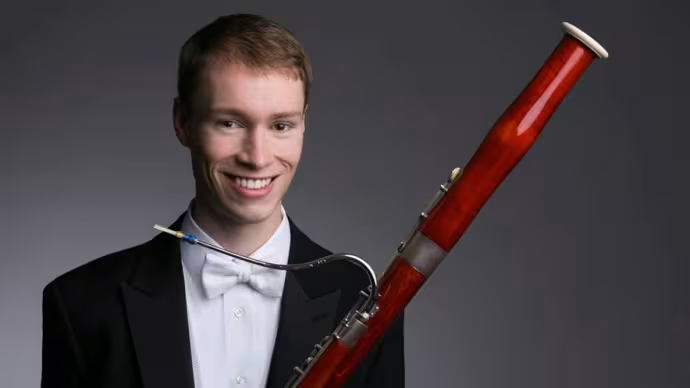
Keith Buncke, Chicago Symphony Orchestra principal bassoonist and Interlochen Arts Academy alumnus, shares his top tips for mastering a new piece.
Updated: September 16, 2026
One of the most daunting skills a musician can master is how to learn a piece of music fast. From working out rhythms, finding the right notes, to teaching your fingers new shapes and patterns, learning a new piece of music can be a multifaceted challenge.
Professional musicians are presented with new music almost every day, and they’re expected to know how to learn a piece of music quickly and proficiently. As such, they’re masters at learning new music and have dozens of successful strategies for preparing a piece from sight-reading to the stage.
We sat down with Chicago Symphony Orchestra principal bassoonist and Interlochen Arts Camp and Interlochen Arts Academy alumnus Keith Buncke (IAC 08, IAA 09-11) to learn his top tips for preparing a new piece:
1. Listen actively to multiple recordings
One of the most useful things when you’re looking to learn new music is listening to recordings. As you listen, pay attention to the overall structure and tempo of the piece. Also pay close attention to how the players use dynamics, shaping, phrasing, and rubato. Really listen—don’t just hear—and be attentive to all the elements.
If you’re just starting to learn a piece, it’s okay to listen to just one recording. But as you get more familiar, vary it up a bit. Even if it’s a really good recording, you can potentially get into a bit of a mimicry if you’re always listening to the same performance.
2. Focus on small passages first
As you learn new music, don't just run through the piece again and again. Focus your attention on the difficult parts to make the most of your practice time. Work locally, then globally.
3. Isolate intervals and foundational scales
Every technical issue comes down to changing from one note to the next. For example, if you have a piece or concerto that is in F major, I would get really familiar with F major. Practice scales, thirds, and fourths. For bassoon, we have a really good etude and scale book called “Milde: 25 Studies in Scales and Chords” which has scales and etudes in each key. I would practice the etudes for the key that your piece is in.
For something that is more tone-based, like a slow movement, long-tone exercises can also be helpful. Focus on a single note or very slow scales to train your brain how to change from note to note. Using these types of exercises is like taking a different perspective or looking at the problem from a different angle—which is great advice that applies to other areas outside of music, too!
4. Practice slow tempo with fast, aggressive finger movement
One way of solving technical issues that I’ve found really useful is fingering on the instrument and without actually playing, focusing solely on the fingerings. Go through a passage—especially a fast or difficult passage—very slowly, but you move your fingers very quickly and aggressively. That sends a strong signal to your fingers and your brain that this is the exact motion that we need to go from this note to the next note. Focus on the tactile feeling, and see if you can get your fingers moving in good synchronicity. Often, you’ll find that it’s easier to go faster since you’re used to going quickly anyway.
5. Don't practice mistakes
If you practice something wrong, it can be extra hard to unlearn those mistakes. If you find you’ve played a section wrong twice in a row, slow down your tempo before playing the section again.
6. Record yourself to spot hidden glitches
Recording yourself can be a really helpful way to catch something you’re in the habit of doing that you haven’t noticed, like a glitch between your notes. When you listen to the recording, go back to the fundamentals. Does the pitch sound right? Do you move smoothly from one note to the next in terms of relative intonation and intervals sounding true? Is your tone beautiful from note to note? Is your rhythm steady? Also take note of your interpretation. Make sure that the rubato makes sense and serves the expressive needs of the music.
7. Know when to take a break and/or do some "mental practice"
If you’re running into a wall, it’s probably a good time to take a break and come back later. Doing some mental practice is also a good way to get a fresh perspective. There are different ways to do this. You can do fingering exercises or other types of physical/mental exercises in that vein. I had one teacher who had me mime doing the fingerings for a piece—completely away from the bassoon—and sing the passage to increase the smoothness and legato of the line. It was a really interesting psychological trick.
I think it’s important to play the piece through in your head, which goes back to the initial phases where you’re just getting familiar with the piece by listening to recordings. Once you’ve played it yourself, your own way of executing it comes to fruition, and you can hear the piece in your head and visualize playing it even when you’re spending some time away from the instrument. Of course, sometimes taking a complete break and doing something else is good too.
Conclusion
Music, like any art form, requires patience and practice in order to improve your skills. As you work to build new muscle memory on a piece, you may feel frustrated or overwhelmed with your progress. It’s important to remember that every musician has pieces they struggle to learn, but with smart practice, you can and will master any piece you set your mind to.
For young artists who are interested in learning more expert tips and practice tricks, Interlochen Arts Camp offers opportunities to study with world-class artists all summer long and Interlochen Arts Academy offers an immersive experience to prepare young musicians for an inspiring future.
For all ages, including adult learners, we also offer a variety of online music courses and certificate programs at Interlochen Online to help support your journey as a musician.
FAQ
What is the best way to learn a new piece of music?
While there is no “best way” to learn a piece of music, whether you’re looking into how to learn a new piece of piano music, bassoon, or viola, musicians generally agree your first step should be understanding your piece before you get started. Take the time to actively listen to the piece multiple times, paying attention to the overall structure and tempo. Once you feel comfortable with the piece, practice difficult sections first, starting out at a slower tempo and slowly ramping up as you grow in confidence. As you start to put the full piece together, try recording yourself to help spot any errors before they become a habit.
How long does it take to learn a new piece of music?
The amount of time it takes for you to learn a new piece of music can vary depending on your expertise, the length of the piece, and the technical difficulty of a piece. Every musician will have their own process and timeline, and may approach each piece differently.
How can I memorize a piece of music fast?
If you’re looking into how to learn a piece of music quickly, understand that the more time you can dedicate to practice, the better your results will be. That being said, there are many times where musicians need to learn new music quickly. By working selectively through difficult sections first instead of practicing the whole piece altogether, you can speed up the time it takes to learn a new piece significantly.
Start Your Journey with Interlochen

- Learn from outstanding faculty and guest artists
- Ignite your creativity
- Make lifelong friendships
- Join a community of high-profile alumni
- Collaborate with like-minded peers