
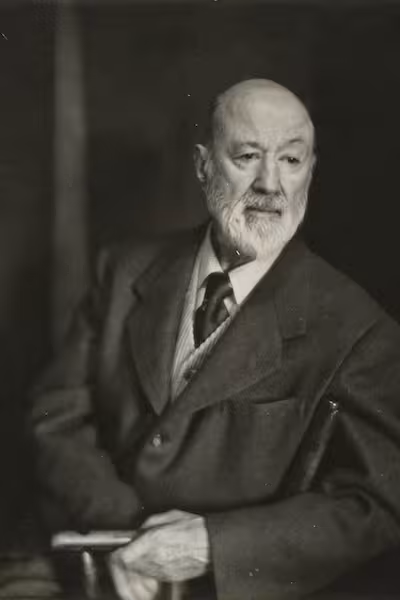
Charles Ives

 Charles Ives

About Charles

Charles Ives had a singular upbringing in music and grew up a singular man and composer. His music stretched from sentimental parlor songs and traditional marches and fugues to the wildest pandemonium ever put on paper. In the process he anticipated most of the innovations of musical modernism: free harmony, polytonality, atonality, polyrhythm, collage, chance effects. Early attempts to classify him ranged from calling him a primitive to a Schoenbergian modernist, but he was none of those things. The best description of Ives’s music is Ivesian. All these qualities are on epic display in his magnum opus, the Fourth Symphony.

That Ives in his teens was already dealing with prophetic musical materials came from the influence of his remarkable father, George Ives, a town band director in Danbury, Ct., who was fascinated by acoustics. Among other experiments George marched two bands past one another playing different pieces, to see what it sounded like as they approached and passed. He had his children sing a song in one key while he accompanied in another. While rearing his son toward a mainstream musical career as an organist (Charlie was a prodigy, a professional church organist from age 14), George told his son something no budding composer in history had ever been told: any harmony at all was acceptable, if you knew what you were doing with it.

That unprecedented gift of freedom, operating on the sensibility of a born creator, kindled Ives’s imagination and gave rise to an unprecedented body of work, at once wildly innovative and steeped in American folk and popular traditions. His experiments with the materials of music, rising from his father’s but going far beyond, took him away from a mainstream musical career. After four years of conventional musical studies at Yale, Ives made his living as an insurance executive while composing nights and weekends. For some twenty years he worked largely in isolation.

Ives composed the Fourth Symphony largely between 1910 and 1916. "The aesthetic program of the work,” he said, “is the searching questions of What? and Why? which the spirit of man asks of life. The three succeeding movements are the diverse answers in which existence replies.”

The first movement is a prelude to the journey. It opens with a craggy, surging bass line rising to searing string harmonies, those voices answered by an offstage choir of strings and harp in a gentle phrase hinting at the hymn tune that underlies the whole symphony: "Nearer, My God, to Thee." Most of the first movement is a choral setting of the hymn “Watchman, tell us of the night,” evoking the “glory-beaming star” that will end the piece.

Ives called the second movement the Comedy. It is based on Hawthorne's comic fantasy "The Celestial Railroad.” Ives turned the story into a pandemonic scherzo building to a sort of apocalyptic traffic jam, most of its contending voices echoing ragtime, marches, and hymns. Finally a rip-roaring march breaks out like a half dozen Fourth of July parades at once. Ives said the gentle and beautiful third movement is "an expression of the reaction of life into formalism and ritualism." Unfolding in the old form of a fugue, it builds to a pealing peroration that recalls the first page of the symphony.

The setting of the finale is a mountaintop: "O'er yon mountain's height/ See that glory-beaming star!" It begins with a whispered reminiscence of the symphony's opening. In a remarkable luminous haze of myriad murmuring voices, the music gathers to the mystical coda, the chorus wordlessly intoning the symphony's essential musical and spiritual theme: "Nearer, My God, to Thee." The music seems to evanesce into the stars, still searching.

Charles Ives's Fourth Symphony is a work of universal religion, made from the concrete stuff of everyday music and life but leaving our gaze turned upward. It stands as his greatest achievement, the furthest way station in his own journey toward that vision.