
Oral History Interview with John Dudd
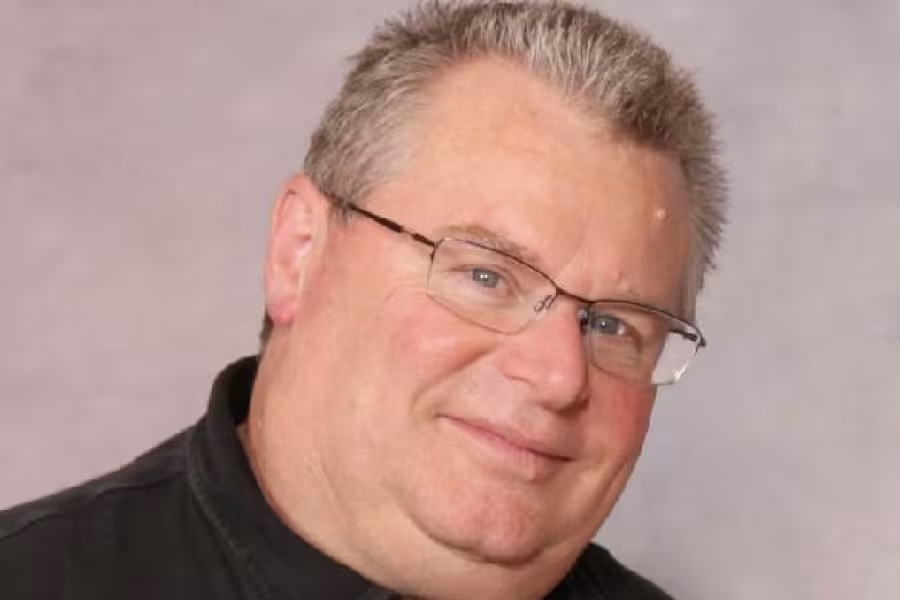
Interlochen Affiliation: IAA 71-75 | IAC/NMC 74 | UNIV 76
Interview Date: October 19, 2024
John Dudd attended Interlochen for many years, studying double bass throughout Academy, Camp, and the University division.
This oral history is provided free by the Archives of the Interlochen Center for the Arts (ARTICA). It has been accepted for inclusion in Interlochen’s audio archive by an authorized administrator of Interlochen Center for the Arts. For more information, please contact archives@interlochen.org.
00:00:00 MERYL KRIEGER
Today is October 19, 2024. This is an oral history interview with John Dudd conducted by Meryl Krieger on the campus of the Interlochen Center for the Arts. John, thank you for sharing your story with us.
00:000:12 JOHN DUDD
You're welcome.
00:00:13 MERYL KRIEGER
Will you please tell us your name, your connection to Interlochen, and the years you attended?
00:00:19 JOHN DUDD
You mean as an actual student or?
00:00:22 MERYL KRIEGER
Your call.
00:00:23 JOHN DUDD
My connection is through my parents. My dad was a High School boy in the 1940s, clarinetist, won scholarships, attended the University of Michigan, which had a lot of ties with Interlochen. And I don't know when exactly he started coming up to Interlochen, but I know in the early 50s he was head of the hotel waterfront. So he was a lifeguard WSI, and very active, formerly a Boy Scout, so he he knew water. He knew watercraft, everything. And as a matter of fact, my brother has a watercolor that was, and I can't remember the artist's name, but it was a picture of the artist, A. Clyde Roller, and my dad standing at the waterfront and bathing suits. So anyway, that was in 1952 he was in charge of the waterfront, and my mom, I believe, I don't think she was up here on staff, but she might have been, but she was down at the hotel waterfront and saw this wonderful, tan, blonde haired Greek God, as she called it. And so in 1953 they were married. So that's '57 is when I arrived. So I asked my mom, actually, a couple days ago, "How many summers did you come up after that?" She said, most of them. There was a little stint that my dad was in the Air Force, and so there was, might have been one summer that he wasn't, okay. So he obviously knew the Maddy's very well. So we continued that until the early 60s, when in 1964, instead of just coming up for the summers, Dr. Maddy hired him to be the Director of Admissions for the Arts Academy and Financial Aid too. In fact, I have a picture of one of his badges, along with several of mine, which I'll be happy to share with you. That's all I could find. Well, anyway, so from my earliest recollections, I was around when they dug the holes. Actually did the clearing and dug the holes for HU four and HU five. I was around when, because I always liked to watch machinery and mechanical things have always been an interest to me. I watched them weld the girders, which ultimately was the roof over Kresge. Actually, my earliest recollections was there was a deer pen right outside here, before it became a parking lot for guests, and now you don't use it even for that, but there was actually a pen that had deer, anyway. So that that went on, we moved up here in 1964 and so I therefore became a faculty brat, officially at that time, although I was, what, six, something like that, I went to- attended the Interlochen Area School, which quite often there were string programs and so on going on while I was in school. And so I fiddled around with violin, didn't like that. Cello, didn't care for that either. And of course, during the summers, I was- even though I was pretty young, Junior division type age, I was taking music instrument classes once or twice a day, or once or twice. I don't know how often they were. I just vaguely remember sitting in there with a bunch of other people doing doing that. And around the time, I want to say it was either sixth or seventh grade, there was a bunch of students here at the Arts Academy, Chris Brubeck, Chris Brown, and several others who were playing in a group called The Fish. I thought that was cool. And Chris Brown played bass. And I thought, man, that's what I want, and I like the Beatles too. So growing up with all of that, I asked my dad. I said, you know, I'd really like to get a bass guitar and an amp. And he said, okay, well, let me think about it. Well, just so happens that Chris Brown was selling his bass guitar. He had a Kalamazoo bass and a Kalamazoo 30 amp, bass amp that he sold to my dad. And my dad bought it for me, of course, and he said there was one condition, that I had to take, I'm got a hard time with this, but I had to take at least three years of string bass lessons in order to do that. I said, okay, so he bought me a Kay Plywood bass. My first bass teacher was Christopher C. Brown. I don't know who, if you know who he is, but he was, amongst other things, he was in the band New Heavenly Blue, and when he was a student at the University of Michigan, studied with Larry Hurst, but he just retired as the principal of the Minnesota, I think it's the Chamber Orchestra, and that was a highly sought after. So I was there '69 and '70, played in the Intermediate Symphony. And then '71, summer of '71 I played in the High School Concert Orchestra. Then summer of '72 I made it into World Youth. So '72, '73, and '74 played in the World Youth Symphony. All right, back to IAA. By the time I was a freshman, obviously, played in the bass section. I think it was second to last chair my first year in the second year, which was what '72, '73. I was in the middle of the section. And then my last two years, I was third chair. And we were all the same age, the bass section, at my junior and senior year. So after we, after we graduated, the Director of Admissions, who was no longer my dad, because my dad left somewhere around my junior year, because the reason why I know that is my badge still said Interlochen versus my senior year, they had moved to Marquette. So I think part of it was selling the house, moving or so on, anyway. So that's what kind of brought us well, and of course, the last part of it is I took a year, I took a summer off, the summer of '75 until we graduated, and I started the University of Michigan and came up here in the summer 1976 played in the University Symphony, and I studied voice with Willis Patterson, who was a voice teacher at University of Michigan. So that's pretty much after I graduated, I went on to other things. I don't know that you want to cover that? But, yeah, okay, so that's, that's my roots.
00:07:25 MERYL KRIEGER
Yeah. What, if you had to pick something, what would be a favorite memory that doesn't need to be the favorite memory? And I, I get that sense that there are many memories, but what's the first one that comes to mind from your time at Interlochen, something that kind of stands out for you.
00:07:44 JOHN DUDD
Well, I guess one of them is being a freshman in high school and having the honor and privilege of going to the Kennedy Center and playing in the Kennedy Center. That was, that was pretty cool.
00:08:01 MERYL KRIEGER
What about it?
00:08:01 JOHN DUDD
What about it? Well, I was a scared kid. I, you know, I remember my dad was still here, and I remember the first orchestra rehearsal. And after it was over, I came running up to and I hugged him, and I said, "Dad, this is too hard. They're too, too much. They're all too much better than I am." And he said, "You'll be okay." So I went from that to getting a lot more confidence by the time we came around to the orchestra tour, which was, in addition to that, I can't remember what was first- whether we went on tour. I actually have a poster where I wrote down all the different venues we played for the first, second and third years that I was in Arts Academy. So I can't, I couldn't tell you by memory which what they are, but the Kennedy Center was just a big thing. I mean, they flew us out there. We're staying with families, which we typically do when we went on tour and got a lot of stories about that. That's not that question, no. Anyway, it was right around the- Okay. Well, first off, I mean, you walk into the Kennedy Center and it is fabulous. The acoustics were pretty darn good, although we played in some pretty play- pretty good places, Krannert Center in Champaign Urbana, Orchestra Hall in Chicago, Hill Auditorium in Ann Arbor, to name a few. And then a whole lot of high schools and other places, gymnasiums. The Kennedy Center was really quite something. Crystal chandeliers hanging from the ceiling, you know, that kind of stuff. I mean, it was royalty like I've never seen before. And of course, HR Haldeman attended the concert. Ted Kennedy was there, and a whole host of others. What was also memorable we were doing, one of the pieces was Stravinsky's, Firebird Suite. And the fun part about that, besides the fact that's an awesome piece, the fun part about it was there was a section before the last movement where it just, it lays back and to the extent where it just gets quieter and quieter, and people are falling asleep, and then bam, tom tom tom tom tom, you know it. And so everybody would look to the audience to see how far they all jump. It's probably not the right kind of reasons why you'd want that, but anyway, but you kind of find the fun and everything. So that's me, that's, that's, that's one. There are several. If you want another one, or.
00:09:57 MERYL KRIEGER
I think we'll get to some of them.
00:10:00 JOHN DUDD
Okay.
00:10:11 MERYL KRIEGER
Hold that thought, because-
00:10:15 JOHN DUDD
Okay.
00:10:15 MERYL KRIEGER
We'll have time at the end to come back. So anything else that comes up, I want to make sure that that the things that you're sharing are the things that feel right as part of this story.
00:11:05 JOHN DUDD
Okay. They all are important.
00:11:08 MERYL KRIEGER
Yeah.
00:11:09 JOHN DUDD
And I've-
00:11:09 MERYL KRIEGER
That's the thing..
00:11:10 JOHN DUDD
I've been reliving- ever since I signed up for this. I've been relieving this day and night so and more and more things pop into my head, and some of them are so memorable, it's, it's hard.
00:11:25 MERYL KRIEGER
Here's a chance to talk about one of them.
00:11:27 JOHN DUDD
Okay.
00:11:28 MERYL KRIEGER
Who is the most memorable person you encountered, encountered at Interlochen, and why?
00:11:33 JOHN DUDD
Teacher wise?
00:11:35 MERYL KRIEGER
Anyone. No agenda.
00:11:38 JOHN DUDD
Wow. When you're around a place like this as long as I, I was, which was, you know, what, 12 years? You meet a lot of people. Some of my, well, I guess one of the conductors I miss the most is Thor Johnson. He was awesome, making that memorable. I mean, not only with the World Youth. We played pieces like The Planets. Mahler, played a couple of Mahler symphonies, I think number two, and I think we did Mahler six, but, in WYSO. But I remember in 1973 and I think that was the last summer he was there, still alive. It was memorable for me, because that year was tough. I had still playing a plywood bass, the same one I started with, and I'm competing against people with instruments that were much nicer and much easier to play than that one. It was just a Kay plywood bass. Anyway, during one of the challenges Thor was conducting, and I think it was The Planet, I went down like four chairs. I went from like fourth chair to seventh or something like that. I got a, I got a picture. I could count them, but I don't remember. And I remember, obviously it upset me terribly, because you know, what are you gonna do? But I remember, I went up to Thor and I said, "I'm sorry. It was my fault. I worked hard." And he said, "Don't give another tear." He said, "I know where you should be." I'll never forget that. Music makes memories, and I have so many from my time, and a lot of the summers kind of run together. It's hard to remember which ones are which and what we did when. But even the Arts Academy, and of course, when you're here summer and winter, there's a whole lot. But the question was, memorable people? Thor was, was one. Chris Brown, we did one of Chris Brown's The Old Man That Never Died piece. I think that was my sophomore year, maybe, which included singing and dancing up on the stage in JVS. And of course, we had that infamous picture of the bass section that was our senior one,
00:14:11 MERYL KRIEGER
Which was which you were in?
00:14:13 JOHN DUDD
Oh yeah.
00:14:14 MERYL KRIEGER
Oh yeah.
00:14:14 JOHN DUDD
Yeah. The bases on either end are, are here this weekend myself, I was on the left. And Keith Orr was on the right, but I knew how to get up on the roof. Not that I, you know, knew a lot, but I knew most of the ways you could sneak into things. But, you know, not, not for the sake of causing harm, but in case you wanted to take pictures on top of JVS's roof. And we were careful to make sure that the end pins didn't go through the shingles. So we were respectful, okay, not like other times where, if we was on the roof of the old fine arts building across from the Junior woman's dorm, we may or may not have thrown snowballs at some people, but you know that was innocent.
00:15:03 MERYL KRIEGER
Of course.
00:15:04 JOHN DUDD
Right.
00:15:04 MERYL KRIEGER
Of course.
00:15:05 JOHN DUDD
Right, and of course, security was just down the way, so I'm sure we'd never harass them or anything.
00:15:11 MERYL KRIEGER
Of course.
00:15:11 JOHN DUDD
No, anyway, okay, go easy next question.
00:15:14 MERYL KRIEGER
I was actually going to say, you mentioned that your dad knew Joe Maddy, really, really well. Did you do you have memories of him yourself?
00:15:22 JOHN DUDD
Joe Maddy? Yeah, oh, yeah. Well, as faculty kids, we got all our meals, so almost every meal we ate in the cafeteria, you know, they had the staff line and they had the student line and, you know, back then, and I mean, from the time that I was still in diapers - My parents have a favorite story of me standing up in the staff side, which is now enclosed. It's a little different now, but standing up in the staff side, saying, here come the dirties when I was actively filling my shorts, my diaper, and I couldn't tell you how old I was, but that was what they you know, and every I stood up so everybody could hear. I don't know why I thought of that one.
00:16:13 MERYL KRIEGER
What sticks out in your memory about Joe Maddy?
00:16:16 JOHN DUDD
Oh, he was just a wonderful both he and Mrs. Maddy were very, very kind. I can remember at one point we were standing together, and of course, my parents were probably talking to them, but they always were very affectionate and caring about us. In fact, my dad, you know, when we moved up here, we lived on Vagabond Lane, which I heard the house is now, like, $350,000 that's like, oh my gosh, how many it doesn't it's well, at a crawl space, and skunks would get underneath it. That's another story, but I'll tell it. What the heck? Skunk got under the house and the exterminator came in to poison it. Okay? So what was supposed to happen is the skunk was supposed to eat the poison and then go out and die. Okay? Well, he didn't die. He died underneath my brother in my bedroom. And of course, when the skunk dies, they released their grip on the scent gland. So my brother had one of these Naugahyde like Russian hats that flipped down with head to ear things, and you could had the chin strap, and that material retained the skunk smell. So when we went to school, school, the teacher threw it outside. Okay, well, getting back to Dr and Mrs. Maddy, they just lived just a little bit down from the intersection of what is it? 137 and Vagabond Lane. Mrs. Maddy called my dad when Dr. Maddy was having his fatal heart attack, and my dad actually drove him to the hospital. There was they always had a warm place in their heart for my dad, because he's just like me. I wear my heart on my sleeve, and it's a blessing, but a curse, but I'm not without passion and love.
00:18:27 MERYL KRIEGER
Is there a specific project, performance or activity at Interlochen that stands out in your memory? And again, I'm there's probably many, but pick the one that kind of comes to mind that's easiest to talk about.
00:18:39 JOHN DUDD
All the ones that really, well, my senior year, when, when I would sing in the choir. And of course, my senior year, I was in the choir. Dr. Jewell wanted me to be in a chorale, so I was in the chorale, and I was playing in the orchestra, so I was busy. And anytime if I was singing in the choir and we were doing a piece that had the orchestra and the choir, I had to be in the orchestra. Earlier years, being Carmina Burana, for example, so I knew the choral parts, but I played bass in the orchestra part, and that piece was awesome. That's very memorable.
00:19:25 MERYL KRIEGER
What about that particular piece, or that performance kind of -
00:19:29 JOHN DUDD
Just, you know, the part, and I don't remember what movement it is, was the one that they use as a theme song for the Omen, but it is so thrilling. And don't ask me to recite the Italian I don't remember it now, but it just used to raise the hair on the back of my neck. It was that exciting. And when you're playing akin to, I like the Beethoven's Ninth is another one, but most memorable for me, I'll skip back to my senior year, was we were getting ready to do the dedication concert. In one of the pieces was Dixit Dominus, and there's a baritone solo, I think it was Jay Thompson, and he had a Dickens of a time singing it and we rehearsed. Of course, I was playing the orchestra, and we had the choir, although I think it was a small orchestra. Might have been shortened, I can't remember now, but all I can tell you is Jay couldn't show up for one of the rehearsals, and he had a really tough time rhythmically, couldn't get the rhythm. The soul comes in. Dominus. Dominus. Don't pray, he couldn't get it. I've always had a good sense of rhythm, because I'm also a drummer. So Dr. Jewell says, "Dudd, we need somebody to sing the solo part." So I got up and and sang the part in, this is where it gets hard again, but everybody clapped and cheered. The orchestra, the choir. That was, that was probably the most memorable.
00:21:30 MERYL KRIEGER
I gotcha.
00:21:31 JOHN DUDD
Another one, and I know you asked for one, but, Katy, bar the door, back to Thor Johnson, again, he always played some pretty wild stuff one year. And I think it was sophomore year we played Joe, Ray Vaughan Williams. I know another piece that we played was Atmospheres by Ligeti, and that was just plain off the wall. That was the first time I played really, any real modern music before. But he pushed the envelope. He was always pushing the envelope, so it was cool. But the thing that made Vaughan Williams Job so memorable to me is that I identified with him. Job that is, and that's the first time I remember wanting a relationship with God.
00:22:14 MERYL KRIEGER
Got it.
00:22:14 JOHN DUDD
I'm now evangelical Christian living in the South, and I play on a worship team bass guitar almost every week, every Sunday. We play different music almost every Sunday, and it keeps me still playing. And I have a five string, fretless Rickenbacker, 4003 s5 that I bought fretted and I had had the frets removed because, hey, string bass player, I don't need frets. So, but that, those are some of the ones that popped up.
00:22:51 MERYL KRIEGER
Got it. Do you have a favorite spot here on campus at Interlochen? And what is about it that makes it a favorite spot?
00:23:010 JOHN DUDD
You mean a place?
00:23:02 MERYL KRIEGER
Sure.
00:23:03 JOHN DUDD
Well, I always like to water. I have a lot of memorable experiences with sitting with friends on the beach. Could have been sneaking over to the high school girls side or just down the hotel waterfront. Really didn't have to sneak much. You mean, you could find peace just about anywhere. In the summertime it was a little more difficult. If I had a girlfriend, I occasionally around the backside of some of the dome, their little niches, and some of them don't have windows. There's like, where the heating and air conditioning stuff is. They're kind of out of sight. So if you wanted to, you know, have a little bit-
00:23:42 MERYL KRIEGER
Privacy
00:23:43 JOHN DUDD
privacy, you could go there. That was, that was good for that. Love, love riding around the state park. Can I have a favorite place? There's a whole bunch of them. Hard to pick one. I'm sorry.
00:23:58 MERYL KRIEGER
No, it's okay. It's okay.
00:24:00 JOHN DUDD
Just like,
00:24:00 MERYL KRIEGER
It's okay.
00:24:01 JOHN DUDD
depends on what the need was.
00:24:06 MERYL KRIEGER
I think we've been leading up to this, and I wanted to ask this question for you now.
00:24:11 JOHN DUDD
Okay.
00:24:11 MERYL KRIEGER
What did you learn at Interlochen that had a significant impact on your life?
00:24:20 JOHN DUDD
Hmm. I've been trying to think about this one because there, there are several things that had really significant impacts in my life, and of course, I've told you a couple of them. You know, to believe in yourself. Don't be afraid to be passionate. Show your passion. And of course, later on, Jesus's commandment above all the other 10 was to love one another like your brother, I love my brother, but yeah, I do. Critical thinking, I think is part also - when you're the kind of personality that wears your heart on your sleeve, it's because you have the gift of insight, and there are a lot of people that don't have that, and I also have a very practical sense. So you know, my career ultimately got away from music, and I was involved in aerospace engineering, aircraft certification, engineering and certification for most of my 40 years that I worked. Part of what got me there was Larry Starr's algebra class and Carol Eilber's English class. I could be free for who I was versus who they thought I should be, even in college, you know, I had good, wonderful teachers and then some. As you know, I think part of when you're in school, it's learning how to deal with the ones that are trying to wreck you and don't like you for whatever reason, so preparing you to deal with the world, to name just a few, but Howard Hanson and like I said, Carol Eilber said, when you know, if I am struggling with something, I say, hey, well, let's do this instead. Or I was always, I suffered a lot because I started school when I was four. I have a November birthday, and I was not a literary genius by any means. I was more of a, you know, hands on person, and subsequently, you know, if I had to read something and it wasn't really interesting to me, it was very difficult, and I learned to overcome that. But, you know, a lot of times I'd have to read something three four times that to get it, you know, so I had to work three times, four times as hard as some of other people. But all of that, I mean, that's the lessons that they taught, and they taught you to be, you mean, just music in itself, covers - I got a poster somewhere when I don't remember them all - but you know, teach you critical thinking and teach you how to be compassionate, your, teaches you math, it's science, it's literature, all of those things wrapped up into package. So allows you to develop as a human being, and I'm so grateful that I had the opportunity to do that. I think if my parents didn't work here, I probably could not have afforded to do it, because my parents were both music educators. I mean, how much money they have, I think now, wow. Anyway, yeah, hopefully that answered your question.
00:27:43 MERYL KRIEGER
It sets us up for the next one I want to ask you, which is how your time at Interlochen influenced your personal and professional journey. And I think you've already been kind of alluding to that, but I'd love to invite you just kind of unpack.
00:27:56 JOHN DUDD
Okay. Well, let's do professional. There been a lot of personal stuff professionally. My last two years I was, I needed scholarship to be a full time student living in the dorm, and so I had a work scholarship, like I said at the audio visual department, and I got a real fascination for speakers and electronics. And so after I tried the music route for a couple of years at the University of Michigan, and I decided no, music skill was really not what I want to do. And I saw how my parents struggled with not making a lot of money, and I thought, well, making it, maybe I can do something else. Well, my dad got a job at the University of Hartford in the music school, and as a result, I got the opportunity to go there. So I ended up going to the Samuel I Ward Technical College, Heart of the University of Hartford, and got a BS degree in Electrical Engineering Technology. I attribute a lot of that to Larry Starr, for one, in his algebra class, where I thought I could, couldn't do anything right in math. And he showed me, he said, I remember my dad telling me that Larry Starr came to him and said, "Hey, you know, I think we can make him a mathematician." And so he saw the science. Pardon me, well, geometry, not so much, I don't even remember who was teaching that. Larry helped me, because in order to get into the technical college, I had to go back and do an algebra course during the summer and trigonometry and stuff that I didn't take when I was here. Then I started in in three years using a lot of humanities that I could pull over from the music courses that I took at the University of Michigan, but I ended up graduating summa cum laude with my degree. From there, I remember the one English teacher that I she taught technical writing, and I used to argue back and forth with her when she asked me to describe a briefcase, and I took the briefcase that I had, and I give her a description and said, Well, that's not right, and and so on and so forth. Well, yes, it is. So I stood my ground, but she only gave me a B in that class. But the karma part was she was the one that had to announce my graduation, that I was graduating, she almost couldn't say summa cum laude. It was more like a question, what? So there was redemption there, but from there, 40 years in aerospace engineering, and I was an FAA designee, because I had a cause and effect. I could be a critical thinker, and all of that, I attribute to being here and the kind of support that I got, so.
00:31:16 MERYL KRIEGER
So this takes me to the next question I have for you, if you were to give advice to a current or a future student at Interlochen, what would it be?
00:31:25 JOHN DUDD
Take advantage of everything that you can while you're here. If you have a good teacher that motivates you, focus on that. Don't, don't ignore the ones that aren't, but use that. Use it to mold you. I know that's probably the biggest thing right there.
00:31:47 MERYL KRIEGER
Pretty big.
00:31:49 JOHN DUDD
Yeah.
00:31:50 MERYL KRIEGER
I only have a couple more questions, and then I want to open it back up if there's other things that you want to share, but there are particular lasting friendships that either formed or came out of your time at Interlochen?
00:32:42 JOHN DUDD
Yeah, a lot of them are here, alumni weekend. There are a lot of pals that I have, and several of them are here. When you go through a school like this, particularly for four years - And there are several others I haven't even mentioned, Dan McCarthy, for example, he was a year ahead of me. He was a class of 74, but he and I played in rock and roll bands while we were here. Now we talked all about me being a bass player, but also I'm a drummer, but I never really did a lot. I had a few lessons, but most of it's self taught. I always like to jokingly say, well, I'm really a bass player, because that's what I grew up on, but I started both at the same time. But I'm also a drummer, and as matter of fact, the two drum sets, besides a few things that I've added to make all one big one, the first drum set was my grandparents bought me. The second one was we purchased it from Jerry Hartweg, who was the percussion teacher. He gave me a few lessons, and then from then on, I just took off. So a lot of times in the summer, there are other faculty brats that came up only in the summer, and we put together a band we had from early 70s. You know, we're talking Led Zeppelin, or talkin Doobie Brothers was easy top, you know, all good stuff. So Dan was at the Arts Academy, but he come up in the summers also we played, matter of fact, I got some pictures of the two of us in one of the bands that we were playing and were on the side of the stage in Kresge, and it was 1973, okay. I'm playing drums. Dan's on guitar. Guy by the name was Chris Nordman was playing bass. Mark Addison, his father was, I think, in drama in the summer, from England, of all things. And that band was together for a couple of years. Later on, I jammed with people like Rick Jacobi. I knew the Jacobi's obviously. So you know, you're not just stuck in even though, when I was a day camper, it was easy for me, because I could bring my drums over. I know when JVS was still there, JVS, there were four rooms. One of them was a bass room, and one was kind of like an athletic room, and the other two were basically, one was percussion, and the other, other one was like a room where you could set equipment up. So I'd have my drum set set up in there if we were rock band practicing. I remember being having my drums over in Pinecrest was another place where there's a lot of ancillary kind of things going on. So it's great to see the number of opportunities that are are presented to the students. If we would have had the the number of things available to us when we were students, I don't know, it might be hard, might have been hard to focus on things that I did focus on. It's hard to say, but yeah.
00:35:26 MERYL KRIEGER
I guess my, my last big question for you is, thinking about what you've said and what you've shared today, and what you've been thinking about when you signed up for this, and as you've been going, why do you do you think the arts matter in the world today?
00:35:47 JOHN DUDD
Well, we've touched on a lot of that -
00:35:48 MERYL KRIEGER
We have.
00:35:49 JOHN DUDD
In general, if you, if you appreciate art, then it opens your mind to being able to accept a whole plethora of other things, not only that stimulate you in ways that are not available otherwise, but also you're thinking, how you treat people, how you're treated, how you're seen, how you see. You know, if I think I got that poster on my phone somewhere, because I post stuff like that on Facebook every once a while, the importance of it. I guess a lot of our tours were sponsored in part by the Michigan Council of the Arts. We go into high schools where they were cutting music programs and everything was cut in the arts to make way for better football equipment or something. And not that athletics isn't important because it is. It's part of being healthy and all that, I get it, but it shouldn't be the only thing, you know. A lot of the people probably didn't, wouldn't appreciate a bunch of high school kids coming in and doing, let's say I remember we played in Cal Casca High School, and we were in the gym, I think. It was on TV. You know the William Tell Overture right? So right [sings] just as you break some kid in the back stood up and went charge, right? The timing was good. You know, he obviously had had knowledge of the song,
00:37:50 MERYL KRIEGER
And rhythm.
00:37:50 JOHN DUDD
Yeah, and rhythm, and it was right on time. And, but to have cameras panning onto you live TV and being able to keep a straight face after that was a real challenge. But, that was, I couldn't help but bring that one there. I don't know why that just came to me. I've forgotten about that for a while, but.
00:38:03 MERYL KRIEGER
This is why I wanted to open it up at the end, if there is anything else that you wanted to make sure that you shared today.
00:38:10 JOHN DUDD
There's plenty opportunity to get into trouble. I don't know. I probably shouldn't talk about any of that, because that's just give them a bunch of ideas, which, you know, no doubt they probably already had, but didn't think that maybe they had enough gumption to do.
00:38:27 MERYL KRIEGER
Things for your story that feel important to share.
00:38:32 JOHN DUDD
Well, you know, I was a naive kid. A lot of things that we did were were just innocent fun, which kids all do, so, you know. Whether it's M-80s on the stage in the dead of winter with a cigarette fuse so you could get back to that dorm, but Kresge has a wonderful four like a four second reverb in the so, you know, you put it right in the center of stage. It's absolutely wonderful. And my dear friend who has passed now, John Knowles, he would come back with a few fireworks from Christmas break. So I mean, we're talking cold, dead of winter. You know, security is all hunkered down, and they were at the end of, I don't know, Mozart Beethoven, whatever that end one is. Which they're no longer, you put them elsewhere, but that was an excellent spot for ambush, but anyway, that was another story. Just a great place to have fun, a great place to learn. When you're that close and tight knit, you build relationships and people that are everlasting. And of course, the difference between Interlochen and a normal high school is not everybody's from your hometown, as a matter of fact, most everybody, you're lucky if they're in the same country. When I was in intermediate I dated a girl from Armenia. Well, actually she was Armenian. I think she lived in California, but her parents absolutely did not want her to have anything to do with me, because I was one of these hippies with long hair, and I wore a headband,
00:40:17 MERYL KRIEGER
Trying to picture that.
00:40:17 JOHN DUDD
Not to say, not unlike probably a lot of the attire that you see now that you don't have uniforms anymore, which, well, anyway, sometimes you can't unsee some of those things. Yeah. Oh, did I answer your question? I forgot what exactly, what it was.
00:40:32 MERYL KRIEGER
It was really if there's any last thoughts that you had that you wanted to share before we stop.
00:40:37 JOHN DUDD
Just, the most, compared to any any regular high school, I don't think there's any comparison. Because of the opportunities as you have, the quality of the education is superior. The people that are here are either so grateful that they're here, or you got the other extremes, where the parents just got rid of them and everything in between. One of the students, and won't mention the name, his father was a brain surgeon, and he was born blind, and he didn't get his eyesight until in his tweens, I think. Not sure, it was before high school anyway. So he's little odd, but extremely smart, you know? And so, yeah, you know, kids make fun, but it allowed you to be compassionate about people who are different. And of course, if you go around the end of the arts, there's a lot of people who are different, which you learn to be accepting,
00:41:42 MERYL KRIEGER
And to value.
00:44:44 JOHN DUDD
And to value the diversity thereof, which unfortunately, nowadays in this country, seems to be lost or losing,
00:41:55 MERYL KRIEGER
or hidden,
00:41:56 JOHN DUDD
yeah, or shunned. Guess that's all, folks, huh?
00:42:00 MERYL KRIEGER
That'll do.
Copyright
Copyright to the audio resource and its transcript is held by the Archives of Interlochen Center for the Arts (ARTICA) and is provided here for educational purposes only. It may not be reproduced or distributed in any other format without written permission