
College credit is now available with certificate programs! Enroll now before prices increase Oct. 26.
Understanding Intervals in Music Theory
A step-by-step guide to identifying and qualifying intervals.
By Dr. Andrew Martin Smith, Interlochen Online Course Author

Understanding and knowing how to interpret intervals can really benefit a musician's performing abilities because they are key drivers of musical momentum. How so, you may ask?
What’s In an Interval?
An interval is a measurement of distance between two pitches in a musical space, whether the two pitches are playing simultaneously in harmony or sequentially as part of a melody. Either way, the greater the distance between pitches, the more energy or tension a listener feels.
We can measure (or “count”) an interval's size in two ways:
- Counting the number of half steps (semitones) between pitches on an instrument such as a keyboard
- Counting the number of staff positions between pitches on a musical staff
Counting Steps
A half step (or one semitone) is the closest distance between two pitches in a Western chromatic scale. On a keyboard, there is exactly one half step between any two adjacent keys.
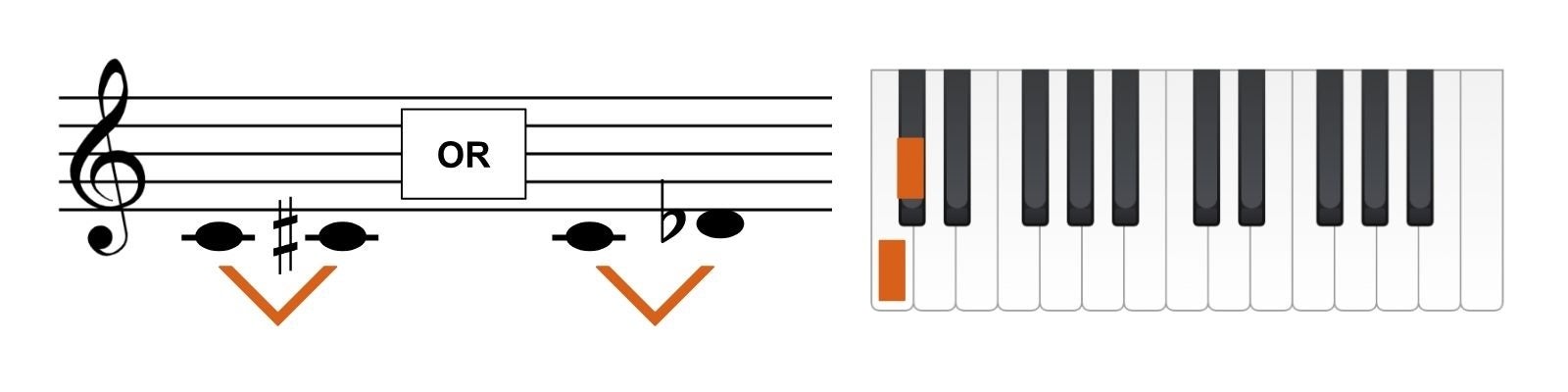
Listen to a half step:
A whole step is the distance of two half steps (semitones) between pitches in a Western chromatic scale, such as C to D.
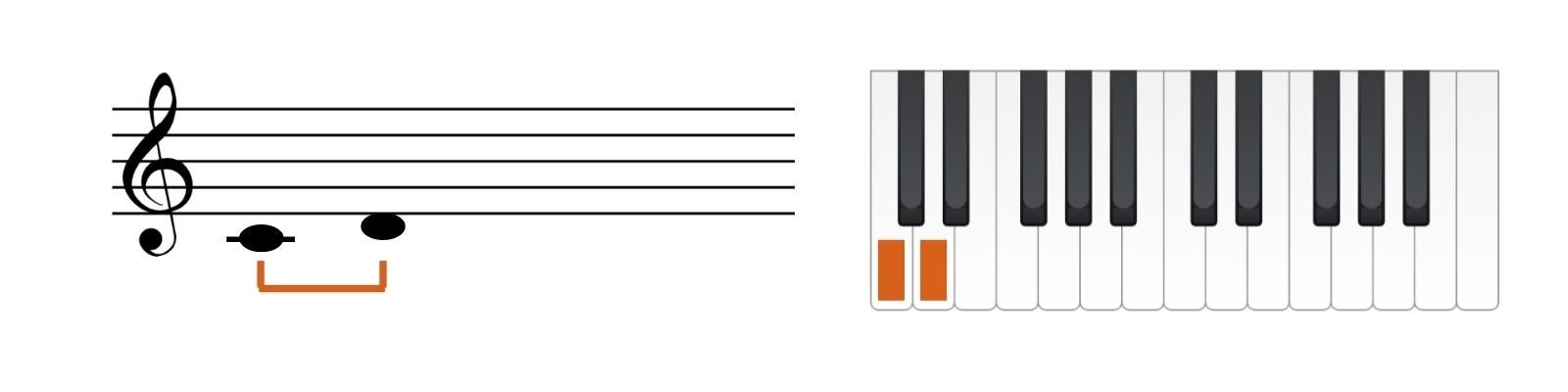
Listen to a whole step:
Counting Staff Positions
Each line or space on a staff is a position that we count when measuring the distance between pitches. So, in counting from one note to the next, the note we begin with is counted as 1. Then, we count to the next line or space as 2, then the next line or space as 3, and so on.
When we do this we get the following musical measurements:
- A unison occurs when two pitches "sit" on the same line or space
- A second occurs when pitches are adjacent (or next to each other) on the staff (e.g., a line next to a space)
- A third occurs when we skip over a staff position from line to line or space to space
- For example, starting from a note that is on a space, we count to the adjacent line to create a second, or to the next space to make a third
- OR, if we are starting from a note that is on a line, we count to the next adjacent space to create a second or to the next line to make a third.
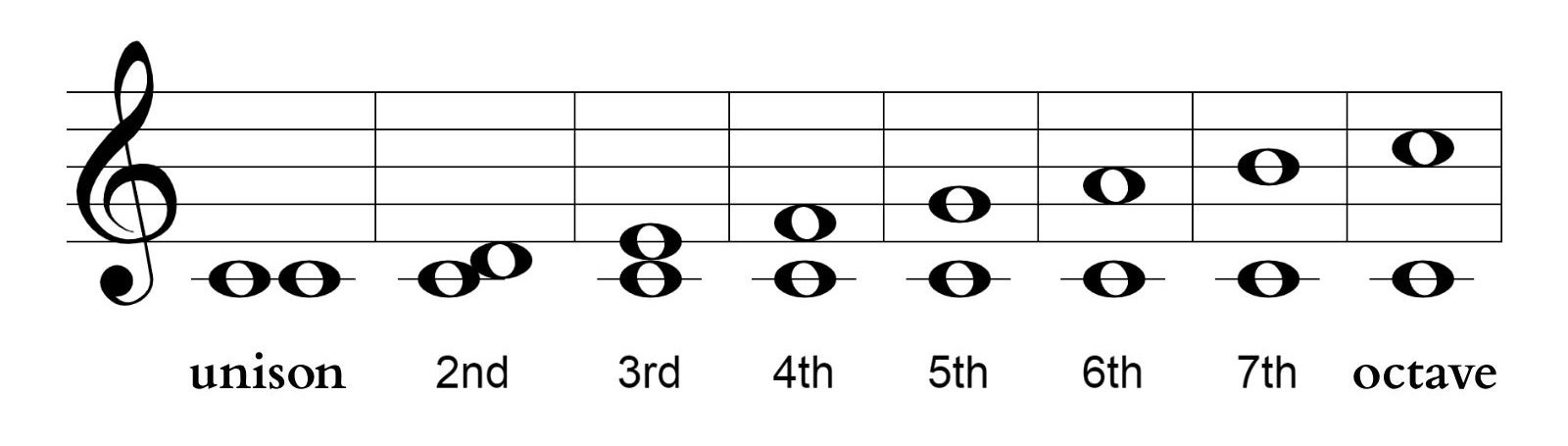
Listen to diatonic intervals:
Remember, always start counting from the lowest note!
Interval Quality
In addition to measuring interval size, musicians also assess the quality of a musical interval. Quality is a way of categorizing different types of interval sounds. Some intervals are more pure or "hollow sounding," while other intervals are more rich in "sonic color."
There are two general categories of intervallic quality:
- perfect intervals (these are the "hollow sounding" intervals)
- imperfect intervals (these are the intervals that possess a little more variety of harmonic color)
Perfect Intervals
The perfect intervals are:
- unisons (or zero semitones)
- 4ths (or five semitones)
- 5ths (or seven semitones)
- octaves (or 12 semitones)
Perfect intervals may be stretched or compressed. If we increase a perfect interval by a semitone, then we say that interval has been augmented. If we decrease a perfect interval by a semitone, then we say that the interval has been diminished.
So...unisons, 4ths, 5ths, and octaves may be:
- augmented (+)
- perfect (P)
- diminished (o)
Imperfect Intervals
The imperfect intervals are:
- 2nds (either one or two semitones)
- 3rds (either three or four semitones)
- 6ths (either eight or nine semitones)
- 7ths (either 10 or 11 semitones)
Unlike perfect intervals, you’ll notice that we have options for each size. Imperfect intervals can be either major or minor. So, more specifically:
- minor 2nd (m2) = one semitone
- major 2nd (M2) = two semitones
- minor 3rd (m3) = three semitones
- major 3rd (M3) = four semitones
- minor 6th (m6) = eight semitones
- major 6th (M6) = nine semitones
- minor 7th (m7) = 10 semitones
- major 7th (M7) = 11 semitones
Imperfect intervals may also be stretched or compressed. If we increase a major interval by a semitone, then we say that interval has been augmented. If we decrease a minor interval by a semitone, then we say that the interval has been diminished.
- So...2nds, 3rds, 6ths, and 7ths may be:
- augmented (+)
- major (M)
- minor (m)
- diminished (o)
Consonance and Dissonance
The quality of an interval matters, because when two notes are sounded simultaneously, we interpret the sound as having a kind of motion or lack thereof. Some intervals played simultaneously sound restful; others feel active, as if they "want" to go forward. We call this relative stability or instability consonance and dissonance, respectively.
- Consonance: The impression of stability and repose experienced by a listener when certain combinations of tones or notes are sounded together.
- Dissonance: The impression of tension or instability experienced by a listener when certain combinations of tones or notes are sounded together.
Measures of Stability
| Consonance | Dissonance | |
|---|---|---|
| perfect unison | ||
| major or minor second | ||
| major or minor third | ||
| perfect fourth | (sometimes, in some styles) | |
| tritone (either +4 or o5) | ||
| perfect fifth | ||
| major or minor sixth | ||
| major or minor seventh | ||
| perfect octave |
Want to continue learning with Interlochen Online?
Find your perfect course now—the next session starts Oct. 26.


Recommended Music Theory Courses
Each online music theory course offers four weeks of instruction and personalized feedback from a professional musician and composer.
Music Theory Basics 1
Begin to master the language of music.
Music Theory Basics 2
Strengthen your understanding of harmonic progressions.
Music Theory Basics 3
Explore extended tertian chords and form.
Take all three courses and earn a certificate from a world-renowned institution.
The Music Theory Fundamentals certificate program is perfect for...
✔ Adults looking to boost their creative résumé and LinkedIn profile
✔ Teens who want to earn high school credit for their passion
What are students saying?
Students who enrolled in music theory courses and certificate programs rated their experience 4.6 out of 5.
How does it work? Sample a course for free.
✔ | Expert Faculty Receive direct, personalized feedback from a professional artist. |
✔ | Real Growth Develop artistic skills that are important to you in 30 days. |
✔ | Collaborate Connect with peers and instructors on your projects—or just for fun. |